









Detailed Explanation of the U.S. Bitcoin Strategic Reserve Act: Purchasing 200,000 Bitcoins Annually, Reaching 1 Million within Five Years
TechFlow Selected TechFlow Selected
Detailed Explanation of the U.S. Bitcoin Strategic Reserve Act: Purchasing 200,000 Bitcoins Annually, Reaching 1 Million within Five Years
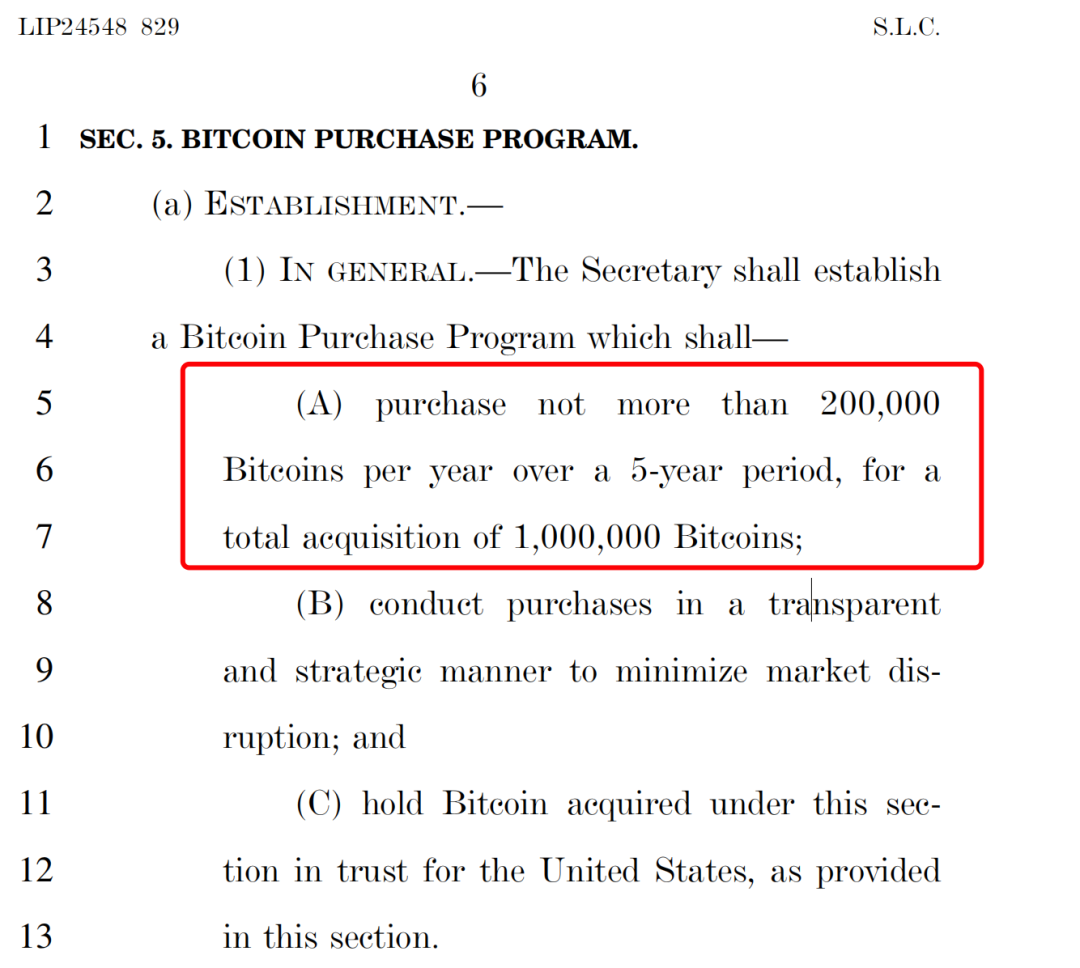
The bill establishes a "Bitcoin Purchase Program," which plans to purchase up to 200,000 bitcoins annually for five years, totaling 1,000,000 bitcoins.
 Navigating Web3 tides with focused insights
Author: Aiying Aiying
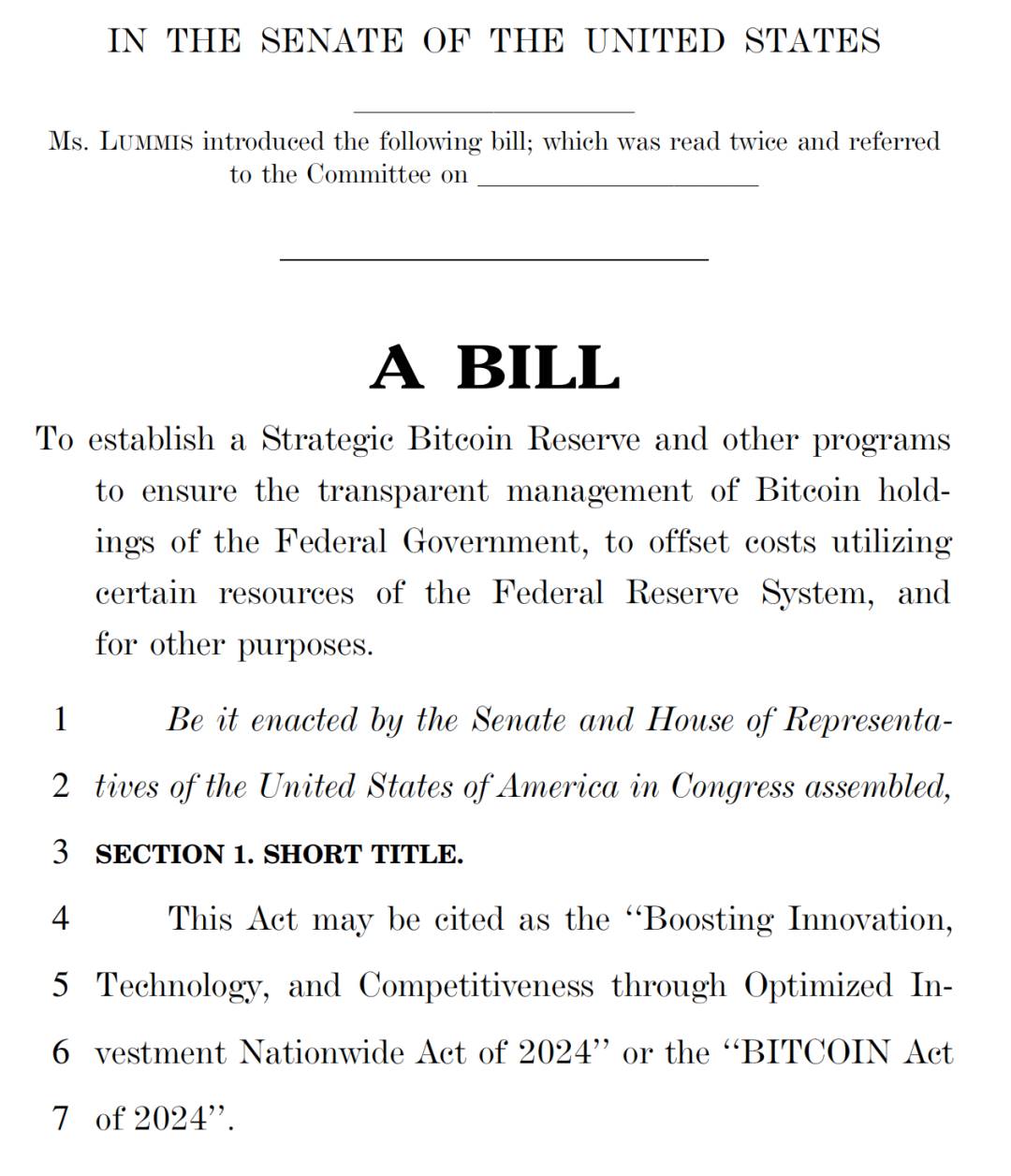
As countries around the world increasingly prioritize digital assets, the United States is actively exploring ways to maintain its leadership in this domain. Against this backdrop, Senator Cynthia Lummis introduced the "United States Bitcoin Strategic Reserve Act" (BITCOIN Act of 2024) on July 31. The bill aims to strengthen U.S. financial security and global leadership by establishing a national Bitcoin reserve.
I. Key Provisions of the Bill
By incorporating Bitcoin into national asset reserves, this legislation seeks to provide the United States with a tool to counter economic uncertainty and monetary instability, enhancing the nation's financial resilience. Below are the key provisions of the bill compiled by Aiying Aiying:
1. Bitcoin Acquisition Program
The bill establishes a "Bitcoin Acquisition Program," authorizing the purchase of up to 200,000 bitcoins annually for five consecutive years, totaling 1 million bitcoins—approximately 5% of Bitcoin’s total supply. Purchases will be conducted transparently and strategically to minimize market disruption. The goal is to ensure the U.S. government holds a substantial Bitcoin position over the next two decades, serving as a long-term financial hedge.
2. Establishment of Secure Storage Facilities
To ensure the secure storage of Bitcoin, the bill mandates the creation of a decentralized network of secure Bitcoin storage facilities managed by the U.S. Department of the Treasury and distributed across the country to enhance the safety and resilience of the reserve. Each facility will employ state-of-the-art physical and digital security measures to protect against unauthorized access and cyberattacks.
3. Funding Sources for Purchases
The bill proposes using existing funds from the Federal Reserve System and the Department of the Treasury to finance Bitcoin purchases. Specific methods include revaluing the Federal Reserve's gold certificates to reflect current market prices and using the surplus value to buy Bitcoin. Additionally, the bill plans to reduce the surplus capital held by Federal Reserve Banks, redirecting the savings toward the Bitcoin acquisition program.
4. Holding Period and Usage Rules
Under the bill, all government-acquired Bitcoin must be held for at least 20 years. During this period, these holdings cannot be sold, exchanged, or auctioned, except for the purpose of repaying national debt. After the initial holding period, no more than 10% of the reserve may be sold every two years. This rule aims to ensure long-term stability of the Bitcoin reserve while allowing limited flexibility to meet future economic needs.
5. Addressing Economic and Monetary Instability
By integrating Bitcoin into national reserves, the bill intends to equip the United States with an effective instrument against economic uncertainty and currency volatility. As a decentralized digital asset with a fixed supply, Bitcoin offers unique inflation-resistant and safe-haven properties. Holding Bitcoin would not only strengthen national financial resilience but also help the U.S. maintain a leading role in global financial innovation, securing a competitive advantage in future economic landscapes.
Through these measures, the United States Bitcoin Strategic Reserve Act aims to deliver new financial safeguards in the digital economy era, advancing the modernization and diversification of the nation's financial system.
II. Status of Current U.S. Cryptocurrency-Related Legislative Proposals
Each Congress typically receives thousands of proposed bills. The 118th Congress (2023–2024): To date, over 9,235 bills and 1,398 resolutions have been introduced, though only a fraction will ultimately pass and become law.
Any member of Congress can introduce a bill. Once submitted, it is assigned to a relevant committee for review and discussion. Committees may hold hearings, amend the bill, and decide whether to advance it to full chamber consideration. For a bill to become law, it must be debated and approved by both chambers of Congress—the House of Representatives and the Senate. After both chambers pass identical versions, the bill is sent to the President for signature. If vetoed, Congress may override the veto with a two-thirds majority vote in both chambers.
According to Aiying Aiying, in recent years, several cryptocurrency-related bills have been introduced in Congress:
-
Digital Asset Market Structure and Investor Protection Act: Introduced on July 28, 2021, by Representative Don Beyer, this bill aims to establish a comprehensive regulatory framework for digital assets, covering stablecoins, decentralized finance (DeFi), and cryptocurrency exchanges. See more in "Understanding Digital Asset Legislation Likely Before the 2024 U.S. Presidential Election"
-
Stablecoin TRUST Act: Introduced on December 21, 2022, by Senator Pat Toomey, this bill seeks to create a federal and state regulatory framework for stablecoin issuance, ensuring capital and reserve requirements are met while supporting the U.S. dollar’s role as a digital transaction medium. See more in "What Does the U.S. Stablecoin Bill Mean for Market Regulation?"
-
Cryptocurrency Accountability Act: Introduced on July 27, 2023, by Representative Elissa Slotkin, this bill requires members of Congress to disclose their cryptocurrency holdings to increase transparency and prevent conflicts of interest.
-
Financial Innovation and Technology for the 21st Century Act: Introduced on July 20, 2023, by Representative Glenn Thompson, this bill aims to clarify whether cryptocurrencies are classified as securities or commodities and expand regulatory oversight over the crypto industry. See more in "Why Is Illinois’ Recognition of BTC and ETH as Digital Commodities Significant? And How Does It Reflect Real-World Regulatory Policy?"
All of the above bills are currently under review and have not yet been enacted. While practical implementation faces challenges such as market volatility and regulatory hurdles, these proposals represent bold and innovative thinking that could inspire central banks worldwide. If Donald Trump returns to office, given his history of bold policy initiatives, the pace of advancing related legislation could accelerate significantly. Notably, Trump recently discussed cryptocurrency during a Fox Business interview on Friday, emphasizing the importance of U.S. leadership in the crypto space and suggesting that the government could use Bitcoin to repay the $35 trillion national debt.
Join TechFlow official community to stay tuned
Telegram:https://t.me/TechFlowDaily
X (Twitter):https://x.com/TechFlowPost
X (Twitter) EN:https://x.com/BlockFlow_News
 Aiying Compliance









