








Vitalik's New Article: Technology and Humanities – Dual Perspectives from Dubai and Tokyo's Future Museums
TechFlow Selected TechFlow Selected
Vitalik's New Article: Technology and Humanities – Dual Perspectives from Dubai and Tokyo's Future Museums
I think they're all trying to address a crucial issue: having concrete, positive visions of a technologically advanced future, rather than just the 3,478th "Black Mirror"-style Hollywood dystopia.
 Navigating Web3 tides with focused insights
Author: Vitalik Buterin
Translation: Mars Finance, Eason
Over the past year, I’ve had the privilege of visiting the Museum of the Future in Dubai, and more recently, Miraikan—the National Museum of Emerging Science and Innovation in Tokyo (whose Japanese name, “Miraikan,” literally translates to “Future Museum”). Both were strongly recommended by close friends and collaborators of mine, and I believe they each attempt to address a crucial question: how can we form concrete, positive visions of a technologically advanced future, rather than yet another dystopian “Black Mirror”-style Hollywood narrative?
What struck me most during these visits was just how different these two visions are. They’re not contradictory: there’s no logical impossibility or even strong tension between the specific technologies and structures imagined by Dubai futurists and those envisioned by their Tokyo counterparts. Yet at the same time, the two feel very different—prioritizing distinct values and directions. This naturally raises the question: what can we learn from and appreciate in each, and is there a way to synthesize them?
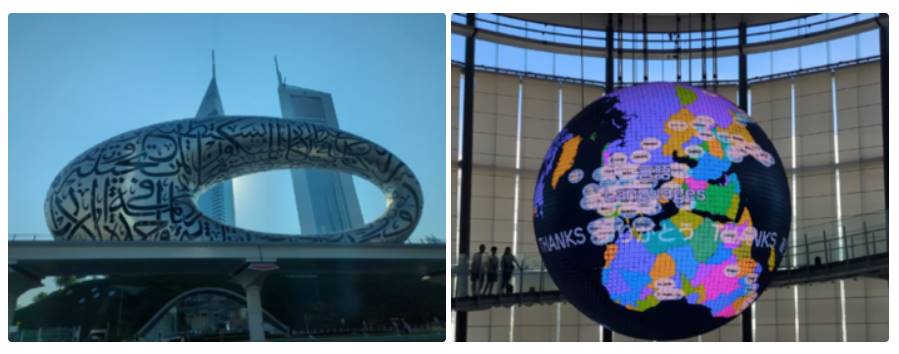
Left: Exterior of the Dubai Museum of the Future
Right: The large globe inside Miraikan, displaying major world languages
What I Like About the Dubai Museum of the Future
Your visit to the Museum of the Future begins with a simulated space elevator ride, transporting you from Earth's surface in 2064 up to a space station in geostationary orbit. Information screens and panels show human settlements across the solar system—on planets, around planets, and at Lagrange points.
Afterward, you encounter exhibits covering various other scientific and technological fields. A central theme is meditation and health, showcasing infrastructure designed to help people access altered states of consciousness. Most impressive to me was the biotechnology section, which presents a vision of using genetic engineering to enhance the resilience of the biosphere, enabling plants and animals to survive in more diverse environments.
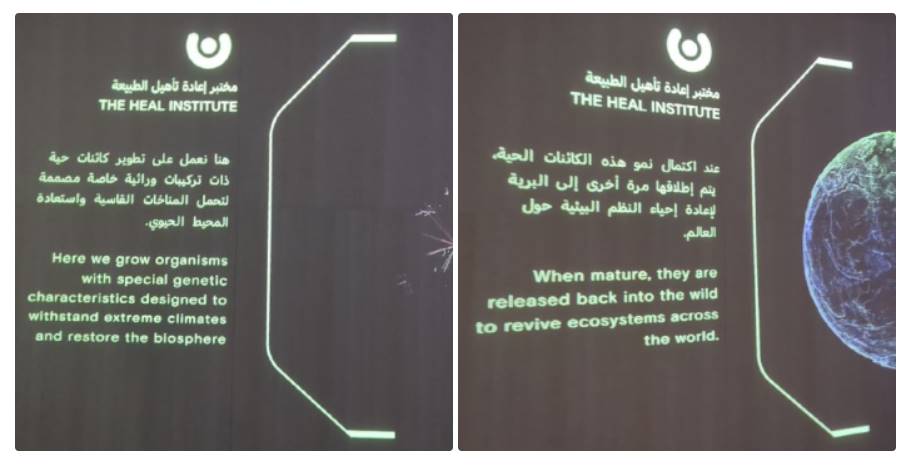
Worth, uh… thinking about. This contrasts sharply with Western approaches to environmental issues. In the West, nature is seen as Eden—beautiful and pristine by default, now corrupted by industrial technology. The primary moral imperative is preservation and minimizing harm. In Dubai, it’s the opposite. Nature’s default state—at least the one they’re accustomed to—is a barren desert. Human ingenuity and skill applied to nature don’t merely offset damage caused by other forms of human ingenuity; they can go further, actually improving the environment beyond its original state.
Miraikan has nothing quite like this. There is an exhibit on pressing environmental challenges facing Earth, but its tone is far more conventional: these problems are humanity’s fault, and we need to be mindful and reduce our footprint. Several exhibits focus on improving life for people with impaired or lost vision or hearing. But the proposed solutions are mostly accommodations aimed at making the world gentler and more accessible—robots that guide people, business cards printed in Braille, etc. These are genuinely valuable and improve many lives. But they aren’t what I’d expect to see in a 2024 museum of the future: solutions that truly restore sight and hearing, such as optic nerve regeneration or brain-computer interfaces.
Dubai’s approach to these issues deeply resonates with me, while Tokyo’s does not. I don’t want a future that’s merely 1.2 times better than today, where my comfortable lifespan increases from 70 to 84 years. I want a future that’s 10,000 times better. I resonate with the Nietzschean spirit Scott Alexander described in his recent blog post, warning against making life’s primary goal things like “I don’t want to upset anyone” or “I want to take up less space”—goals better suited to the dead than the living. If I become physically frail due to medical conditions, living in a world that remains comfortable despite those limitations would certainly be an improvement. But what I truly desire is technology that heals me, restoring my strength.
Nevertheless, the Dubai Museum of the Future also feels incomplete and limiting in certain ways—gaps that Miraikan fills admirably. So it’s time to shift focus and discuss what I believe makes Miraikan great.
What I Like About Miraikan (Tokyo’s Future Museum)
Upon first entering Miraikan, the initial exhibit addresses planetary crises: global warming and various environmental issues tied to excessive pollution or insufficient basic resources. Next come artistic exhibitions heavily utilizing AI to mimic patterns observed in nature. Then, a massive globe repeatedly plays a short informational film titled “Journey into the Multiverse,” presenting statistical data on different regions of the world and how people live in them. Following that is a hands-on exhibit demonstrating the inner workings of fundamental low-level internet protocols.
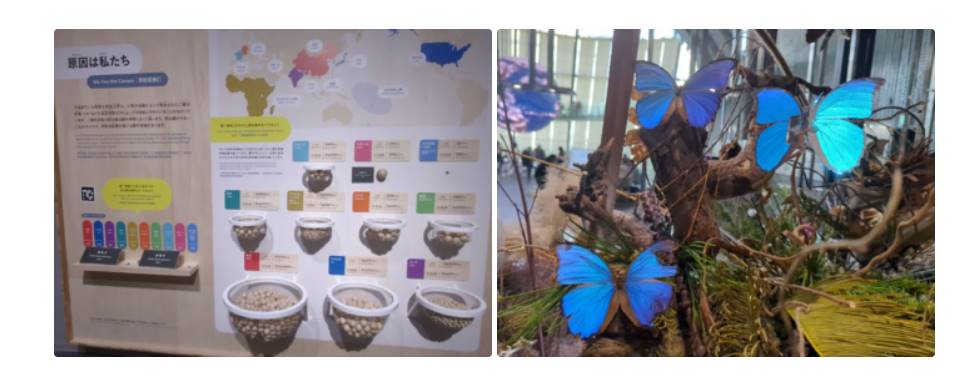
Left: Chart showing CO₂ emissions contributions by country
Right: Real butterfly and robotic butterfly replicas
What particularly impressed me about these exhibits was the way they invite active learning and participation. All informational displays strive to present content in tangible, accessible ways, helping visitors grasp key details and implications of each issue. The overfishing section includes lines like: “I love sushi… but we probably won’t be able to eat it freely in the future, right?” At least two exhibits conclude with interactive segments posing questions related to the content and inviting visitor responses. The exhibit on solving Earth’s resource challenges takes the form of a game.
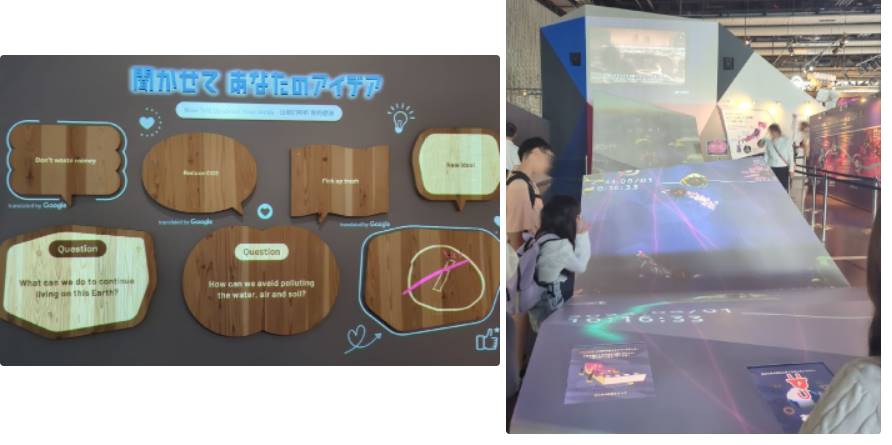
Left: Billboard inviting visitors to submit answers to “How can we avoid pollution?” and “What can we do to keep living on this planet?”, displaying recent responses
Right: A game themed around avoiding ecological pitfalls and reaching a positive future by 2100
Here, the tone of the two museums diverges sharply. The Dubai museum feels consumerist: here’s the wonderful future we’re building, just sit back and enjoy it. The Tokyo museum feels participatory: we won’t dictate the future to you, but we want you to think about these issues, understand what’s happening behind the scenes, and become part of building a shared future.
The main type of technology I found missing in the Dubai Museum of the Future is social technology, especially governance. The only explicit mention of governance structures I encountered in Dubai’s imagined 2064 world was a passing remark in the description of a major Martian space station: “Operator: Global Space Agency, SpaceX.” In contrast, Miraikan’s own structure emphasizes collaborative discussion, and you frequently encounter references to language, culture, government, and press freedom.
Are These Two Visions Compatible?
At first glance, these two visions seem entirely different, perhaps even pulling in opposite thematic directions. But the more I reflect, the more I see them as deeply synergistic—one filling the gaps of the other. I don’t want a world in 2100 that’s merely 20% better than today. Civilizations dominated by a mindset of “making do with less” will find themselves constantly pressured—both by external forces and by internal desires to break through boundaries more boldly. Yet at the same time, the more radically our societies advance beyond historical norms, the more essential it becomes to ensure broad participation—not just in understanding what’s happening, but in discussing and shaping that future collectively.
My own posts attempting to make advanced topics in cryptography more accessible are written precisely in this spirit: yes, we need advanced tools, but they must also be understandable and usable, so more people can collaborate, and so the future empowers people rather than becoming a series of iPhone-like interfaces built by a few, accessed by the rest of us in standardized, passive ways.
Perhaps the ideal future museum I’d like to see would combine the bold imagination of the Dubai Museum of the Future with the warm, inclusive spirit uniquely embodied by Miraikan.
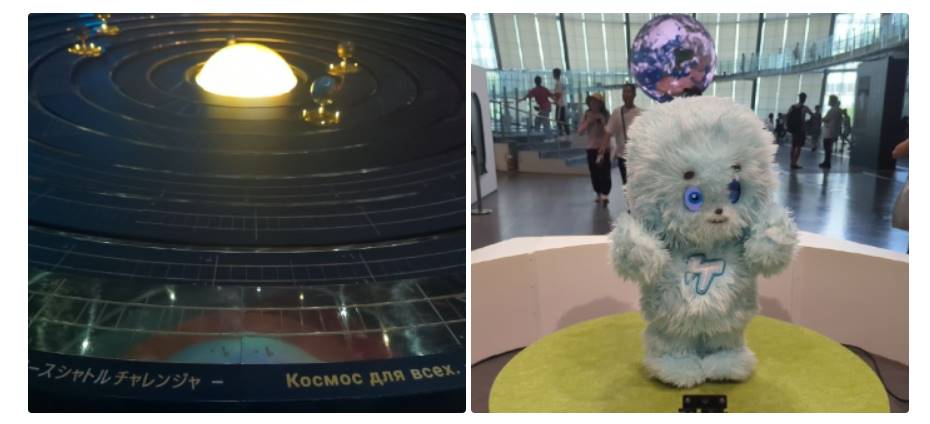
Left: “The universe belongs to everyone,” Dubai Museum of the Future
Right: A future robot, deliberately designed to appear cute and friendly rather than threatening
Join TechFlow official community to stay tuned
Telegram:https://t.me/TechFlowDaily
X (Twitter):https://x.com/TechFlowPost
X (Twitter) EN:https://x.com/BlockFlow_News
 @VitalikButerin









