If Trump were to actually announce Bitcoin as a strategic reserve asset, what would be the impact?
TechFlow Selected TechFlow Selected
If Trump were to actually announce Bitcoin as a strategic reserve asset, what would be the impact?
If realized, its status would rival that of genuine gold.
 Navigating Web3 tides with focused insights
Author: Kaori
Last weekend, rumors spread widely that Trump would announce at the Bitcoin 2024 conference that BTC would be adopted as a U.S. strategic reserve asset. Amid this speculation, Bitcoin quickly rebounded to $68,000, significantly boosting overall market sentiment. Everyone is now anticipating what the so-called "Crypto President" might unleash at this weekend’s Bitcoin event.
What Are Strategic Reserve Assets?
Strategic reserve assets refer to assets held by a nation to address economic uncertainties, external shocks, or other emergencies. These typically include traditional safe-haven assets such as gold, foreign exchange reserves represented by currencies like the U.S. dollar, euro, and yen, Special Drawing Rights (SDR) allocated by the International Monetary Fund (IMF), as well as government bonds, foreign-currency-denominated deposits, and other highly liquid assets.
The composition and management of reserve assets play a crucial role in a country's economic stability and its relationship with international financial institutions such as the IMF.
Dennis Porter, co-founder of Satoshi Action Fund and also attending the Bitcoin Conference, posted on social media that the most likely path for Bitcoin to become a U.S. strategic reserve asset would be through inclusion in the Treasury's Exchange Stabilization Fund (ESF).
The ESF is a special fund operated by the U.S. Department of the Treasury, established under the Gold Reserve Act of 1934, primarily aimed at stabilizing the value of the U.S. dollar. It provides the Treasury with tools to conduct currency and gold operations to influence exchange rates and promote stability in foreign exchange markets. Today, Bitcoin is generally viewed in the U.S. as a form of foreign currency.
Markus, a researcher at 10x Research, analyzed that the U.S. government currently holds approximately 212,847 bitcoins, worth around $15 billion. In comparison, its total gold reserves amount to about 261.5 million troy ounces, valued at roughly $600 billion. If Bitcoin holdings were doubled ($15 billion), it would nearly match the net inflows into spot Bitcoin ETFs from the beginning of the year to date ($16 billion). From a signaling perspective, such a move would undoubtedly carry greater impact.
On July 25, pro-crypto Republican Senator Cynthia Lummis of Wyoming plans to announce legislation for a Bitcoin strategic reserve during the Bitcoin Conference. While the specific details of the bill remain unclear, according to someone who has seen an early draft, the legislation aims to direct the Federal Reserve to purchase Bitcoin and hold it as a reserve asset—similar to how central banks hold gold and foreign currencies—to help manage the U.S. monetary system and maintain the stability of the dollar.
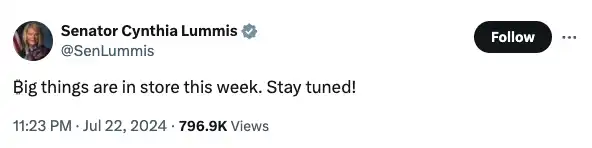
Lummis hinted at a major announcement on her X account: "Something big is happening this week—stay tuned."
Asset manager Bryan Courchesne recently discussed on CNBC the potential for Bitcoin to become a strategic reserve asset under a future Trump administration. According to the asset manager, while adopting Bitcoin as a reserve asset would be difficult, it is not impossible. Courchesne pointed out that the U.S. Department of Justice holds 200,000 bitcoins, making the U.S. government the largest holder of Bitcoin after the anonymous creator Satoshi Nakamoto. The DOJ could simply transfer these bitcoins to the U.S. Treasury, paving the way for the Treasury to begin long-term accumulation and holding of this scarce asset.
If Trump does announce at the conference that Bitcoin will be adopted as a national strategic reserve asset, what kind of impact would this have on Bitcoin and the broader crypto industry?
If Realized, Its Status Would Rival Physical Gold
First and foremost is the price impact. As one of the world's largest economies, policy changes in the United States exert significant influence over global financial markets. News that Bitcoin would become a strategic reserve asset would trigger a strong market reaction, sharply increasing investor demand and driving up its price.
This would also greatly enhance its mainstream acceptance. Other countries and institutions might follow the U.S. lead and add Bitcoin to their own reserve portfolios, further solidifying Bitcoin’s position within the global financial system. As more nations and institutions adopt Bitcoin as a reserve asset, the nature of such holdings—typically long-term—could reduce volatility in the Bitcoin market.
However, before any of this happens, we must recognize that designating an asset as a national strategic reserve is not something decided by any single individual. Even if Trump wins the presidency, he alone cannot unilaterally make Bitcoin a strategic reserve asset. This process would require extensive deliberation among policymakers, economists, and financial experts, congressional approval, and coordination with the Federal Reserve and the Treasury Department.
Once such a decision is finalized, the U.S. may establish clearer and stricter cryptocurrency regulations to protect and manage its strategic reserve assets. Such policies could profoundly affect the entire cryptocurrency market and prompt other countries to strengthen their own crypto regulations.
As Bitcoin’s importance grows, related infrastructure and technology would also advance further—such as more secure storage solutions, more efficient transaction systems, and more robust legal and regulatory frameworks.
Bitcoin’s role as a strategic reserve asset could reshape the structure of existing financial markets. The title of "digital gold" could challenge the status of traditional assets like gold and Treasury bonds in reserve portfolios, altering investment diversification and risk management strategies.
Regardless of the final outcome, the crypto industry has undoubtedly entered the mainstream public consciousness through politics.
Join TechFlow official community to stay tuned
Telegram:https://t.me/TechFlowDaily
X (Twitter):https://x.com/TechFlowPost
X (Twitter) EN:https://x.com/BlockFlow_News
 BlockBeats