









How to Set Up a Compliant Crypto Fund in Hong Kong?
TechFlow Selected TechFlow Selected
How to Set Up a Compliant Crypto Fund in Hong Kong?
Choosing to establish a cryptocurrency fund in Hong Kong is not only a strategic decision but also a significant step toward future financial innovation.
 Navigating Web3 tides with focused insights
By Attorney Bai Zhen, Shanghai ManQin Law Firm
In the fast-evolving world of finance, crypto funds are rapidly emerging as a new favorite among investors. However, choosing the right jurisdiction to establish a crypto fund is crucial. Hong Kong, this international financial hub, with its unique advantages and vast prospects, is attracting growing attention.

Establishing a crypto fund in Hong Kong is not only a strategic decision but also an important step toward future financial innovation.
So why are more and more investors and fund managers choosing Hong Kong as the location to set up their crypto funds? Let’s follow Attorney Bai Zhen from ManQin Law Firm to uncover the background and profound significance behind this choice.
Advantages of Establishing a Crypto Fund in Hong Kong
Establishing a crypto fund in Hong Kong offers numerous benefits, beginning with its robust legal and regulatory environment. Hong Kong boasts a stable legal system and investor-friendly financial regulations, particularly the transparent and consistent regulatory framework provided by the Securities and Futures Commission (SFC), which safeguards the operations of crypto funds. This environment provides reliable legal protection for both investors and fund managers. Moreover, Hong Kong’s financial regulatory regime has mutual recognition agreements with major developed economies, paving the way for Hong Kong-based financial products to be distributed in other jurisdictions under certain conditions.
Additionally, Hong Kong’s favorable tax policies are a key attraction for crypto funds. Known for its low tax rates and partial tax exemptions, Hong Kong gives funds a clear competitive edge in terms of tax efficiency. For crypto funds aiming to optimize their global tax structure, Hong Kong is undoubtedly an ideal choice.
Finally, as a global financial center, Hong Kong features a highly developed financial market and seamless cross-border financial services. This enhances capital liquidity and opens broad market opportunities and diverse investment channels for crypto funds. Its high degree of internationalization positions Hong Kong as a vital bridge connecting Eastern and Western financial markets.
Requirements for Applying to the Securities and Futures Commission (SFC)
To manage a crypto fund in Hong Kong, one must apply for a Type 9 (Asset Management) license from the Securities and Futures Commission (SFC).
Business Scope
The businesses requiring a Type 9 (Asset Management) license fall into two main categories:
-
Securities Management. A license is required if the fund’s portfolio includes securities or futures contracts. Securities may include digital tokens representing equity or debt.
-
Virtual Asset Management. The SFC has implemented an expanded licensing regime for managing portfolios invested in virtual assets such as Bitcoin and Ethereum. This involves additional terms and conditions (Pro Forma T&Cs) attached to the existing Type 9 license.
Notably, for companies managing portfolios (or portions thereof) where:
the total value of virtual assets is less than 10% (de minimis threshold); or
investments in virtual assets are indirect (e.g., through a fund-of-funds that invests in virtual assets)
the SFC will regulate these fund managers under the traditional regime of the Securities and Futures Ordinance, and the additional terms and conditions for virtual asset management will not apply. Conversely, if a company falls into any of the following categories, the virtual asset fund manager terms and conditions will apply:
-
Type 9 License. Managers overseeing portfolios invested in securities/futures contracts and those investing in virtual assets.
-
Type 9 License. Managers handling portfolios that invest partly in securities/futures contracts and partly in virtual assets.
-
Type 1 License. Managers operating collective investment schemes (CIS) that invest solely in non-security/non-futures virtual assets and are distributed or intended to be distributed in Hong Kong.
Application Materials
If the above criteria are met and you are preparing to apply, the applicant must prepare the following key documents:
-
Business Plan. A detailed description of the business model, target market, and strategy.
-
Compliance Manual. Outlines compliance policies and procedures to ensure adherence to regulatory requirements.
-
Risk Management Framework. Describes risk management strategies, including measures for market, operational, and liquidity risks.
-
Corporate Governance. Provides information on governance structure, including board composition and responsibilities.
Challenges in Application
Now, what are the key challenges in applying for a Type 9 (virtual asset) license?
Applying for a traditional Type 9 license typically takes between 4–5 months to 12 months from preparation to approval. However, the timeline can vary significantly when applying as a crypto fund manager. Below are the primary reasons why the process may take longer, along with critical points to consider during preparation.
First, the SFC will conduct thorough due diligence on key personnel to ensure they have relevant experience in virtual asset fund management (preferably three years within the past six). In particular, the SFC will scrutinize senior management, including department heads, team leaders, and key investment professionals.
Second, the SFC will closely examine the company's proposed operational processes. Key questions include:
-
Are there appropriate separations of key functions (e.g., portfolio management, risk management, valuation, custody)?
-
Which individuals are involved in transferring assets from the fund or custodian, and what security measures are in place?
-
Who is responsible for reconciling trades and holdings, and how frequently is reconciliation performed?
-
Who determines pricing methods, and how is the reasonableness of each virtual asset’s valuation assessed?
Third, the company’s IT infrastructure will undoubtedly be a focal point for the SFC. Consider the following:
-
How will the company ensure proper controls and access? For example: a. Private keys to wallets? b. Transferring assets from location X to location Y? c. Maintaining an appropriate balance of assets between hot and cold wallets?
-
Does the company self-custody assets? If so, has it obtained adequate insurance coverage?
The above are just some key considerations; the actual nature of fund management activities, as well as counterparties such as trading platforms and custodians, must also be evaluated.
Process of Establishing a Crypto Fund in Hong Kong
Including the application for a Type 9 license, the process of establishing a crypto fund in Hong Kong involves the following steps:
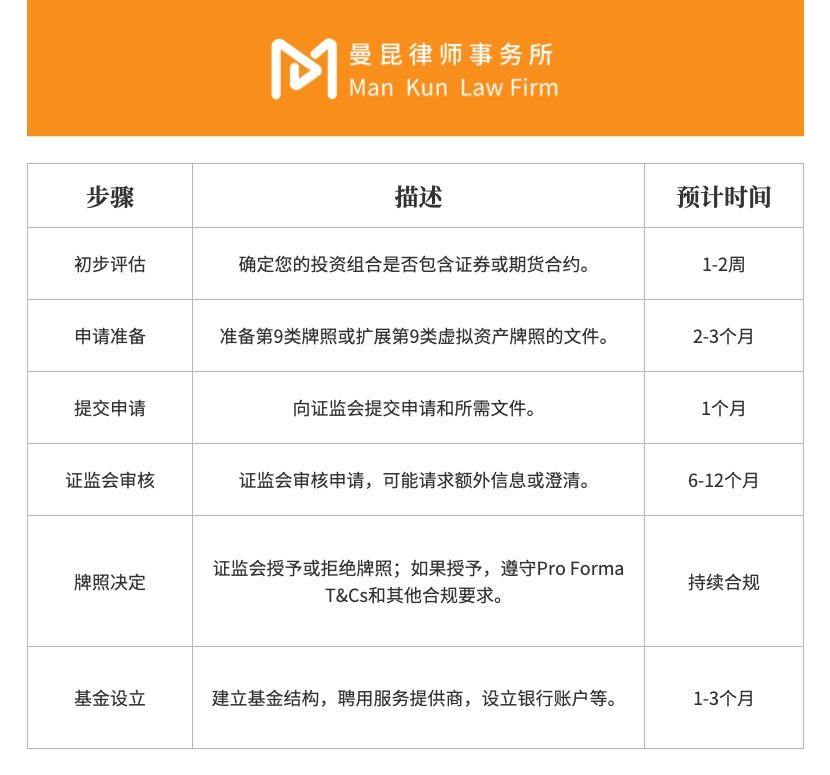
Preliminary Assessment
-
Determine Regulatory Scope. Assess whether your fund’s portfolio includes securities or futures contracts to determine if a Type 9 license is required.
-
Virtual Asset Classification. Clarify whether the digital assets in the portfolio qualify as securities under Hong Kong law.
Application Preparation
-
Document Preparation. Prepare required documents, including a detailed business plan, compliance manual, risk management framework, and corporate governance structure.
-
Consultation. Work with legal and compliance advisors to ensure all documents meet SFC standards.
Submit Application
-
Submit Application. Submit a complete application package to the SFC, including all required documents and application fees.
SFC Review
-
Review Period. The SFC reviews the application, which may involve multiple rounds of feedback and requests for additional information. This process can take several months.
License Decision
-
Notification of Decision. Upon approval, the SFC grants the license. If conditional, the conditions must be strictly followed to maintain compliance.
Fund Establishment
-
Establish Fund Structure. Create the fund’s legal structure, appoint service providers (administrator, auditor, custodian), and set up necessary operational infrastructure.
-
Investor Onboarding. Begin marketing the fund to potential investors and manage subscription procedures.
Costs of Setting Up a Crypto Fund
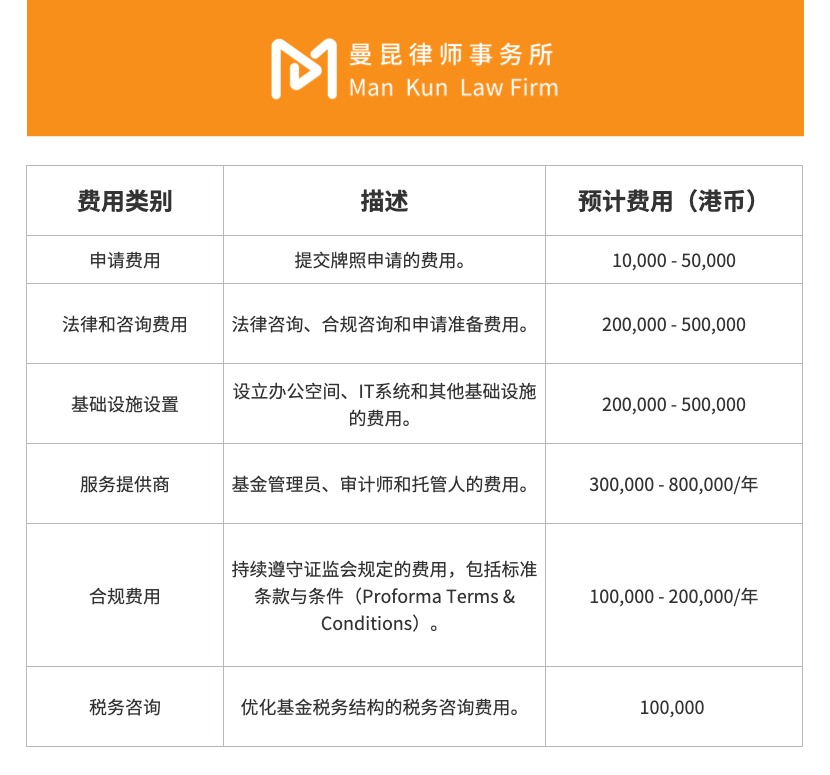
The costs of establishing and maintaining a crypto fund in Hong Kong can vary significantly. Specific expenses depend on multiple factors, including fund size, management strategy, and compliance requirements. Typically, legal and audit fees must be paid to ensure compliance with local regulations. Additionally, license application and annual fees must be considered. To improve operational efficiency and cost-effectiveness, it is advisable to work with professional service providers experienced in the crypto fund market. The table below outlines typical costs:
ManQin Lawyer’s Recommendations
Crypto funds are transforming the investment landscape, offering exciting opportunities alongside complex challenges. Successfully integrating virtual assets into traditional fund frameworks requires a nuanced approach. Future asset managers must carefully select service providers and legal advisors with deep expertise—particularly in understanding the unique risks, characteristics, and operational details of crypto funds. By assembling the right team and leveraging specialized knowledge, asset managers can effectively navigate the complexities of this innovative asset class and fully unlock its potential in the evolving financial markets.
Establishing a crypto fund in Hong Kong is a complex process requiring careful planning and strict adherence to regulatory requirements. By understanding licensing obligations, following the outlined steps, and budgeting accordingly, you can successfully establish and operate a crypto fund in one of Asia’s leading financial centers. Nevertheless, despite Hong Kong’s structured regulatory environment, interest in registering fund structures there remains relatively low due to past tax concerns. Offshore vehicles remain more popular among investors and fund managers. Historical tax issues have made jurisdictions like the Cayman Islands or British Virgin Islands more attractive, highlighting the need for Hong Kong to continue enhancing its appeal as a destination for crypto funds.
In conclusion, while establishing and managing a crypto fund presents challenges, with proper planning and support from a professional team, it is possible to secure a foothold in emerging financial markets. Despite current obstacles, Hong Kong still holds significant potential to become a major hub for crypto funds. To achieve this, Hong Kong must continue improving its regulatory and tax environment to strengthen its attractiveness to global asset managers.
Join TechFlow official community to stay tuned
Telegram:https://t.me/TechFlowDaily
X (Twitter):https://x.com/TechFlowPost
X (Twitter) EN:https://x.com/BlockFlow_News










