









The End of the Prologue and the Dawn of a New Chapter: Reflections on the Current State and Visions for the Future of the Cryptocurrency Industry
TechFlow Selected TechFlow Selected
The End of the Prologue and the Dawn of a New Chapter: Reflections on the Current State and Visions for the Future of the Cryptocurrency Industry
The social demand for speculation continues to grow, attracting "degens."
 Navigating Web3 tides with focused insights
Author: pillarbear, Four Pillars
Translation: Yangz, Techub News
Executive Summary
-
The narrative game driving the cryptocurrency industry is shifting, with market participants developing meta-awareness of the narrative game itself.
-
The crypto industry urgently needs applications that generate demand for blockspace.
-
Crypto's greatest strength lies in its ability to assign economic value to any idea and provide a trading platform. Recently, new experimental forms leveraging attention economics and speculation—such as memecoins, social trading, and prediction markets—have emerged. More diverse on-chain applications and business models may follow.
-
For on-chain applications, speculation is one of the most powerful features. Growing social demand for speculation can attract "degens."
-
In the long run, the industry should aim to deliver value beyond speculation. It’s essential to convert users drawn by speculative demand into those who genuinely appreciate the core value of services, build sustainable token economies, and ultimately offer social graphs and product value that transcend speculation.

Source: Delievery at Dawn | a 4844 film
As Paradigm co-founder Matt Huang said, we're like building casinos on Mars. From redefining money to reshaping interactions with applications, the systems and mechanisms society has built are being reimagined to fit the new paradigm called "Crypto." It goes beyond technological innovation, embodying distinct cultural and social meanings. For libertarians, crypto offers a path toward free markets and self-governance. For cypherpunks, it provides a censorship-resistant, permissionless value exchange network. For entrepreneurs, it's the foundation for building the next-generation internet. For traders, it's an endless source of dopamine and potential profit. Depending on individual perspectives, the casino shaped by cryptocurrency will look vastly different. What do you think about the future shaped by crypto?
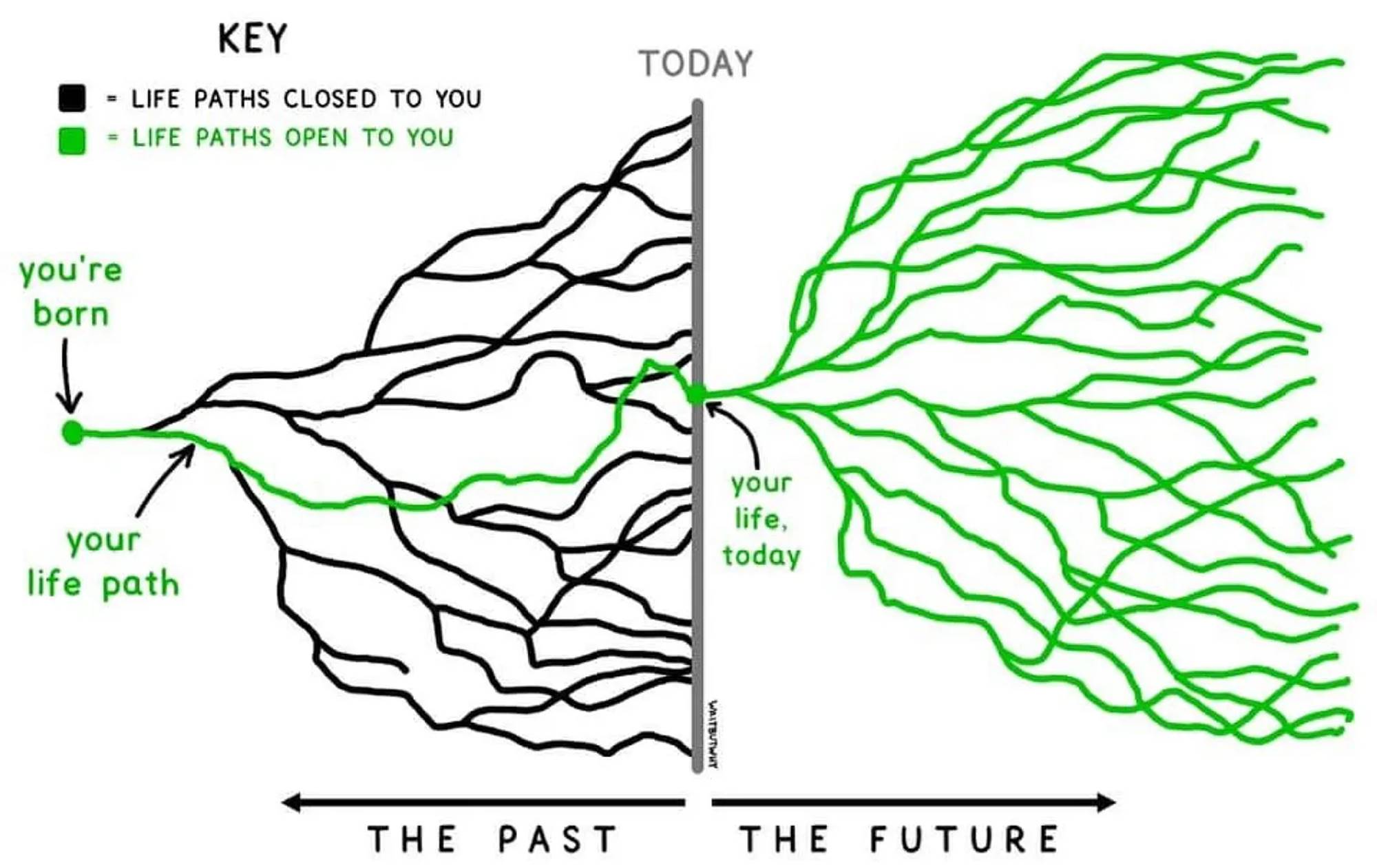
More than half of 2024 has passed. Looking back, this year has been vibrant, highlighting the multifaceted nature of the crypto industry. Bitcoin gained institutional recognition through ETFs. Ethereum successfully implemented the Dencun upgrade, including EIP-4844. Rollups have been deployed across numerous projects and have become the mainstream solution for launching new chains. Solana, after a difficult period, has made a stunning comeback, while last year's bull market triggered investor frenzy over memecoins and celebrity tokens.
On the application front, we've seen significant developments in the crypto space. Over time, mainstream DeFi protocols have matured and grown steadily. Meanwhile, sectors like SocialFi, along with narratives around restaking and artificial intelligence, have attracted attention and speculation.
Compared to previous bear markets, the market has clearly recovered. However, alongside this recovery, the industry has also experienced unprecedented polarization. Regarding memecoins, critics dismiss them as meaningless speculation, while supporters see them as innovative go-to-market strategies and exemplars of emerging attention economy models. Additionally, regarding narratives, the industry is divided between those praising new narratives and infrastructure evolution and those fatigued by elitism within the space.
Since Bitcoin’s inception in 2008, the crypto industry has followed a more turbulent path than any other, undergoing multiple cycles of growth and decline to reach its current state. Whenever public interest shows signs of waning, the industry dramatically resurges, sparking new narratives and hype. Similarly, the future development of cryptocurrency encompasses countless scenarios and possibilities. This article reflects on the narrative games that have driven the crypto industry so far, explores the latest trends amid an evolving landscape, and contemplates the direction of industry development.
Narrative Game

Source: Fractal Lives
It all began with Bitcoin. Since its inception, the crypto industry has undergone countless developments and changes, yet Bitcoin remains the benchmark for the entire sector. At the time of writing, Bitcoin’s market cap stands at $1.2 trillion, ranking tenth among all asset classes. With the approval of spot ETFs, Bitcoin has further solidified its status as “digital gold.” The reason Bitcoin achieves a $1.2 trillion valuation isn’t because it operates as a profit-generating business but because it is perceived as a scarce and legitimate asset. Even Visa and Mastercard—the world’s most widely used payment networks—have market caps less than half of Bitcoin’s.
Source: Visions of Bitcoin
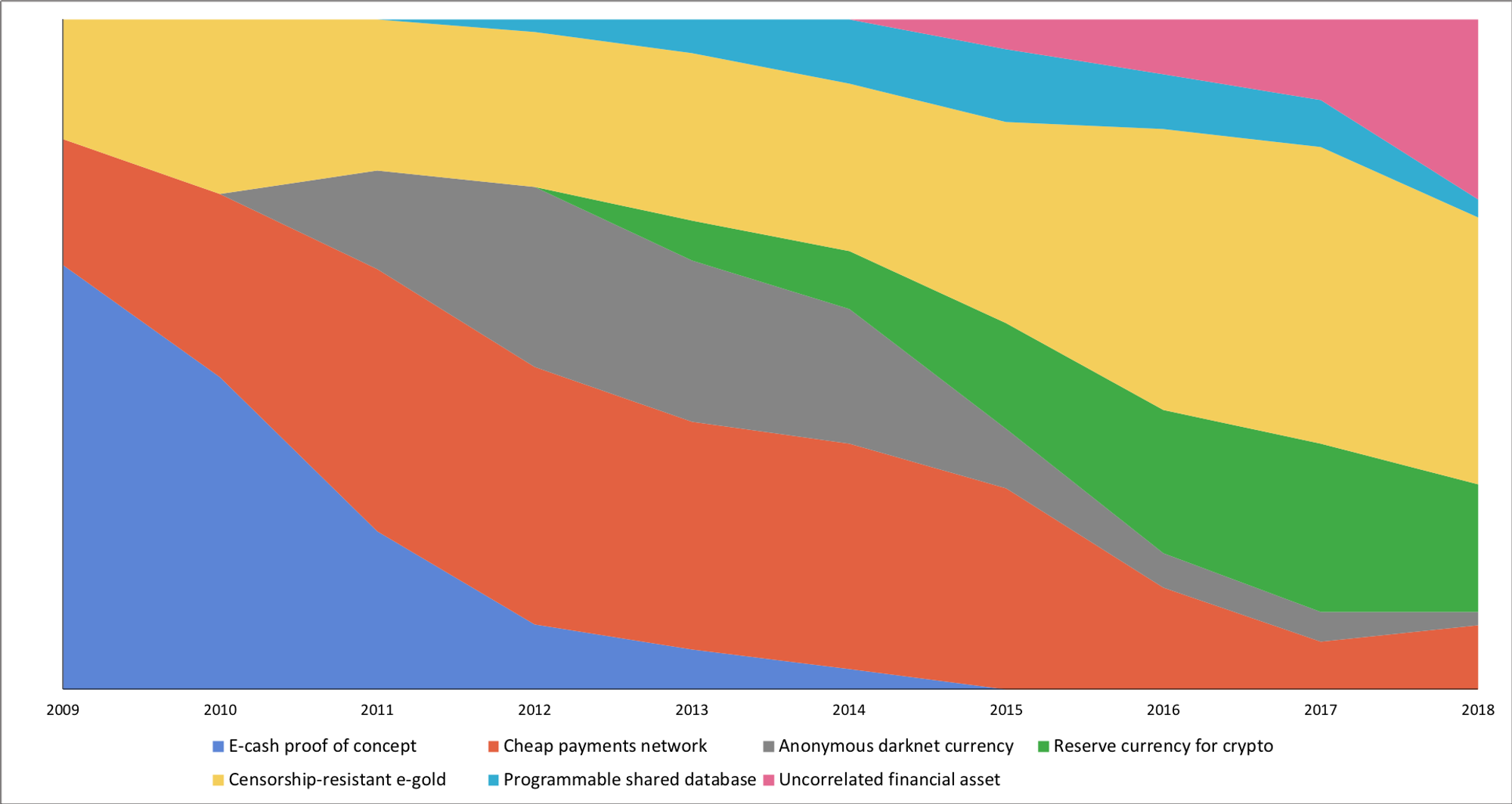
Bitcoin wasn't always seen as “digital gold.” Early on, most people viewed it as a new form of electronic cash or low-cost payment network. In the early 2010s, many still considered Bitcoin a darknet currency. However, over time, Bitcoin gradually gained legitimacy, and its narrative shifted from medium of exchange to store of value. The latter part of the chart above, around 2018, clearly shows public opinion leaning toward viewing Bitcoin as an asset class rather than a payment network. Although the chart doesn't extend beyond 2018, the discourse around Bitcoin as “digital gold” has not only persisted but strengthened.
Satoshi Nakamoto’s insight about Bitcoin was that the essence of money stems from social consensus. Blockchain is merely the cryptographic implementation of social consensus among participants. A network’s value depends on how participants value it. If Bitcoin were seen only as a payment network or darknet currency rather than a store of value, achieving its current valuation would be extremely difficult.
Bitcoin’s success set a precedent for subsequent protocols and tokens. Like Bitcoin, most crypto tokens possess both commercial and asset characteristics. Furthermore, blockchain’s censorship resistance and permissionless nature provide the foundation for anyone to issue tokens and allow others to trade them. To increase token value, each protocol must convince more people to believe in its vision and perceive its token as valuable.
Source: X(@alphanonceStaff)
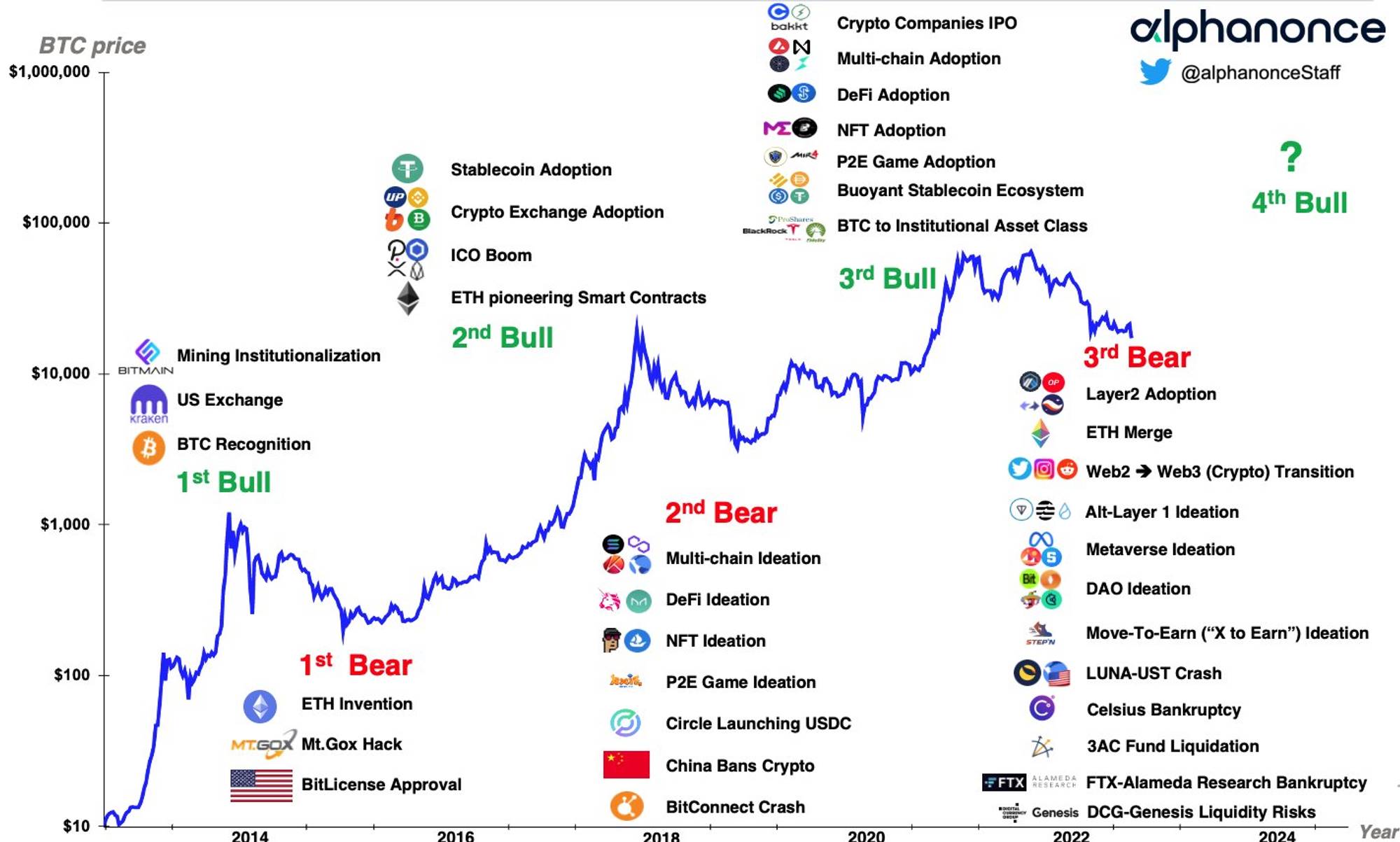
Thus, a unique culture of "narrative games" began flourishing throughout the crypto industry. Emerging industries typically emphasize future potential over immediate user benefits. Yet in crypto, this narrative-driven approach has become dominant. Since the ICO boom, marketing strategies based on compelling stories have proven effective—people rushed to publish whitepapers then, just as they do now. In the crypto space, the most influential figures have consistently been philosophers, researchers, and thought leaders. The tendency to idolize these individuals has become one of the industry’s most distinctive traits.
Moreover, narrative games are particularly effective because most participants in the crypto market are investors and traders. The success of crypto narrative games isn’t solely due to effective marketing campaigns. Their greatest advantage lies in the permissionless nature and ownership model, which allow anyone to tokenize any idea and assign it economic value. How convincing and appealing a project’s narrative is becomes a key factor directly tied to its market value. As token prices rise and trading volume increases, traders continuously search for the next compelling story, while projects create an endless cycle to supply these narratives. The crypto industry sustains growth through the constant emergence and disappearance of new narratives.
Source: X(@intuitio_)
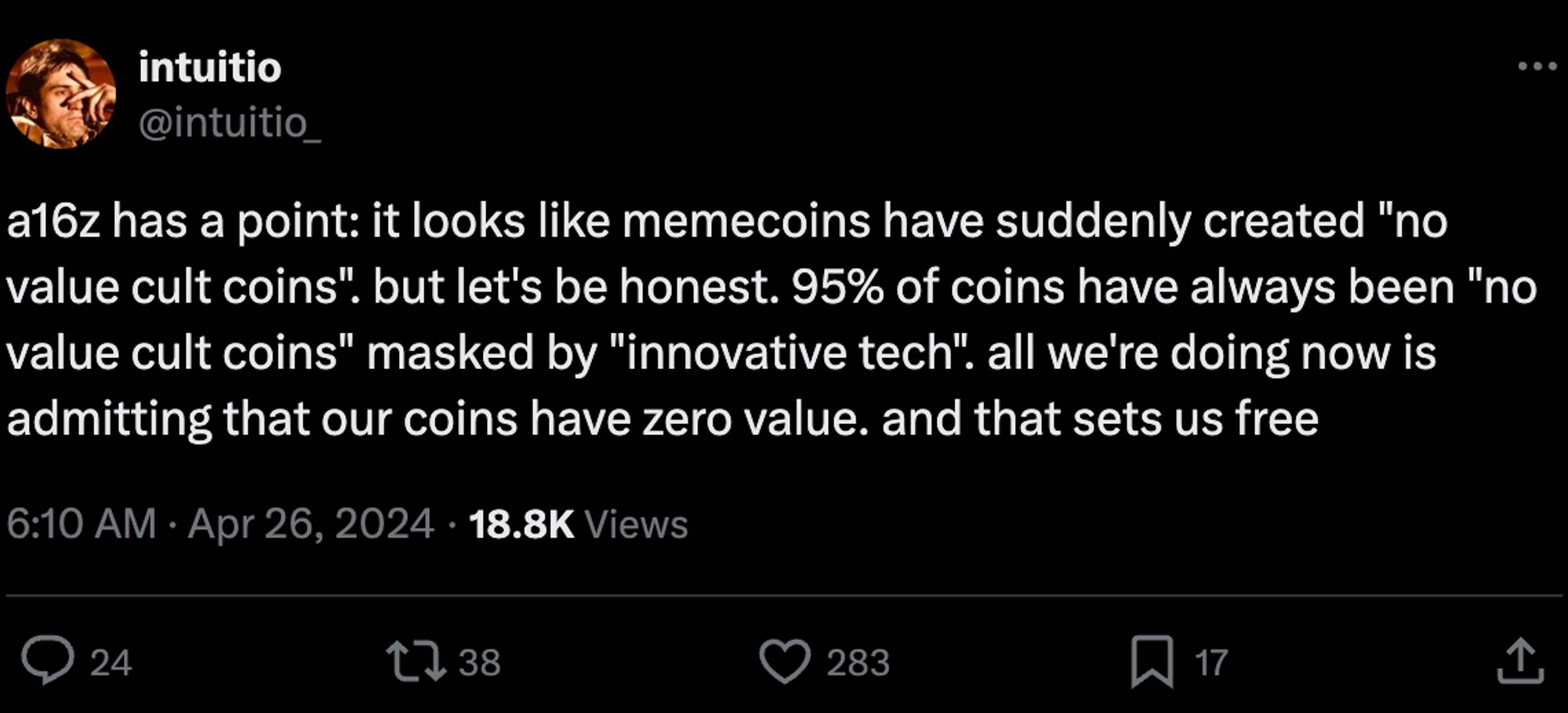
The memecoin craze since the beginning of this year has exposed the essence of the crypto industry’s narrative game. The phenomenon of tokens with almost no practical utility or vision being追捧 in the market fully indicates that narrative games remain the dominant force driving the crypto market.
The rise of memecoins isn’t just about speculation. It also reflects criticism of elitism in crypto’s pursuit of complexity and the imbalance between retail investors and VCs. As the industry matures, truly innovative narratives are becoming rarer. More and more projects brand themselves as the next “blockchain revolution” based on minor differences. This leads to platform oversaturation, excessive blockspace, and fatigue from repetitive narratives. Moreover, mainstream projects often secure inflated valuations from VCs before launch and attempt to control prices through limited circulating supply. This makes it difficult for many retail investors to participate in the narrative game.
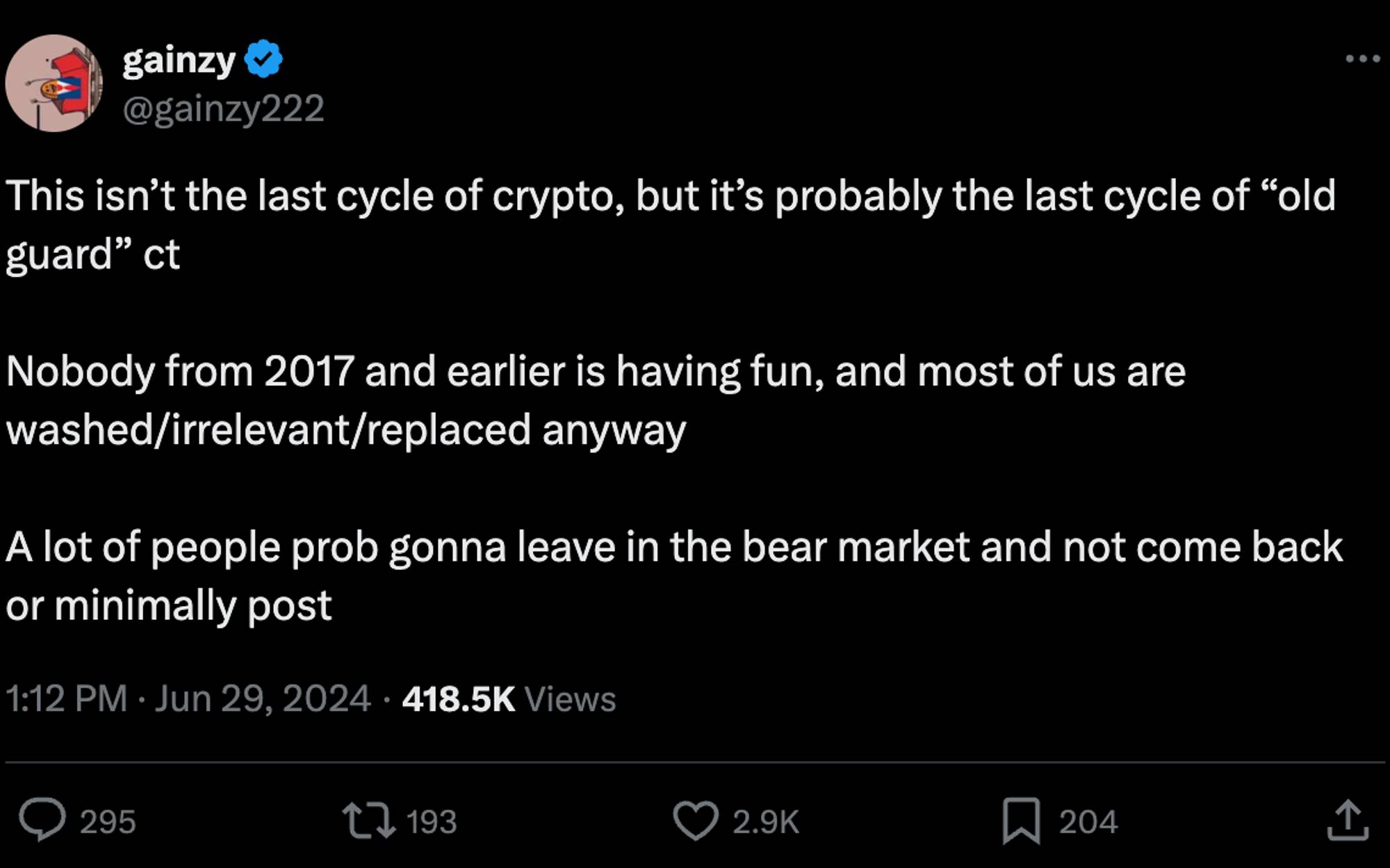
Source: X(@gainzy222)
The significance of crypto narratives and how practitioners consume them is changing. It’s unclear how long the old playbook of creating new stories to justify high market caps can last. But we also can’t expect groundbreaking technological innovations or business models to emerge every week.
Historically, the crypto industry has largely relied on technological breakthroughs and capital efficiency for its narratives. Now, however, investors and users seem to be developing meta-awareness of the narrative game itself. Crypto’s narrative game appears to be evolving in a polarized way. One side laments that new innovations and narratives aren’t as strong as before, while the other keeps hyping newly emerged memecoins and hot projects, only to watch them burst like bubbles. In the near future, we may see this shift become even more pronounced.
Where Are We Now?
Since its inception, the narrative game in crypto has undoubtedly played a crucial role in building the industry’s foundation. Beyond maintaining token prices, the crypto industry needs goals and visions to justify its existence and potential, especially under fraud, speculation, and regulatory pressure. Many embraced the vision of blockchain and Web3, dedicating themselves to advancing the industry and playing a vital role in shaping its current form.
However, the technical limitations of blockchain and Web3 are evident. Networks with sufficient security and censorship resistance are too slow and expensive for everyday applications. During DeFi and NFT Summer, single transaction fees on Ethereum routinely exceeded $100.
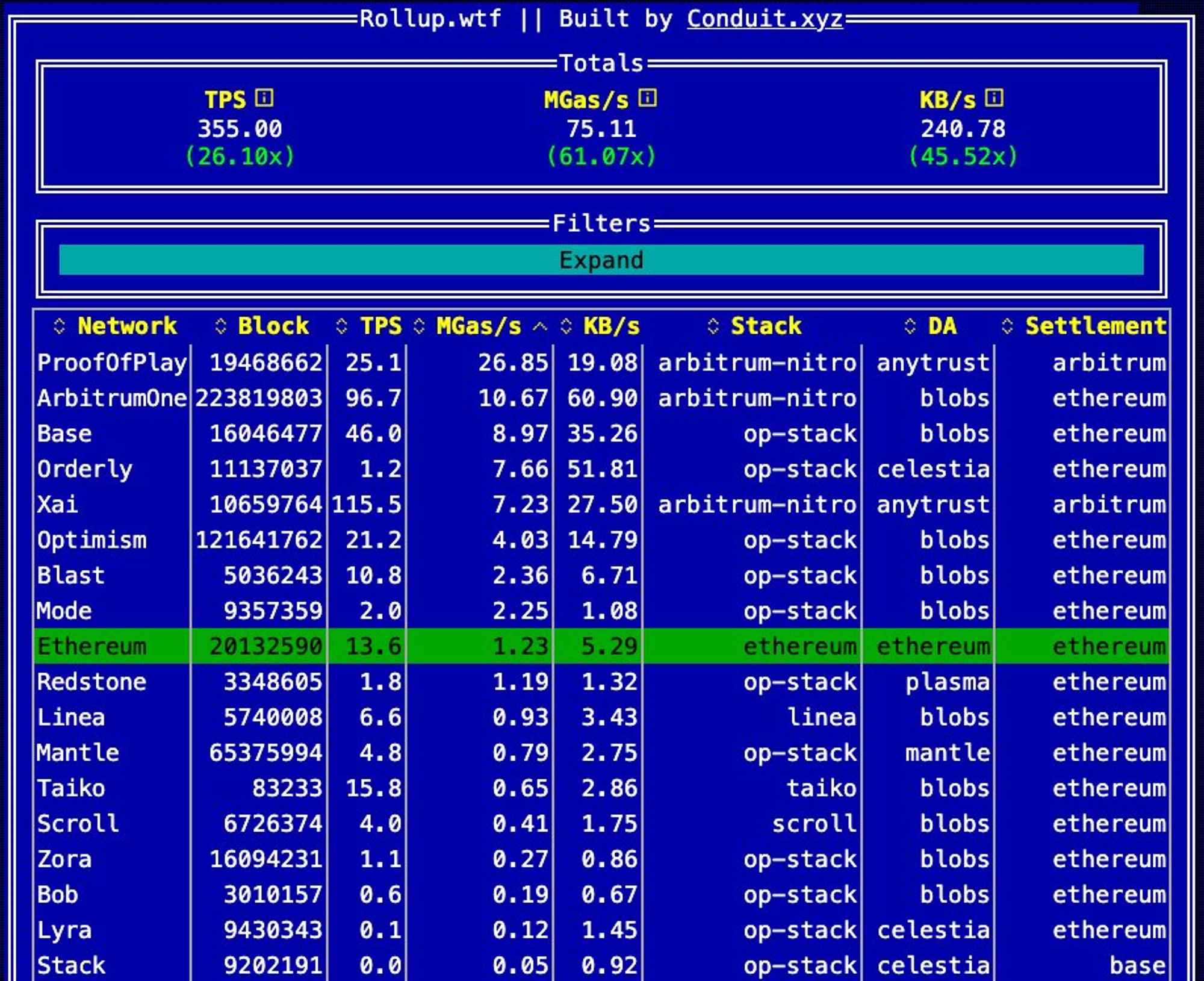
Source: Rollup.wtf
Fortunately, thanks to the efforts of engineers and researchers, blockchain technology has steadily advanced. Secure and scalable blockchain spaces are now a reality. Most L2s or high-performance chains have transaction fees below $0.01 and speeds comparable to traditional apps.
Source: The Myth of The Infrastructure Phase
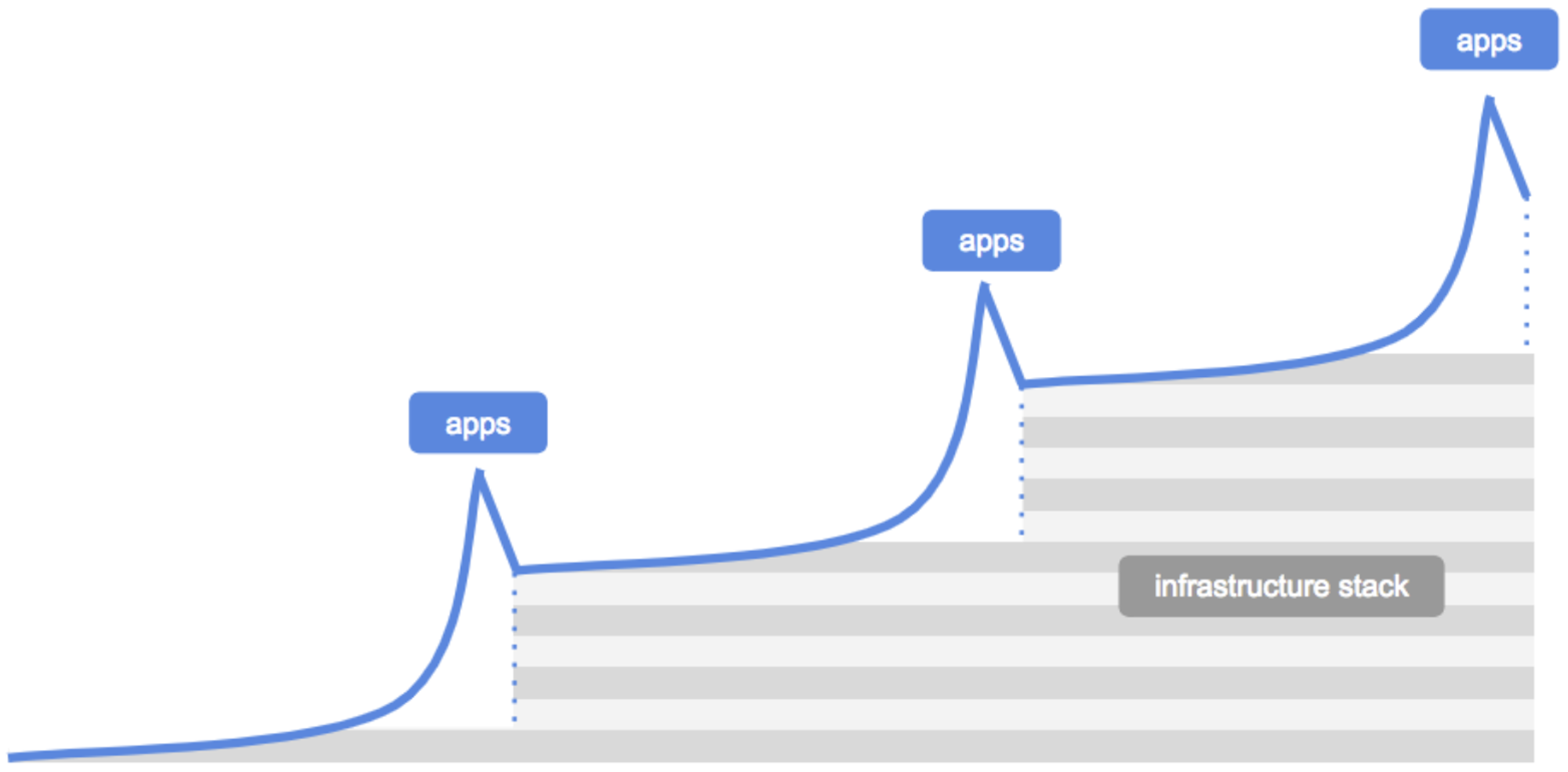
Looking back, Bitcoin has existed for 16 years, and Ethereum for 9. Over these years, the crypto industry has gone through several cycles of infrastructure and application development, experiencing both technological progress and declines driven by greed. Initially, development was relatively slow due to lack of demand and resources needed for R&D. By 2020’s DeFi and NFT Summer, demand for applications exploded, but the systems supporting this demand were insufficient. At that time, we acutely felt the need for stable and scalable infrastructure.
The crypto winter after 2022 marked a period of rapid development in blockchain infrastructure. Rollups, data availability layers, and ZK technologies moved from research to commercialization. The market actively adopted these innovations. Chains like Solana attracted new users with low-cost, fast transactions. High-performance chains such as Sui and Monad have generated interest and are expected to launch more applications in the foreseeable future.
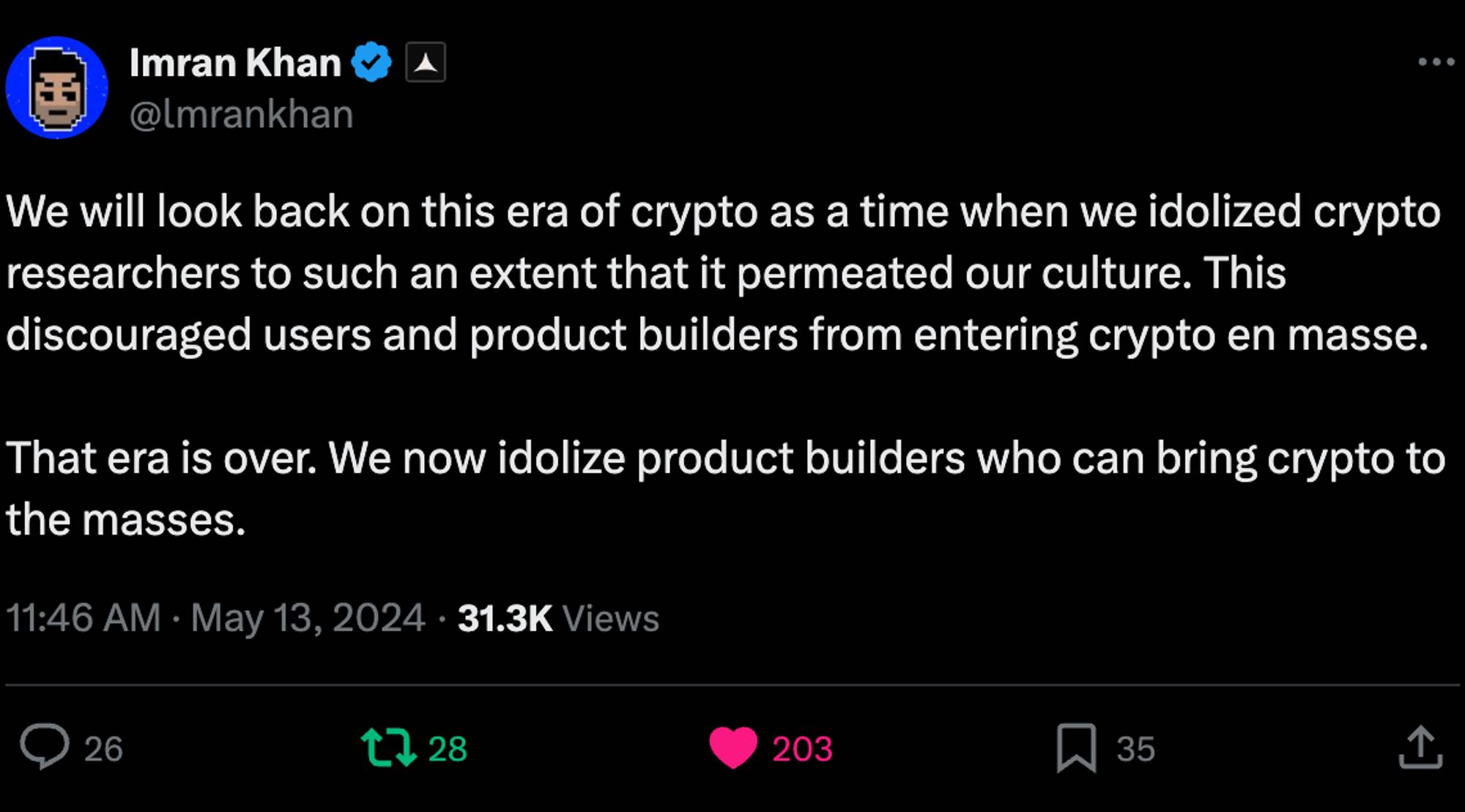
Infrastructure and application development are complementary; neither is more important nor necessarily precedes the other. Applications spark demand for infrastructure, and advanced infrastructure lays the groundwork for new types of applications. YouTube could launch in 2005 rather than 1995 because broadband infrastructure had become widespread. In turn, broadband普及ation was driven by the success of early web companies like Amazon and eBay.
Source: X(@Imrankhan)
Blockchain technology still has ample room for improvement. We hope to see wider adoption of networks offering better user experience and security. Nevertheless, it's undeniable that the crypto industry's narrative has overly focused on technical improvements and ideological concepts. Now, it's time for crypto applications to drive infrastructure development. Most importantly, we need applications capable of generating demand for blockspace.
As previously mentioned, there has always been market demand for new narratives in the crypto industry—a tendency especially strong in the Web3 environment where value accrual is concentrated at the protocol layer. Consequently, almost out of inertia, the industry continues to favor platforms and infrastructure, with applications lagging behind and their impact on users underestimated.
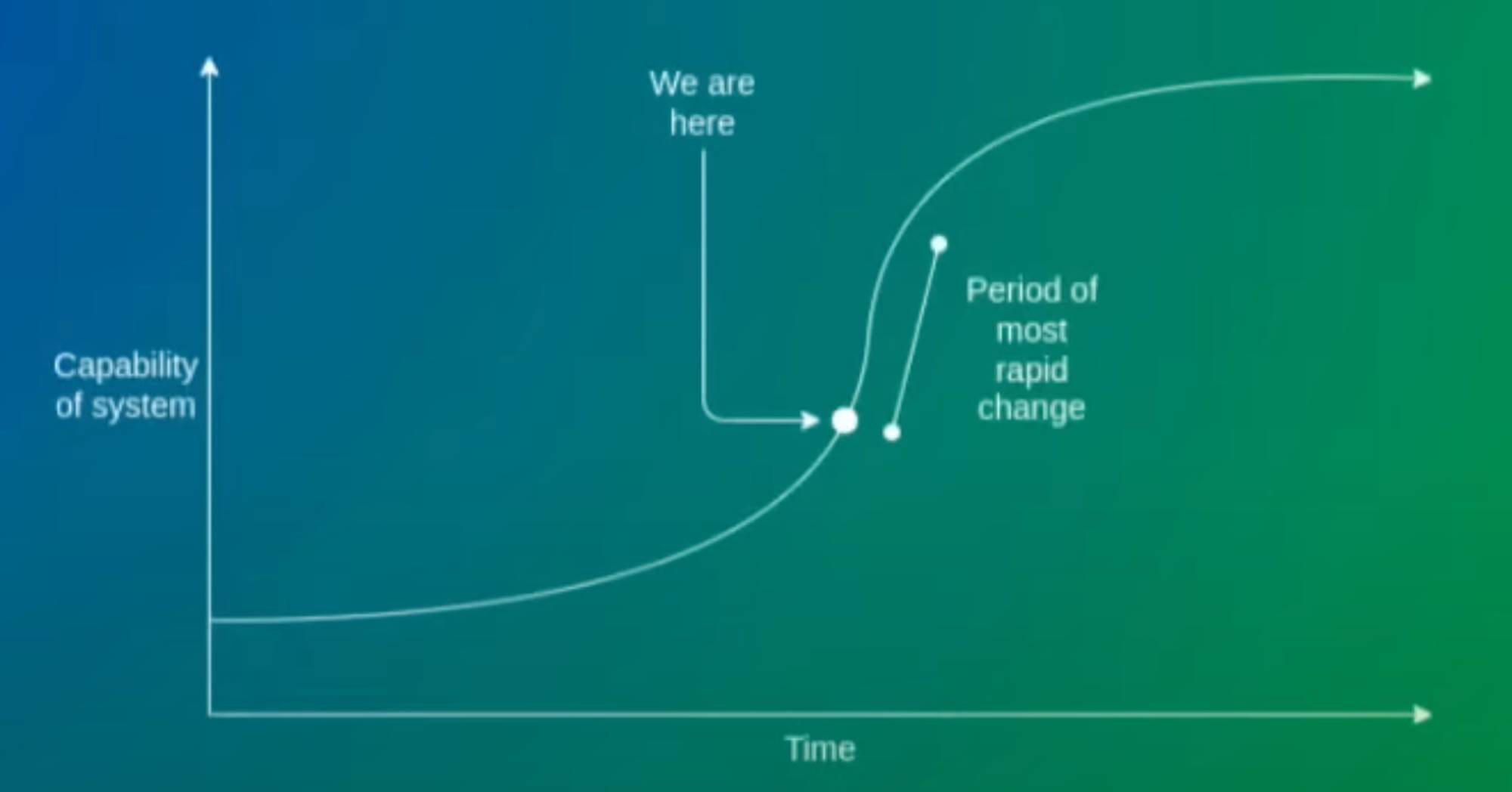
Source: Vitalik Buterin (EthCC 2022)
Shortly after Ethereum’s Dencun upgrade earlier this year, Vitalik Buterin shared his thoughts on the future direction of the crypto industry.
Today, I’d say we’re clearly on the right side of this S-curve—that is, the deceleration phase. Up until two weeks ago, Ethereum’s two biggest changes—switching to proof-of-stake and restructuring blobs—were already behind us. Further improvements remain important but won’t have as dramatic an impact as proof-of-stake and sharding.
Ethereum’s first decade was largely a “trainee” phase, focused on getting Ethereum L1 operational, with applications primarily used by a small group of enthusiasts. Until recently, we set ourselves a low bar: building applications that obviously couldn’t scale, as long as they functioned as prototypes and were reasonably decentralized.
Now, we already have most of the tools needed to build cryptopunk-style yet user-friendly applications. We should just go ahead and build them—developers have no excuse left.

Source: X(@QwQiao)
If broken down by category, tokens serving as stores of value (like Bitcoin) and stablecoins used as payment methods have entered maturity. Stablecoins have become on-chain reserve currencies and are actively adopted in countries with unstable currencies, such as in Latin America or Africa. The DeFi sector has also moved past disillusionment, with mainstream projects’ businesses stabilizing. Data from Token Terminal shows MakerDAO generated $3 million in revenue in Q1 2024, annualizing to approximately $12 million. Yet its token market cap is only $2 billion, giving it a P/E ratio of around 16. Compared to traditional fintech companies, this doesn’t seem overvalued.
On the other hand, applications in certain areas remain limited for broader user groups. NFTs appear to be undergoing a “disillusionment.” After the 2021 bull market, most NFT projects failed to gain societal traction except for a few core IPs. Moreover, despite high expectations for gaming, performance in this sector has been disappointing, receiving cold responses from users. Other categories like AI, DePIN, and social are either yet to peak in hype or just beginning their innovation journey.

The crypto industry has crossed a critical threshold. Despite various challenges—including the Terra and Luna incident, FTX collapse, harsh macroeconomic conditions, and regulatory pressures—crypto continues to move forward. Imagining a scenario where the entire industry collapses now seems highly unreasonable, even under extreme hypothetical circumstances. Yet it’s undeniable that blockchain applications remain largely confined to finance and trading, catering to a limited user base without broad mainstream appeal.
The current crypto industry stands at a crossroads. It might continue in its present state, making incremental improvements only in mature areas like value storage or DeFi. This doesn’t mean continuing as a financial market lacks meaning, but doing so would confine the crypto industry to a hobbyist-driven market, akin to poker or cannabis industries. Crypto holds immense potential at the application layer. Ideally, leveraging this potential could lead to mainstream application adoption and new business models.
Tokenizing Everything
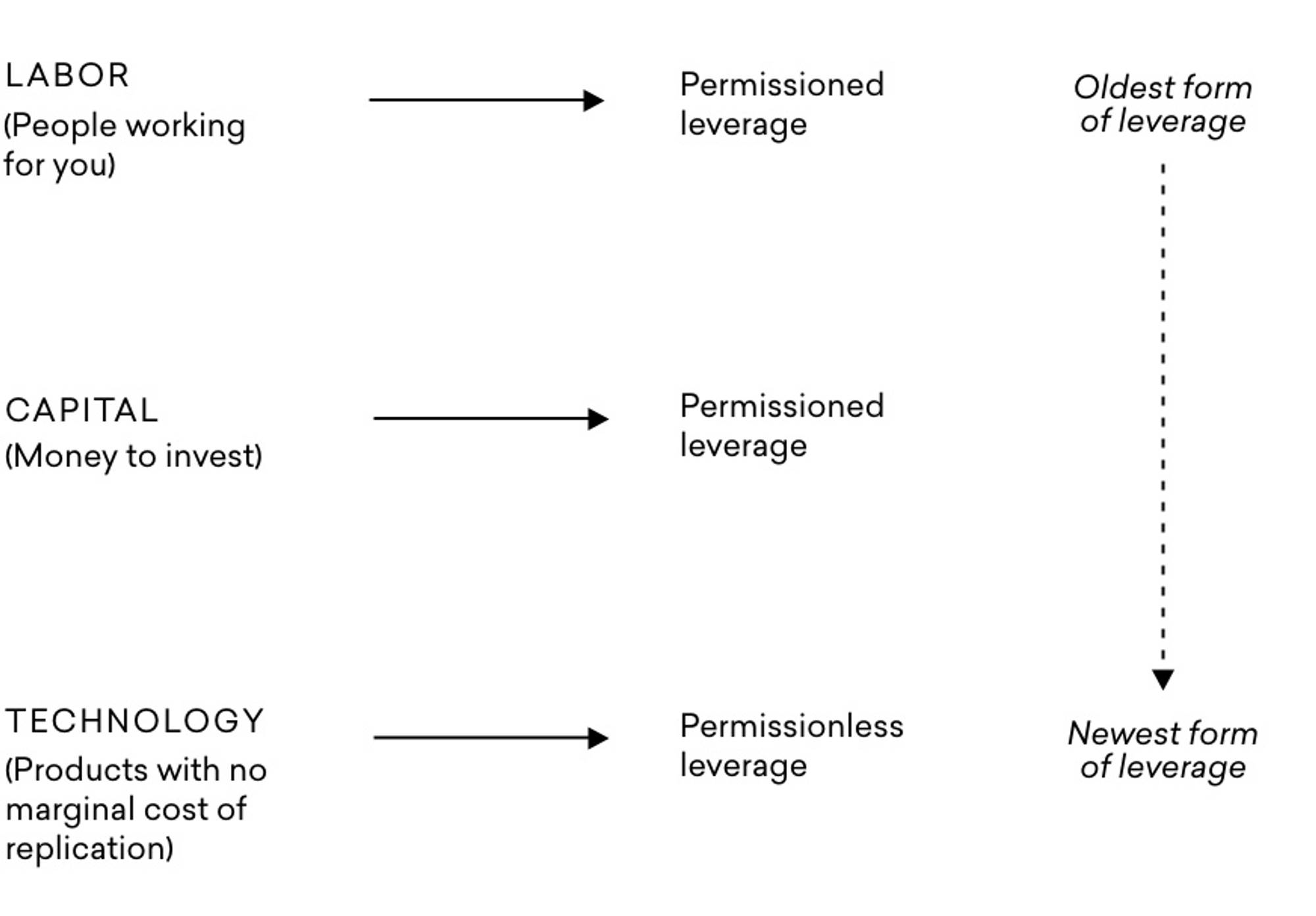
Source: Insights from 'The Almanack of Naval Ravikant'
Traditionally, only individuals or enterprises possessing capital and labor had leverage. However, the proliferation of software and media disrupted this. Software enables individuals with minimal capital to develop applications and services, fostering innovation and spawning numerous platforms and SaaS products. The widespread use of platforms like YouTube and Instagram amplifies individual influence, triggering a "Cambrian explosion" of influencers and micro-media.
The greatest value offered by crypto lies in its ability to assign economic value to any idea and provide a trading platform. In traditional systems, market formation requires intermediaries and permissions to maintain economic value and mutual trust. However, blockchain technology provides the foundation for tokenization, enabling users to exchange economic value and form markets over the internet without trusting others or obtaining permission.

The term "meme" was first introduced by Richard Dawkins in his book *The Selfish Gene*, describing a concept analogous to genes, which transmit genetic information physically. In society, a meme is a cultural unit representing ideas, trends, fashion tastes, etc. Later, memes adapted to internet culture and are now widely used in their current sense. Like genes, memes spread through social interaction, evolving through replication, modification, and reproduction.
Recently, Michael Rinko of Delphi Digital emphasized in his article *Attention is all you need* that crypto assigns economic value to people’s ideas and interests, allowing users to own their interests and profit from them.
On Instagram, we follow brands and influencers. But the most I can do is repost and share content with friends. My attention’s value is 100% captured by others.
Crypto is different. Crypto democratizes attention—we can truly own it. If you find yourself spending a lot of time on certain topics, you can actually own your attention and profit from it. This idea seems obvious and almost silly, yet it represents a major shift in internet economics.
Memecoins take the "attention-as-value" framework to the extreme. They offer the purest way to buy a token simply because you believe it will capture attention in the future.
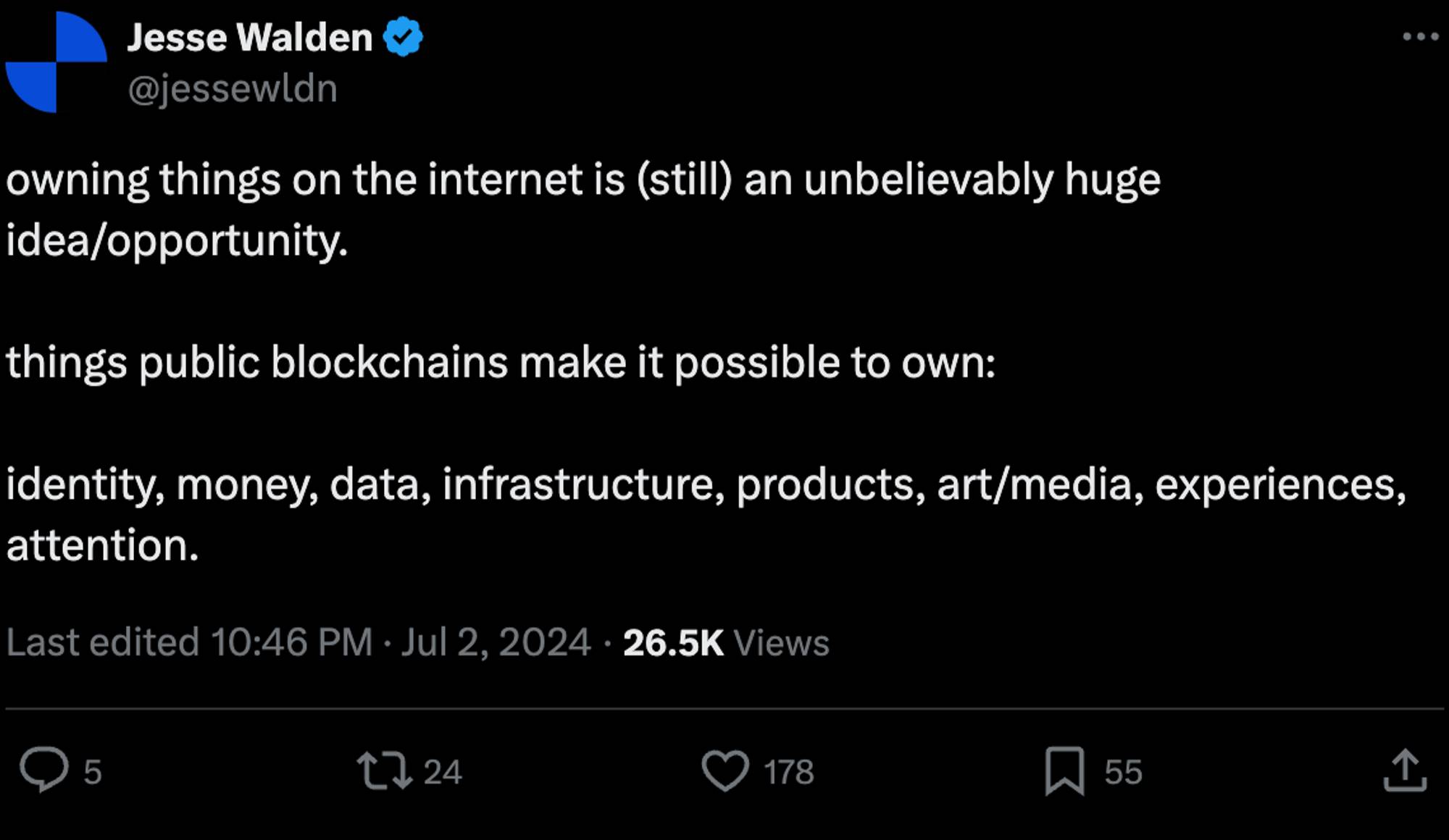
Source: X(@jessewldn)
One must recognize that memecoins themselves aren’t the most important thing. They are ultimately just memes—once they lose interest, they quickly vanish from sight. What memecoins demonstrate is the raw potential of tokenization, hinting at the possibility of entirely new applications. From identity and data to creator economies, the ability to assign economic value to attention paves the way for unprecedented markets and applications.
This became especially evident in the first half of 2024. The crypto market reactivated, and applications converting attention into speculative demand rapidly grew.
Solana’s pump.fun became the primary platform for launching memecoins, temporarily topping all protocols in fee generation.
Friend.tech and Fantasy.top integrated social trading features linked to Twitter, generating strong speculative demand, achieving $65 million in fees and over $36 million in trading volume respectively.
DEGEN, the Scenecoin built on Farcaster, attracted substantial users and activity through innovative airdrops and community incentives, contributing to Farcaster ecosystem success.
During the U.S. presidential election, Polymarket saw a significant surge in activity and trading volume, recording $100 million in trades in June alone.
Hamster Kombat in the TON ecosystem leveraged its simple functionality and seamless integration with Telegram to achieve 100 million users.
Although this list is not exhaustive, the release and experimentation of large and small applications continue. Despite over a decade of existence, work on developing applications leveraging crypto’s unique characteristics has only just begun. The range of unique user experiences on-chain applications can offer remains undefined. We should pay greater attention to these initiatives, as they provide meaningful experimental results on how crypto applications can meet user needs and adapt to markets. We look forward to more experiments in underexplored areas of crypto—social, gaming, NFTs, and prediction markets.
Speculation Is a Feature, Not a Bug
Blockchain is a backend technology. Aside from chains designed for specific applications, most networks provide general execution environments and databases for running applications. In principle, most applications we use daily could run on blockchains. Just as software no longer highlights mobile compatibility or cloud usage as marketing keywords, crypto shouldn’t be a term used to describe application functionality. Ultimately, “blockchain” or “crypto” won’t be used to describe applications, and users should be able to use apps without knowing the underlying chain or wallet.
When someone wants to launch a product or service, no one asks why it should be published online. Because deployment costs are lower, speed is faster, and customers enjoy greater convenience and accessibility than offline alternatives, except in special cases. Likewise, running applications on-chain will eventually be seen as natural. As permissionless markets and interconnected application ecosystems with wallet usage become common, we’ll stop questioning why an app needs to run on a blockchain.
However, in today’s limited blockchain environment, such assumptions remain aspirational. Current blockchain development environments are still challenging. Users aren’t familiar with wallets and tend to avoid them. Except for a small group of enthusiasts, most users need strong incentives to use on-chain applications. This isn’t just about improving adoption by 10% or 20%; we need user experiences and functionalities that can only exist in on-chain environments.
Source: Sound.xyz
Most users in the industry are airdrop "hunters" and traders, primarily motivated by speculative demand. Those pursuing crypto ideals argue that such speculation contradicts crypto’s fundamental purpose and try to distance themselves from these practices. However, we need to reassess the role "degens" play in the industry. Without exaggeration, the crypto industry is built on capital injected through speculation. The fact that most on-chain trading volume stems from speculative demand, arbitrage, or MEV profits cannot be ignored. Infrastructure without users is worthless. Undoubtedly, degens are a crucial pillar of the crypto industry.
During the 2021 NFT Summer, many companies and brands joked about entering crypto, generating excitement. Yet in the end, it wasn’t Disney that succeeded, but Pudgy Penguins. Crypto has reached a level where it can sustain growth autonomously. Rather than external entities entering crypto, expansion outward from successful products within the industry may be a more plausible path to mainstream adoption. Ultimately, degens are the early adopters and core user base for all on-chain applications. Meeting their needs should be the first step in validating product-market fit.
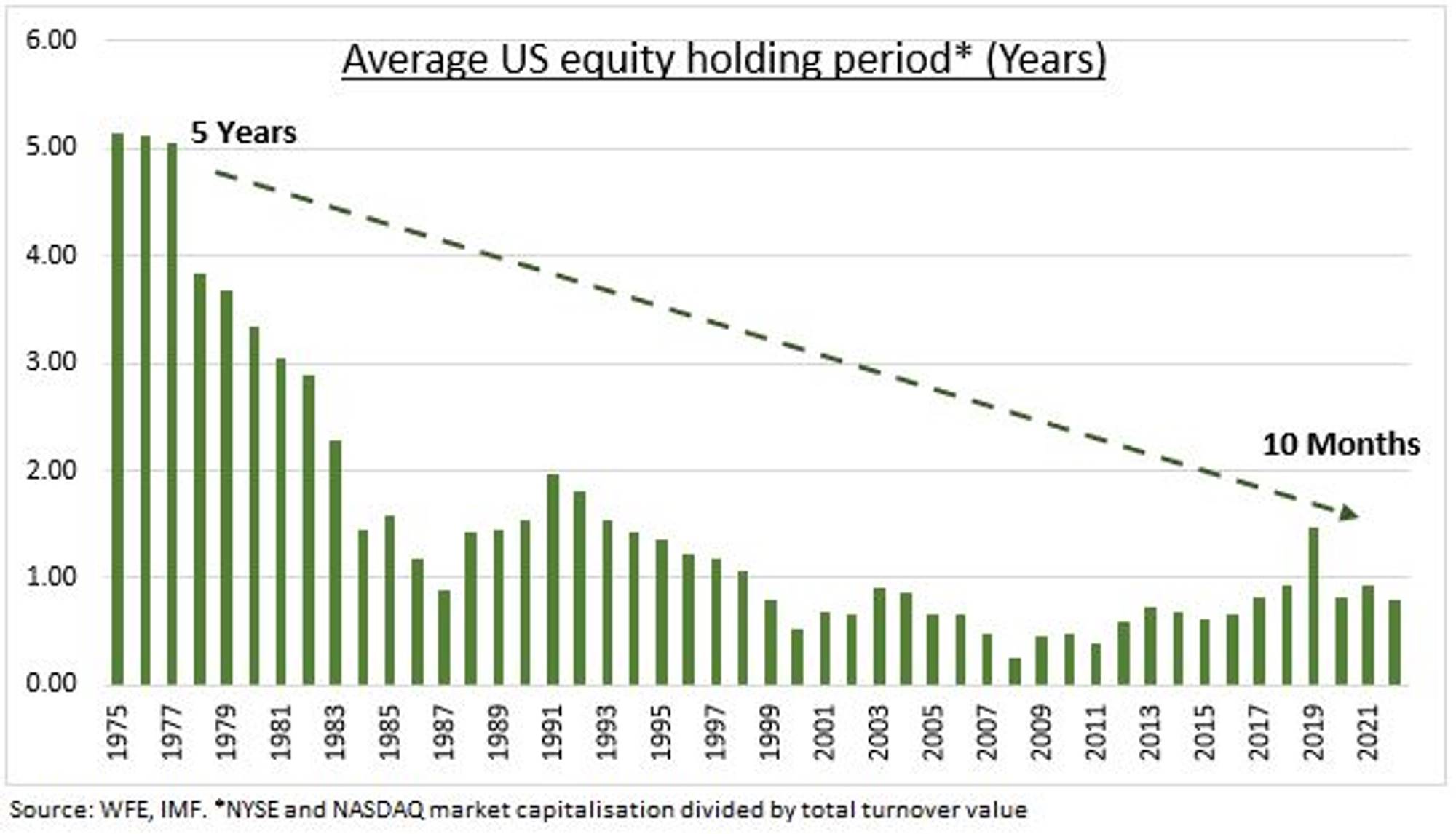
Source: eToro
Preference for speculation isn’t limited to crypto—it’s a social phenomenon. Deepening economic inequality and shrinking attention spans due to social media have continually increased people’s risk tolerance for investing assets. In the 1970s, the average holding period for stocks in the U.S. was five years; by 2020, it had dropped to ten months.
Blaming Gen Z for lack of focus or gambling tendencies due to their high-risk preferences would be unfair. In most major countries today, it’s increasingly difficult for younger generations to live better than their parents. Recognizing clearly that labor income cannot surpass capital income, many investors adopt a “nothing to lose” mindset. They may have little stake, but if they don’t actively bet, their chances of surviving at the table grow slimmer.
While the current situation is undoubtedly dystopian, the high volatility of tokens is seen by many as a rare opportunity to reverse fate. Memecoins—accessible speculative assets—have proven to be a primary means of attracting new users into the crypto industry. Driven by the memecoin boom in the Solana ecosystem, Phantom Wallet ranked third among utilities in the U.S. App Store, reaching 7 million monthly active users. Users drawn by speculative demand gradually learn about digital ownership, wallets, and markets during app usage, integrating into the culture and potentially converting into organic traffic.

Source: X(@0xJim)
Although most on-chain applications have attracted significant short-term attention through unique user experiences and speculative demand, their lifespans are often short due to rough designs and extreme speculation. However, concluding from this that on-chain applications cannot achieve structural retention would be premature.
Reasons for shorter on-chain application lifespans include: most users being degens and traders with very low product loyalty; significantly less time and resources allocated to product development compared to infrastructure; and most products overly focusing on short-term speculation rather than long-term utility.
Finally, I want to say that if speculation were crypto’s only use case, I wouldn’t contribute to this industry. However, to realize Web3’s vision and make general applications like games and social platforms accessible, we must consider not just the goal but also feasible paths to get there. Given the current industry and social environment, speculative demand appears to be the most powerful tool crypto can leverage.
Still, in the long run, users attracted by speculative demand must be converted into those who genuinely appreciate the core value of services, creating meaningful funnels for interactions beyond speculation. Additionally, a token issuance and distribution framework resilient to short-term price and demand fluctuations is needed, ultimately delivering social graphs and product value that transcend speculation.
End of the Prologue
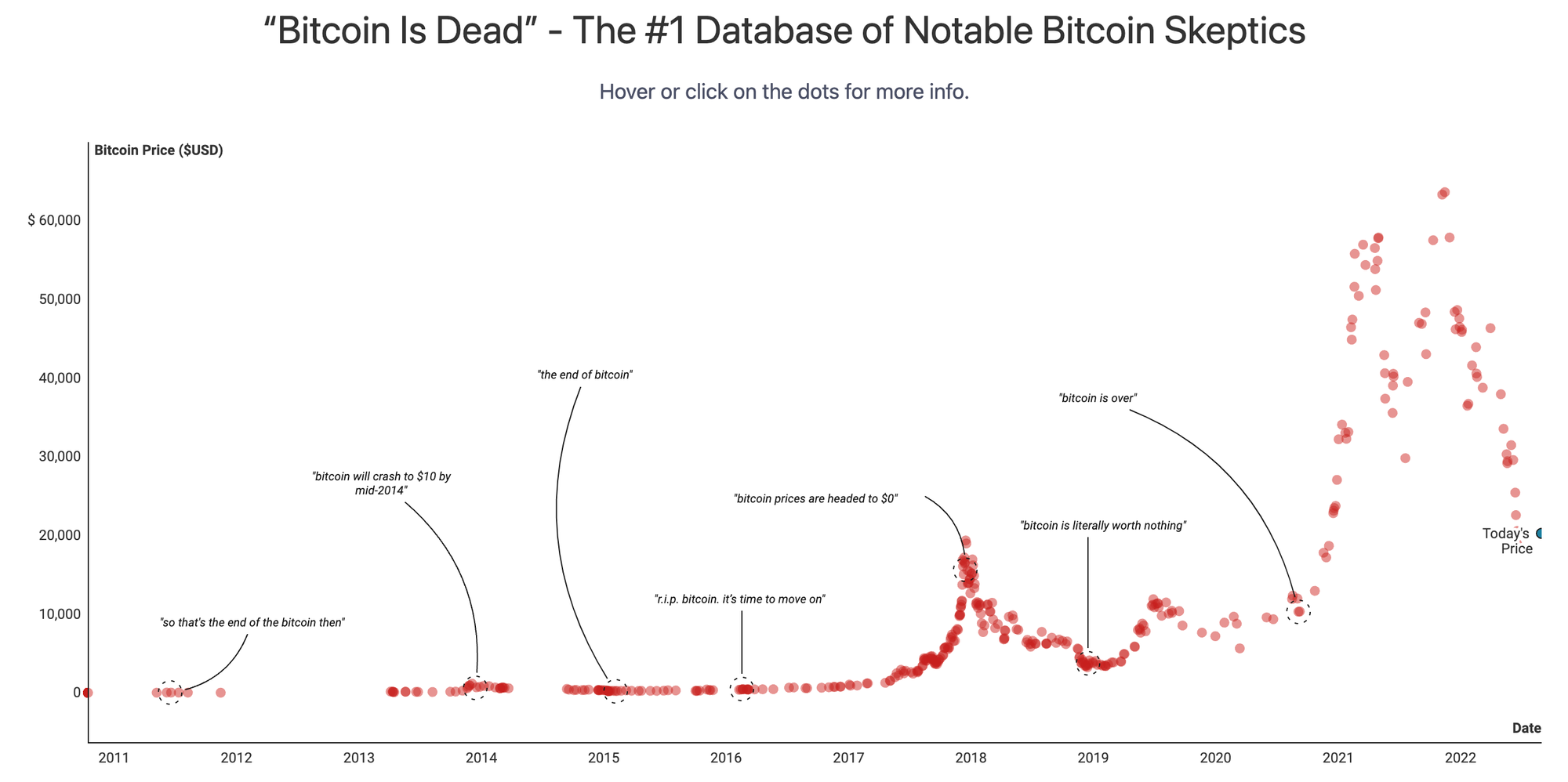
Source: "Bitcoin Is Dead"
People’s emotions fluctuate even more violently than token prices. When prices fall, everyone pronounces a death sentence on the market. Since its inception, Bitcoin has died annually. I believe the crypto industry has evolved to a level where it can operate and grow without external intervention. However, the next two to three years will be critical in determining whether the industry can fulfill the Web3 vision and achieve mainstream status. If key product-market fits aren’t validated within this cycle, there will be no more excuses.

It has been 10 years since the launch of Ethereum, the first general-purpose blockchain. Despite extensive research and development over the years and the industry’s ups and downs, only recently has it evolved into a technology reliably usable by real users. While token prices and narrative games have driven industry progress, now more than ever, focus should shift to products and their impact on actual users.
Join TechFlow official community to stay tuned
Telegram:https://t.me/TechFlowDaily
X (Twitter):https://x.com/TechFlowPost
X (Twitter) EN:https://x.com/BlockFlow_News
 Four Pillars









