Ethereum, Bitcoin, Solana ecosystem restaking protocols funding boom: Which protocols offer opportunities?
TechFlow Selected TechFlow Selected
Ethereum, Bitcoin, Solana ecosystem restaking protocols funding boom: Which protocols offer opportunities?
Sort the 9 major restaking protocols within the Ethereum, Bitcoin, and Solana ecosystems.
 Navigating Web3 tides with focused insights
Author: Xiyu, ChainCatcher
Editor: Marco, ChainCatcher
In April, ChainCatcher reviewed restaking protocols and LRT protocols on Ethereum in an article titled "Frequent Capital Backing, Project Airdrops Galore—The Restaking LRT Sector Becomes a 'New Gold Rush'," covering EigenLayer and its ecosystem-based LRT protocols such as Renzo, Ether.fi, Kelp DAO, EigenPie, YieldNest, Swell, and Pendle Finance.
Although Renzo has launched its token and the long-anticipated EigenLayer airdrop has materialized, over the past three months, market enthusiasm for the restaking sector remains strong. The "points race + maximize yield" strategy continues to ignite fervor across the crypto community, with million-dollar funding rounds occurring frequently.
For example, on June 18, Renzo announced a $17 million funding round led by Galaxy Ventures; on June 11, the restaking project Symbiotic announced a $5.8 million seed round co-led by Paradigm and Cyber Fund.
Data shows that 16.3% of all staked ETH is now participating in restaking via platforms like EigenLayer and Karak Network.
Perhaps due to recognition of wealth opportunities within restaking, the narrative around restaking has recently expanded beyond its primary base on Ethereum to include ecosystems such as Bitcoin and Solana.
Reportedly, at least six teams in the Solana ecosystem are currently building Solana-based restaking projects.
Recently, two multi-million dollar financings occurred in the Bitcoin ecosystem: On May 30, Babylon completed a $70 million funding round led by Paradigm; on July 2, the Bitcoin restaking protocol Lombard closed a $16 million seed round led by Polychain Capital.
Three Major Restaking Protocols on Ethereum: EigenLayer, Symbiotic, Karak Network
Controversy Over Non-Transferable Tokens from EigenLayer Airdrop
As the pioneer of the restaking concept, EigenLayer has long been the leading player in the restaking space. However, since announcing the EIGEN tokenomics on April 30—with the stipulation that airdropped tokens cannot be transferred—it has sparked widespread controversy.
The most criticized aspect is EigenLayer's whitepaper stating that EIGEN tokens are restricted from transfer during the initial phase, meaning users cannot trade or sell them on secondary markets.
Officially, this restriction was justified due to concerns about liquidity. However, many users see it as unfair conduct. The stablecoin project Ethena, which recently launched its own transferable token, sarcastically posted on social media: “Tokens can be transferred—we love you,” clearly mocking EigenLayer’s decision.
Beyond non-transferability, user dissatisfaction deepened when EigenLayer imposed IP address restrictions only upon airdrop distribution, despite not having enforced such limits during earlier deposit stages—creating a sense of being discarded after serving their purpose.
However, data suggests the backlash hasn't impacted EigenLayer’s Total Value Locked (TVL). Instead, TVL rose from $14 billion on May 9 to a peak of $19 billion on June 16, before settling back to $14.9 billion.
EigenLayer supports both native restaking and liquid restaking: 68% of assets are native ETH, while 32% are LSTs. Currently, EL has approximately 161,000 restakers, yet about 67.6% ($10.3 billion) of the value is delegated to just 1,500 operators.
On July 3, EigenLayer tweeted that it would make “major progress” in Q3. Community speculation centers on whether EIGEN tokens will soon become tradable.
As of July 12, EIGEN tokens still cannot be transferred or traded, though they are priced at $5.39 on the off-chain points trading marketplace Whalesmarket.
Symbiotic: A New Restaking Project Backed by Lido and Paradigm
While EigenLayer faced public scrutiny over its airdrop rules, news broke on May 15 that Lido’s co-founders and Paradigm were secretly funding a new competitor called Symbiotic. In the community’s view, Symbiotic emerged precisely to challenge EigenLayer’s dominance.
On June 11, Symbiotic officially launched and announced completion of a $5.8 million seed round led by Paradigm and Cyber Fund.
Notably, Cyber Fund—the second-largest investor in Symbiotic—was co-founded by Lido co-founders Konstantin Lomashuk and Vasiliy Shapovalov. Additionally, Symbiotic explicitly allows restaking using assets incompatible with EigenLayer natively, such as Lido’s stETH.
Thus, Symbiotic is widely seen as Lido’s strategic move into the restaking arena and a direct rival to EigenLayer.
Unlike EigenLayer, which only supports ETH and ETH-derived LSD tokens, Symbiotic offers broader asset support, allowing any ERC-20 token to be restaked—including stETH, cbETH, Ethena’s governance token ENA, and its stablecoin USDe.
This means crypto protocols can launch native staking for their own tokens via Symbiotic to enhance network security.
In terms of product design, Symbiotic enables developers to customize based on business needs—for instance, choosing supported assets, node operators, reward structures, and slashing mechanisms. In contrast, EigenLayer uses centralized management where official teams delegate ETH stakes and node operators validate various AVSs.
Backed by Lido and Paradigm, Symbiotic accumulated over $1 billion in deposited assets within one month of launch.
As of July 12, Symbiotic’s TVL reached $1.09 billion, with wstETH from Lido accounting for $760 million—or roughly 70% of total deposits.
Currently, LRT protocols including Ether.fi, Renzo, YieldNest, Swell, and Pendle Finance have integrated with Symbiotic, enabling users to earn Symbiotic points by depositing assets through these platforms.
Mellow: An LRT Protocol Built on Symbiotic
Mellow originally operated as a liquidity solution and partner within the Lido alliance, allowing users to stake ETH and receive stETH while earning additional Mellow staking points. Moreover, Mellow assists Lido validators in launching their own LRTs, enhancing stETH usability and generating extra revenue for Lido DAO members.
On June 4, Mellow announced a partnership with Symbiotic, launching as a modular LRT liquidity restaking project within the Symbiotic ecosystem.
Compared to typical LRT protocols, Mellow functions more like modular infrastructure for creating customizable LRTs, enabling anyone to deploy solutions with varying risk-return profiles—such as traditional hedge funds or staking providers like Lido—allowing users to select configurations tailored to their risk appetite for optimized returns and flexible risk management.
For end-users, depositing ETH into Mellow automatically routes it to Lido, yielding stETH, which is then restaked into Symbiotic. Users thus earn dual points from both Mellow and Symbiotic platforms.
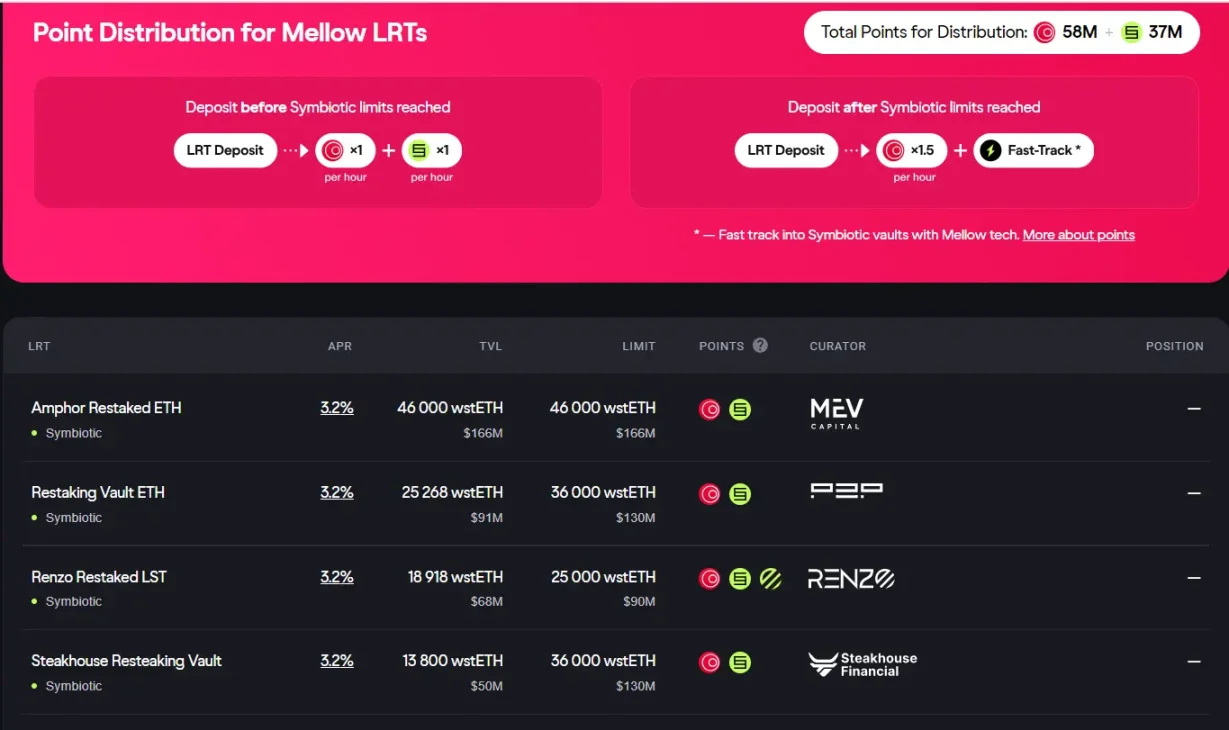
On July 15, Mellow’s TVL stood at $488 million, with 37 million Symbiotic points accumulated.
Karak Network: A Multi-Asset, Multi-Chain Restaking Protocol
Karak Network operates similarly to EigenLayer but refers to its AVS services as Distributed Security Services (DSS), and has also launched its own Layer 2 network called K2.
Unlike EigenLayer, Karak aims to enable restaking of any type of asset. Supported assets currently include ETH, various LSTs and LRTs, and stablecoins such as USDT, USDC, DAI, and USDe.
Additionally, Karak is deployed across multiple chains, aiming to allow deposits from any chain. It is already live on Ethereum, Arbitrum, BSC, Blast, Mantle, and others, enabling users to deposit according to their cross-chain asset distribution.
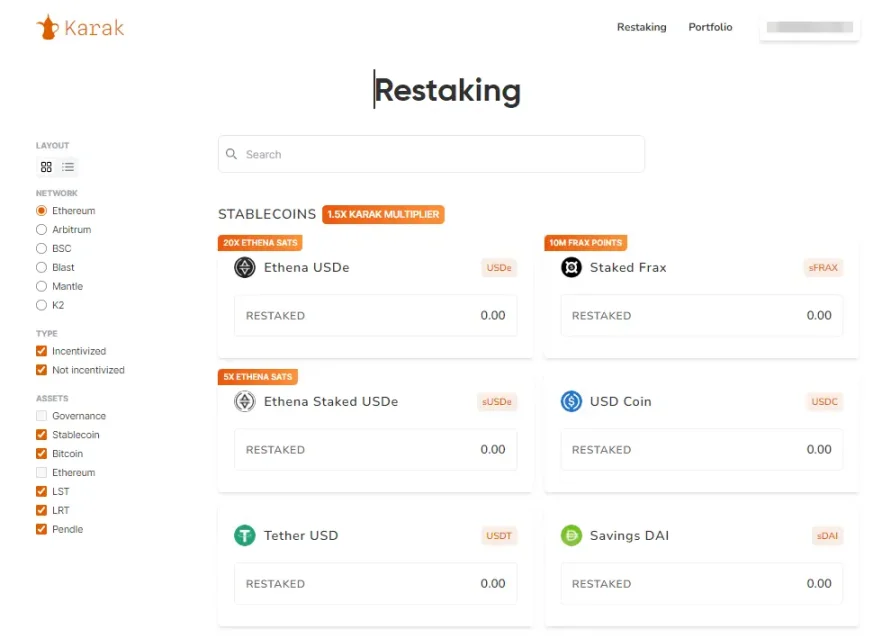
Currently, Karak’s TVL exceeds $1 billion, although the platform is temporarily not accepting new deposits.
Bitcoin-Based Restaking Protocols: Babylon, Lombard, BounceBit
Babylon: Bitcoin Restaking Protocol
Babylon is a Bitcoin-based restaking protocol that introduces staking functionality to BTC. It allows Bitcoin holders to trustlessly stake their assets into other protocols or services requiring security and trust, thereby earning PoS-like staking rewards and governance rights. Simultaneously, it extends Bitcoin’s security to middleware, data availability layers, sidechains, and other protocols, enabling them to benefit from Bitcoin-grade security at lower costs.
In terms of scope, Babylon serves two main purposes: first, BTC holders can stake their coins to provide security and trust layers to other protocols and earn yield; second, PoS chains or new protocols within the Bitcoin ecosystem can leverage BTC stakers as validating nodes to improve security and efficiency.
According to Babylon’s co-founder in a ChainCatcher interview, its operational mechanism mirrors EigenLayer on Ethereum. However, because Bitcoin lacks smart contract support, Babylon must take an extra step—first making non-stakable BTC stakable—before enabling restaking.
On May 30, Babylon announced another $70 million funding round led by Paradigm. According to Rootdata, Babylon had raised a total of $96 million by July 12, with investors including Paradigm, Polychain Capital, Framework Ventures, Polygon Ventures, and Binance Labs.
Currently, users can experience BTC staking via the Babylon Testnet4.
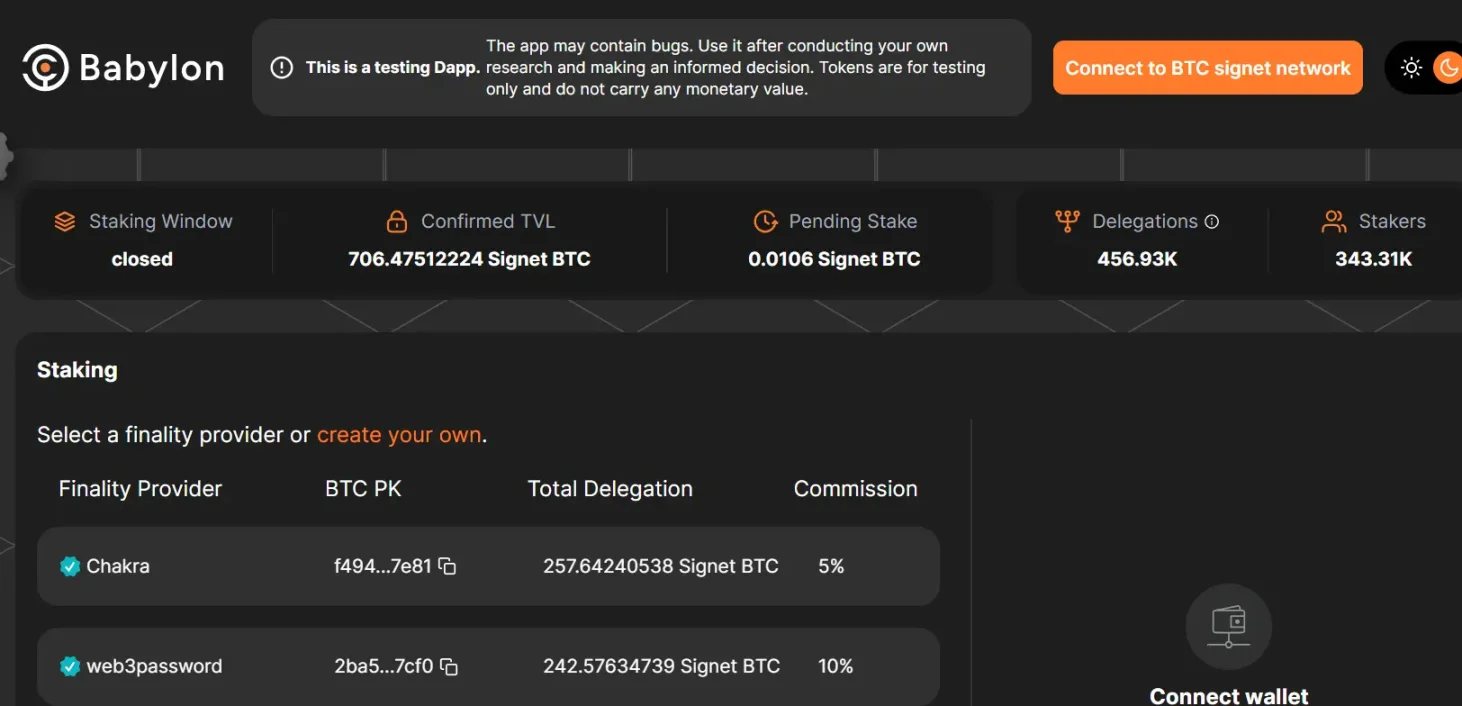
Liquid Restaking Protocols Based on Babylon
1. Lombard – Raised $16 Million in Seed Round
Lombard is a liquid restaking protocol built on Babylon. On July 2, it announced a $16 million seed round led by Polychain Capital, with participation from BabylonChain, Foresight Ventures, Mirana Ventures, and Nomad Capital.
The relationship between Lombard and Babylon resembles that of Renzo and EigenLayer—BTC deposited into Lombard is automatically restaked on Babylon to generate yield.
Lombard issues LBTC to unlock liquidity for BTC staked on Babylon. When users deposit BTC on Lombard, they receive an equivalent amount of LBTC, a restaking receipt token that can be used across DeFi applications—such as lending, trading, and staking—to boost capital efficiency.
Currently, users can apply via email for the whitelist to join Lombard’s testnet.
2. Lorenzo
Lorenzo is another Bitcoin liquid restaking protocol based on Babylon, allowing users to directly deposit BTC into Babylon. The project previously received support from Binance Labs.
On May 28, Lorenzo launched a pre-staking campaign for Babylon, enabling users to deposit BTC and receive stBTC. All BTC collected will be staked on Babylon immediately upon its mainnet launch.
Currently, users who stake BTC via Lorenzo can earn dual points from both Lorenzo and Babylon.
BounceBit: A Bitcoin Restaking Chain
BounceBit is a dedicated BTC restaking chain designed specifically for Bitcoin, comprising three core components: BounceBit Portal (user interface), BounceClub (aimed at combining CeFi and DeFi ecosystems), and BounceBit Chain (core module enabling restaking).
BounceBit Chain serves as the backbone for restaking within the BounceBit ecosystem, secured by both staked Bitcoin and BounceBit’s native token BB. Middleware such as cross-chain bridges and oracles can gain enhanced security by integrating BounceBit’s liquidity.
Specifically, once users transfer native assets to BounceBit, new B-Token assets are minted. For example, upon depositing BTC, users receive BBTC, which operates on the BounceBit mainnet.
Currently, BBTC can be used in two primary ways: First, under BounceBit’s hybrid staking model, BBTC and BB can jointly participate in node staking, with resulting LST tokens eligible for further restaking to amplify returns; Second, BBTC can be utilized across various DeFi applications on-chain to generate yield.
In April, BounceBit announced a strategic funding round backed by Binance Labs. Earlier, in February, it disclosed a $6 million seed round from investors including Blockchain Capital, Bankless Ventures, NGC Ventures, DeFiance Capital, and OKX Ventures.
On July 12, BB was priced at $0.40, with a fully diluted valuation (FDV) of $800 million.
Solana Ecosystem Restaking Protocols: Solayer, Cambrian, Picasso
Liquid Restaking Protocol Solayer
Solayer is a restaking protocol within the Solana ecosystem, enabling SOL holders to stake their assets into other Solana-native protocols or dApps requiring security and trust, thereby earning additional PoS staking rewards—functionally similar to EigenLayer.
On July 2, Solayer announced completion of a builders’ funding round, with undisclosed amounts. Investors include Anatoly Yakovenko (co-founder of Solana Labs), Rooter (founder of Solend), Richard Wu (co-founder of Tensor), and Sandeep Nailwal (co-founder of Polygon). Prior reports indicated that three VCs familiar with the matter said Solayer aimed to raise $8 million in seed funding at an $80 million valuation. Rachel Chu of Solayer Labs stated they are nearing $10 million in fundraising, including participation from Solana founder Anatoly Yakovenko.
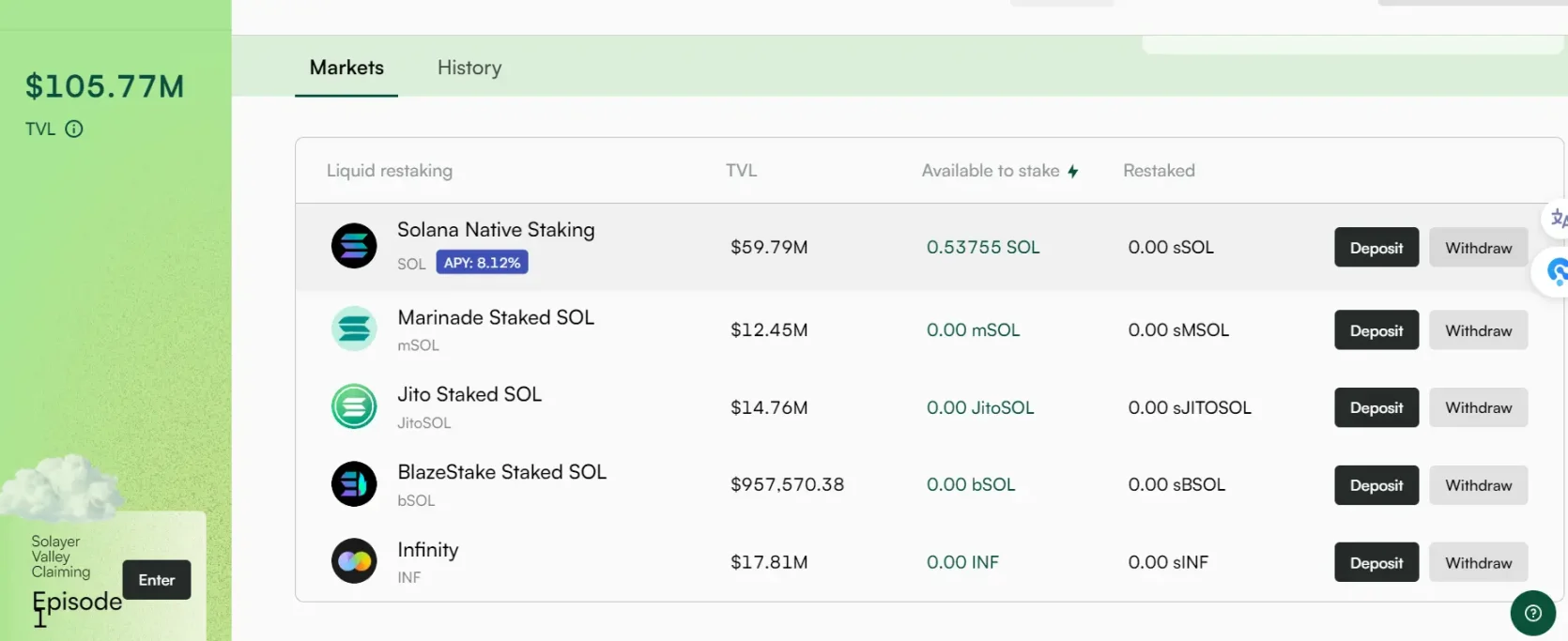
Currently, Solayer accepts deposits of native SOL, mSOL, JitoSOL, and other assets. As of July 15, Solayer’s TVL exceeded $105 million, with SOL accounting for approximately 60%.
Cambrian: Restaking Protocol in Funding Talks
Cambrian is another Solana-based restaking protocol, supporting the staking of SOL and LST assets into middleware or dApps to generate higher yields.
According to Cambrian founder Gennady Evstratov, the team is finalizing a $2.5 million funding round, with three investors valuing the project around $25 million. Cambrian plans to launch its restaking network, initiate a points program, and issue tokens by the end of Q2 or early Q3.
As of July 15, Cambrian has not yet launched any staking products.
Restaking Protocol Picasso
Picasso was originally a cross-chain protocol in the Polkadot ecosystem. On January 28, it announced the launch of SOL restaking services, enabling SOL and LST liquidity tokens to secure middleware, dApps, and L2 rollups—AVS (Active Validation Services).
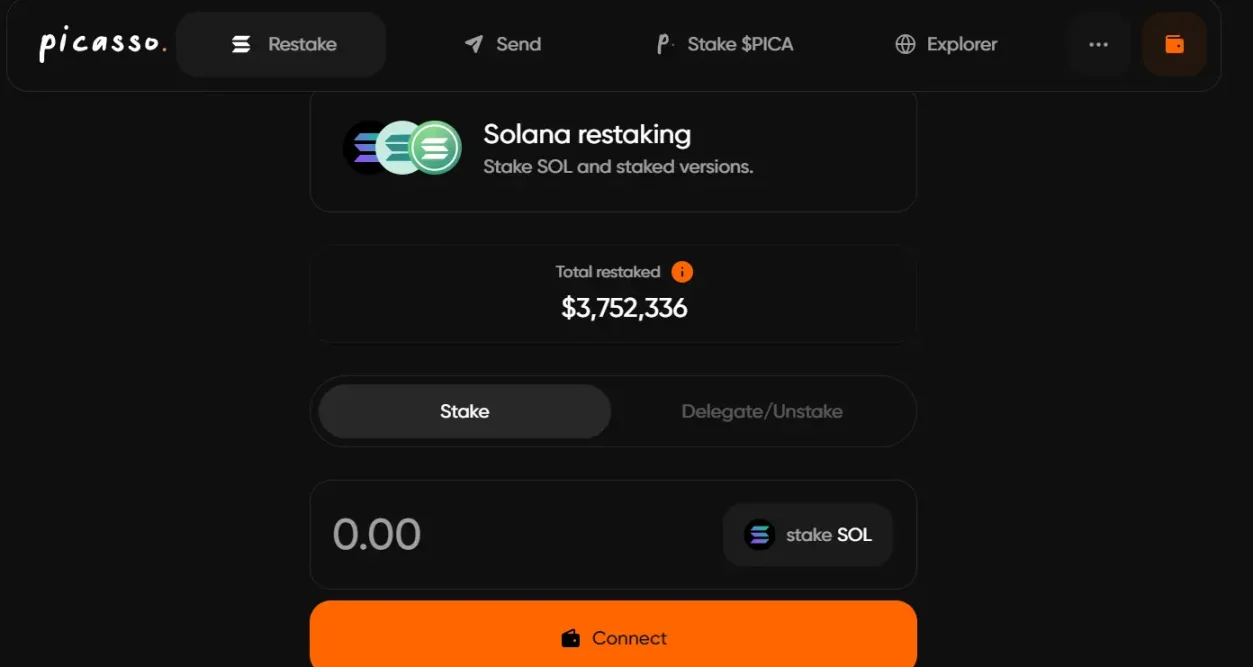
Currently, Picasso supports restaking of SOL and LSTs such as JitoSOL, mSOL, and bSOL. However, total locked restaking assets on the platform amount to only $3.75 million.
Join TechFlow official community to stay tuned
Telegram:https://t.me/TechFlowDaily
X (Twitter):https://x.com/TechFlowPost
X (Twitter) EN:https://x.com/BlockFlow_News
 ChainCatcher 链捕手