OKX Ventures Investment Bimonthly Report for May-June 2024: Steady Improvement Across Multiple Sectors, Maintaining Optimism About Market Prospects
TechFlow Selected TechFlow Selected
OKX Ventures Investment Bimonthly Report for May-June 2024: Steady Improvement Across Multiple Sectors, Maintaining Optimism About Market Prospects
The crypto industry continues to grow amid ups and downs.
 Navigating Web3 tides with focused insights
Author: OKX Ventures
The U.S. economy continues to show resilience, yet its high-interest-rate environment is still exerting pressure on economic activity. Meanwhile, many countries and regions are showing signs of stagnation or mild recession. Although inflation is cooling in line with the Federal Reserve’s expectations, ongoing macroeconomic uncertainty has further intensified volatility in the cryptocurrency market.
However, factors such as the approval of Ethereum spot ETFs, on-chain data trends, native application innovations across major public blockchains, and ecosystem advancements within TON continue to provide sustained growth momentum for the industry. OKX Ventures remains optimistic about the market outlook.
Sustained Progress Across Multiple Sectors
According to observations and research by OKX Ventures, multiple sectors within the crypto industry are currently demonstrating a "stable and improving" development trend.
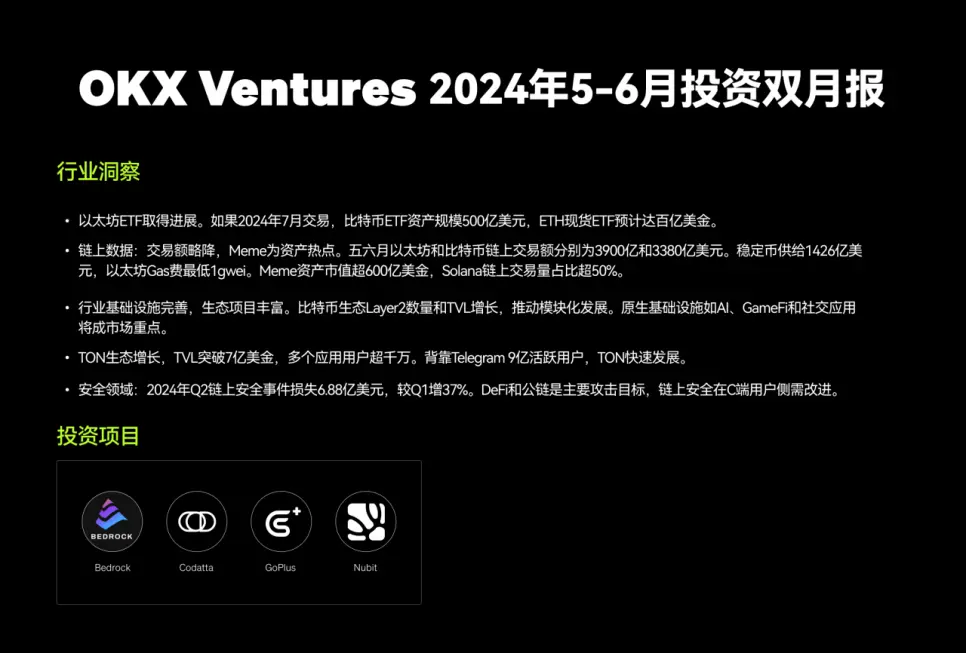
On the policy front, the industry has finally seen significant progress with Ethereum ETFs. The U.S. Securities and Exchange Commission (SEC) approved all 19b-4 filings on May 23. If spot Ethereum ETFs begin trading in July 2024, given that Bitcoin ETFs have already reached $50 billion in assets under management (AUM), ETH spot ETFs could reach a scale of tens of billions of dollars based on market capitalization comparisons.
From an on-chain data perspective, activity remains stable with slight declines, while Meme assets have become a key focus. On Ethereum and Bitcoin, on-chain transaction volumes were $390 billion and $338 billion respectively in May and June, continuing a downward trend from March and April. Stablecoin supply increased to $142.6 billion. Ethereum burned 26.7k and 26.3k ETH in May and June respectively, with gas fees dropping as low as 1 gwei. Meme assets maintained high热度 during this period, with total market cap exceeding $60 billion—particularly on Solana, where Meme trading accounted for over 50% of total volume. On-chain data suggests the industry has likely bottomed out, and we remain optimistic about on-chain innovation in the second half of the year.
Infrastructure continues to improve, and the ecosystem is becoming richer. The number of Bitcoin Layer 2 solutions and their total value locked (TVL) have grown, driving modular development in the Bitcoin ecosystem—for example, Nubit’s data availability (DA) inherits Bitcoin’s security, while Solv focuses on liquidity yield aggregation. OKX Ventures believes robust native infrastructure will be a key market focus in the coming period, including AI, GameFi, social applications, and more.
The TON ecosystem continues to grow rapidly, with explosive application and data growth. Backed by Telegram’s 900 million active users, TON has quickly expanded its TVL beyond $700 million and hosts several applications with over 10 million users. This presents a promising new gateway toward mass adoption, and OKX Ventures will continue supporting innovative TON-based projects.
Security remains a long-term concern. In Q2 2024, on-chain security incidents resulted in losses totaling $688 million—an increase of 37% compared to Q1. DeFi and public chains are the primary targets of attacks. Much work remains to strengthen user-side security, and security tools like GoPlus still have a long path ahead.
Latest Investment Updates from OKX Ventures
As a long-term value investor in the industry, OKX Ventures continues to identify and invest in innovative projects across multiple sectors, providing support through funding, technical expertise, and ecosystem integration.
Bedrock
According to its official website, Bedrock is the first protocol supporting multi-asset liquidity restaking. In collaboration with RockX—a long-time builder of blockchain infrastructure—Bedrock offers a non-custodial solution to ensure asset security. It supports staking and restaking of various assets such as uniBTC, uniETH, and uniIOTX, partnering with blockchains like Babylon, EigenLayer, and IoTeX to enhance the security and yield of staked assets.
Specifically, uniBTC is a restaking protocol powered by the Babylon chain that accepts wrapped BTC tokens (e.g., wBTC), enabling BTC holders to earn staking rewards while benefiting from Ethereum’s network security. uniETH is a Liquid Restaking Token (LRT) designed for native restaking to capture additional rewards from EigenLayer, combining institutional-grade security with enhanced yields. uniIOTX provides a liquid staking solution on the IoTeX blockchain, addressing limitations of existing delegated proof-of-stake (DPoS) systems. Bedrock aims to unlock the liquidity and value of PoS tokens through its universal ("uni") standard, offering secure liquid staking tokens and improved yield opportunities.
In terms of technological innovation and security, Bedrock employs end-to-end integration between smart contracts and node management, implementing an oracle-free architecture to avoid centralization and associated risks. Its non-custodial smart contracts ensure the highest level of asset protection, allowing users to stake and withdraw at any time without fund restrictions.
Regarding multi-asset support and yield strategies, Bedrock delivers high staking returns via iniTokens such as uniETH and uniBTC, along with potential airdrop incentives. For instance, uniETH holders can expect ETH staking rewards, EIGEN rewards, AVS airdrops, and $ARB tokens, while uniBTC holders may receive BTC staking rewards via Babylon and additional Layer 2 BTC incentives.
In cross-chain deployment and compatibility, Bedrock’s uni-series assets have been deployed across multiple ecosystems including Arbitrum, Linea, Scroll, zklink, and Manta, significantly expanding its interoperability and market reach. This provides users with greater flexibility to stake and restake across multiple blockchain platforms.
Codatta
According to its official website, Codatta is the first decentralized data protocol building infrastructure for developers, protocols, and artificial intelligence, distinguished by its scientific methodology for generating data confidence scores. By annotating metadata for blockchain addresses, Codatta enhances transparency and integrity across the crypto ecosystem. Leveraging advanced AI technologies and economic incentive mechanisms, Codatta integrates community participation to ensure data accuracy and reliability, providing a solid foundation for developers and applications.
With flexible scalability, Codatta integrates and manages data from diverse sources, ensuring high quality and trustworthiness through collaborative and automated mechanisms. Its infrastructure is highly adaptable, capable of supporting new data categories as needed.
On data reliability and security, Codatta uses a decentralized approach to annotate metadata, relying on community contributions to validate and confirm labels. It combines AI, algorithms, and economic models to ensure high data confidence and precision, while leveraging blockchain technology to guarantee immutability and data integrity, enhancing overall platform security.
Regarding accessibility and privacy, Codatta is a permissionless platform allowing free access for developers, individuals, and protocols. At the same time, it imposes minimum access requirements for certain sensitive datasets to prevent misuse, protecting user information and unauthorized access.
GoPlus
According to its official website, GoPlus is an open, permissionless, and user-driven modular Web3 user security layer. Designed to seamlessly integrate with any blockchain platform, it greatly enhances user security by providing comprehensive protection throughout every stage of the transaction lifecycle. By leveraging a decentralized user security network and cutting-edge AI-powered security solutions, GoPlus conducts thorough risk analysis and delivers intelligent, efficient security services. Its goal is to fill the gap in user security within existing blockchain architectures, creating a safer and more user-friendly Web3 interaction environment.
On comprehensive security lifecycle protection, GoPlus offers end-to-end safeguards—from transaction initiation to final settlement—securing every user interaction and transaction within the blockchain environment.
As a multi-chain security hub, GoPlus addresses the fragmentation of current security services by creating a unified security center for cross-chain security policy management, enabling users to monitor and manage security across multiple blockchains from a single platform. It currently serves over 11 million interacting wallets, has more than 60,000 paying users, and achieves a daily active user count of up to 2 million.
Through its seamless on-chain firewall, GoPlus introduces an innovative firewall directly integrated into the blockchain, capable of real-time blocking of risky transactions to ensure uninterrupted transaction safety.
On decentralization, GoPlus’s security services are fully decentralized, aligning with core Web3 values by ensuring openness, permissionless access, and user-driven governance.
Nubit
According to its official website, Nubit is a secure and scalable Bitcoin data availability (DA) layer designed to expand Bitcoin’s data capacity, supporting applications such as ordinals, Layer 2 solutions, and price oracles, thereby broadening the scope and efficiency of the Bitcoin ecosystem. Nubit aims to address bottlenecks caused by data throughput limitations in Bitcoin. Its four core components include validating nodes, full storage nodes, light clients, and a consensus mechanism among nodes. Nubit implements a secure and efficient data verification and storage system, enabling participants to verify data authenticity and availability without downloading the entire dataset.
On inheriting Bitcoin’s security, Nubit derives its security directly from Bitcoin, reinforced through Bitcoin’s own economic commitment mechanisms to ensure resistance against tampering and censorship.
Using Data Availability Sampling (DAS), Nubit ensures data integrity and availability. This technique allows nodes to verify data existence through random sampling of data blocks, eliminating the need to download entire datasets.
On performance efficiency, by combining KZG commitments with Reed-Solomon error correction coding, Nubit significantly accelerates data retrieval speeds—up to 100 times faster than traditional Merkle proofs, especially in complex or large-data scenarios.
On testnet and community engagement, Nubit has launched its Alpha testnet and actively encourages community members to participate in testing various features, accelerating technical refinement and optimization.
Optimized specifically for Bitcoin’s native environment and scalability, the Nubit DA chain—built on the Cosmos SDK—is tailored for the Bitcoin ecosystem. It supports native Bitcoin staking, enhances economic security, and holds potential for broader application across Bitcoin-based services.
Outlook Remains Positive
Driven collectively by technological innovation, increasing institutional investment, macroeconomic influences, growing user adoption, and improving regulatory clarity, the crypto industry continues to move forward positively. An increasing number of enterprises and institutions are now adopting blockchain technology to develop decentralized applications (DApps), smart contracts, and decentralized finance (DeFi) solutions. These technologies not only improve efficiency and transparency but also enable new business models and opportunities. For example, Ethereum’s upgrade roadmap—including the “Dencun” upgrade—has significantly reduced data costs and enhanced network performance, attracting more developers and users.
Notably, blockchain’s decentralized, secure, and transparent nature makes it a powerful tool for addressing challenges in traditional financial systems—such as trust deficits, high transaction fees, and slow processing times. Moreover, it promotes financial inclusion by enabling easier access to financial services globally, particularly for populations excluded from traditional banking systems, thus driving innovation and reform in socioeconomic systems.
Overall, the continued expansion of the crypto industry stems from both technological innovation and financial inclusion, as well as driven by investment opportunities and the transformative potential of decentralization. As technology and markets mature, the crypto sector is poised to play an increasingly significant role in shaping the evolution of the global economy and financial systems. Having weathered multiple market cycles, OKX Ventures remains firmly committed to supporting, investing in, and nurturing innovation, with strong conviction in the vast future potential of the crypto market.
“We remain optimistic about the outlook for the crypto market.”
Join TechFlow official community to stay tuned
Telegram:https://t.me/TechFlowDaily
X (Twitter):https://x.com/TechFlowPost
X (Twitter) EN:https://x.com/BlockFlow_News
 OKX Ventures