
Galaxy Research: Estimated $1 billion in monthly net inflows for Ethereum ETFs, one-third of Bitcoin ETFs
TechFlow Selected TechFlow Selected
Galaxy Research: Estimated $1 billion in monthly net inflows for Ethereum ETFs, one-third of Bitcoin ETFs
The net inflows of ETH ETFs are expected to reach 20-50% of BTC ETF net inflows within the first five months, with a target of 30%, implying $1 billion in monthly net inflows.
 Navigating Web3 tides with focused insights
Author: Charles Yu
Translation: TechFlow

Key Takeaways
-
Bitcoin ETFs achieved a net inflow of $15.1 billion between January 11, 2024 and June 15, 2024.
-
Nine issuers are competing to launch 10 spot Ethereum ETFs in the United States.
-
After the approval of all 19b-4 filings on May 23, the SEC is expected to allow these products to begin trading in July 2024.
-
Similar to Bitcoin ETFs, we believe the primary new accessible market consists of independent investment advisors or those affiliated with banks or broker-dealers.
-
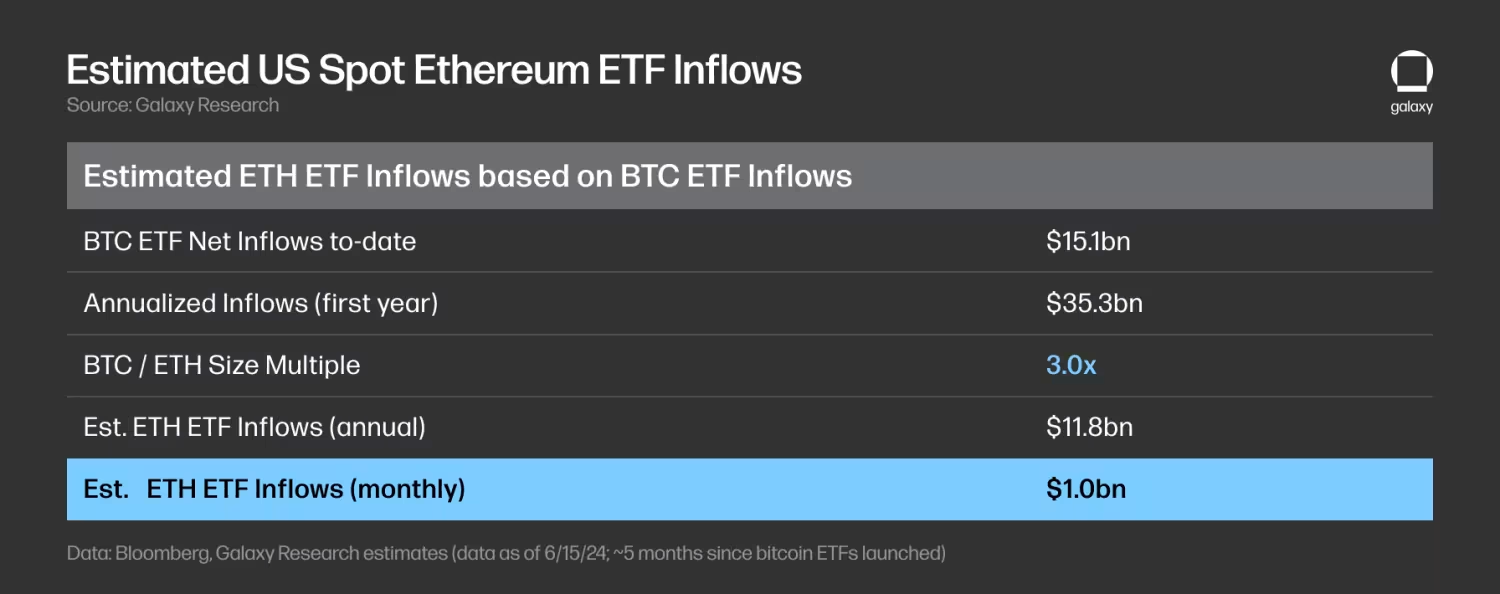
We estimate that ETH ETF net inflows will reach 20–50% of BTC ETF net inflows over the first five months, targeting 30%, implying $1 billion in monthly net inflows.
-
Overall, due to a large portion of ETH’s total supply being locked in staking, bridges, and smart contracts—and relatively low availability on centralized exchanges—we believe ETHUSD is more sensitive to ETF inflows than BTC.
Introduction
For months, observers and analysts have underestimated the likelihood that the Securities and Exchange Commission (SEC) would approve spot-based Ethereum exchange-traded products (ETPs). Pessimism stemmed from the SEC's hesitation to clearly state that Ethereum is a commodity, reports of no engagement with potential issuers, and news of investigations and pending enforcement actions related to the Ethereum ecosystem. Bloomberg analysts Eric Balchunas and James Seyffart assigned only a 25% chance of approval in May—just before initial final approval/denial deadlines for some prospective issuers. However, on Monday, May 20, Bloomberg analysts suddenly raised the odds to 75% after reporting that the SEC had contacted exchanges. In fact, all spot Ethereum ETP applications were approved by the SEC later that week. While we are still awaiting the actual launch of these products following S-1 effectiveness—expected sometime during summer 2024—this report draws lessons from the performance of spot Bitcoin ETPs to forecast demand post-launch for Ethereum ETPs. We estimate that spot Ethereum ETPs will see approximately $5 billion in net inflows within the first five months of trading (about 30% of spot Bitcoin ETP inflows).
Background
Currently, nine issuers are racing to launch exchange-traded products (ETPs) holding spot ETH. Over recent weeks, several have exited. ARK chose not to partner with 21Shares on launching an Ethereum ETP, while Valkyrie, Hashdex, and WisdomTree withdrew their applications entirely. The table below shows the current application status sorted by 19b-4 filing date:
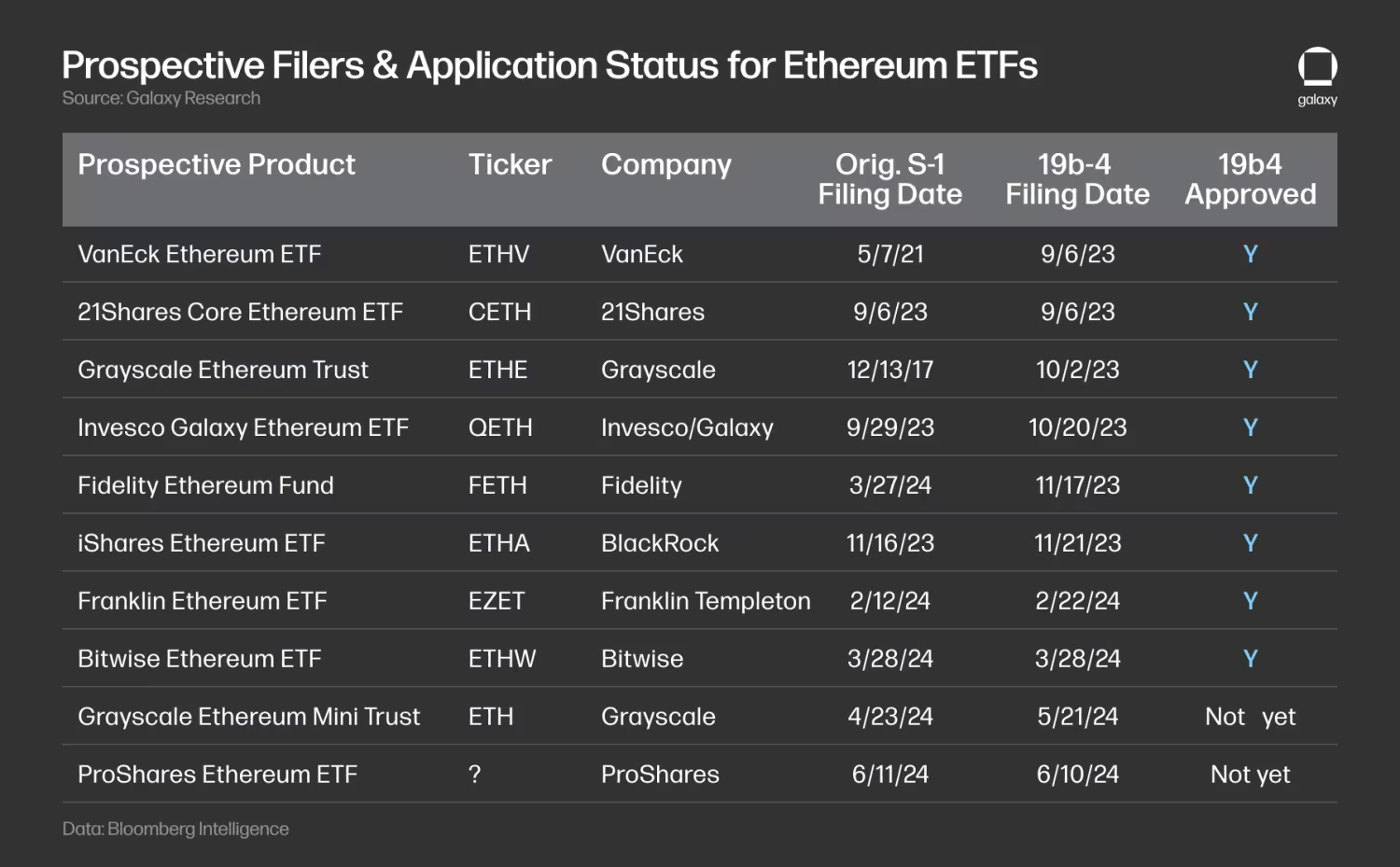
Grayscale is seeking to convert the Grayscale Ethereum Trust (ETHE) into an ETP, similar to what it did with the Grayscale Bitcoin Investment Trust (GBTC), but has also filed for a “mini” version of the product.
The SEC approved all 19b-4 filings on May 23—rule changes allowing securities exchanges to ultimately list spot ETH ETPs—but each individual issuer now needs to go through iterative communications with the regulator regarding their registration statements. These products cannot begin trading until the SEC allows their S-1 (or S-3 in the case of ETHE) to become effective. Based on our research and reporting from Bloomberg Intelligence indicating, we believe spot Ethereum ETPs could start trading as early as the week of July 11, 2024.
Lessons from Bitcoin ETFs
Bitcoin ETFs have been live for less than six months and serve as a useful benchmark for studying potential adoption of spot Ethereum ETFs.
Source: Bloomberg
Here are some observations from the first few months of spot Bitcoin ETP trading:
-
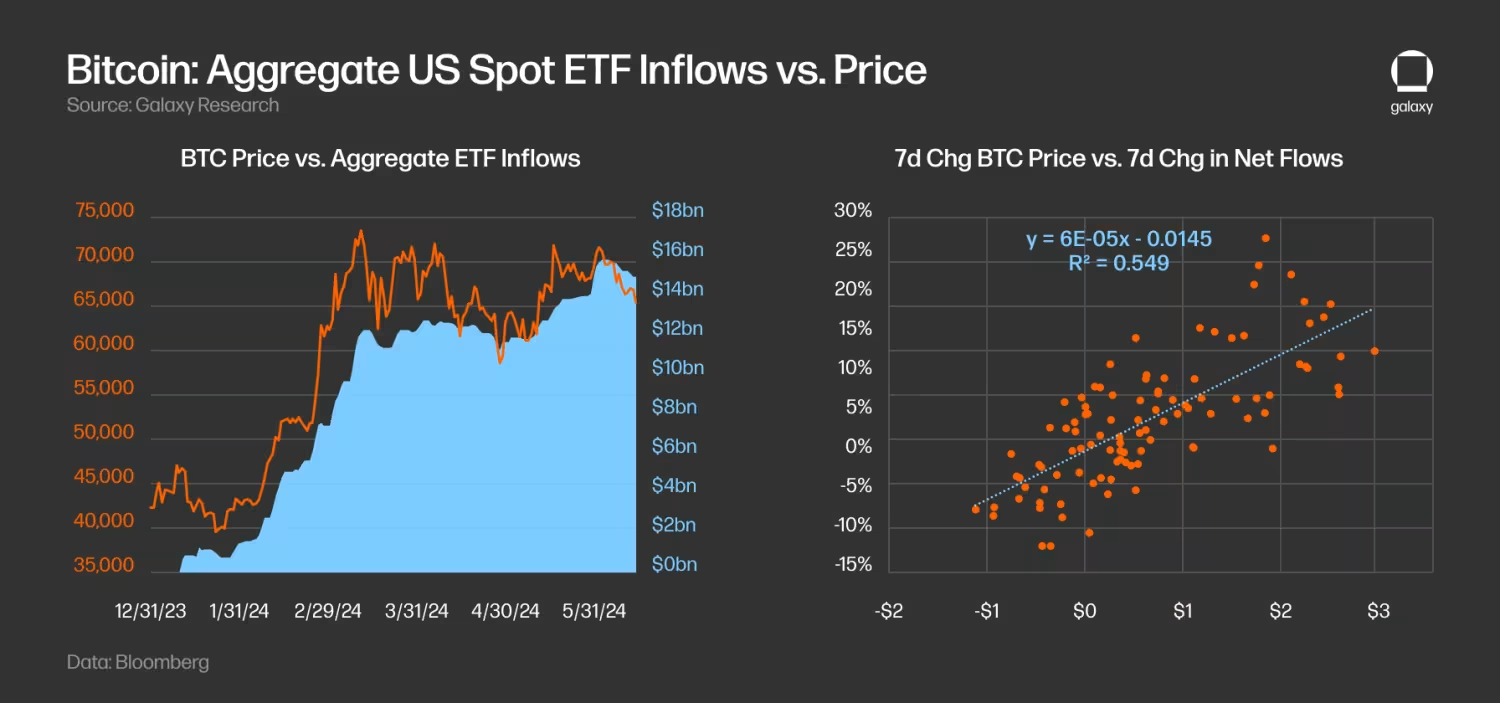
Inflows have exceeded expectations so far. As of June 15, U.S. spot Bitcoin ETFs have accumulated over $15.1 billion in net inflows since launch, averaging $136 million in daily net inflows. These ETFs hold approximately 870,000 BTC, representing 4.4% of current BTC supply. With BTC trading around $66,000, total assets under management across all U.S. spot ETFs amount to roughly $58 billion (note: prior to ETF launch, GBTC held about 619,000 BTC).
-
ETF inflows have partially driven BTC price appreciation. By regressing weekly changes in BTC price against ETF net inflows, we calculate an r-squared of 0.55, indicating a strong correlation between the two variables. Interestingly, we also find that price changes are a better leading indicator of inflows than vice versa.
-
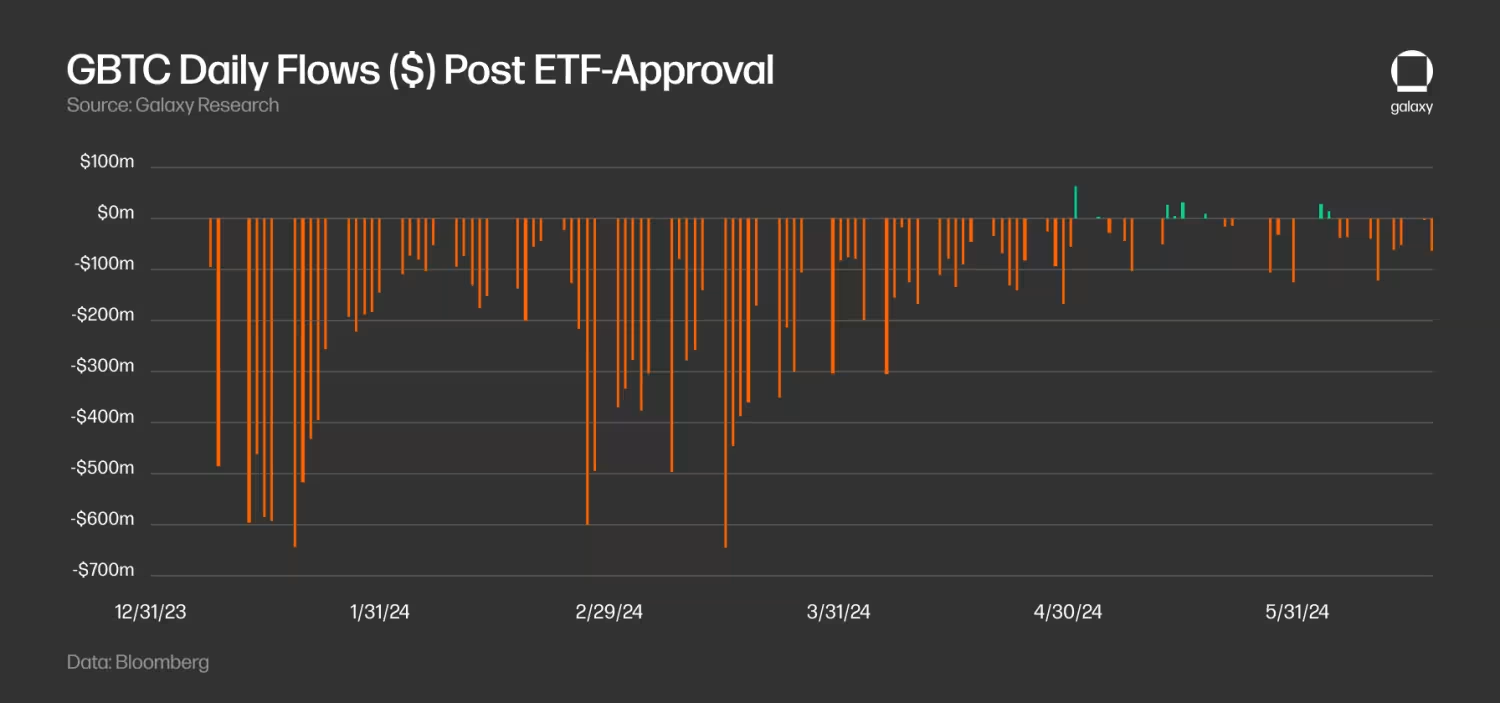
GBTC's trading unlock impacted overall ETF inflows. Following its conversion from trust to ETF, GBTC experienced significant outflows in the early months. Daily outflows peaked in mid-March, reaching $642 million on March 18. Since then, outflows have moderated, and GBTC has even seen several days of net inflows since May (first recording net inflows on May 3 after 78 consecutive days of outflows). As of June 15, GBTC’s BTC holdings declined from 619,000 BTC at launch to 278,000 BTC—a 55% reduction.
-
ETF demand has been primarily retail-driven; institutional demand is growing. 13F filings show that as of March 31, over 900 U.S. investment firms held Bitcoin ETFs, with holdings totaling about $11 billion—approximately 20% of total Bitcoin ETF holdings—indicating most demand comes from retail investors. Institutional buyers include prominent banks (e.g., JP Morgan, Morgan Stanley, Wells Fargo), hedge funds (e.g., Millennium, Point72, Citadel), and even pension funds (e.g., Wisconsin Investment Board).
-
Wealth management platforms have not yet begun offering access to Bitcoin ETFs. The largest wealth platforms have not allowed their brokers to recommend Bitcoin ETFs, although reports suggest Morgan Stanley is exploring such a move. As outlined in our report "Sizing the Market for a Bitcoin ETF," access via wealth platforms—including broker-dealers, banks, and independent registered investment advisors—is expected to unfold over multiple years. So far, there has been minimal sales-driven inflow from institutional platform access, but in our view, this will become an important catalyst for Bitcoin adoption in the medium term.
Estimating Potential ETH ETF Inflows
Using Bitcoin ETPs as a reference point, we can estimate potential demand for a comparable Ethereum product.
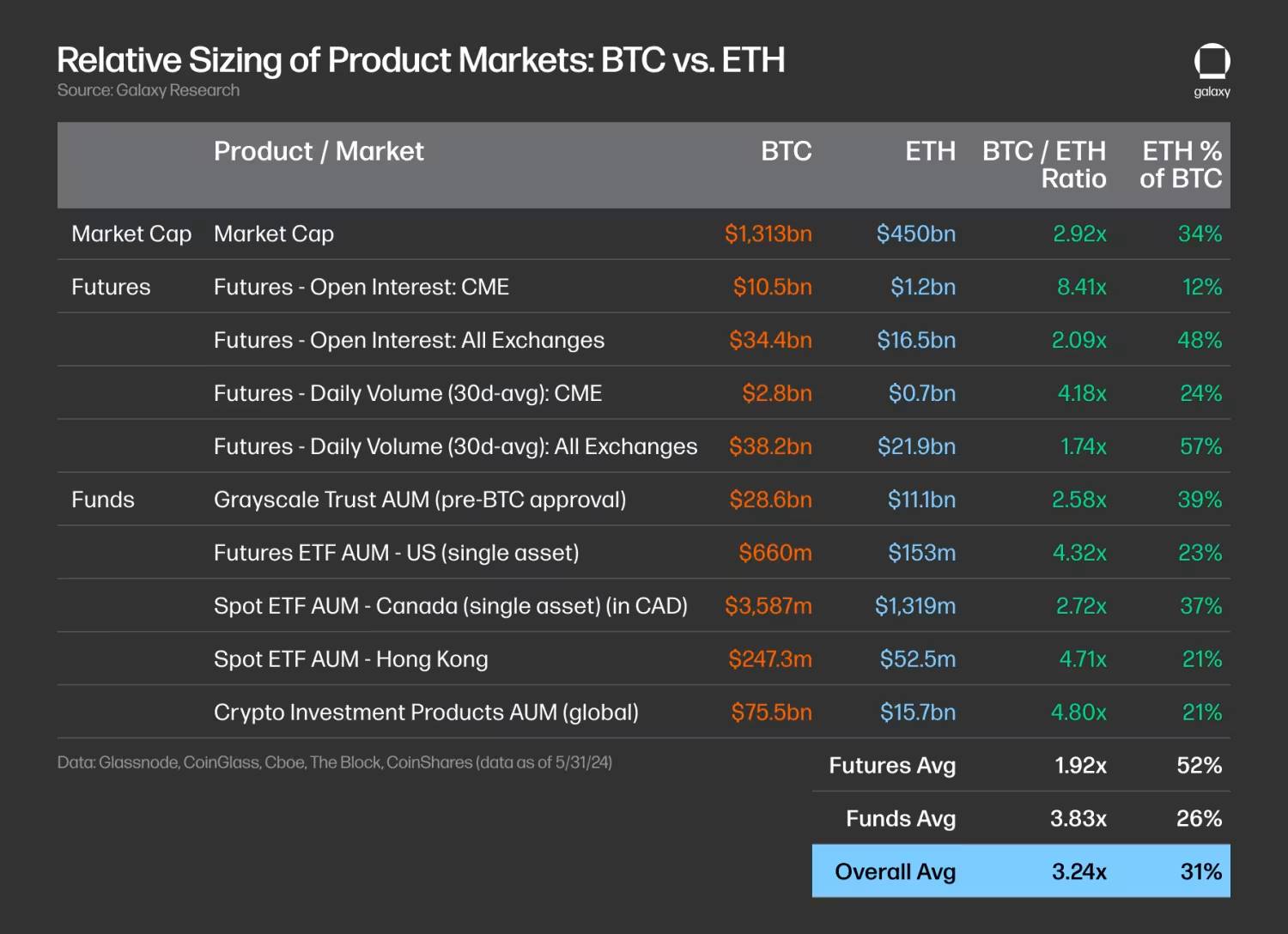
To estimate potential ETH ETF inflows, we apply BTC/ETH multiples to U.S. spot Bitcoin ETF inflows based on the relative asset size of BTC and ETH across several markets. As of May 31:
-
BTC’s market cap is 2.9 times that of ETH.
-
Across all exchanges, BTC’s futures market is about twice the size of ETH’s based on open interest and volume. Specifically, at CME, BTC’s open interest is 8.4 times higher than ETH’s, and daily trading volume is 4.2 times greater.
-
Total assets under management across various existing funds (including Grayscale trusts and products like futures and spot, segmented across selected global markets) show BTC funds ranging from 2.6x to 5.3x larger than ETH funds.
Based on the above data, we believe inflows into spot Ethereum ETFs will be roughly three times smaller than those into U.S. spot Bitcoin ETFs (consistent with the market cap multiple), within a range of 2x to 5x smaller. In other words, we expect spot Ethereum ETF inflows to be about 33% of U.S. spot Bitcoin ETF inflows, with a range of 20% to 50%.
Applying this multiple to the $15.1 billion in Bitcoin ETF inflows as of June 15 implies approximately $1 billion per month in net inflows into Ethereum ETFs during the first five months following approval and launch (estimated range: $600 million to $1.5 billion per month).
Some estimates we’ve seen are lower than ours, due to several factors. That said, our prior estimate of $14 billion in first-year Bitcoin ETF inflows was based on wealth platform access, yet Bitcoin ETFs saw substantial inflows even before those platforms came online. Therefore, we advise caution when forecasting insufficient demand for Ethereum ETFs.
Several structural and market differences between BTC and ETH will affect ETF inflows:
Demand for spot Ethereum ETFs may be limited due to lack of staking rewards. Non-staked ETH forfeits the following opportunity costs:
(i) Inflation rewards paid to validators (which also carry negative dilution effects),
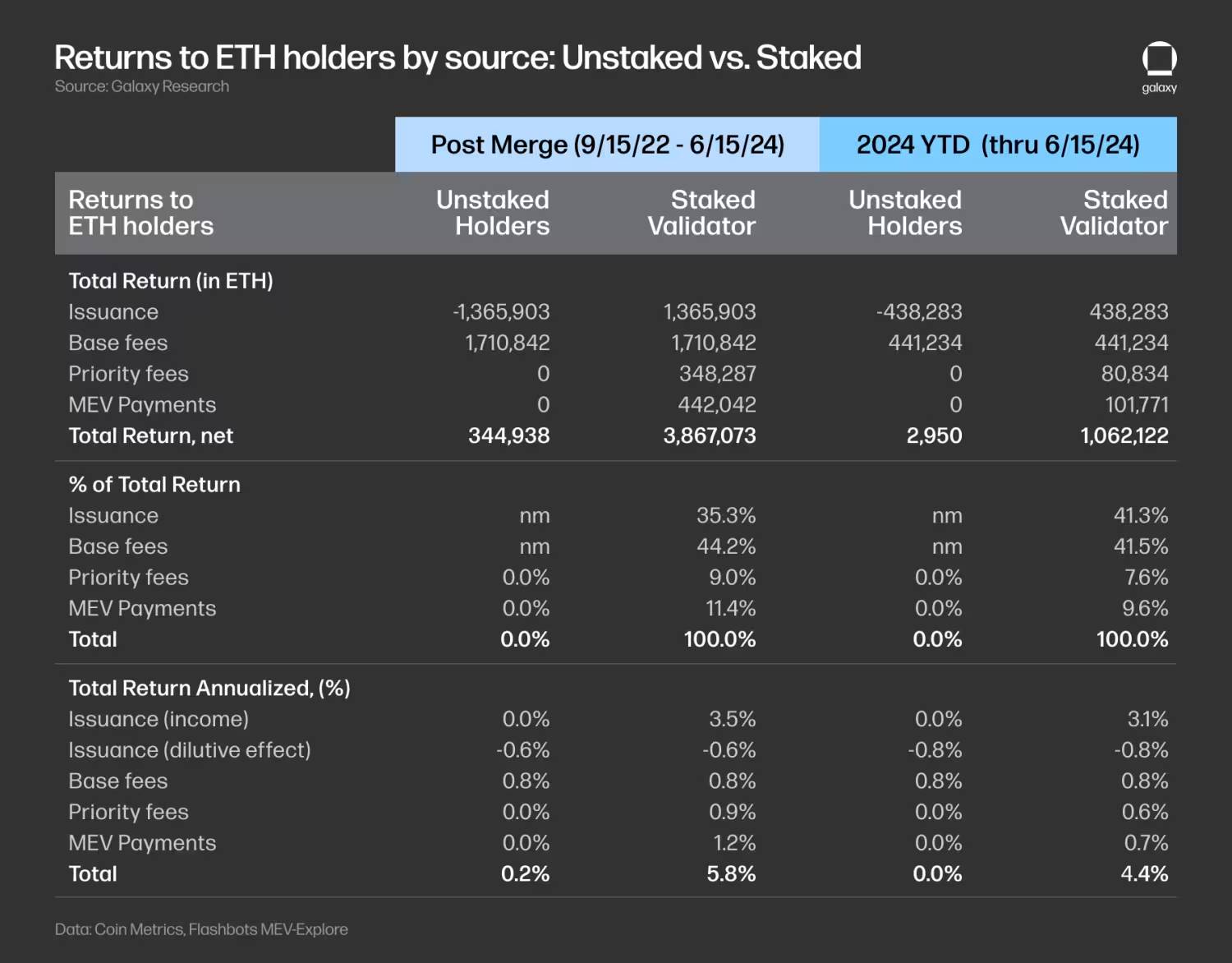
(ii) Priority fees paid to validators, and MEV revenue paid to validators via relays. Using post-merge data (>September 15, 2022) up to June 15, 2024, we estimate the annualized opportunity cost of forgoing staking rewards at 5.6 percentage points for spot ETH holders (or 4.4 percentage points using year-to-date data)—a non-trivial difference. This makes spot Ethereum ETFs less attractive to potential buyers. Note: ETPs offered outside the U.S. (e.g., in Canada) provide additional yield to holders through staking.
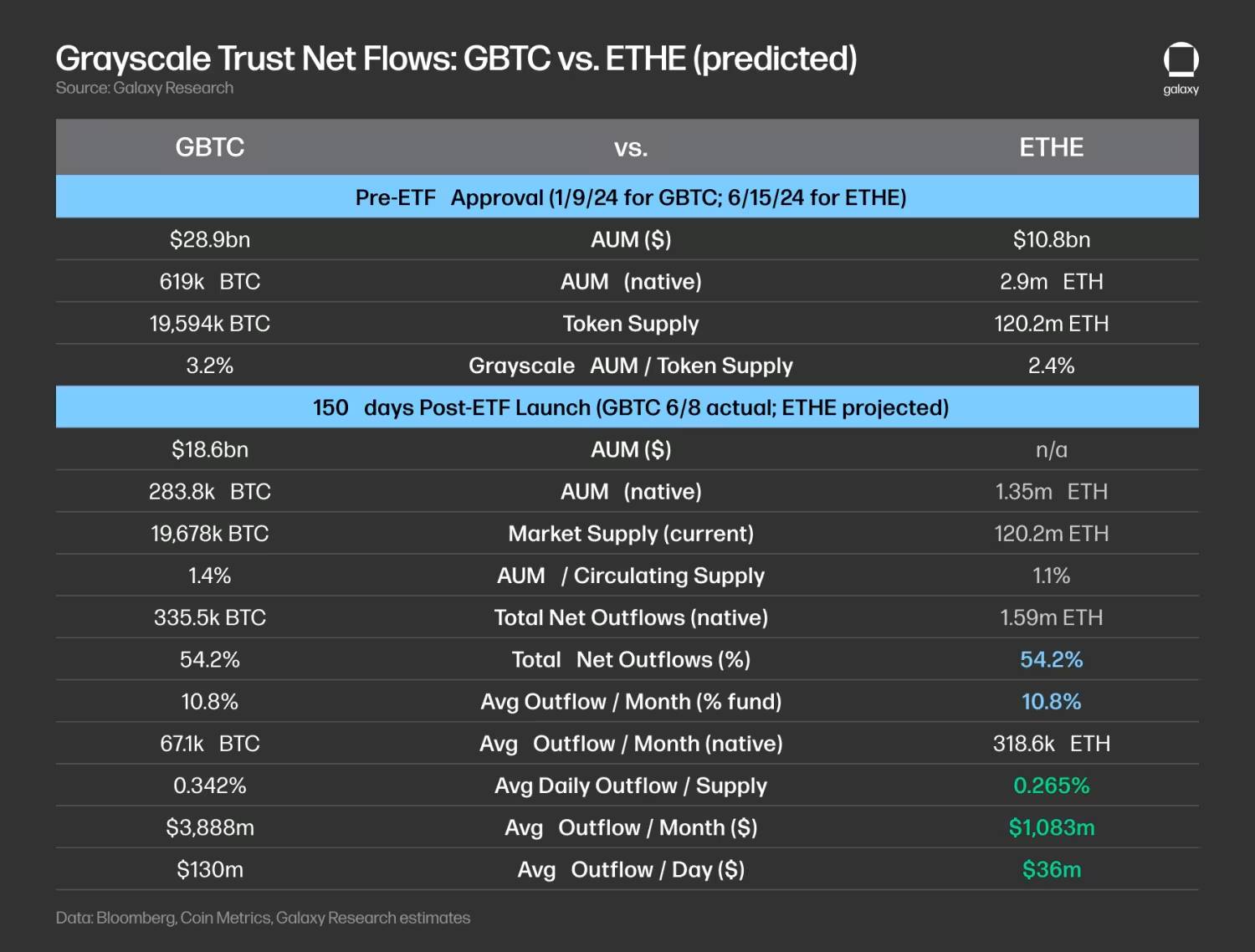
Grayscale’s ETHE could weigh on Ethereum ETF inflows. Just as the GBTC Grayscale Trust experienced significant outflows upon conversion to an ETF, ETHE Grayscale Trust converting to an ETF will similarly lead to outflows. Assuming ETHE’s outflow pace matches GBTC’s over the first 150 days (i.e., 54.2% of trust supply withdrawn), we estimate monthly outflows of approximately 319,000 ETH—worth about $1.1 billion at current prices (~$3,400), or an average daily outflow of $36 million. Note that these trusts hold 3.2% of BTC supply and 2.4% of ETH supply, suggesting the drag from ETHE’s ETF conversion on ETH price is relatively smaller than GBTC’s conversion. Additionally, unlike GBTC, ETHE does not face forced sellers due to bankruptcies (e.g., 3AC or Genesis), further supporting the view that selling pressure from Grayscale’s ETH-related trust should be relatively muted.
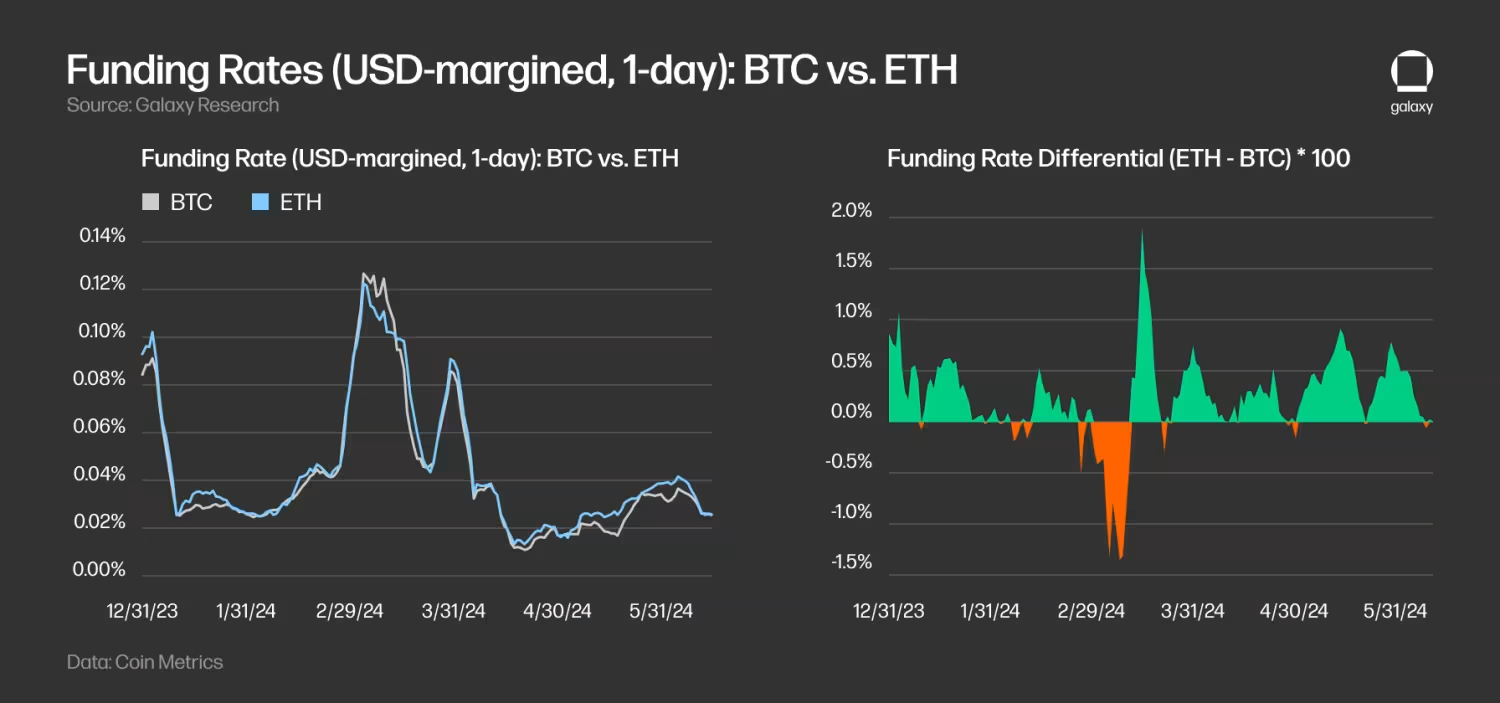
Basis trading likely drove hedge fund demand for Bitcoin ETFs. Hedge funds looking to arbitrage the spread between Bitcoin spot and futures prices were likely key drivers behind ETF adoption. As previously noted, 13F filings show that as of March 31, 2024, over 900 U.S. investment firms held Bitcoin ETFs, including well-known hedge funds such as Millennium and Schonfeld. Throughout 2024, ETH funding rates across exchanges have averaged higher than BTC’s, suggesting: (i) relatively stronger demand for long ETH positions; (ii) spot Ethereum ETFs could attract even greater hedge fund demand from those seeking basis trade opportunities.
Factors Affecting ETH vs. BTC Price Sensitivity
Since we estimate Ethereum ETF inflows to be roughly proportional to BTC ETF inflows in terms of market cap, ceteris paribus, we would expect a similar impact on price. However, there are key differences in supply and demand dynamics between the two assets that could make ETH more sensitive to ETF flows:
-
Exchange Supply: Currently, the proportion of BTC supply held on exchanges is higher than that of ETH (11.7% vs. 10.3%), suggesting ETH supply may be tighter. Assuming inflows scale proportionally with market cap, ETH prices would be more sensitive (note: this metric heavily depends on exchange address attribution, which varies significantly among data providers).
-
Inflation vs. Burning: Following the latest halving on April 20, 2024, Bitcoin’s annual inflation rate is about 0.8%. Post-merge (>September 15, 2022), Ethereum’s net issuance has been negative (annual issuance -0.19%), as newly issued ETH to stakers (+0.63%) is more than offset by burned base fees (-0.83%). However, over the past month, ETH base fees have been relatively low (annualized -0.34%), failing to offset new issuance (annualized +0.76%), resulting in a net positive inflation rate of +0.42%.
-
Supply Held in ETFs: To date, net BTC inflows into U.S. spot ETFs (excluding GBTC’s starting balance) total 251k BTC, representing 1.3% of current supply. If sustained annually, ETFs would absorb 583k BTC—or 3.0% of current BTC supply—far exceeding miner reward dilution (0.81% inflation).
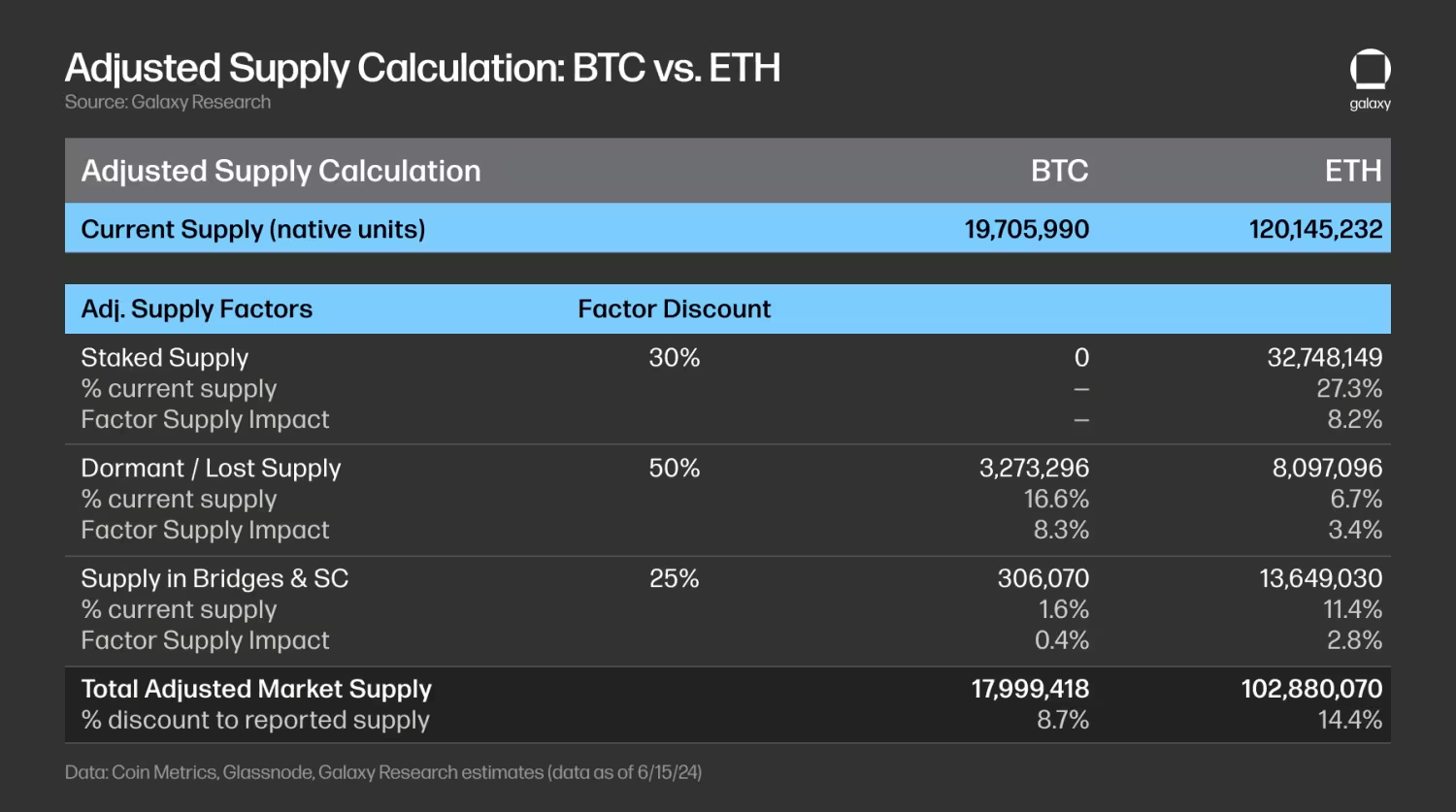
However, actual market liquidity available for ETF purchases is far lower than reported circulating supply. We believe a better reflection of available market supply for each asset within ETFs requires adjustments for various factors such as staked supply, dormant/lost supply, and supply held in bridges and smart contracts:
-
Staked Supply (discount: 30%): Staked ETH reduces market liquidity. Currently, BTC has no staking option. Staked ETH secures network security, but stakers can withdraw portions for other uses. Currently, staked ETH accounts for about 27% of total supply. We apply a 30% discount to estimate market-available supply, resulting in an 8.2% supply discount.
-
Dormant/Lost Supply (discount: 50%): Some BTC and ETH are considered irrecoverable (e.g., lost keys), reducing available supply. We use BTC inactive for over 10 years and ETH last active more than 7 years ago, accounting for 16.6% and 6.7% of current supply respectively. We apply a 50% discount to these supplies, as they may potentially reactivate at any time.
-
Supply in Bridges and Smart Contracts (discount: 25%): This supply is locked in bridges and smart contracts for productive purposes. For Bitcoin, BitGo-custodied wrapped BTC (wBTC) amounts to about 153k BTC; we estimate a similar amount locked in other bridges, totaling ~1.6% of supply. ETH locked in smart contracts represents about 11.4% of current supply. We apply a 25% discount, as we consider this supply more liquid than staked supply (i.e., less subject to locking requirements and withdrawal queues).
After applying these discounted weights to calculate adjusted BTC and ETH supply, we estimate available supply for BTC and ETH is 8.7% and 14.4% lower than reported circulating supply, respectively.
Overall, ETH should exhibit higher price sensitivity relative to BTC due to: (i) lower available market supply based on adjusted supply factors, (ii) lower proportion of supply on exchanges, and (iii) lower net issuance. Each of these factors should have a multiplicative effect (rather than additive) on price sensitivity, as prices tend to be more reactive to changes in market supply and liquidity.
Looking Ahead
Looking ahead, we have several questions regarding adoption and secondary effects:
-
How should product managers and allocators view BTC and ETH? Will existing holders shift from Bitcoin ETFs to ETH? Should allocators expect rebalancing? Will spot Ethereum ETFs attract new marginal buyers who haven’t purchased BTC? What will be the mix of investors holding BTC-only, ETH-only, or both?
-
When (if ever) will staking be added? Will the lack of staking rewards affect spot Ethereum ETF adoption? Could investment demand for DeFi, tokenization, NFTs, and other crypto-native applications drive greater adoption of Ethereum ETFs compared to Bitcoin, especially given the lack of alternative investment products?
-
What are the potential implications for other altcoins? After Ethereum, are we more likely to see ETF approvals for other altcoins?
Overall, we believe the potential launch of spot Ethereum ETFs should positively impact market adoption for Ethereum and the broader crypto market for two main reasons: (i) expanded accessibility within the wealth segment, and (ii) greater legitimacy through formal recognition by regulators and trusted financial services brands. ETFs can provide broader coverage for retail and institutional investors, enable wider distribution through additional investment channels, and support more diverse investment strategies involving Ethereum in portfolios. Moreover, greater understanding of Ethereum by financial professionals could ideally accelerate investment in and adoption of the technology.
Join TechFlow official community to stay tuned
Telegram:https://t.me/TechFlowDaily
X (Twitter):https://x.com/TechFlowPost
X (Twitter) EN:https://x.com/BlockFlow_News
 @galaxyhq