









Rumors of mass token delistings in South Korea continue to circulate—what impact will the upcoming Virtual Asset User Protection Act have?
TechFlow Selected TechFlow Selected
Rumors of mass token delistings in South Korea continue to circulate—what impact will the upcoming Virtual Asset User Protection Act have?
Recently, South Korea's virtual asset regulators have frequently announced new regulatory developments, with some instances of sudden reversals in the reported information.
 Navigating Web3 tides with focused insights
By Weilin, PANews
Recently, South Korea's virtual asset regulators have frequently announced new regulatory developments, at one point leading to a reversal in market sentiment. Initially, online rumors claimed that regulators had "notified nearly 30 registered exchanges to review over 600 cryptocurrencies listed on their platforms," with reports suggesting "16 tokens would be delisted." This triggered widespread panic of mass delistings across the market, causing sharp price declines for affected tokens.
On June 18, the Financial Services Commission (FSC) of South Korea stepped in to clarify that it would not directly participate in inspections of cryptocurrencies listed on domestic exchanges—instead, the reviews would be conducted through industry self-regulation. In fact, to align with the upcoming enforcement of the Virtual Asset User Protection Act on July 19, South Korean crypto-related regulatory bodies and self-regulatory organizations are proactively taking action.
Regulators Establish Monitoring System for "Suspicious" Activities; 1,333 Virtual Assets to Be Reviewed in Six Months
The latest development came on July 4, when the Financial Supervisory Service (FSS) of South Korea stated in a press release that it is establishing a 24-hour monitoring system to track abnormal cryptocurrency trading activities. The FSS urged exchanges to input data and information into this system to ensure compliance with the Virtual Asset User Protection Act, set to take effect on July 19. Warning signs include trading volumes and prices exceeding normal ranges, unusually high transaction volumes, and abnormally slow execution speeds. The FSS noted one goal of this measure is to identify accounts linked to "suspicious" activities.
This announcement is part of a series of recent regulatory moves in South Korea. In mid-June, lists circulated widely across South Korean crypto communities and social media platforms titled “Tokens likely to be delisted from KRW markets in June,” involving 16 tokens. This caused approximately half of all listed tokens on KRW-denominated markets to experience steep price drops. At the same time, reports indicated that regulators had notified nearly 30 registered exchanges to conduct reviews of over 600 cryptocurrencies.
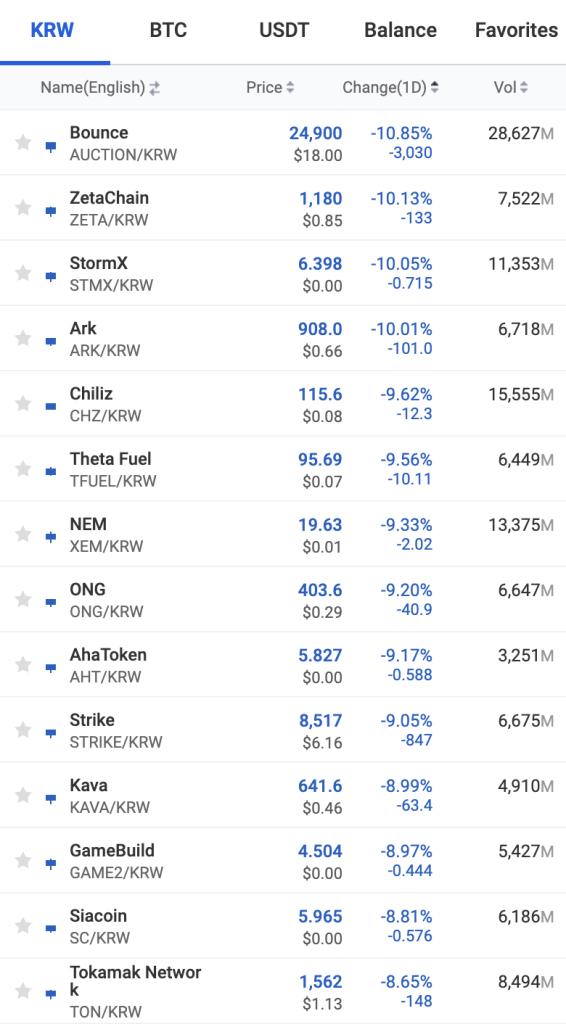
On June 18, rumors spread on South Korean social media that regulators instructed exchanges to "review over 600 cryptocurrencies," triggering a sharp decline in prices of newly listed tokens on Upbit, South Korea’s largest crypto exchange by trading volume.
However, on June 18, the Financial Services Commission (FSC) clarified that it would not directly participate in reviewing cryptocurrencies listed on domestic exchanges.
Shortly afterward, on July 2, DAXA—the alliance formed by South Korea’s five major cryptocurrency exchanges—announced a six-month re-evaluation plan covering 1,333 digital assets. DAXA stated that in preparation for the implementation of the Virtual Asset User Protection Act, it has developed the Self-Regulatory Guidelines for Virtual Asset Trading Support, which will officially take effect domestically alongside the Act on July 19. For more than 1,333 virtual assets, exchanges will conduct reassessments over a six-month period starting from the effective date. These self-regulatory guidelines were formulated in response to requirements from regulatory authorities such as the Financial Services Commission and the Financial Supervisory Service, incorporating expert opinions.
Under this re-evaluation initiative, 29 cryptocurrency trading platforms—including Upbit, Gopax, and Bithumb—will assess whether their listed tokens meet the requirements of the new regulations, which will also serve as benchmarks for future token listings.
Additionally, for overseas virtual assets, the alliance plans to implement a more flexible "alternative review scheme." If a virtual asset has been traded for over two years on qualified foreign virtual asset markets, certain review criteria may be relaxed. DAXA is currently identifying eligible foreign exchanges, including those recognized by the International Organization of Securities Commissions (IOSCO).
South Korea’s Virtual Asset User Protection Act to Take Effect
The Virtual Asset User Protection Act, set to take effect on July 19, aims to protect virtual asset users and establish a healthy market order. The Act defines what constitutes a virtual asset and specifies exclusions, while outlining obligations for virtual asset operators to securely store and manage user deposits and virtual assets.
Key provisions include: expanding the list of excluded virtual assets (e.g., central bank digital currencies issued by the Bank of Korea are not considered virtual assets); requiring virtual asset service providers to separate user funds from their own assets and deposit or entrust them with custodians such as banks; mandating that operators keep over 80% of user funds in cold wallets to safeguard assets and participate in insurance programs to potentially compensate users in case of security breaches. Furthermore, using undisclosed material information, manipulating market prices, and engaging in fraudulent trading—classified as unfair trading practices such as "painting the tape"—are prohibited. Violators may face liability for damages and fines. Exchanges are also barred from arbitrarily blocking user access to virtual assets and must continuously monitor for abnormal trading activity, take appropriate measures, and report suspicious cases to financial regulators.
One of the strongest protections for users is that, in cases where a virtual asset company goes bankrupt or its business registration is canceled, custodian banks will publicly announce the time and location for fund disbursement via newspapers and websites, collect user deposit data, verify it with the operator, and then directly pay out deposits to users.
Building on these foundations, the Act formally establishes the Virtual Asset Committee. On June 18, the proposal to create a new Virtual Asset Committee under the Financial Services Commission was approved by the State Council. With formal institutionalization, 12 employees have been converted to permanent positions, and a fifth-level public official specializing in AI in finance has been added. The committee will operate temporarily, overseeing market order and user protection in the virtual asset sector. It also plans to actively address unfair trading practices in virtual assets, imposing penalties and pursuing criminal charges when necessary.
In terms of legislative background, South Korea already implemented the revised Act on the Protection of Specific Financial Information in 2021, focusing on anti-money laundering and introducing an audit system for virtual asset operators. However, lawmakers believed further progress was needed in user protection, prompting active discussions led by members of parliament. In April 2023, legislators reached consensus and drafted the Virtual Asset User Protection Act, prioritizing urgent user safeguards. Since then, there has been agreement to gradually and progressively improve related legislation.
KRW Becomes World’s Most Active Crypto Trading Currency in Q1; Market Impact of New Law Viewed Differently
The importance of South Korea’s cryptocurrency market is growing rapidly. In the first quarter of 2024, the Korean won became the world’s most actively used currency for crypto asset trading, surpassing the U.S. dollar. According to data from research firm Kaiko, cumulative trading volume denominated in KRW reached $456 billion on centralized crypto exchanges during Q1 2024, compared to $445 billion in USD.
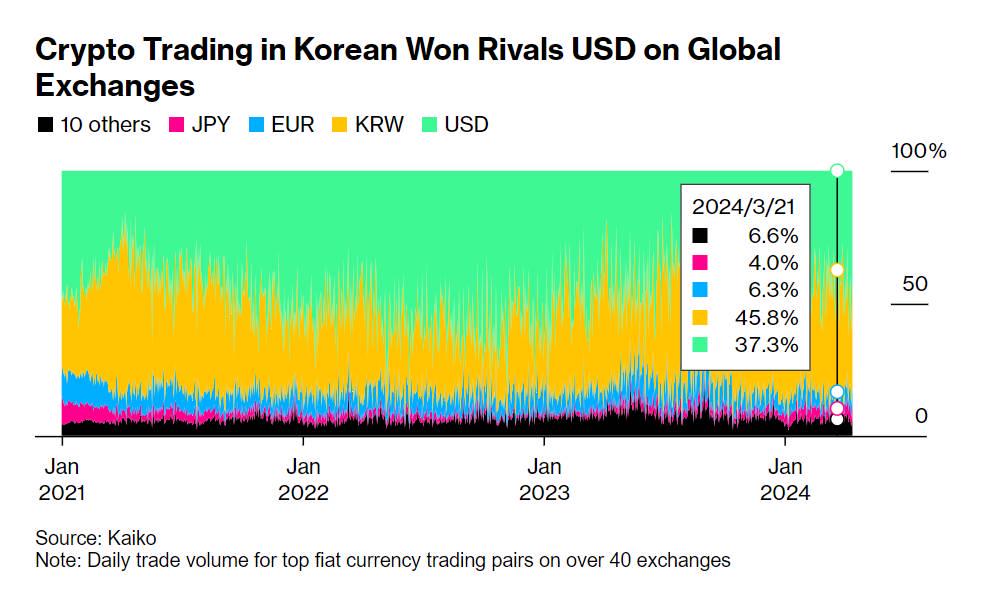
The rise in KRW-denominated trading is partly due to ongoing fee wars among Korean exchanges. Smaller platforms like Bithumb and Korbit have recently launched zero-fee trading promotions to attract traders away from Upbit, which dominates the local market with over 80% share of spot trading volume.
In South Korea, users tend to favor smaller-cap, more volatile altcoins rather than mainstream cryptos like Bitcoin and Ethereum. On average, trades involving lower-market-cap tokens account for over 80% of all activity in the country.
Meanwhile, crypto activities are attracting increasing attention from young Koreans. A recent survey shows that more young people are viewing cryptocurrencies and stocks as alternative investment options for retirement, with over half of respondents aged 20–39 expressing distrust in the national pension system. Notably, about 7% of election candidates disclosed ownership of digital assets in their financial disclosures.
Now, the new legislation marks a new phase in South Korea’s virtual asset regulation. Regarding the impact of the new law, Matt Younghoon Mok, senior attorney and partner at Lee & Ko law firm in Seoul, said the FSS guidelines could pose significant challenges for altcoins unable to quickly meet regulatory requirements.
However, DAXA, the alliance of the five major exchanges mentioned above, explained: "Major exchanges have already adopted key review criteria in advance. The re-evaluation based on the new self-regulatory standards will be carried out gradually over six months, so a large-scale, one-time delisting is unlikely."
At the same time, domestic industry insiders remain optimistic that the implementation of the Virtual Asset User Protection Act could enhance the competitiveness of South Korea’s virtual asset market. Researcher Yoon Chang-bei from Upbit’s Investor Protection Center said: "We must view the impact of regulations from a long-term perspective. We may not see increased liquidity in the short term." He added: "The core of the Virtual Asset User Protection Act is enhancing market stability. By protecting investors and strengthening market integrity, it could drive corporate expansion and innovation in the future."
Kim Myung-woon, former head of Seoul Eastern District Prosecutors’ Office, analyzed that as the scale of crypto transactions grows exponentially, various side effects and related crimes are also increasing. For example, cases such as the PICA virtual asset price manipulation worth 90 billion KRW, the operation of an unregistered offshore exchange involving 580 billion KRW, and the Haru Invest deposit fraud amounting to 1.4 trillion KRW. In handling these cases, prosecutors primarily rely on fraud provisions under the Criminal Code or violations of the revised Act on the Protection of Specific Financial Information. However, existing laws struggle to fully cover transactional relationships unique to the virtual asset space, creating gaps in enforcement. Due to this uniqueness, proving criminal suspicion related to virtual asset transactions—such as demonstrating fraudulent intent or causality between misinformation and user actions—requires significantly more investigative effort and time compared to other cases.
"Some believe the new law will lead to contraction in virtual asset trading—for instance, banning 'market making' (MM), mandating cold wallet storage (offline wallets isolated from the internet), real-time monitoring of suspicious transactions, and reporting to financial authorities. However, I believe that through the implementation of this new law, virtual asset trading will become fairer and more transparent, preventing specific groups from monopolizing profits through speculative trading—and ultimately making the virtual asset sector even more vibrant."
Join TechFlow official community to stay tuned
Telegram:https://t.me/TechFlowDaily
X (Twitter):https://x.com/TechFlowPost
X (Twitter) EN:https://x.com/BlockFlow_News
 PANews









