









Uncovering the Truth Behind the Market Crash: German Government Continues Selling, Mt. Gox Adds Fuel to the Panic
TechFlow Selected TechFlow Selected
Uncovering the Truth Behind the Market Crash: German Government Continues Selling, Mt. Gox Adds Fuel to the Panic
Mentougou has begun small-scale transfer testing today; the German government has sold nearly 10,000 BTC over the past half month.
 Navigating Web3 tides with focused insights
By 1912212.eth, Foresight News
After hovering above the 60,000 psychological level for several days, Bitcoin finally chose to accelerate downward today, breaking through multiple key levels including 58,000 and 57,000 during afternoon trading. The price briefly dipped as low as 56,952 USD, marking a nearly two-month low. Ethereum followed in tandem, sliding from 3,300 to 3,126 USD. Driven by these moves, the broader crypto market entered a broad selloff. On Binance’s USDT market, fewer than ten non-stablecoin assets posted gains over the past 24 hours, with ARB even hitting a new all-time low of 0.71 USD intraday.
According to Coinglass data, total liquidations reached $207 million over the past 12 hours, with long positions accounting for $187 million of that amount.
What has triggered this deep correction within the so-called "bull market" fueled by a series of bullish catalysts such as the halving, ETF approvals, and the upcoming U.S. election? Has the bull run truly ended?
German Government Sells Approximately 10,000 BTC Over Half a Month
At the beginning of this year, German authorities seized 50,000 BTC valued at $2.17 billion, linked to a 2013 case involving copyright violations related to a piracy website. The operation's proceeds were later converted into Bitcoin. Authorities stated that one of the two suspects voluntarily transferred the Bitcoin to Germany’s Federal Criminal Police Office (BKA). While no formal charges have been filed yet, investigations into subsequent business-related money laundering activities are ongoing. At the time, police noted that final decisions regarding the use of the seized Bitcoin had not yet been made.
These Bitcoin holdings began being moved and sold in June, with approximately 9,600 BTC sold off, leaving a remaining balance of 40,359 BTC.
On June 19, 6,500 BTC were sold;
On June 25 at 5:20 PM, 400 BTC were transferred to exchanges and another 500 BTC to other addresses;
On June 26 at 3:50 PM, 750 BTC were moved out;
On July 1 at 4:26 PM, 400 BTC were sent to exchanges; shortly after, an additional 282.74 BTC were transferred to multiple exchanges;
On July 2 at 7:20 PM, 361.877 BTC were transferred to Flow Traders;
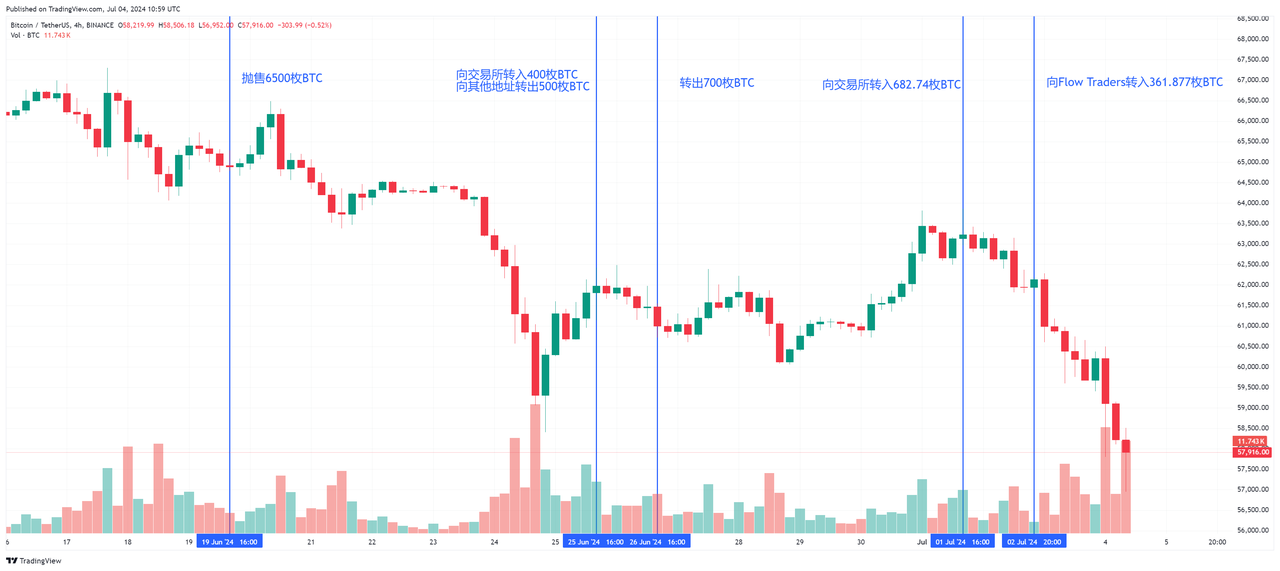
Today, at 4:25 PM, the German government transferred 1,300 BTC to exchanges, followed by another 1,700 BTC sent to anonymous wallet addresses at 4:35 PM.
Bitcoin eventually broke below $57,000 around 5:15 PM today, briefly touching a low of 56,952 USD.
Mt.Gox Massive Repayment Begins Small-Scale Transfer Tests
The Mt.Gox repayment issue has captured market attention, with potential selling pressure from up to 142,000 BTC and 143,000 BCH. This caused panic on June 24, pushing Bitcoin down toward the $60,000 level. However, since actual fund disbursements hadn't started then, the $60,000 level was ultimately defended. According to earlier disclosures on its official website, the Mt.Gox trustee announced that BTC and BCH repayments would begin in early July.

Now on July 4, according to the latest data from Arkham, Mt.Gox conducted test transfers at noon today. The market had already begun falling sharply around 9:00 AM—though the selling pressure wasn’t directly from Mt.Gox, it cast a shadow over market sentiment, as the looming threat of large-scale sell-offs makes investors reluctant to stay exposed.
BTC Spot ETF Sees First Net Outflow After Five Days of Net Inflows
Bitcoin spot ETFs serve as a key indicator for gauging buying and selling pressure in the market. However, recent data paints a concerning picture. According to SoSoValue, total net outflows reached $20.45 million on July 3—the first net outflow following five consecutive days of net inflows.
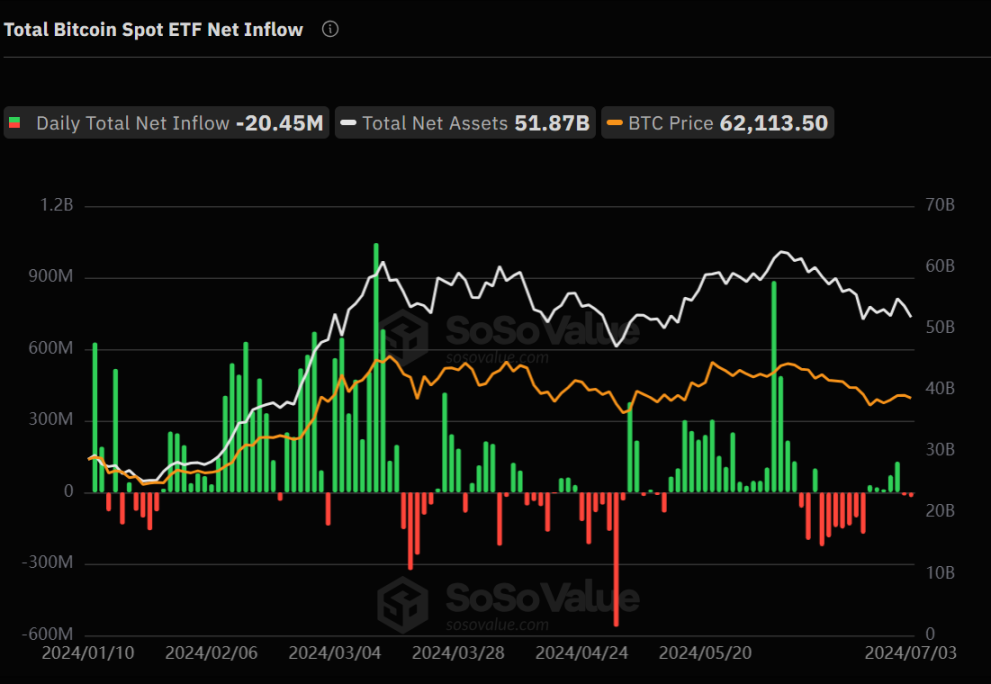
Extending the timeline, the chart above clearly shows that periods of high net inflows into Bitcoin spot ETFs often coincide with rising Bitcoin prices, while significant daily net outflows tend to precede price declines. Throughout May, consistent net inflows supported Bitcoin’s upward momentum. However, starting in June, net outflows accelerated sharply, indicating substantial capital withdrawal.
What’s Next for the Market?
QCP Capital stated in its latest market analysis that BTC broke below the $60,000 support level under heavy selling pressure, and signs of miner capitulation have emerged. Historically, this often signals a potential bottom. The last comparable drop in hash rate occurred in 2022 when Bitcoin traded around $17,000. Despite the severe sell-off in the crypto market, options markets remain optimistic, particularly showing strong bias toward ETH call options expiring in September and December.
QCP Capital believes that given recent Bitcoin-driven selling pressure, along with factors such as Mt.Gox distributions, miner behavior, and regulatory actions, ETH may stage a stronger rebound—especially with the pending submission of its spot ETF S-1 filing.
In contrast, Andrew Kang, co-founder and partner at Mechanism Capital, appears more pessimistic.
He noted that most market participants have yet to fully grasp the severity of what could be a four-month-long Bitcoin consolidation phase ending in a sharp decline. The closest precedent is the May 2021 range, when both Bitcoin and altcoins experienced a parabolic rally. Currently, leverage across cryptocurrencies exceeding $50 billion is again approaching historical highs (excluding CME), but this time the consolidation period has been longer (18 weeks vs. 13 weeks) and hasn’t yet seen an extreme washout like those witnessed during the 2020–2021 bull run.
He also suggested that his initial estimate of a $50,000 bottom might be too conservative, and we could see an even more extreme pullback toward the $40,000 range. Such a correction could inflict significant damage on the market and likely require months of consolidation or downtrend (recovery period) before any upward reversal occurs.
Join TechFlow official community to stay tuned
Telegram:https://t.me/TechFlowDaily
X (Twitter):https://x.com/TechFlowPost
X (Twitter) EN:https://x.com/BlockFlow_News
 Foresight News









