









Galaxy Digital Q2 Crypto Venture Capital Report: Rebound Continues, But Still Lags Behind Previous Bull Market
TechFlow Selected TechFlow Selected
Galaxy Digital Q2 Crypto Venture Capital Report: Rebound Continues, But Still Lags Behind Previous Bull Market
Compared to the strong performance of Bitcoin and liquid cryptocurrencies in the first quarter, the market cooled slightly in the second quarter, but still showed significant growth compared to the same period last year.
 Navigating Web3 tides with focused insights
Written by: Alex Thorn and Gabe Parker, Research Analysts at Galaxy Digital
Translated by: Yangz, Techub News
While the second quarter saw a slight cooling compared to the strong performance of Bitcoin and liquid cryptos in Q1, market activity remained significantly higher than the same period last year. The rebound in crypto venture capital observed in Q1 appears to have continued into Q2. Founders and investors across the industry demonstrated that the fundraising environment has become more active than in previous quarters—though as of July 1st, data slightly underperformed relative to overall market sentiment.
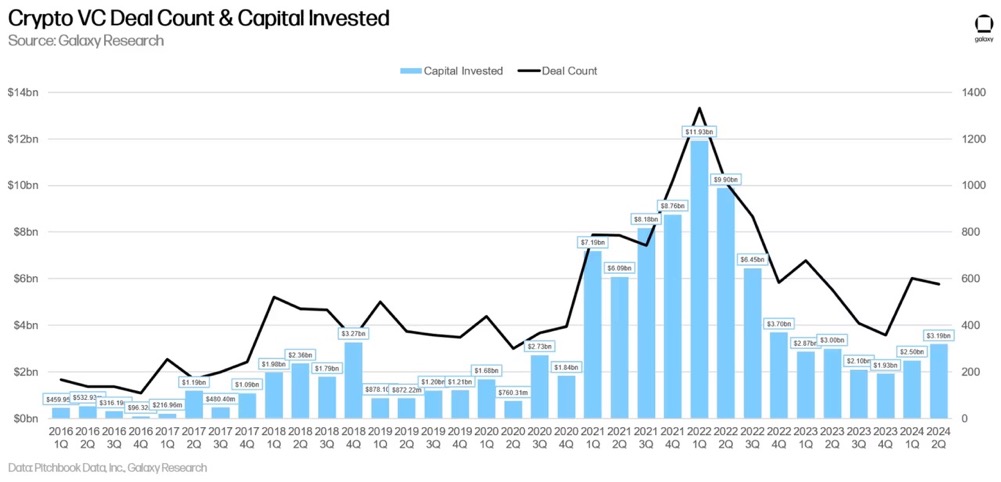
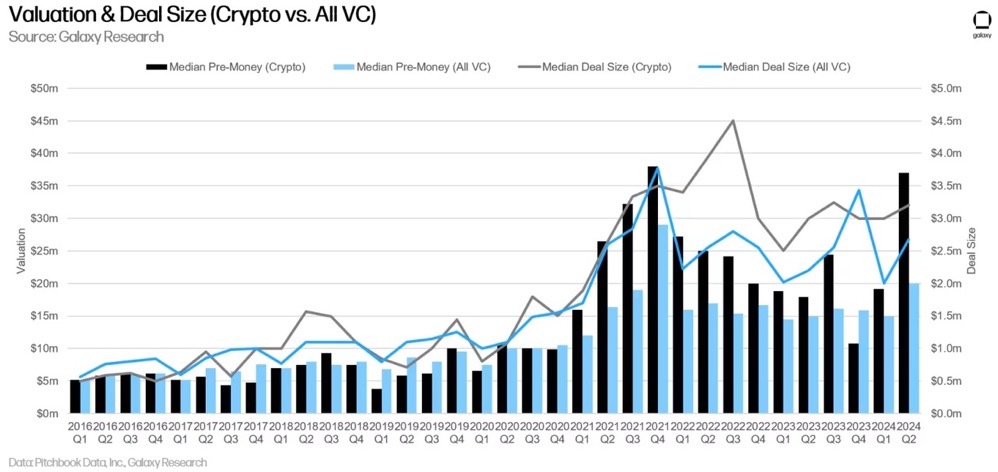
The number of venture deals in the sector declined slightly quarter-over-quarter, from 603 in Q1 to 577 in Q2, while invested capital rose from $2.5 billion to $3.2 billion. The median deal size increased modestly from $3 million to $3.2 million, but the median pre-money valuation jumped from $19 million to $37 million—approaching historical highs. These figures suggest that despite less available investment capital compared to prior peaks, the crypto market recovery over recent quarters has intensified competition among investors, fueling FOMO (fear of missing out).
Deal Count and Invested Capital
In Q2 2024, venture capital invested $3.194 billion into cryptocurrency and blockchain companies (up 28% quarter-over-quarter), across 577 deals (down 4%).
Invested Capital vs. Bitcoin Price
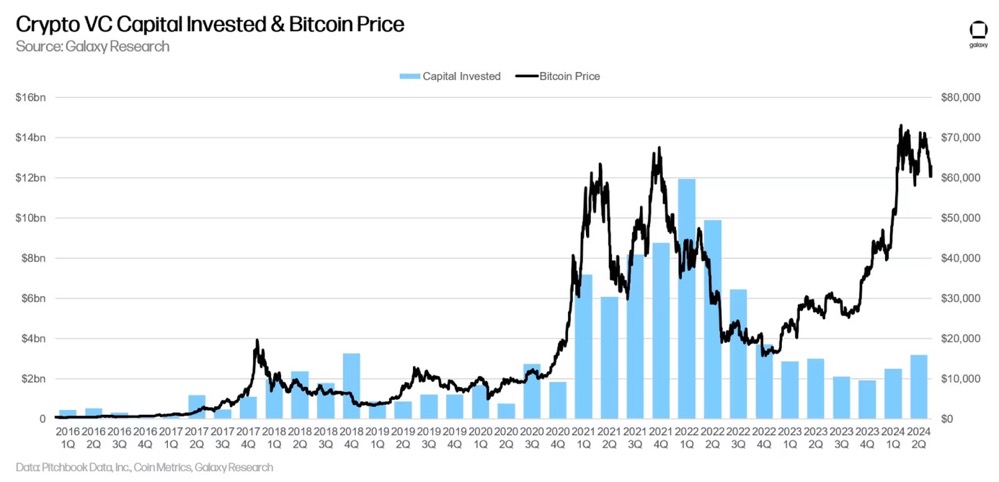
The long-standing correlation between Bitcoin’s price and capital deployed into crypto startups has broken down. Since January 2023, Bitcoin has surged significantly, but venture activity has not kept pace. While Bitcoin has appreciated strongly this year and capital inflows have risen, they remain far below levels seen during 2021–2022 when Bitcoin surpassed $60,000. This divergence stems from native crypto catalysts such as Bitcoin ETFs and emerging sectors like restaking, modular architectures, and Bitcoin Layer 2s, alongside pressures from bankruptcies among crypto startups and regulatory challenges, compounded by macroeconomic headwinds (interest rates). Now, with the revival of liquid cryptocurrencies, VCs are preparing to re-enter, and venture activity is expected to increase in the second half of the year.
Venture Investment by Stage
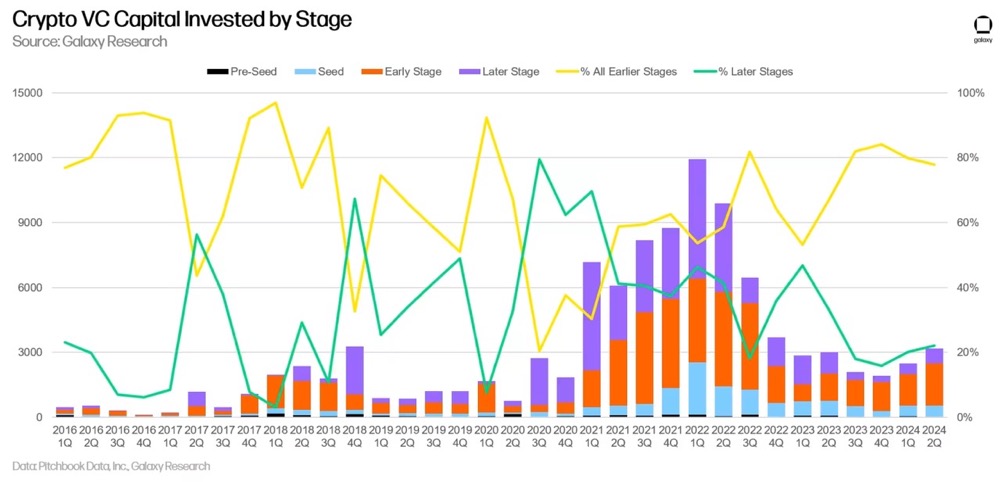
In Q2 2024, 78% of capital was allocated to early-stage companies, while 20% went to late-stage ventures. Although early-stage crypto-focused VC funds remain highly active and are deploying capital raised back in 2021 and 2022, large generalist venture firms appear to have exited or significantly scaled back their involvement in the space, making it harder for later-stage startups to raise funding.
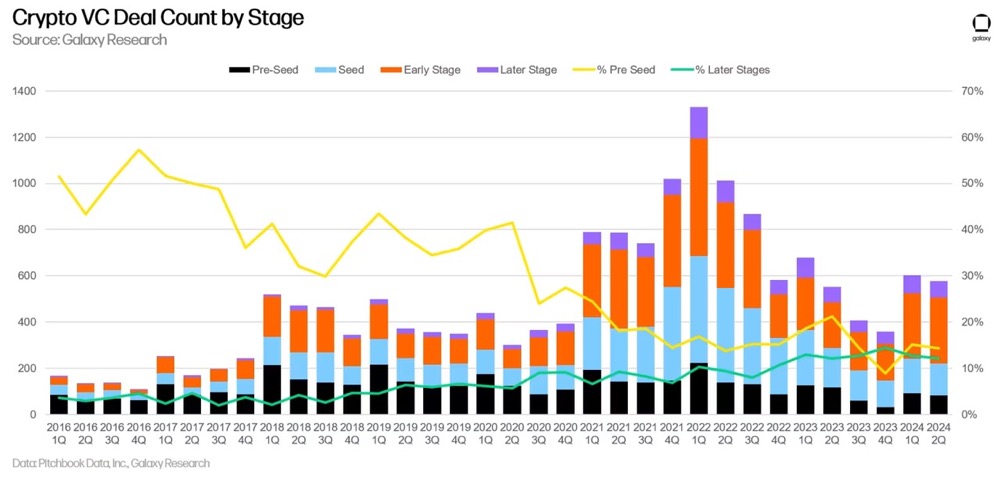
In terms of deal count, Pre-Seed rounds saw a slight decline in share but remain above levels from the previous market cycle.
Valuations and Deal Size
In 2023, valuations for venture-backed crypto companies dropped sharply, reaching their lowest median pre-money valuation since Q4 2020 in Q4 of that year. However, valuations began recovering in Q1 2024 and surged in Q2 to $37 million (up 94% quarter-over-quarter)—the highest level since Q4 2021. It should be noted that due to reporting lags and limited public valuation data, these figures can fluctuate significantly as more information becomes available. We strive to provide timely updates after each quarter ends, so revisions may occur—but this peak still signals a clear trend. Meanwhile, median deal size rose slightly (+7%) to $3.2 million, consistent with the past five quarters. Rising valuations reflect improved market sentiment; despite no significant increase in total capital, founders have capitalized on heightened interest and competition among existing investors.
Investment Categories
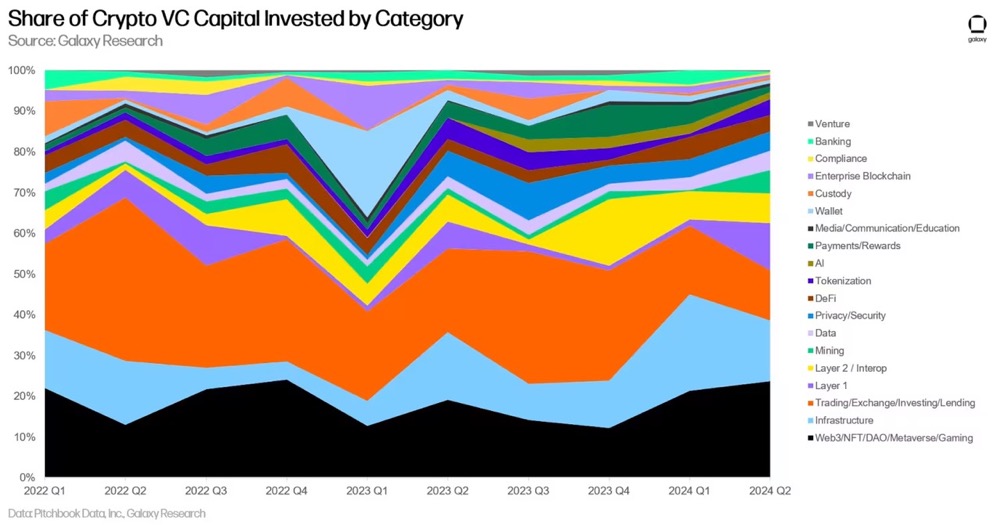
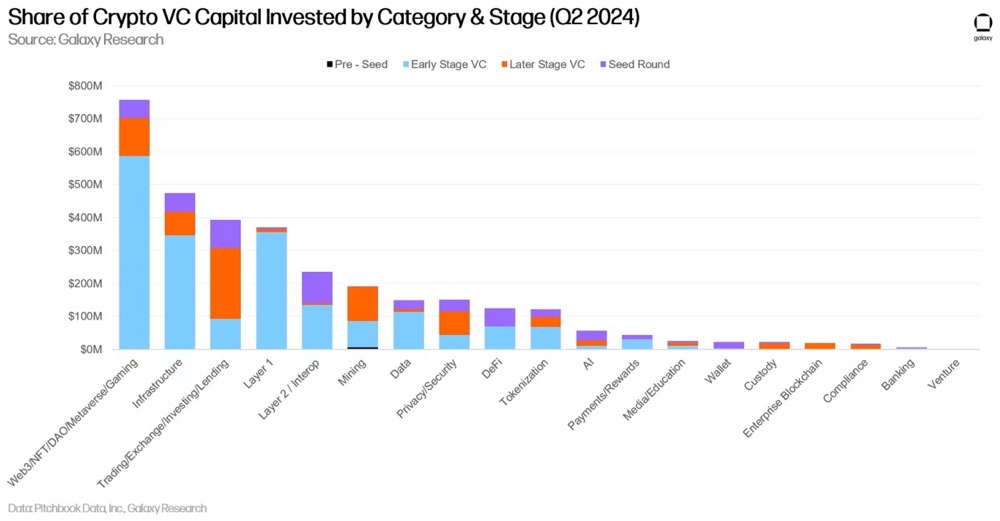
In Q2 2024, crypto companies and projects in the "Web3/NFT/DAO/Metaverse/Gaming" category raised $758 million in venture capital—the largest share across all categories (24%). The two largest deals in this category were Farcaster ($150 million) and Zentry ($140 million).
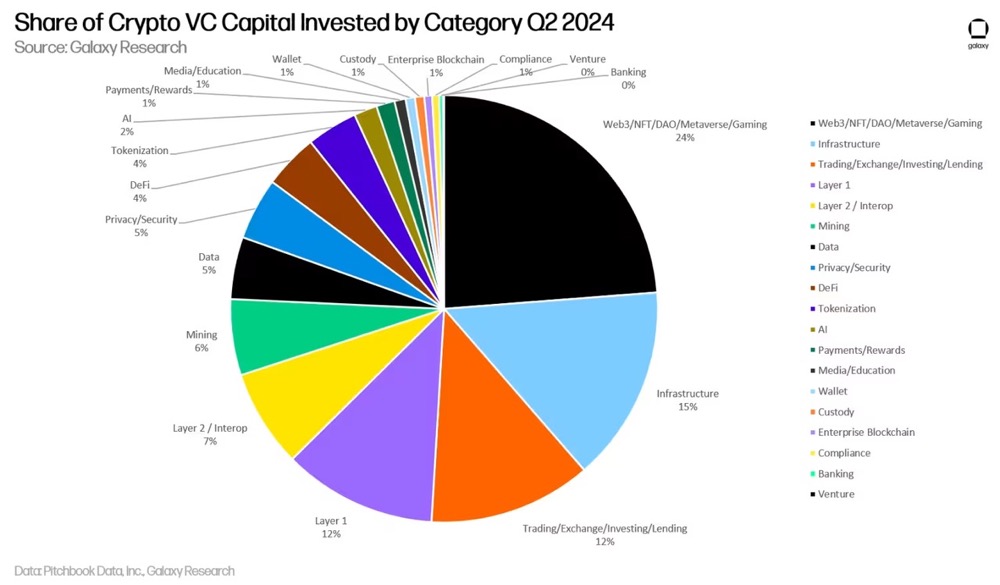
Following closely were infrastructure, trading, and L1-related companies/projects, accounting for 15%, 12%, and 12% of total investments respectively. Notably, L1 investment share grew more than sixfold, driven by Monad raising $225 million and Berachain securing $100 million. Additionally, Bitcoin L2s raised $94.6 million in Q2 2024, a 174% increase from Q1 ($34.7 million).
Deal Count by Category
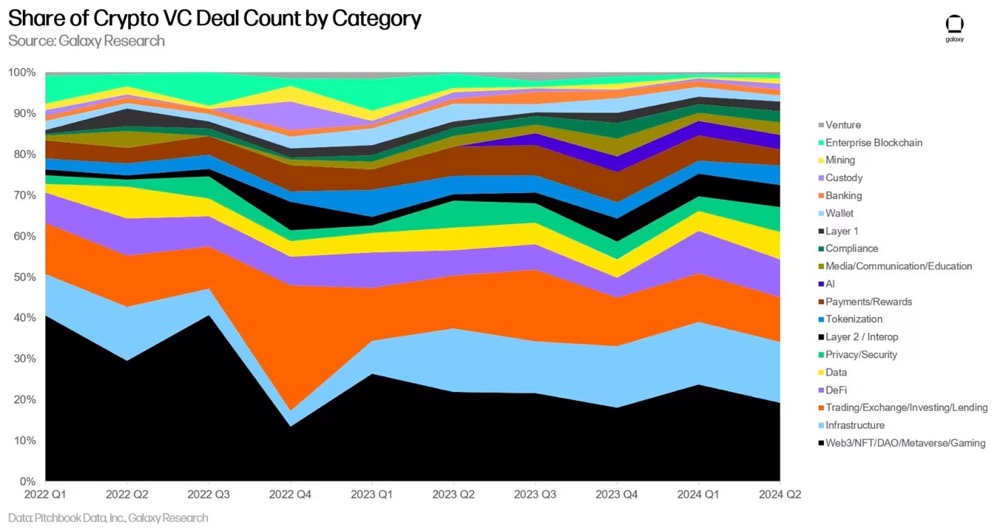
In terms of deal count, the "Web3/NFT/DAO/Metaverse/Gaming" category led by a wide margin with 19%, largely driven by increased activity in decentralized social media and gaming-related deals. Although the number of fundraising events related to restaking decreased in Q2 2024, infrastructure ranked second in deal volume with 15%.
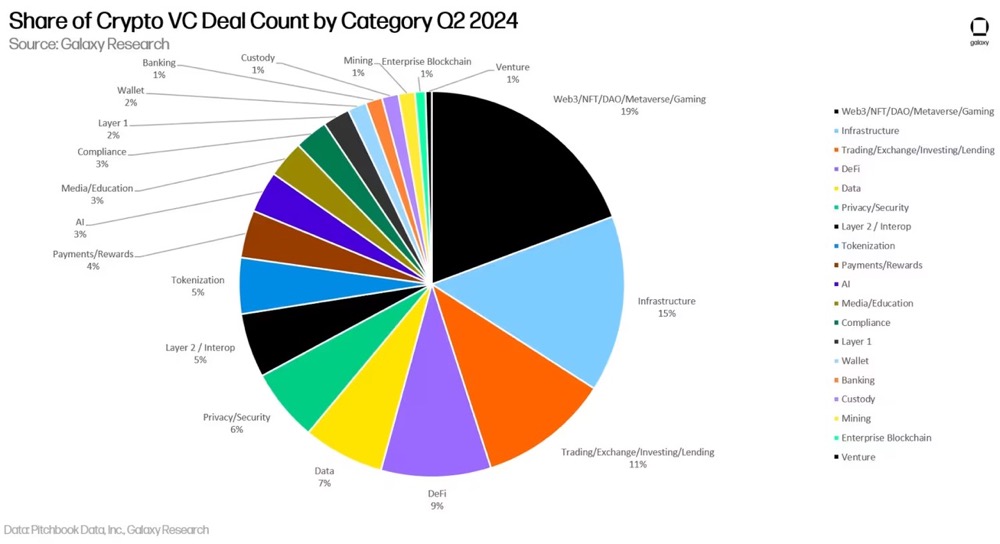
Trailing behind were trading and DeFi-related crypto companies/projects, representing 11% and 9% of total completed deals in Q2 2024, respectively.
Venture Stages and Categories
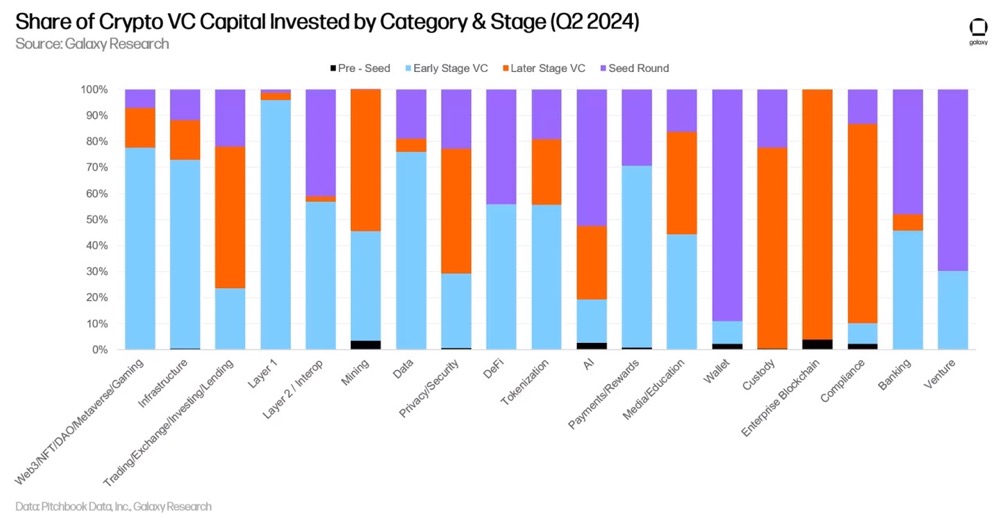
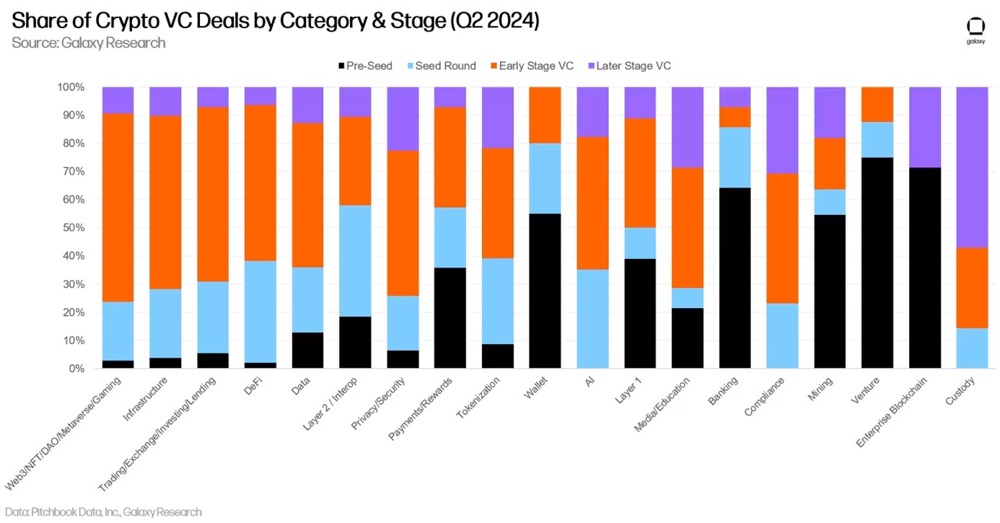
Breaking down capital and deal counts by stage and category provides clearer insight into which types of companies are raising funds within each segment. In Q2 2024, the vast majority of capital in Web3, L1, and infrastructure categories went to early-stage companies and projects, whereas venture capital in the trading category was more heavily directed toward later-stage ventures.
Analyzing the share of capital invested across stages within each category offers insights into the maturity levels of various investable sectors.
Deal counts also tell a similar story: across nearly all categories, a substantial portion of completed deals involved early-stage companies and projects.
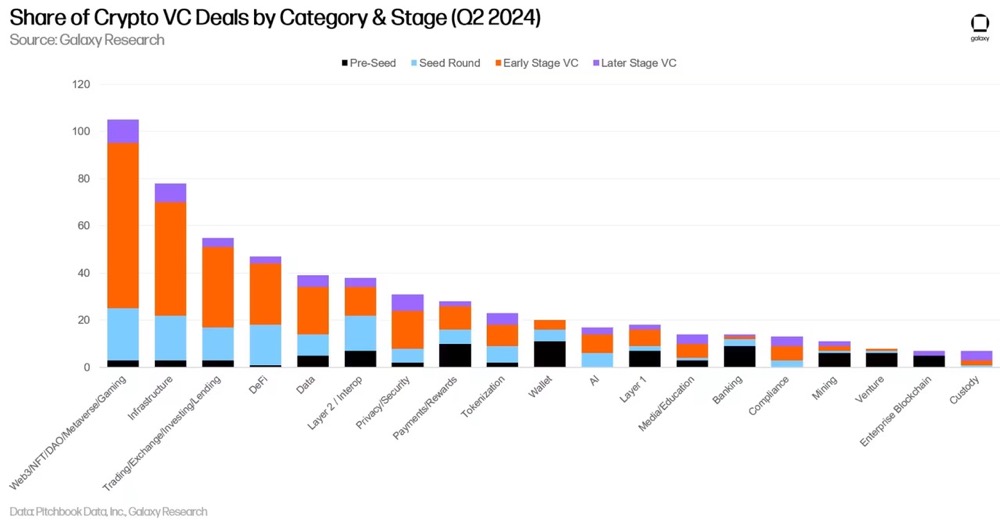
Examining the share of deals completed at each stage within categories sheds light on the development stage of each investable segment.
Geographic Distribution of Investments
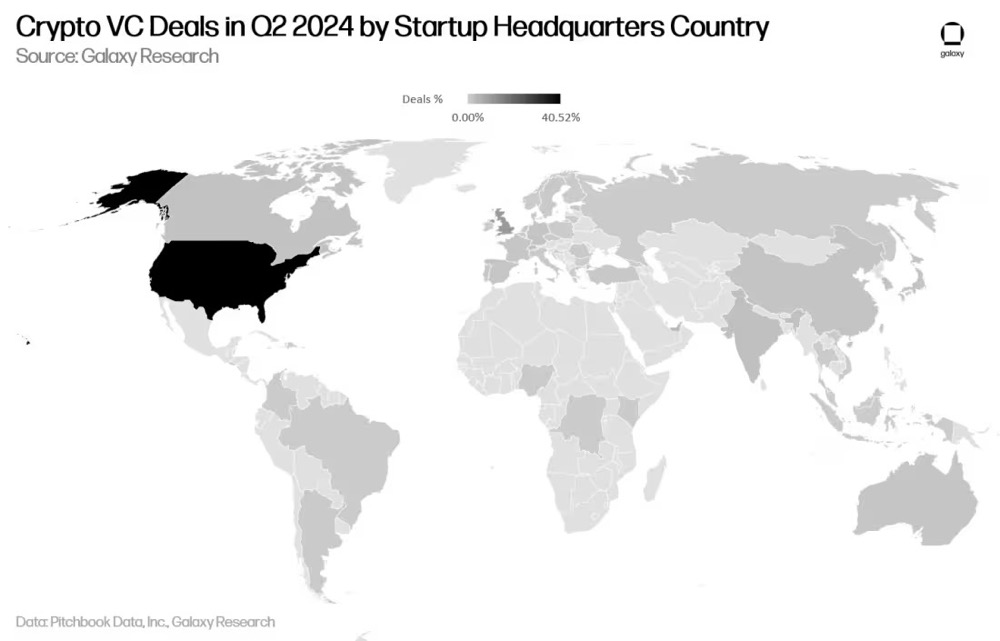
By deal count, over 40% of venture capital in Q2 2024 went to companies headquartered in the United States. The UK accounted for 10%, Singapore 8.7%, UAE 3.13%, and Hong Kong 2.78%.
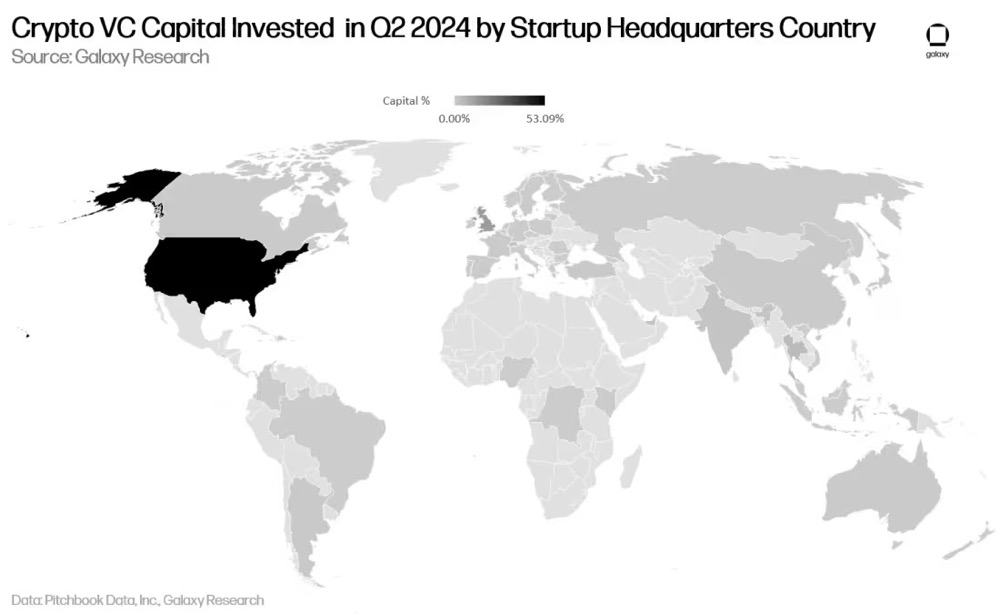
By invested amount, U.S.-headquartered companies attracted 53% of venture capital, up 23.5% quarter-over-quarter. The UK accounted for 12.78%, Singapore 4.6%, and UAE 4.39%.
Investments by Cohort
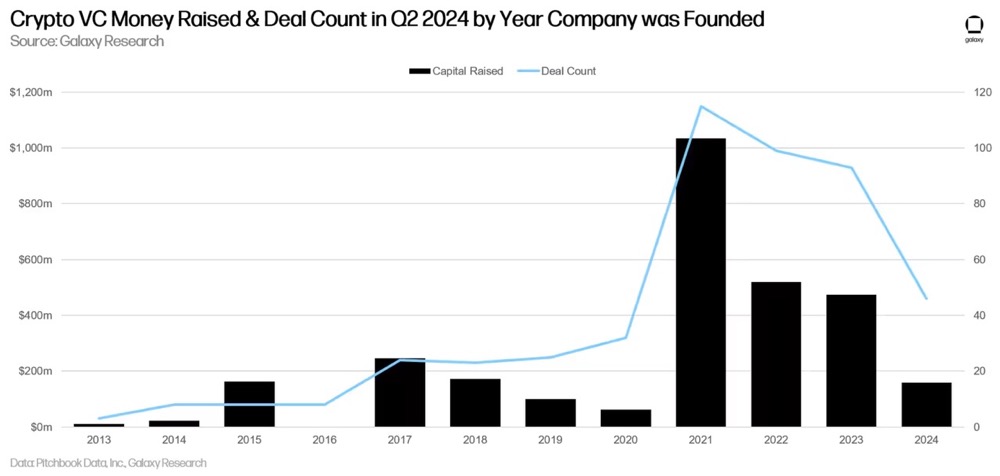
In Q2 2024, the vast majority of venture capital was directed toward companies founded between 2021 and 2023.
Summary
Crypto venture sentiment continues to improve, though remains well below the 2021–2022 bull market highs. With Bitcoin and Ethereum up roughly 50% year-to-date, invested capital rose 28% quarter-over-quarter while deal count remained flat. If this pace continues through year-end, 2024 will rank third in both capital deployed and deal volume, behind only 2021 and 2022.
Investments in Web3 and L1 categories stood out. Driven by Farcaster ($150M) and Zentry ($140M), the Web3 category led with approximately $750 million in total funding. Meanwhile, L1 secured fourth place with $371 million, boosted by Monad ($225M) and Berachain ($100M).
Median valuations for venture-backed crypto firms surged dramatically, reaching the highest level since Q4 2021 (the peak of the last bull run). Due to the 2022 bear market and adverse macro conditions, most traditional venture firms remain on the sidelines, while crypto-native VCs operate in an increasingly competitive landscape—giving founders stronger negotiating leverage. Note that this median is based on data available as of July 1st and may be revised downward as more Q2 transaction details emerge.
Bitcoin L2s continue to attract significant investment, with related companies and projects raising $94.6 million—up 174% quarter-over-quarter. Investor enthusiasm remains high for the prospect of greater composable blockspace emerging on Bitcoin, drawing back use cases like DeFi and NFTs. Our internal research indicates at least 65 projects identify themselves as “Bitcoin L2s.”
Early-stage deals dominated in Q2, capturing nearly 80% of invested capital, with Pre-Seed rounds accounting for 13% of all deals. Sustained focus on early-stage investing signals long-term health for the broader crypto ecosystem. While some late-stage companies struggle to raise, entrepreneurs are finding willing investors for new innovative ideas.
The U.S. continues to lead the crypto startup ecosystem. While maintaining a clear edge in both deal flow and capital, unfavorable regulatory developments could push more companies to relocate overseas. For the U.S. to remain a long-term hub for technological and financial innovation, policymakers must recognize how their actions—or inaction—impact the crypto and blockchain ecosystem.
Join TechFlow official community to stay tuned
Telegram:https://t.me/TechFlowDaily
X (Twitter):https://x.com/TechFlowPost
X (Twitter) EN:https://x.com/BlockFlow_News
 @galaxyhq









