









OpenAI bans Chinese companies from using its API; will Microsoft Azure OpenAI become the next compliant alternative?
TechFlow Selected TechFlow Selected
OpenAI bans Chinese companies from using its API; will Microsoft Azure OpenAI become the next compliant alternative?
OpenAI's cutoff triggers survival crisis for Chinese companies.
 Navigating Web3 tides with focused insights
Author: Huang Peng, Senior Lawyer at Shanghai Manqin Law Firm
On June 25, OpenAI sent an official email to its API (application programming interface) users, announcing that starting July 9, it would block API traffic originating from regions not included in its list of supported countries and areas. To continue using OpenAI's services, access must be made from a supported region.
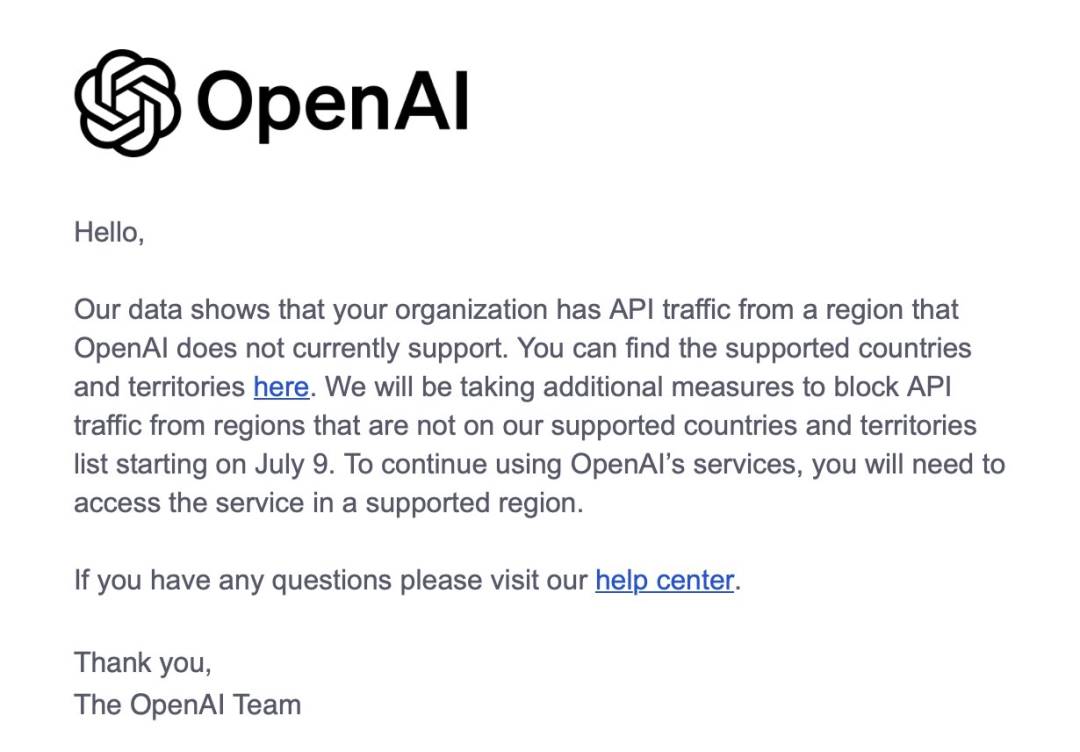
This move sparked widespread debate, with media outlets describing OpenAI’s action as a "cut-off." Some attributed it to U.S. suppression policies toward China; others believed it aimed to prevent domestic AI models from cloning or harvesting training data. In reality, OpenAI has never officially provided services to the Chinese market—so calling this a "cut-off" is overstated. A more accurate description is that OpenAI is tightening existing restrictions. As such, all Chinese enterprises currently using the OpenAI API are operating in violation of both OpenAI's terms and domestic regulations. What should these companies do next?
Migrate Proactively
In July 2023, China's Cyberspace Administration, together with relevant authorities, released the "Interim Measures for the Management of Generative Artificial Intelligence Services," the first dedicated legislation globally targeting generative AI. According to these measures, providers of generative AI services must use data and foundational models with legal origins. However, OpenAI has not completed algorithm registration or generative AI service filing required under Chinese regulations. Meanwhile, OpenAI’s policy explicitly prohibits providing GPT services to users in China.
Under this "double illegality," applications built on top of the OpenAI API ("shell" applications) operate under constant risk of being shut down—a precarious position for any long-term project. The fact that domestic regulators have maintained a degree of tolerance so far reflects the industry’s early development stage and a gradual enforcement ramp-up. OpenAI’s recent restriction could thus serve as a catalyst, pushing domestic projects toward compliance.
Given this context, migrating to domestic AI models has become a key solution for applications relying on OpenAI APIs. At the same time, Chinese large model providers have seized the opportunity by rolling out their own "migration" support programs.

Migration allows existing applications to maintain functionality while helping companies avoid contractual breaches caused by losing API access. While evaluating cost-effectiveness, applications should prioritize large models already registered with the CAC to avoid new compliance risks. Notably, as of March 2024, a total of 117 large models had completed registration with China’s Cyberspace Administration.

However, following OpenAI’s announcement, some articles suggested that affected applications could migrate instead to Azure OpenAI—arguing that Microsoft has partnered with OpenAI and does not prohibit access for Chinese users. Can these applications safely adopt this approach? And what about compliance?
Azure OpenAI
First, let’s clarify what Azure OpenAI is.

Azure OpenAI is a service provided by Microsoft that enables REST API access to OpenAI's large language models, including GPT-4, GPT-4 Turbo with Vision, GPT-3.5-Turbo, and embedding model series. The Azure OpenAI service is fully controlled by Microsoft, which hosts OpenAI models within its Azure environment. This service operates independently and does not interact with any services run directly by OpenAI, such as ChatGPT or the OpenAI API. Moreover, Microsoft has also joined the migration race following OpenAI’s access restrictions.

Unlike OpenAI, Azure OpenAI does not restrict access for users in China—an assertion confirmed through both official promotions and verbal confirmations from staff. Yet paradoxically, one official document listing available service regions appears to indicate unavailability in China.
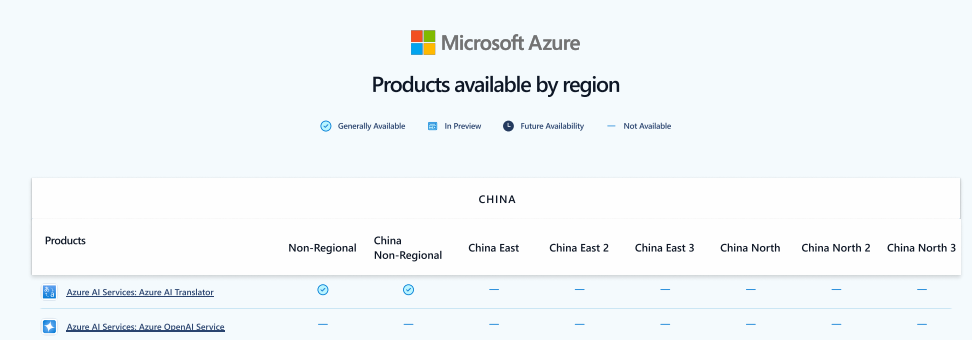
So, can Chinese enterprises using OpenAI APIs for AI projects migrate to Azure OpenAI and rest assured about compliance?
Compliance Uncertainty
As a global service, Microsoft maintains comprehensive data compliance policies. It commits to not sharing customer data with OpenAI, not using data to improve OpenAI or Microsoft products and services, allowing data deletion upon request, preventing harmful content generation, and complying with GDPR, ISO 27001, ISO 27002, and ISO 27018 standards. However, according to information gathered by Manqin Law Firm, Azure OpenAI’s compliance framework has not been specifically adapted to meet Chinese legal requirements. Therefore, its compliance status remains questionable in several aspects.
Question 1: Data Cross-Border Transfer
Azure’s services in China are operated by CenturyLink within data centers located inside China. However, Azure OpenAI is a global service with data centers located outside China. When critical information infrastructure operators or other data handlers transfer sensitive personal information, personal data, or important data exceeding certain thresholds, they are required to apply for cross-border data transfer security assessments with national cyberspace authorities or obtain personal information protection certification. For domestic users, this presents significant compliance burdens. Furthermore, since Azure OpenAI itself hasn’t undergone China’s required evaluation or certification processes, there is no guarantee it would pass scrutiny.
Question 2: Lack of Required Filings
According to the "Regulations on Algorithmic Recommendation for Internet Information Services," the "Regulations on Deep Synthesis for Internet Information Services," and the "Interim Measures for the Management of Generative Artificial Intelligence Services," any provider offering generative AI services with public opinion influence or social mobilization capability must conduct security assessments and complete algorithm and model filing procedures. Upon review, Azure OpenAI has not completed the required algorithm or large model filings. Thus, for users intending to offer services to the domestic public, it would be difficult to demonstrate use of legally sourced foundational models or meet other regulatory obligations.
In summary: For enterprises using the service solely for internal R&D or operations—not面向 the public and not involving personal or important data—Azure OpenAI may be a viable option. For all other cases, especially those面向 the Chinese public, the compliance risks of using Azure OpenAI must be carefully evaluated. Based on publicly available information and without access to full details, this analysis represents my best effort; if factual inaccuracies exist, I welcome correction from Microsoft.
Worst-Case Approach
Some industry insiders suggest bypassing restrictions by using overseas servers or setting up reverse proxies. While technically feasible, this workaround fails to resolve any compliance issues. On the contrary, it increases data security and privacy risks. From an operational standpoint, app stores like Apple’s and Android’s in China could delist such applications, and service stability would remain highly uncertain.
Conclusion
In light of OpenAI restricting API access to China, domestic AI companies considering migration to Azure OpenAI or other international platforms must carefully assess compliance risks. At the same time, facing new legal challenges brought by emerging technologies, businesses should actively explore localized solutions rather than simply seeking foreign alternatives. Only through localization can sustainable and compliant growth be achieved amid rapidly evolving technological landscapes.
Join TechFlow official community to stay tuned
Telegram:https://t.me/TechFlowDaily
X (Twitter):https://x.com/TechFlowPost
X (Twitter) EN:https://x.com/BlockFlow_News










