In-Depth Analysis of Circle's Historic Opportunity and Starting Point in Gaining Regulatory Approval Under MiCA to Issue USDC and EURC
TechFlow Selected TechFlow Selected
In-Depth Analysis of Circle's Historic Opportunity and Starting Point in Gaining Regulatory Approval Under MiCA to Issue USDC and EURC
Starting July 1, Circle officially launched the issuance of the stablecoins USDC and EURC for European customers.
 Navigating Web3 tides with focused insights
Author: Aiying Aiying
Circle has announced that its USDC and EURC stablecoins now comply with the European Union’s newly enacted stablecoin regulations, making it the first global stablecoin issuer to achieve compliance under the MiCA framework. Starting July 1, Circle officially began issuing these two stablecoins to European customers.
This marks a significant milestone in the development of internet financial systems, signaling that one of the world's largest economies has established clear regulations enabling stablecoins to become legitimate digital currencies—accelerating the integration of cryptocurrency into mainstream payment, finance, and commercial infrastructure.
Prior to this, Aiying Aiying published an in-depth analysis titled "Comprehensive Research Report on Europe’s MiCA Legislation: Far-Reaching Impacts on Web3, DeFi, Stablecoins, and ICO Projects," which thoroughly explored how the legislation would affect the industry, especially the stablecoin market. MiCA requires fiat-backed stablecoins to maintain sufficient liquid reserves and obtain an “Electronic Money Institution (EMI)” license. It also sets transaction volume caps and additional asset-backing requirements. June 30 was a critical deadline by which exchanges were required to delist non-compliant stablecoins.
USDC from Circle is expected to gain market share from its larger competitor Tether Holdings Ltd.’s USDT. Major exchanges including OKX, Binance, Bitstamp, and Kraken have already taken steps this year to change their support for USDT within the EU, removing the ability to use the stablecoin to buy or sell other crypto assets.
Circle’s current opportunity mirrors the historical rise of USDT
In yesterday’s article by Aiying Aiying titled [In-Depth Research Report] The Stablecoin Sector: Models, Mechanisms, Trends, and Considerations for Hong Kong Stablecoins, it was noted that while USDT’s biggest advantage lies in first-mover status, its rise was primarily driven by exchange support and favorable market conditions. From the early days of Bitcoin blockchain through the later Ethereum ecosystem, USDT was undeniably a pioneer—and it correctly anticipated major market rallies. A review of its holder addresses and market capitalization shows that although founded in 2014, USDT truly began rising in 2017. That year not only saw a bull market but also massive new issuance of USDT, leading to accusations of manipulating Bitcoin prices.
In hindsight, however, this view reverses cause and effect. What’s often overlooked is that China shut down cryptocurrency trading around that time, and more importantly, USDT simultaneously launched on the top three exchanges at the time.
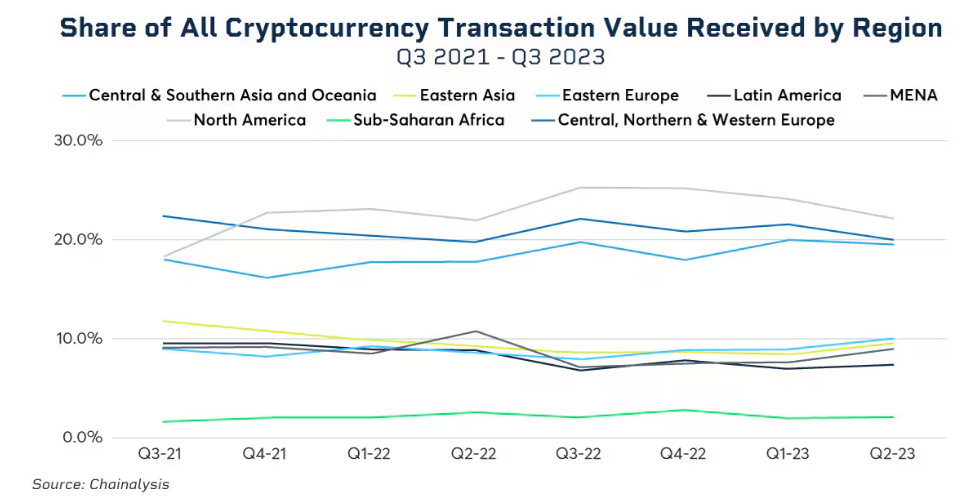
Similarly today, according to Chainalysis’ "2023 Geography of Cryptocurrency Report," the region accounted for 17.6% of global trading volume between July 2022 and June 2023. Thanks to the MiCA regulation, the regulatory environment has been effectively cleared for Circle to operate freely in this space.
Moreover, Circle stands to benefit significantly as the growth and adoption of euro-denominated digital currency (i.e., euro stablecoins) becomes increasingly certain. MiCA establishes clear rules for issuing and operating euro stablecoins, allowing banks and electronic money institutions to integrate them as core components of their products and services. This means the entire regulated European financial sector can now adopt this network, greatly expanding stablecoin usage in commerce and finance—a market Aiying Aiying sees as enormous.
Circle’s global compliance vision and strategic positioning enabled its current success
Veterans in the crypto space know USDC rose during periods of crisis for USDT, gaining user trust through transparency, regulatory compliance, and stronger reserve liquidity. Looking back at USDC’s rise, surges in its holder addresses typically coincided with declines in USDT holders—especially during times of risk events involving USDT. Early on, being the sole stablecoin trading pair on compliant exchange Coinbase gave USDC a major boost, providing a key competitive edge in challenging USDT’s dominance. Due to its compliance, DeFi protocols favor USDC, and yield farming helped USDC scale rapidly, giving it an advantage on-chain. After Maker introduced regulated stablecoin USDC in 2020, it quickly became the preferred choice across major DeFi protocols. Today, MakerDAO, Compound, and Aave are among USDC’s strongest supporters—not just because of regulatory benefits, but also because USDC offers lower volatility than USDT when used as collateral in DeFi protocols. In short, USDC’s initial advantage can be summarized as regulatory compliance.
What compliance efforts has Circle undertaken globally?
Circle is registered as a money services business with the U.S. Department of Treasury’s Financial Crimes Enforcement Network (FinCEN), and operates in accordance with state-level money transmission laws, generally treated by regulators as a form of prepaid payment. Unlike USDT, USDC’s reserve assets are held separately; in the event of Circle’s bankruptcy, these reserves are protected under New York banking law and federal bankruptcy law.
Circle was the first cryptocurrency company to obtain a money transmitter license in the United States, the first to receive a New York BitLicense, and has also obtained an electronic money issuer license in the UK. For deeper insights into the U.S. legal framework for payments, read: [Payments Series] In-Depth Analysis of Legal Foundations and Requirements for U.S. Cryptocurrency Payment Licenses.
Two years ago, the EU reached agreement on the MiCA regime, which was later approved by the European Parliament, becoming the world’s most comprehensive regulatory framework for stablecoins and digital asset markets. Following this, Circle announced the launch of a euro-based stablecoin and committed fully to aligning with the new EU regulations. France has been at the forefront of establishing crypto and digital asset regulation, and Circle’s decision to base its European headquarters there proved strategic. The company worked closely with France’s financial regulator, ACPR, to ensure full MiCA compliance.
Circle has now obtained an electronic money issuance license from ACPR and is recognized as a MiCA-compliant issuer of both USDC and EURC. European customers can now directly access USDC and EURC via Circle Mint France.
As a result, USDC has become the only major global stablecoin fully compliant with Europe’s new stablecoin regulatory regime. Through close collaboration with regulators in France, the EU, and the U.S., Circle has achieved full interoperability of global stablecoins on blockchain networks—balancing technological innovation with strict regulatory standards.
Currently, all USDC and EURC circulating in Europe meet MiCA requirements. All EURC reserves held by Circle are managed under supervision by French regulated entities, while USDC reserves in Europe are managed by globally systemically important banks within the EU. USDC held by European users remains fully interchangeable worldwide and can still be traded, transferred, self-custodied, and used in DeFi applications without any changes. For further details, refer to Aiying Aiying’s earlier article: [S&P] USDC Stability Assessment and Reserve Fund Operations.
Additionally, it’s important to note that USDC does not conduct direct redemption with individual users. While Tether allows direct exchange for over $100,000 upon payment of a registration fee, Circle operates a tiered customer model. Only partners or Class A users (such as exchanges and financial institutions) are eligible to redeem directly with Circle. Ordinary individual users (Class B) must go through third-party channels (e.g., Coinbase). As of now, Circle will issue and redeem USDC and EURC directly with major institutions in the European market via Circle Mint France—including exchanges, market makers, brokerages, consumer wallets, fintech companies, payment processors, banks, and large enterprises. This distribution model significantly reduces money laundering risks by effectively managing and isolating risks through large institutional counterparts.
Summary
The launch of MiCA signals a major structural shift in the market. Over the next year, comprehensive stablecoin regulations are expected in key jurisdictions worldwide—including Japan, the U.S., UK, Singapore, Hong Kong, UAE, and Brazil—all requiring strict regulatory compliance. The gray-market space of the wild west era continues to shrink, ultimately converging with regulated, compliant markets. We are all witnessing this transformative period in financial history, and Aiying Aiying will continue sharing insights into this evolving convergence.
Join TechFlow official community to stay tuned
Telegram:https://t.me/TechFlowDaily
X (Twitter):https://x.com/TechFlowPost
X (Twitter) EN:https://x.com/BlockFlow_News
 Aiying Compliance