








Shanghai releases its first official industry report on Web3.0: global multi-power格局 emerging, calls for innovative regulatory system
TechFlow Selected TechFlow Selected
Shanghai releases its first official industry report on Web3.0: global multi-power格局 emerging, calls for innovative regulatory system
The surveyed companies expressed hope for clear Web3.0 support policies from mainland China, stating, "Only with clear policy guidance will funding support Web3.0 startups, and compliance costs for enterprises will be significantly reduced."
 Navigating Web3 tides with focused insights
By Xiao, PANews
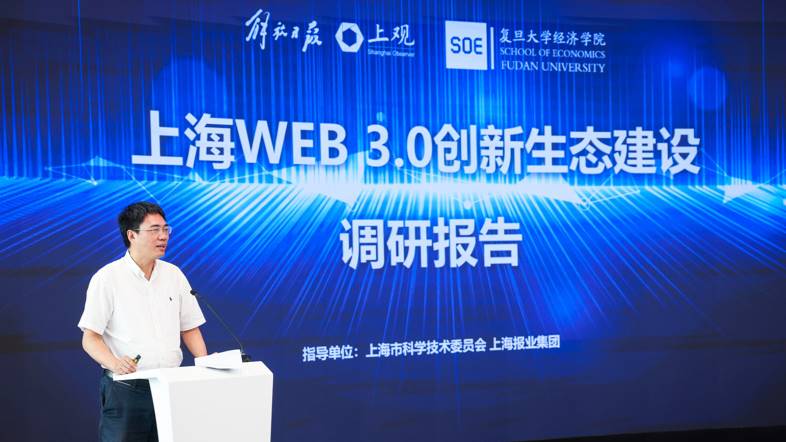
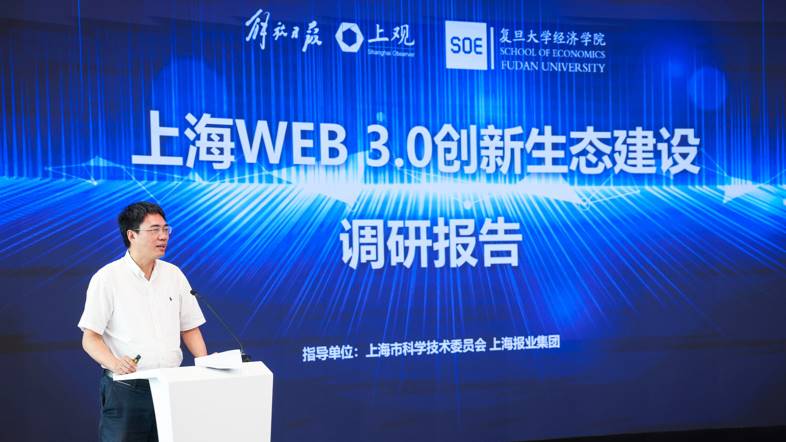
At the recent launch event of the "2024 Shanghai Web3.0 Innovation Ecosystem Development Research Report" (hereinafter referred to as the "Report"), representatives from government agencies, academic institutions, and relevant industries unanimously agreed that the development of Web3.0 is crucial for the information technology sector. Guided by the Shanghai Science and Technology Commission and jointly released by Jiefang Daily and the School of Economics at Fudan University, this report marks Shanghai's first industry-wide analysis focused on Web3.0.
Initial Industry Ecosystem Takes Shape, RWA Momentum Builds
To gain a comprehensive understanding of Web3.0, the research team conducted extensive surveys across upstream and downstream enterprises in the ecosystem. Participating organizations included foundational technology developers such as Conflux and Artela; security auditing firms like Certik and ZAN; data analytics provider Trusta Labs; infrastructure providers including TRON and Binance; and end users such as COSCO Shipping.
Through thorough investigation, the Report finds that globally, Web3.0 has preliminarily formed an ecosystem built upon diversified computing networks, distributed data storage, and high-speed communication networks, with blockchain infrastructure at its core. Currently, core blockchain innovations are thriving, industrial scale is steadily expanding, and enterprise capabilities continue to strengthen. Ethereum, Solana, Polygon, and others have established rich, high-performance, secure public chain ecosystems, gradually shaping a global landscape led by Ethereum with multiple strong chains coexisting.
Regarding the next phase of Web3.0 development, both the Report and attending experts highlighted RWA as a key emerging trend.
RWA stands for "Real World Assets," referring to the tokenization of tangible assets such as currencies, bonds, trade finance instruments, and energy resources. The Report forecasts that over the next 5–10 years, as governments, regulators, and financial institutions deepen their exploration, traditional finance and RWA will increasingly converge, forming multiple global networks for tokenized asset trading and enhancing interoperability in international financial payments.
Currently, with maturing policies, technologies, and markets, Web3.0 financial assets and technologies are gaining acceptance among governments and mainstream financial institutions worldwide. In this context, the tokenization of funds—represented by fiat-based stablecoins, tokenized deposits, and central bank digital currencies (CBDCs)—alongside the tokenization of real-world assets (RWA), is experiencing rapid growth.
For example, the IMF is developing a CBDC platform to facilitate cross-border transactions between nations. In March this year, BlackRock launched its first tokenized fund on the Ethereum network—the BlackRock USD Institutional Digital Liquidity Fund (BUIDL).
Among various initiatives, Hong Kong’s efforts stand out. With participation from the Bank for International Settlements (BIS), the Hong Kong Monetary Authority (HKMA), the Bank of Thailand, the People's Bank of China Digital Currency Research Institute, and the Central Bank of the UAE jointly developed the "Multiple Central Bank Digital Currency Bridge" project, helping central banks accelerate the use of CBDCs to improve cross-border payment efficiency and address long-standing bottlenecks in traditional international payments.
On May 7, the HKMA announced the working group lineup for Project Ensemble—a wholesale CBDC (wCBDC) initiative aimed at enabling interoperability among wCBDCs, tokenized currencies, and tokenized assets. Founding members include the HKMA, Securities and Futures Commission, BIS Innovation Hub Hong Kong Centre, CBDC expert panel, and seven institutions: Bank of China (Hong Kong), Hang Seng Bank, HSBC, Standard Chartered Hong Kong, HashKey Group, AntChain, and Microsoft Hong Kong. This move is seen as a critical step toward establishing Hong Kong as a hub for RWA markets.
During preliminary research for the Report, TRON noted that the mass adoption of stablecoins and RWA is an inevitable stage in blockchain and crypto technology evolution. With the approval of spot Bitcoin ETFs, stablecoins and RWA are expected to enter a period of accelerated growth, driving broader development across the Web3 industry.
"RWA will be a future trend—not only involving on-chain and off-chain interactions but also requiring regulatory compliance. Once regulatory pathways are cleared, RWA can advance rapidly and efficiently," said Gu Ronghui, co-founder of cybersecurity firm CertiK, at the launch event.
Mainstream Capital Enters: 'Waiting for the Wind' Requires Top-Down Design
Parallel to RWA development, ETFs are attracting mainstream capital into the Web3.0 market. In January 2024, the U.S. Securities and Exchange Commission (SEC) approved spot Bitcoin ETFs for the first time in history, authorizing 11 ETFs to begin trading.
Similarly, in April, the Hong Kong Securities and Futures Commission approved Bitcoin and Ethereum ETF products from China Asset Management (Hong Kong), Harvest Fund Management International, and Bosera International. On June 20, Bitcoin ETFs made their debut on Australia’s primary stock exchange. The Report views the listing of spot ETFs as a landmark moment for the Web3.0 industry, significantly boosting market liquidity and further stimulating ecosystem innovation and growth.
The Report notes that with the listing of cryptocurrency ETFs, Hong Kong's goal of becoming a Web3.0 hub is becoming increasingly clear. However, it also observes that from the outset, Hong Kong has pursued a prudent and sustainable approach to mainstream capital entering the Web3.0 market—including passing the *Anti-Money Laundering and Counter-Terrorist Financing (Amendment) Bill 2022* and implementing a dual licensing regime involving credible regulators overseeing exchanges. To date, only HashKey Exchange and OSL Digital Securities have obtained virtual asset licenses in Hong Kong.
Drawing lessons from Hong Kong’s model, the Report and participants agree that strengthening top-level design is one of the most urgent priorities for Web3.0 development today.
Meng Yan, Managing Partner of SFT Labs, pointed out that Web3.0 is currently in the prelude to large-scale development—"possessing one condition and awaiting two catalysts." The "one condition" refers primarily to technological advancement, including significant progress in high-performance blockchains, privacy computing, zero-knowledge proofs (ZK), and security auditing. One of the "two catalysts" lies in external financial conditions, particularly macro-monetary policy, while the other is regulatory policy. He added: "Web3.0 is now in a dormant phase, waiting for a looser macroeconomic environment. Moreover, due to the lack of a unified global regulatory framework, the market continues to face substantial risks of speculation and fraud, posing long-term challenges to the healthy development of Web3.0."
Experts Recommend Studying 'Token Economics'
"I'm speaking from Melbourne about overseas Web3.0 developments," said Meng Yan, Managing Partner of SFT Labs and co-author of the ERC-3525 token standard, via video link. In his view, Web3.0 stands on the brink of major breakthroughs—akin to the internet before 2005—promising yet not yet on a fast-growth trajectory. While technical foundations are now robust, including advances in high-performance blockchains, privacy computing, and real-world asset integration, external support through macroeconomic and regulatory policies remains essential. "I recommend that domestic government agencies accelerate research and formulation of token regulation policies to provide safeguards for the 'token economy' and digital assets," he said.
On the topic of the "token economy," Xu Xiaoyu, Managing Partner at Silicon Valley-based Amino Capital, stated that as the Web3.0 era draws closer, "Token Economics" is emerging as a field worth deep academic exploration. Governments, universities, and research institutions should study this new economic paradigm to support the growth of the next-generation internet and innovative regulatory frameworks.
Li Chao, Deputy Director of the Blockchain Research Institute at Shanghai Academy of Sciences, also emphasized: "Balancing regulation with Web3.0 innovation applications is key to ensuring healthy and rapid development."
Shanghai releases its official first industry report on Web3.0: Global multi-chain格局 emerges, calls for innovative regulatory systems
Precisely because of these trends, professional institutions and industry insiders see significant opportunities for China—and Shanghai in particular—in the development of Web3.0.
During the Report’s preliminary research, Conflux expressed hope for clear national policies supporting Web3.0 in mainland China: "Only with clear policy direction can funding support Web3.0 startups, and corporate compliance costs would be greatly reduced."
How Can Shanghai Advance Web3.0?
The Report highlights that Shanghai has already undertaken systematic, institutionalized, market-driven, and rule-of-law-oriented explorations in advancing Web3.0. Under supportive policies and strategic guidance such as the *Shanghai Digital Economy Development 14th Five-Year Plan* and the *Action Plan for Key Blockchain Technology Breakthroughs in Shanghai (2023–2025)*, Web3.0-related industries represented by blockchain technology have continuously advanced, accelerating the growth of the digital economy and contributing significantly to Shanghai’s development as an international center for science and technology innovation.
Based on this foundation, the Report proposes six strategic areas where Shanghai can play a leading role in the Web3.0 era: First, fully leverage Shanghai’s strengths in the digital economy to lay a solid foundation for building a Web3.0 ecosystem. Second, introduce targeted support policies for the Web3.0 sector, advancing top-level design and system construction. Third, increase financial support for Web3.0 development. Fourth, actively promote the establishment of standards in the Web3.0 domain. Fifth, build an innovation hub for the Web3.0 industrial ecosystem. Sixth, innovate the regulatory framework for Web3.0.
In summary, Shanghai can leverage its advanced technologies and rich experience in fintech, artificial intelligence, and cloud computing, combined with its unique industrial structure, to lead through digital transformation—transforming traditional productivity into new-quality productivity—and drive the practical application and落地 of Web3.0 industries on a strong foundation of digital economy.
Join TechFlow official community to stay tuned
Telegram:https://t.me/TechFlowDaily
X (Twitter):https://x.com/TechFlowPost
X (Twitter) EN:https://x.com/BlockFlow_News
 PANews









