









Which countries and regions offered tax-free treatment on cryptocurrency in 2024?
TechFlow Selected TechFlow Selected
Which countries and regions offered tax-free treatment on cryptocurrency in 2024?
This article delves into 12 countries that offer significant tax advantages for cryptocurrency investors.
 Navigating Web3 tides with focused insights
Author: Sandhya Deepak
Translation: TaxDAO
Amid the rapid development of cryptocurrency, this article delves into 12 countries offering significant tax advantages for crypto investors, highlighting the importance of favorable crypto tax policies in saving money, gaining regulatory benefits, and facilitating smoother trading.
1. Why Consider Crypto Tax-Free Countries?
Investing in countries with crypto-friendly tax policies can result in substantial cost savings, provide regulatory advantages, and enable smoother crypto transactions. By investing in jurisdictions with favorable tax treatment, individuals can maximize returns, encouraging greater capital inflow into the crypto market. This influx supports new blockchain projects and technologies, fostering a vibrant ecosystem that promotes technological advancement and increases global cryptocurrency adoption.
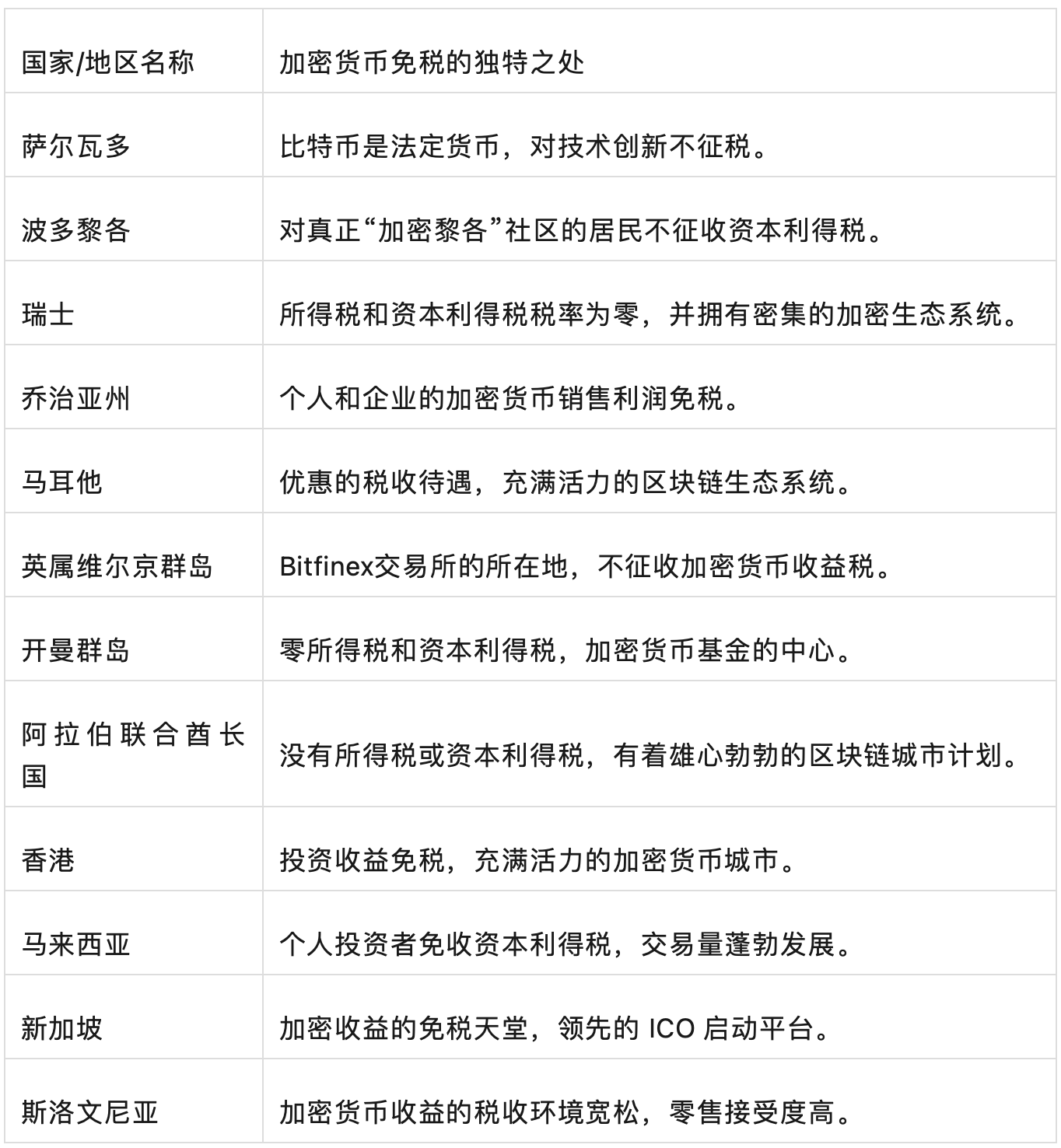
2. List of Top Crypto Tax-Free Countries/Regions in 2024
2.1 El Salvador
Overview: The first country to adopt Bitcoin as legal tender, featuring stunning landscapes and a growing economy.
Crypto Tax Policy: No capital gains tax on cryptocurrencies; foreign investors are exempt from income tax; crypto entrepreneurs can easily obtain residency.
Advantages: Favorable for avoiding crypto taxes, low cost of living; offers residency options for crypto entrepreneurs.
Challenges: High crime rates and vulnerability to natural disasters.
2.2 Puerto Rico
Overview: A U.S. territory offering unique tax conditions for American investors.
Crypto Tax Policy: No capital gains tax on digital assets acquired as a resident, though U.S. federal laws apply to assets obtained before relocation.
Advantages: Significant tax savings for U.S. citizens relocating to Puerto Rico, along with preferential territorial income tax rates.
2.3 Switzerland
Overview: Known as "Crypto Valley," Switzerland provides a tax-advantaged environment for individual investors.
Crypto Tax Policy: Capital gains from cryptocurrency investments are exempt from tax for individual investors, although wealth tax and income tax may apply in certain cases.
Advantages: Attractive due to its regulatory environment and unique opportunities for tax minimization, with specific tax regimes designed to reduce taxes on crypto transactions.
2.4 Georgia
Overview: Offers a favorable tax environment for both individuals and businesses.
Crypto Tax Policy: Individuals are exempt from income tax on crypto profits; businesses pay only a low 15% rate.
Advantages: Ideal for individual and corporate investors seeking tax efficiency.
2.5 Malta
Overview: Known as the "Blockchain Island," Malta offers a friendly regulatory framework for crypto investors.
Crypto Tax Policy: No long-term capital gains tax on cryptocurrencies, though income tax may apply depending on residency status and activities.
Advantages: Moderate to low income tax rates, attractive due to its vibrant crypto ecosystem.
2.6 British Virgin Islands
Overview: A leading offshore financial center known for its flexible regulatory regime for crypto and blockchain enterprises.
Crypto Tax Policy: The British Virgin Islands maintains a tax-neutral policy—no capital gains tax, corporate tax, income tax, or withholding tax on crypto transactions. Entities are not required to file income tax returns but must submit annual economic substance filings. Virtual asset activities are primarily governed by the Virtual Asset Service Providers Act, requiring businesses engaged in virtual asset services to register and comply with anti-money laundering regulations.
Advantages: A tax-neutral environment highly attractive to crypto businesses and investors, offering transparency and exemption from various traditional taxes.
2.7 Cayman Islands
Overview: Regarded as a global financial hub, the Cayman Islands is particularly appealing to fintech and crypto companies due to its stable political environment, tax neutrality, and advanced service providers.
Crypto Tax Policy: The Cayman Islands does not impose income tax, capital gains tax, corporate tax, or other taxes on the issuance, holding, or transfer of digital assets. Entities can obtain tax exemption certificates ensuring no future legislation will impose taxes on profits, income, gains, or appreciation for 20 to 50 years. Stamp duty may apply to certain original documents.
Advantages: Provides an exceptionally favorable tax environment for crypto businesses and investors. Additionally, the jurisdiction regulates businesses providing virtual asset-related services under the Virtual Asset Service Providers (VASP) Act, ensuring compliance while promoting innovation.
2.8 United Arab Emirates
Overview: Supported by progressive regulations and a vision to become a blockchain hub, the UAE is rapidly emerging as a primary destination for blockchain and fintech companies.
Crypto Tax Policy: Generally offers a tax-free environment for income and capital gains for both individuals and businesses, though specific policies may vary across emirates.
Advantages: Strategic location, state-of-the-art infrastructure, and strong government support for innovation make it an ideal base for crypto startups and investors.
2.9 Hong Kong
Overview: As a major financial center, Hong Kong features a thriving crypto sector with a favorable regulatory and tax environment for crypto investment.
Crypto Tax Policy: No capital gains tax on cryptocurrency investments, making it an attractive hub for crypto traders and businesses.
Advantages: Strategic access to Asian markets, robust legal framework, and a dynamic financial technology innovation ecosystem.
2.10 Malaysia
Overview: Malaysia is becoming increasingly crypto-friendly, introducing regulations that support the use of cryptocurrencies and blockchain technology.
Crypto Tax Policy: No capital gains tax on crypto transactions, encouraging crypto investment and trading activity.
Advantages: Government initiatives supporting blockchain technology and a growing fintech startup ecosystem.
2.11 Singapore
Overview: A global financial center taking a proactive approach to crypto and blockchain regulation, fostering a thriving fintech ecosystem.
Crypto Tax Policy: No capital gains tax on cryptocurrency investments, with a supportive regulatory framework for fintech and blockchain businesses.
Advantages: Strategic location in Asia, strong economy, and government support for innovation and tech startups.
2.12 Slovenia
Overview: Slovenia is known for its positive stance on cryptocurrency, offering a supportive environment for crypto businesses and investments.
Crypto Tax Policy: Favorable tax policies for cryptocurrencies, including tax incentives for crypto investors and enterprises.
Advantages: Growing recognition as a blockchain-friendly nation, with a vibrant community of blockchain startups and enthusiasts.
3. Success Stories from Crypto Tax-Free Countries
Below are two success stories from crypto tax-free jurisdictions, offering valuable insights into how strategic relocation or investment can drive business growth and personal wealth management in tax-advantaged environments.
3.1 El Salvador Embraces Bitcoin
El Salvador made history by becoming the first country to adopt Bitcoin as legal tender—an unprecedented move. This decision was not merely symbolic but brought tangible economic benefits. By eliminating capital gains tax on Bitcoin and offering crypto entrepreneurs a streamlined path to residency, El Salvador positioned itself as a pioneer in the crypto world. Following the shift, the country experienced economic improvement, achieving a 10% GDP growth rate in 2021, significantly reducing remittance fees, increasing tourism by over 30%, and boosting exports by more than 13%. The adoption of Bitcoin not only enhanced El Salvador’s economic resilience but also demonstrated the potential of cryptocurrency to drive national growth.
3.2 Bermuda's Comprehensive Digital Asset Regulation
Bermuda enacted the Digital Asset Business Act in 2018, creating a favorable environment for crypto enterprises. With no income tax or capital gains tax, the island attracted major crypto firms such as Gemini, Bittrex, and Circle. The ability to pay taxes using Circle’s USDC in Bermuda exemplifies the country’s innovative approach to integrating digital currencies into its financial system, solidifying its position as a leading crypto hub.
4. How to Choose the Right Country for You?
Factors to consider include the legal requirements and financial implications of the jurisdiction, lifestyle preferences, and personal or business needs. Each country offers a unique combination of advantages catering to different priorities.
5. Conclusion
This article underscores the strategic importance of selecting the right crypto tax-free country in 2024. By providing a comprehensive overview of available destinations, it equips investors with the knowledge needed to optimize their cryptocurrency investments within tax-advantaged environments.
Join TechFlow official community to stay tuned
Telegram:https://t.me/TechFlowDaily
X (Twitter):https://x.com/TechFlowPost
X (Twitter) EN:https://x.com/BlockFlow_News










