









How to launch a crypto fund with low cost and fast compliance?
TechFlow Selected TechFlow Selected
How to launch a crypto fund with low cost and fast compliance?
Selecting an appropriate fund structure and ensuring compliance is critical for the management of crypto assets.
 Navigating Web3 tides with focused insights
Author: Jin Jianzhi
The development of the Web3.0 industry is booming, with blockchain technology and cryptocurrencies bringing unprecedented investment opportunities. More and more people want to seize this trend and achieve wealth growth through investment. However, in practice, many lack relevant knowledge and experience, so they hope to have professionals or institutions invest on their behalf—this has led to growing demand for entrusted asset management and fund establishment.
In particular, setting up crypto funds has become an essential part of the crypto ecosystem. Manqin Law frequently receives such inquiries—for example, how to legally accept other people’s capital, and what are the requirements and procedures for establishing a crypto fund. Therefore, this article will analyze the differences and applicable scenarios of various approaches, and explore how to launch a crypto fund at low cost and high speed.
Why Establish a Crypto Fund?
First, we must understand that the essence of a fund lies in collective investment—wealthy investors pool their capital for commercial investments, aiming to diversify risk, gain professional management, and ultimately achieve higher returns. Second, there are multiple ways to realize collective investment. Common methods include: entrusted asset management, forming partnerships/companies, and establishing funds. Each method has its unique characteristics and suitable contexts.
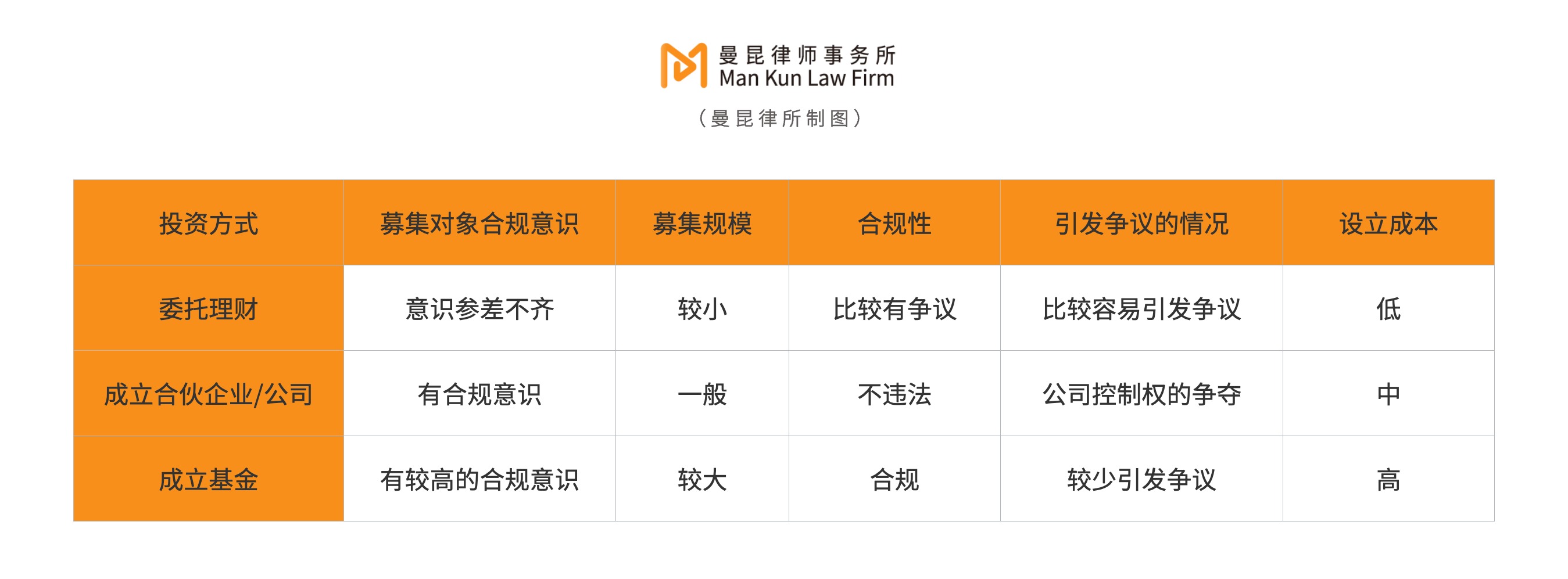
Overall, entrusted asset management is the lowest-cost but highest-risk option, commonly used for small-scale personal arrangements. Forming a partnership or company offers higher compliance and lower risk, though internal conflicts among shareholders may arise as the business matures. A fund represents the most modern and civilized form of collective investment—it effectively protects investors, enables specialists to manage assets professionally, and supports large-scale capital management. This is precisely why the Web3.0 industry widely opts to establish crypto funds. After all, the Web3.0 sector itself carries high risks and, due to its high entry barriers and technical complexity, is not investor-friendly for traditional market participants.
However, unlike traditional industries where funds can be established almost anywhere, in the Web3.0 space, offshore funds are the mainstream choice.
Why Choose an Offshore Fund?
Offshore funds are highly favored by global investors due to their unique advantages, which manifest in the following aspects:
-
Tax Efficiency: Offshore funds are established in low-tax jurisdictions such as the Cayman Islands, enjoying zero corporate tax and capital gains tax, significantly reducing tax burdens for both the fund and its investors and enhancing net returns.
-
Privacy and Confidentiality: Offshore funds offer greater privacy protection. Investor identities and transaction details do not need to be publicly disclosed, making them highly attractive to those who wish to keep their investment strategies or personal information confidential.
-
Free Capital Movement: Offshore funds enjoy freer capital flows. With no strict capital controls, funds can move across borders freely, facilitating global investments and attracting investors from around the world.
-
Cost-Effectiveness: The operational and management costs of offshore funds may be lower. Due to the relaxed regulatory environment in offshore jurisdictions, setup and maintenance fees are reduced, improving overall cost efficiency.
How to Register an Offshore Fund?
According to previous articles published by Manqin lawyer Jin Jianzhi, such as “Web3 Project Compliance: Why Choose a Cayman Foundation for Token Issuance?”, taking a Cayman fund as an example, a standard crypto fund typically requires the following compliance setup:
Regulatory Registration
-
Registration Timeline: Submit registration within 21 days of accepting capital commitments; no call for actual contributions may be made before registration is completed.
-
Required Documents: Submit foundational fund documents, consent letters from auditor/administrator, and notarized director affidavits.
-
Directors and Management: At least two natural person directors; appoint two anti-money laundering officers.
Audit and Financial Statements
-
Appoint a Cayman-based auditor approved by CIMA.
-
Submit audited financial statements to CIMA within six months after the fiscal year ends.
-
Maintain financial records for at least five years, ensuring they are complete and accurate enough to reflect and explain transactions.
Valuation and Conflict of Interest Disclosure
-
Establish appropriate and continuous valuation procedures, conducting valuations at least annually.
-
Clearly disclose any conflicts of interest within the fund.
Asset Custody and Cash Management
-
Fund assets are usually held by a custodian unless explicitly notified otherwise to CIMA.
-
Clear cash monitoring requirements, which may be fulfilled by the general partner (GP).
Security Identification and Fundraising Documentation
-
The fund should maintain security identification numbers for all transactions, available upon request by CIMA.
-
Prepare fundraising documents or term sheets to ensure compliance with relevant regulations.
Therefore, a conventional fund involves various parties such as auditors, custodians, administrators, and lawyers to maintain operations. Undoubtedly, this increases operational costs. Although these costs are ultimately borne by investors, committing significant operational expenses early in the project lifecycle—when investment returns are uncertain—poses a major challenge for both fund managers and investors alike.
How to Launch a Crypto Fund at Low Cost?
After extensive experimentation and exploration, Manqin Law has identified a cost-effective approach to fund formation—the BVI Incubator Fund. This structure has extremely low entry thresholds: no more than 20 investors, each investing at least $20,000, and minimal setup costs.

At the same time, the BVI Incubator Fund is a regulated entity supervised by the BVI Financial Services Commission and can later convert into other types of funds. Based on Manqin Law's assessment, it is particularly well-suited for various Web3.0 projects.
When establishing a BVI Incubator Fund, Web3.0 projects should pay attention to the following compliance points:
Registration Process
-
Regulatory registration: Business activities may commence within two working days after the Financial Services Commission receives the application.
-
Submission materials: Foundational fund documents and one authorized representative.
Director Appointment and Management
At least two directors, one of whom must be a natural person. One anti-money laundering officer must be appointed, who may be an internal party of the fund.
Audit Requirements
Financial statements must be submitted, but audit is not required.
Valuation Process
Establish appropriate and continuous valuation procedures, conducting valuations at least once per year.
Fundraising Document Preparation
Prepare fundraising documents or term sheets in accordance with relevant regulations.
Notably, during the establishment and operation of a BVI incubator fund, Chinese founders must avoid accepting onshore RMB from mainland investors, refrain from assisting investors in exchanging into stablecoins (e.g., USDT), and avoid public fundraising or promotional activities.
Summary
In today’s rapidly evolving Web3.0 landscape, selecting the right fund structure and ensuring compliance are crucial for effective crypto asset management. The BVI Incubator Fund, with its low entry barrier, fast setup process, and low costs, emerges as an ideal option—particularly suitable for early-stage Web3.0 projects and smaller investor groups.
Join TechFlow official community to stay tuned
Telegram:https://t.me/TechFlowDaily
X (Twitter):https://x.com/TechFlowPost
X (Twitter) EN:https://x.com/BlockFlow_News










