








How BlackRock, Fidelity, and JPMorgan Are Dominating RWA?
TechFlow Selected TechFlow Selected
How BlackRock, Fidelity, and JPMorgan Are Dominating RWA?
Fidelity International recently announced its joining of JPMorgan's tokenized network.
 Navigating Web3 tides with focused insights
Source: beincrypto
Compiled by: Blockchain Knight
Interest in tokenizing real-world assets (RWA) has surged as financial giants like BlackRock, Fidelity, and JPMorgan take the lead.
This trend signals a major shift in finance, indicating growing adoption of blockchain technology to enhance efficiency and accessibility in capital markets.
Fidelity International's recent announcement to join JPMorgan’s tokenization network marks a significant milestone.
According to Kaiko analysts, this move positions Fidelity International alongside other major players in the tokenization space. The collaboration further highlights increasing interest in leveraging blockchain for practical applications.
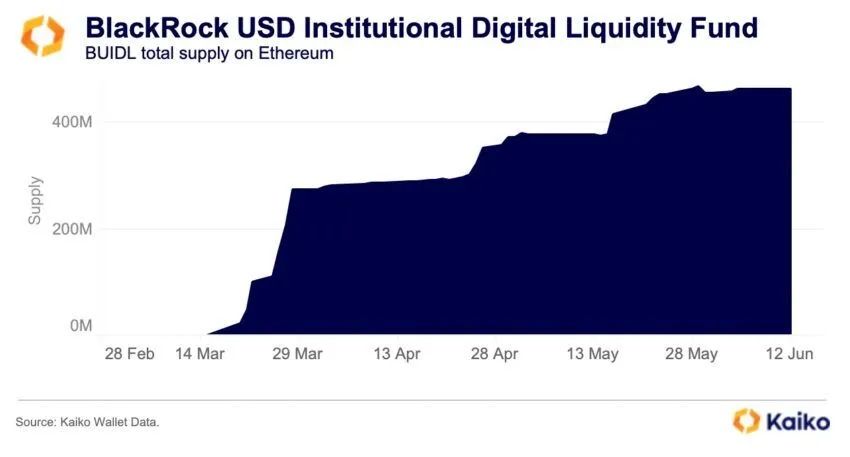
BlackRock’s tokenized liquidity fund, BUIDL, exemplifies this trend.
Launched in March this year, BUIDL has already accumulated over $460 million in assets, surpassing several crypto-native firms such as Maple Finance.
Although Maple has been recovering from the 2022 crypto lending collapse, its Cash Management Fund lags behind with approximately $16 million in assets, underscoring BUIDL’s success.
"Since its launch in March, BlackRock's BUIDL has surpassed several crypto-native companies," wrote Kaiko analysts, "including Maple Finance's cash management fund, which focuses on short-term cash instruments."
The appeal of blockchain technology lies in its potential to transform capital markets.
Maredith Hannon, Head of Business Development at WisdomTree, emphasized this point, noting that blockchain can address infrastructure challenges and unlock new investment opportunities. Its ability to streamline workflows and shorten settlement times is particularly compelling.
Smart contracts are at the heart of this transformation, enabling transaction automation by executing predefined conditions without intermediaries.
These self-executing contracts ensure transparency and efficiency, recording actions on the blockchain. For example, in securities lending, smart contracts can automate operations, reduce errors, and create standardized identity credentials.
"Smart contracts offer opportunities to simplify and systematize many steps or manual transactions in today's traditional financial markets," said Hannon.
"They can be used to share identities and usage credentials among financial institutions, eliminate counterparty risk, and verify investor eligibility—such as whether an investor based in a certain jurisdiction is permitted to hold a specific private equity fund."
The collaboration between Citigroup, Wellington, and DTCC Digital Asset Company on the Avalanche Spruce Subnet demonstrates real-world applications of smart contracts. These initiatives also illustrate how tokenization can improve operational efficiency and reduce counterparty risk.
However, transitioning to digital infrastructure also presents challenges.
Legal considerations, identity standards, and data privacy require careful evaluation in coordination with regulators. The financial services industry must work together to build an identity infrastructure that supports broader adoption of tokenization while ensuring security and compliance.
Join TechFlow official community to stay tuned
Telegram:https://t.me/TechFlowDaily
X (Twitter):https://x.com/TechFlowPost
X (Twitter) EN:https://x.com/BlockFlow_News
 @beincrypto






