Bitcoin Ecosystem Milestone: Zulu Leverages Bitcoin Script to Achieve ZKP Verification
TechFlow Selected TechFlow Selected
Bitcoin Ecosystem Milestone: Zulu Leverages Bitcoin Script to Achieve ZKP Verification
Implemented ZKP for Bitcoin script, meaning the Bitcoin network can verify Layer2.
 Navigating Web3 tides with focused insights
Author: Ri Yue Xiao Chu
A significant milestone recently occurred in the Bitcoin ecosystem: Zulu announced the first-ever zk-SNARK verification (ZKP) implementation using Bitcoin Script. This includes mainstream algorithms such as Groth16 and FFlonk, with code contributions submitted to the BitVM repository.
Enabling ZKP within Bitcoin Script means that the Bitcoin network can now verify Layer 2 transactions. This marks a true Layer 2 solution—one that inherits the security of the Bitcoin network through its Proof-of-Work (PoW) mechanism, arguably the most secure blockchain network in existence.
Due to Bitcoin's limited programmability, achieving ZKP has been particularly challenging. Most existing Bitcoin L2 solutions are not truly Layer 2 systems because their on-chain states cannot be directly verified on the Bitcoin network. Currently, these projects generate a zk proof and publish it onto the BTC network—but this proof is not validated by Bitcoin itself, but rather by roles within their own networks. As a result, the L2 state remains decoupled from the Bitcoin network.
This stands in clear contrast to Ethereum’s Layer 2 solutions. Whether zk-rollups or op-rollups, both bundle data and submit it for validation on Ethereum’s mainnet. The primary advantage of Ethereum’s Layer 2 over other public chains lies precisely in Ethereum guaranteeing their security.
Becoming a Bitcoin-verified Layer 2 brings the major benefit of inheriting Bitcoin’s unparalleled security. Bitcoin’s security clearly surpasses that of Ethereum. Currently, there are two ways to genuinely inherit Bitcoin’s security. The first, exemplified by Babylon, involves staking native BTC to form a PoS network that manages and penalizes malicious actors. When the amount of staked BTC is substantial, the cost of misconduct becomes prohibitively high, thus ensuring security. However, this approach requires a large quantity of BTC to be staked upfront.
The second method leverages Bitcoin’s own PoW network. As the first and highest-market-cap blockchain, Bitcoin has securely operated for 14 years with the highest global hash rate, making its security self-evident. A critical step toward inheriting Bitcoin’s security is enabling BTC to perform verification—precisely the significance of Zulu’s recent ZKP breakthrough. The last time I paid attention to Zulu Network was when it pioneered a dual-layer Bitcoin architecture. This latest achievement in zk-SNARK verification further demonstrates Zulu’s formidable technical capabilities.
Importance of zk-SNARK
SNARK (Succinct Non-Interactive Argument of Knowledge) is a succinct, non-interactive proof system built on mathematical algorithms, allowing verifiers to confirm data correctness without accessing the original data. As we know, Ethereum Layer 2 currently features both zk-rollups and op-rollups. Op-rollups are widely seen as an interim solution, while zk-rollups represent the ultimate form. This is because zk-rollups use zk algorithms to batch transactions and generate SNARK proofs submitted to the main chain, where all transactions in the batch are verified. zk-SNARK enables effective privacy protection and strong scalability, earning praise from Vitalik Buterin as one of the most crucial technologies for the next decade.
BitVM
It’s essential to introduce BitVM here. Before BitVM, Bitcoin’s scripting language was considered non-Turing-complete. Despite extensive efforts by many developers, this limitation remained unresolved—until October last year, when Robin Linus released the groundbreaking BitVM. His approach involved verifying a special type of logic gate called the NAND gate (“not-and” gate) within Bitcoin scripts. The NAND gate is a fundamental computing primitive at the physical/electrical level, and all possible computations can be constructed from NAND gates alone.
Recently, Robin proposed the BitVM 2 design, which no longer uses direct script-based NAND gates, but instead employs them to build a universal SNARK zero-knowledge proof verifier.
The significance of BitVM lies in enabling verification via the Bitcoin network—without requiring upgrades or forks, and without imposing any additional burden on BTC. Complex computations are handled off-chain by Layer 2, while security is inherited from the main chain. Given BitVM’s profound implications, numerous Layer 2 projects have begun building upon it. For example, Bitlayer adopts BitVM as a core component, implementing a layered virtual machine (Layered Virtual Machine) as its Layer 2 solution.
Within Zulu Network, BitVM plays a crucial role. Moreover, Zulu is also a key contributor to BitVM—implementing zk-SNARK verification using Bitcoin Script represents the most critical step forward for BitVM. Zulu has made substantial contributions to the official BitVM 2 GitHub repository, earning high recognition from BitVM’s creator, Robin Linus.
Last week, Zulu completed the segmentation of the Groth16 script. With two public inputs, it was split into 1,701 sub-scripts, totaling under 4MB in size and maintaining a stack depth below 1,000. This successful script segmentation marks another milestone toward BitVM’s commercialization. Thanks to Zulu’s outstanding work, BitVM2 is now poised to achieve the first-ever SNARK proof on Bitcoin shortly—a testament to Zulu’s technological leadership.

Caption: Zulu's technical progress has received high praise from BitVM inventor Robin Linus
Finally, a brief introduction to Zulu Network
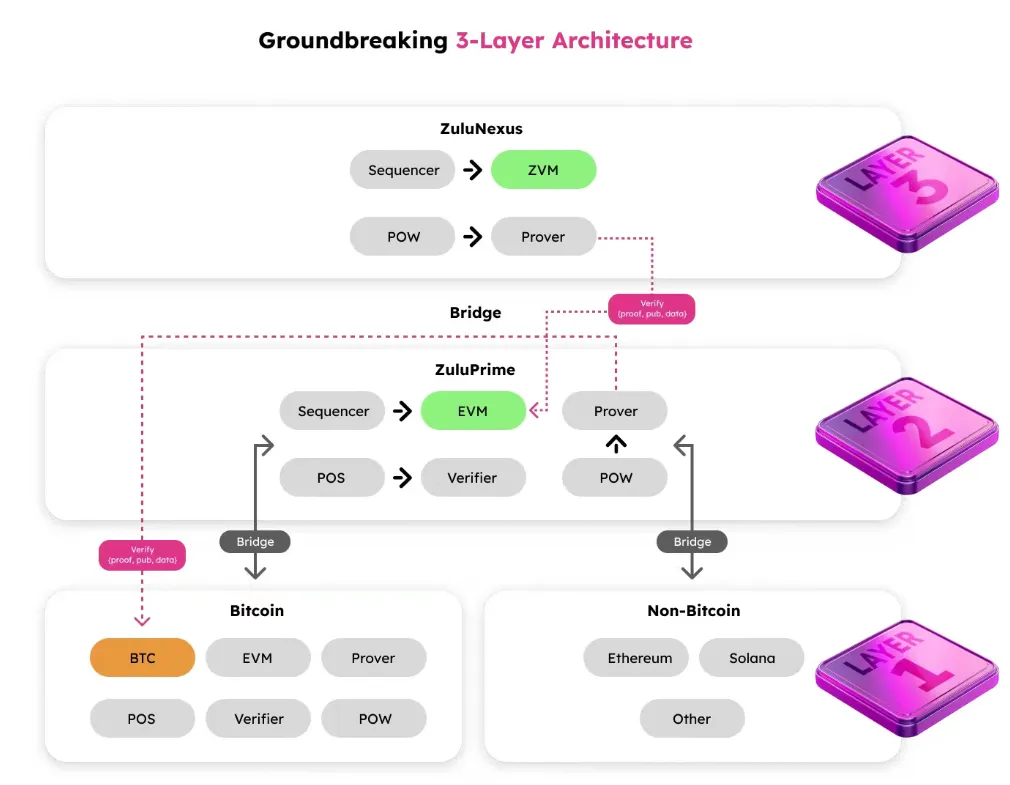
Zulu Network is the first dual-layer network in the Bitcoin ecosystem. Its Layer 2, called ZuluPrime, is EVM-compatible, enabling low-cost, rapid deployment of EVM-based projects and fostering ecosystem growth. The other layer, Layer 3, named ZuluNexus, innovatively unifies UTXO and account-based asset models, enabling smart contract innovations based on the UTXO model. This allows full utilization of UTXO’s advantages while supporting future innovations on UTXO. Zulu is currently developing two products:
-
A Zulu Bridge capable of verifying off-chain states via ZKP, supporting asset issuance
-
The first decentralized ZK bridge enabling users to perform cross-chain operations with arbitrary amounts
Zulu has not yet launched a token. Those interested in early participation can join Zulu’s current testnet points campaign. For details, refer to the official documentation: https://www.yuque.com/zulunetworkzhongwenshequn/zvggg8/kr9epkg0v27rh860?singleDoc#
Join TechFlow official community to stay tuned
Telegram:https://t.me/TechFlowDaily
X (Twitter):https://x.com/TechFlowPost
X (Twitter) EN:https://x.com/BlockFlow_News
 @riyuexiaochu