








From Theory to Practice: Can a Based Rollup Achieve an L1 Sequencing-Driven Rollup Solution?
TechFlow Selected TechFlow Selected
From Theory to Practice: Can a Based Rollup Achieve an L1 Sequencing-Driven Rollup Solution?
An L2 network node consists of several components, the most important being the sequencer, but currently sequencers in Rollups face centralization issues.
 Navigating Web3 tides with focused insights
Author: YBB Capital Researcher Ac-Core
Introduction
Ethereum operates on the principle that every node stores and executes every transaction submitted by users. To scale the network, Ethereum has adopted Rollup solutions. In simple terms, Rollups move most transaction processing off-chain (L2), thereby reducing the burden on Ethereum's mainnet (L1) and lowering transaction fees. A Rollup consists of a set of smart contracts on L1 and network nodes on L2—essentially on-chain smart contracts and off-chain aggregators. These rely on Ethereum for settlement, consensus, and data availability, while only handling execution. The L2 network nodes consist of several components, with the sequencer being the most critical. However, current Rollup sequencers face significant centralization issues.
Rollups and Sequencers
A Rollup is a layer-1 (L1) scaling solution for Ethereum that executes transactions off-chain and batches them into blocks. For each block, the Rollup publishes the data required to reconstruct the chain state (as a source of data availability) to a data availability layer, and posts proofs of correct off-chain execution to a settlement layer. There are two types of Rollups: in ZK-Rollups, zero-knowledge proofs are published for every block; in Optimistic Rollups, fraud proofs are only published when disputes arise. After EIP-4844, when data publication shifts to blobs, this layer may be referred to as the "data publishing layer." Rollup smart contracts on L1 verify these published proofs, and each Rollup typically includes one or more bridges enabling data transfer between chains, including deposits and withdrawals.
Within the Rollup architecture, the sequencer is a key component responsible for receiving transaction requests from users or applications, determining their execution order, batching them, and ultimately submitting these batches to the Rollup smart contract on L1—playing a vital role in improving transaction efficiency and reducing costs.
The sequencer’s functionality and operation can be broken down into four main parts:
1. Transaction reception: The sequencer receives transaction requests from users or dApps. These transactions are first processed on L2 rather than directly on the Ethereum mainnet;
2. Transaction ordering: The sequencer orders the received transactions, determining their sequence of execution—a process similar to what Ethereum miners do before packaging transactions into blocks;
3. Transaction batching: The sequencer packages the ordered transactions into batches containing aggregated information from multiple transactions;
4. Submission to L1: Finally, the sequencer submits the batched transactions to Ethereum’s mainnet (L1) for settlement and data storage. This allows L1 to validate and store state updates from L2.
Although Rollup technology offers an effective scaling approach, challenges remain in sequencer design and implementation. Chief among them is centralization—most Rollup projects currently rely on centralized sequencers, often controlled by a single entity or small group. This introduces clear risks such as lack of transparency and single points of failure.
Beyond these rigid technical explanations, discussions around decentralized L2 sequencer solutions—such as Metis opening its sequencing pool to public staking, or independent projects like Espresso—ultimately revolve around how the "sequencing profit pie" is distributed and expectations for future market hype. Thus, the real crux lies in balancing interests and legitimacy.
Historical Background and Design of Based Rollups

Image source: @drakefjustin
The concept of Rollups was first proposed by Ethereum co-founder Vitalik Buterin, originally envisioning a completely unrestricted “Total Anarchy” state allowing unlimited transaction scalability. Building upon the aforementioned issues with current sequencers, in 2023, Ethereum researcher Justin Drake introduced the idea of Based Rollups—where sequencing is managed directly by Ethereum L1 itself. The proposal is outlined below (source in extended links):
Definition:
“When a Rollup’s sequencing is driven by the base layer (L1), we call it an L1-based or L1-sequenced Rollup. Specifically, an L1-based Rollup enables the next L1 proposer to collaborate with L1 searchers and builders to permissionlessly include the next Rollup block within the next L1 block.”
Advantages:
● Liveness: Based Rollups inherit the same liveness guarantees as L1. Note that non-Based Rollups equipped with escape hatches have reduced liveness (an escape hatch is a safety mechanism in Rollups allowing users to withdraw assets securely from L2 back to the L1 mainchain when problems occur—it acts like an emergency exit);
Weaker settlement guarantee: Transactions via escape hatches must wait through a timeout period before final settlement;
MEV under censorship: Rollups with escape hatches are vulnerable during the timeout window to adverse MEV caused by short-term sequencer censorship;
Risk to network effects: Mass exits triggered by sequencer liveness failures (e.g., a 51% attack on a decentralized PoS sequencing mechanism) could severely damage the Rollup’s network effect. Unlike L1, Rollups cannot use social consensus to recover gracefully from sequencer liveness failures. In all known non-Based Rollup designs, mass exit remains a Damoclean sword;
Gas penalties: Transactions settled through escape hatches often incur gas penalties for users (e.g., due to suboptimal data compression from non-batched transactions).
● Decentralization: Based Rollups inherit L1’s decentralization and naturally reuse the existing L1 searcher-builder-proposer infrastructure. L1 searchers and builders are incentivized to include Rollup blocks in their L1 blocks to capture Rollup MEV, which in turn motivates L1 proposers to package those Rollup blocks.
● Simplicity: Based Rollup sequencing is the simplest approach—even simpler than centralized sequencing. It eliminates the need to verify sequencer signatures, implement escape hatches, or maintain external PoS consensus mechanisms.
Historical note: In January 2021, Vitalik referred to L1-based sequencing schemes as “complete anarchy,” noting the risk of multiple Rollup blocks being submitted simultaneously, leading to wasted gas and computational effort. Today’s Proposer-Builder Separation (PBS) model enables strictly controlled L1 sequencing—one Rollup block at most per L1 block—with no gas waste. When a Rollup’s n+1 block (or n+k for k ≥ 1) includes the SNARK proof of block n, proof work in ZK-Rollups can also be preserved.
● Cost: Based Rollups have zero gas overhead—they don’t even require signature verification from centralized or decentralized sequencers. Their simplicity reduces development cost, accelerates launch timelines, and minimizes exposure to code vulnerabilities. Moreover, Based Rollup sequencing requires no native token, avoiding regulatory burdens associated with token-based sequencers.
● L1 Economic Alignment: MEV generated by Based Rollups naturally flows to the underlying L1. This strengthens L1’s economic security and increases scarcity of the L1 native token if MEV is burned. This tight economic integration with L1 may enhance the legitimacy of Based Rollups. Importantly, despite forgoing MEV revenue, Based Rollups retain the option to earn income from L2 congestion fees (e.g., L2 base fees in an EIP-1559 format).
● Sovereignty: Despite delegating sequencing to L1, Based Rollups preserve sovereignty. They can still have governance tokens, collect base fees, and use those revenues appropriately—for example, funding public goods as Optimism does.
Disadvantages:
● No MEV revenue: Based Rollups relinquish MEV to L1, limiting their income to base fees alone. Counterintuitively, this might actually increase total revenue. Given that the Rollup landscape appears winner-takes-all, the winning Rollup may leverage the security, decentralization, simplicity, and alignment of Based Rollups to dominate and ultimately maximize revenue.
● Constrained sequencing: Delegating sequencing to L1 reduces flexibility, making certain sequencing services harder—or even impossible—to implement:
○ Pre-confirmations: Fast pre-confirmations are not an issue for centralized sequencers and can be achieved via external PoS consensus. Achieving fast pre-confirmations using L1 sequencing remains an open problem, though promising research directions exist, including EigenL, inclusion lists, and builder bonds.
○ First-come-first-served (FCFS): FCFS sequencing à la Arbitrum may not be feasible on Based Rollups. EigenL might offer an FCFS overlay for L1-sequenced Based Rollups.
Naming:
The term “Based Rollup” stems from its close relationship with the base chain (Base L1). This coincidentally conflicts with Coinbase’s recently announced Base chain—an interesting overlap. In fact, Coinbase outlined two design goals in their Base announcement:
● Tokenlessness: “We have no plans to issue a new network token.”
● Decentralization: “We [...] plan to gradually decentralize the blockchain over time.”
Base could achieve tokenless decentralization by becoming a Based Rollup.
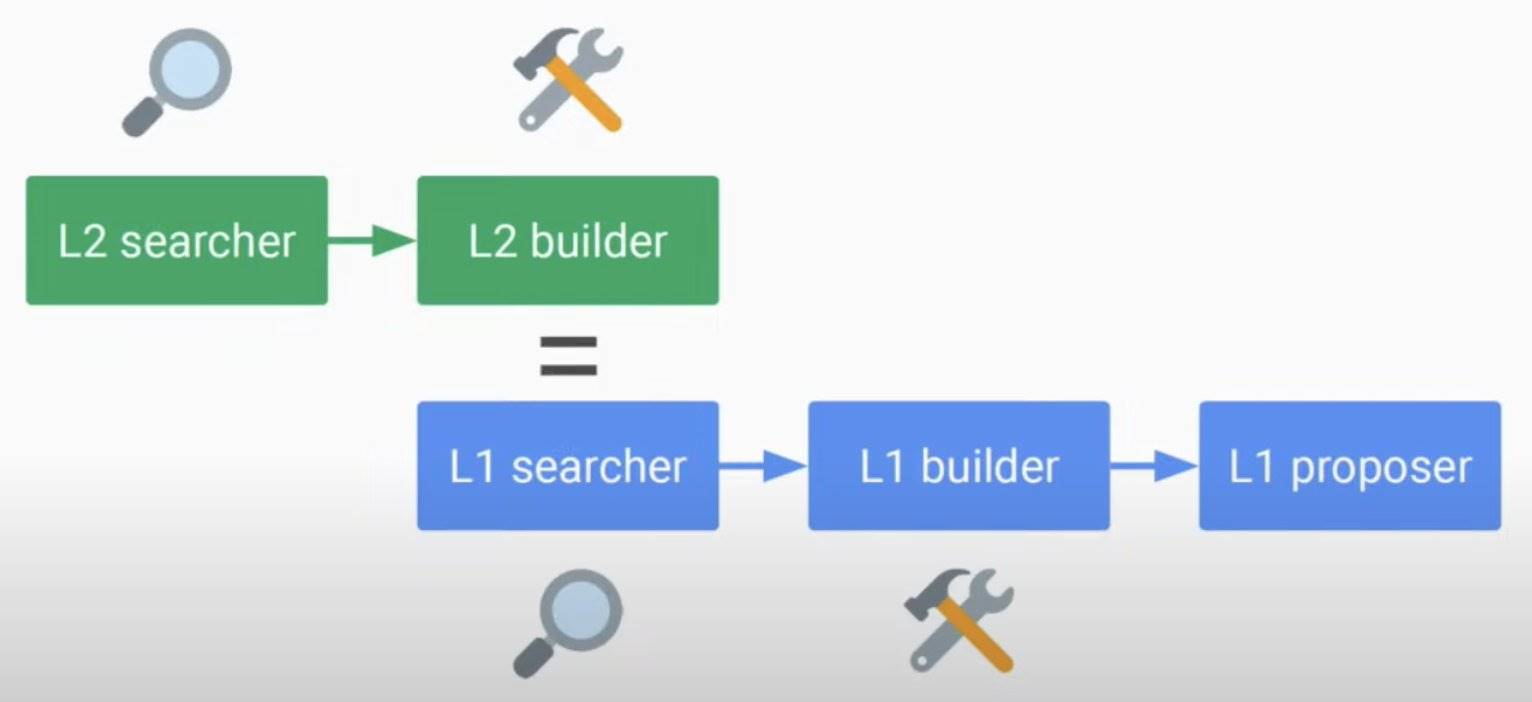
Image source: @jchaskin22
In summary, Based Rollups allow anyone to extend Rollup blocks—simply publish post-execution state changes to L1 to extract MEV from L2, with all sequencing and security provided by Ethereum L1. This avoids the need for external proof-of-stake consensus or Rollup-specific tokens. Compared to other Rollups that require essential “emergency escape hatches” to safeguard assets, Based Rollups aim to eliminate this entirely—so long as Ethereum remains secure, transactions on the Rollup can proceed smoothly.
Taiko Labs on Based Rollups
Image source: Taiko official website
Taiko Labs is the primary team developing and promoting Based Rollups—an initiative focused on Ethereum Layer 2 scaling. Its vision is to solve Ethereum’s scalability challenges through innovative technologies like Based Rollups. It features three core characteristics:
1. Fully Ethereum-equivalent EVM (Type 1) ZK-EVM: The Type 1 zkEVM used ensures full compatibility with Ethereum, allowing developers to seamlessly migrate dApps between Ethereum and Taiko without worrying about smart contract execution failures;
2. Open-source: All Taiko source code is publicly available on GitHub, allowing anyone to view, build, or modify it. This open-source model ensures blockchain development isn’t limited to a small team but benefits from global community and developer contributions;
3. Fully decentralized: Beyond ensuring high EVM compatibility, Taiko is committed to full protocol decentralization. It plans to use decentralized proposers and provers to submit blocks and generate zkPs, preserving the system’s decentralized nature.
Taiko aims to build a Type 1 fully Ethereum-equivalent ZK-EVM—the kind referenced by Vitalik Buterin in “The Different Types of ZK-EVMs” (see extended link 2)—pursuing complete, uncompromising equivalence with Ethereum. The goal is full compatibility to enable verification of Ethereum blocks (at least the execution layer, excluding beacon chain consensus but including all transactions, smart contracts, and account logic, without replacing hashes, state/transaction trees, or other consensus logic). As such, compared to other types, Type 1 represents the most complex and challenging path toward a native-like solution.
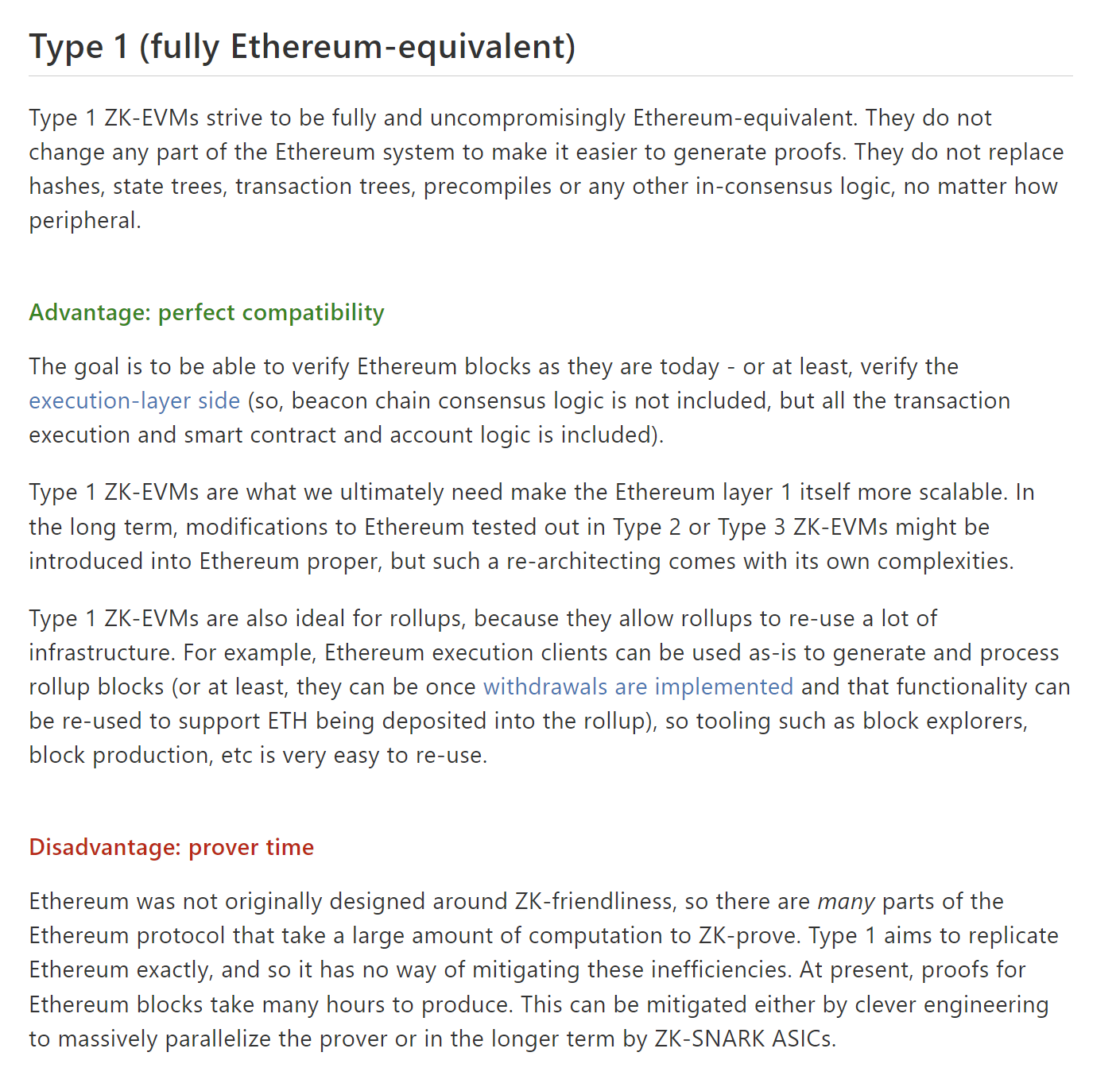
Image source: Vitalik Buterin, “The Different Types of ZK-EVMs”
Other Core Architectures:
Base Competitive Rollup (BCR)
BCR is an innovative blockchain scaling solution developed by Taiko Labs. BCR aims to improve Rollup efficiency and security through a competitive mechanism, enabling different participants to freely compete in submitting blocks and generating proofs—thus enhancing overall network performance and decentralization. Key aspects are summarized below.
● Features
Open competition: Allows any qualified participant to compete in block submission and proof generation. This open mechanism reduces centralized control and enhances network decentralization. Competitors earn rewards and transaction fees by providing higher-quality service;
Efficient scalability: Effectively improves block generation and validation efficiency. Multiple competitors can work in parallel, eliminating single-point bottlenecks and increasing transaction throughput and network scalability;
Security: The multi-party competitive mechanism enhances resistance to attacks. Blocks and proofs generated by multiple parties increase transparency and security, making it difficult for any single entity to control or compromise the system.
● Advantages
EVM Compatibility: BCR is fully compatible with the Ethereum Virtual Machine (EVM), enabling existing Ethereum smart contracts and dApps to migrate easily without major modifications;
High Throughput: By enabling parallel transaction processing and block generation, BCR significantly increases network throughput, handles higher transaction volumes, and reduces costs and latency;
Decentralization: Decentralized block generation and proving mechanisms ensure network decentralization and reduce the risk of control by centralized entities.
● Disadvantages
Increased complexity: Requires sophisticated algorithms and protocols to coordinate block generation and validation among multiple competitors. Smart contracts may need additional logic to handle competition outcomes;
Potential issues: Under BCR’s competitive mechanism, simultaneous computation and submission by multiple competitors could lead to rising fees. Users may face higher transaction costs, especially during peak network activity or intense competition. Additionally, well-resourced large nodes may gain disproportionate advantages, leading to centralization.
Based Booster Rollup (BBR)
In BBR, a booster is a special participant responsible for optimizing transaction batches—compressing transaction data and processing multiple batches in parallel. Its practical function is to separate execution from storage, maintaining L2 execution while keeping L1 decentralized, and ensuring smart contract addresses remain consistent across L1 and all BBRs.
At the same time, it faces challenges such as increased system complexity, resource consumption, and potential centralization. Going forward, BBR will require further optimization and expansion to meet the evolving demands of blockchain technology.
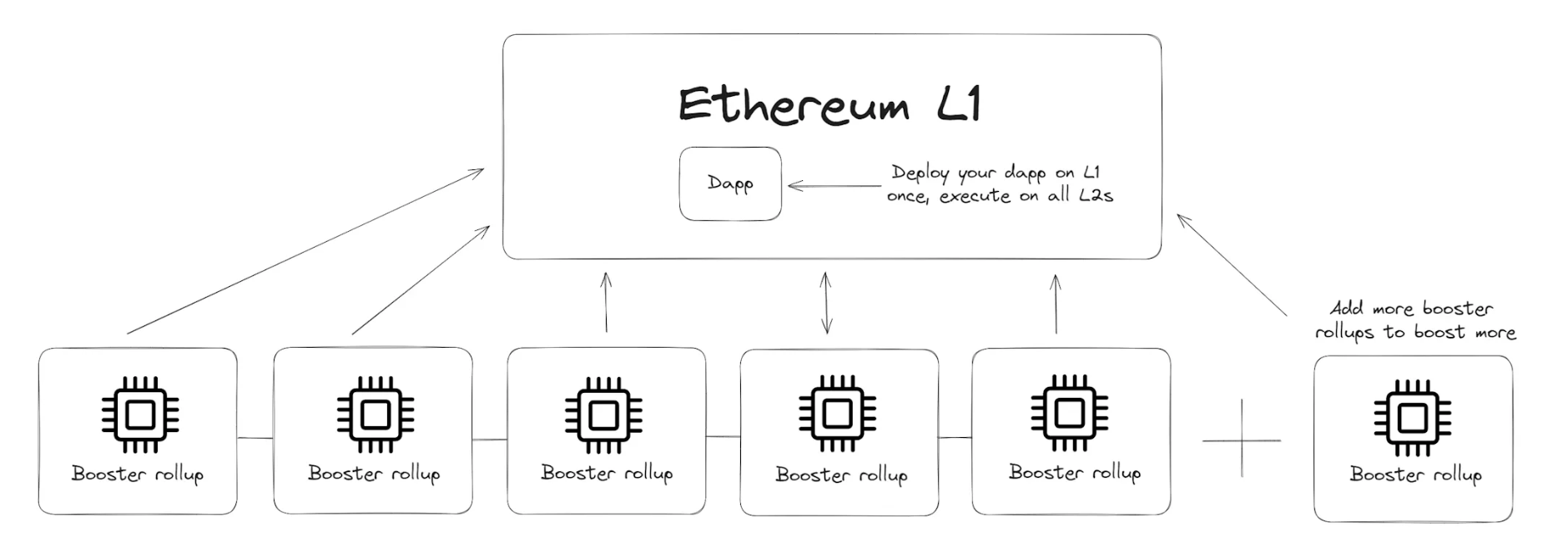
Image source: Taiko Labs
Conclusion
Overall, Based Rollups represent a transformative shift in Ethereum’s Layer 2 scaling paradigm—delegating Rollup sequencing directly to L1 proposers and leveraging proposer-builder separation so that L1 performs all sequencer roles. It also expands MEV opportunities: L2 searchers can bundle transactions and send them to L2 builders—who are also L1 searchers—and these complete L2 blocks then become part of L1 blocks, ultimately processed by L1 builders and the Ethereum mainnet.
Whether Based Rollups can be considered the ultimate solution for Rollups remains to be seen. Nevertheless, there’s no denying they represent a major innovation in Ethereum’s Layer 2 scaling—offering a safer and more decentralized alternative. If similar thinking were applied to Bitcoin’s ecosystem, achieving native, decentralized VM scalability comparable to Ethereum would be equally challenging. Thus, the entire industry still has a long way to go in solving the true challenge of decentralized scaling.
Extended Links:
【1】Based rollups—superpowers from L1 sequencinghttps://ethresear.ch/t/based-rollups-superpowers-from-l1-sequencing/15016/1
【2】The different types of ZK-EVMs
References
【1】The Game of Trust: Rollups Controlled by Multisigs and Committees
【2】Taiko Report: A Seamless Scaling and Fully Compatible Ethereum Layer 2 Solution
Join TechFlow official community to stay tuned
Telegram:https://t.me/TechFlowDaily
X (Twitter):https://x.com/TechFlowPost
X (Twitter) EN:https://x.com/BlockFlow_News
 @YBBCapital









