








10X Research: Altcoin Bear Market, Traders Face Tough Times
TechFlow Selected TechFlow Selected
10X Research: Altcoin Bear Market, Traders Face Tough Times
Be a Trader, not a Gambler.
 Navigating Web3 tides with focused insights
Author: 10X Research
Translation: Wenser, Odaily Planet Daily
Editor's Note: As one of the well-known research firms previously bullish on BTC, 10X Research recently shared its latest view on the sharp market downturn: "Selling pressure from large altcoin token unlocks is dragging down Bitcoin." Subsequently, 10X Research further elaborated this perspective in its newsletter. Odaily Planet Daily has translated the article for readers' reference.
Sharp Decline in Cryptocurrencies, Altcoins Hit Hard
The title of this article likely resonates with everyone who traded altcoins during 2017 or 2021. We analyzed 115 cryptocurrencies: on average, they have declined around 50% from their 2024 price peaks. As discussed below, unless liquidity conditions in the crypto market improve, these losses are likely to deepen.
Bitcoin (down 11%) and Ethereum (down 13%) have performed relatively better, possibly benefiting from traders rotating out of altcoins into these two major assets—a phenomenon also observed in the previous two market cycles.
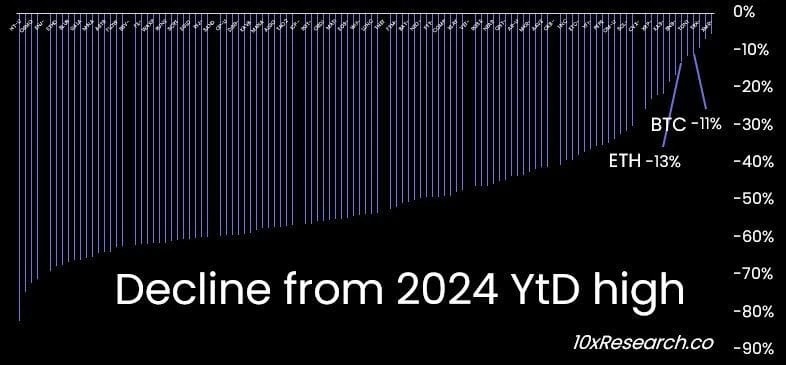
10X Research: Price decline overview of selected cryptocurrencies
The key to surviving an altcoin bear market lies in effective risk management.
Large token unlocks and scarce cryptocurrency liquidity indicators are the primary causes behind this altcoin collapse.
On May 8, we warned the market that "nearly $2 billion worth of token unlocks over the next ten weeks could lead to further contraction in the altcoin market." The core argument of that article was that venture capital funds deployed $13 billion in investment capital during Q1 2022, only for the market to enter a prolonged bear phase afterward. Now, these funds face redemption pressure from investors as artificial intelligence has become a more attractive investment area.
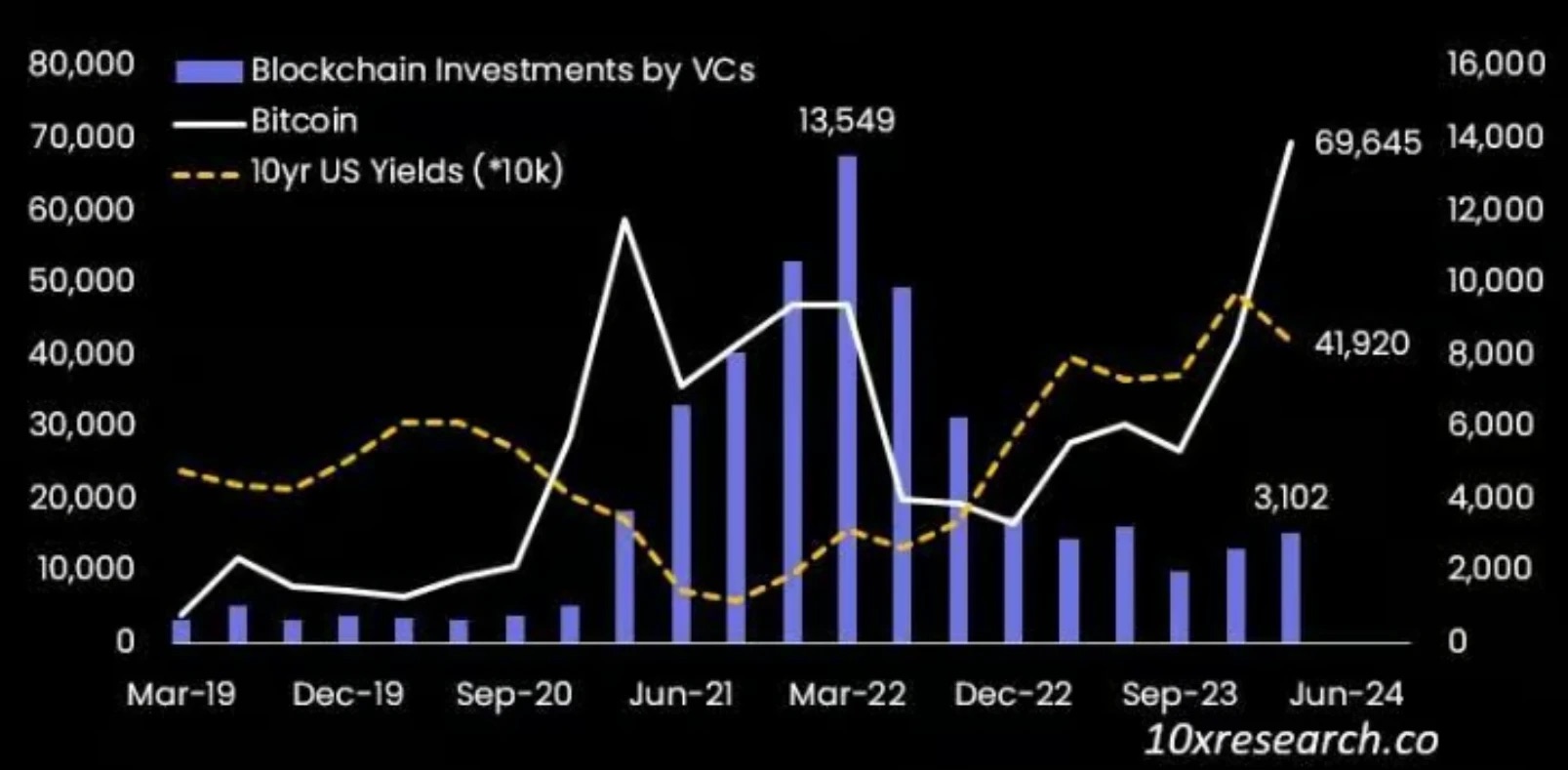
VC Investment Scale in Blockchain and Bitcoin Price Trend
Today, altcoins are in a brutal bear market. Yet earlier this year, 73% of these 115 cryptocurrencies reached new highs in March. We’ve consistently predicted that Bitcoin would outperform other cryptocurrencies—including Ethereum—but in early March, the market dynamics shifted.
So, what unique changes occurred in March?
March as a Turning Point: Early Signs of Liquidity Deterioration
In early March 2024, Bitcoin reached our projected year-end target of $70,000 much earlier than expected.
Last year, we accurately forecasted Bitcoin’s year-end 2023 target at $45,000.
In October 2022, we successfully predicted Bitcoin would rise to around $63,000 ahead of the 2024 halving. At the time, although quantitative analysis suggested even higher targets (e.g., $125,000), we refrained from asserting them due to diminishing crypto market liquidity affecting actual performance.
Subsequently, we gradually turned cautious, attempting to buy bullish breakouts above $70,000 in Bitcoin while setting $68,300 as our “minimum” stop-loss level. After all, we are traders, not gamblers.
When Bitcoin dropped below $60,000, we lowered our stop-loss to $62,000 as a re-entry benchmark, in case the short-term downside target of $55,000 failed to materialize.
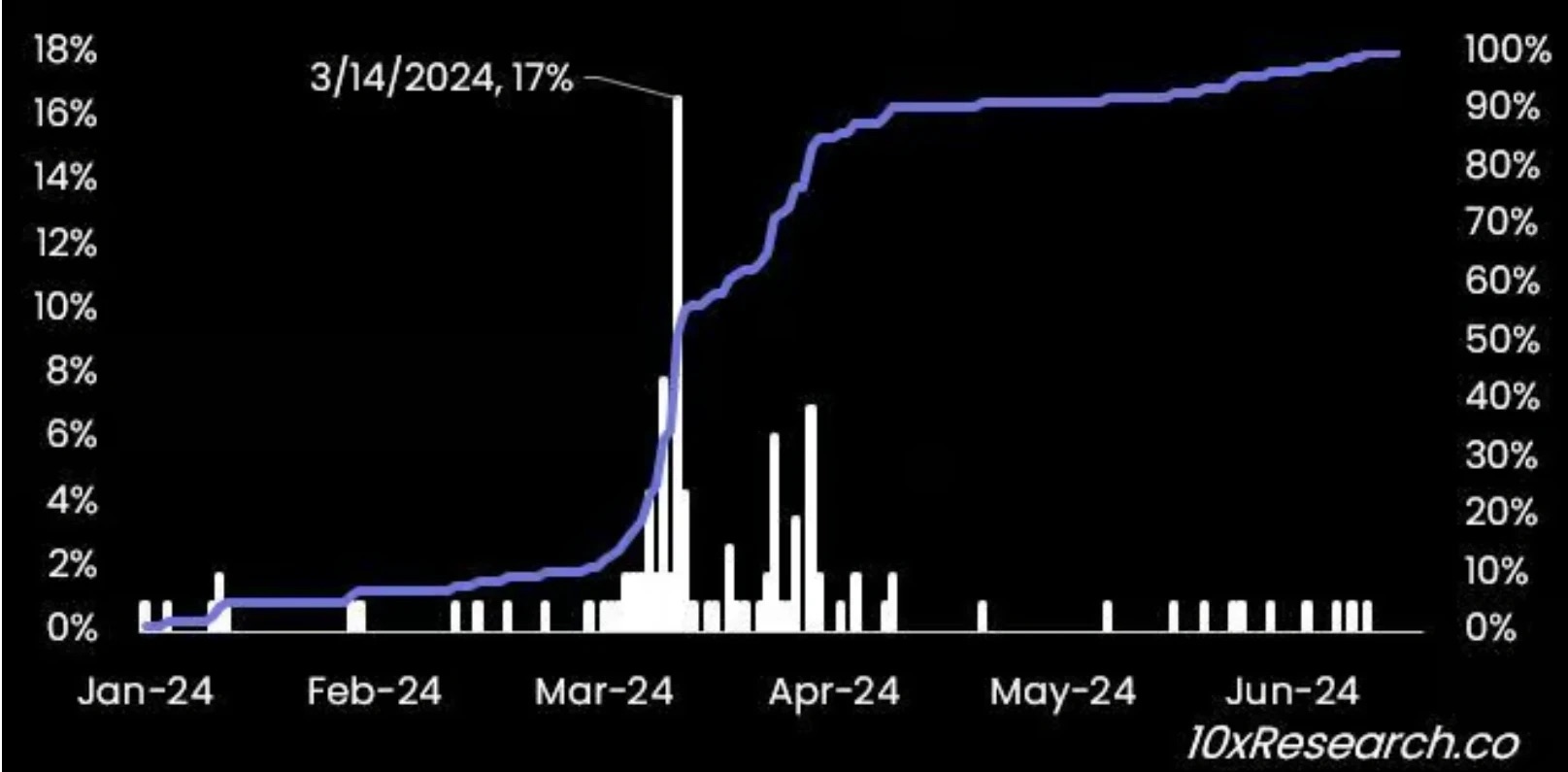
17% of 115 cryptocurrencies (left) peaked on March 14; currently, all coins are in drawdown (right)
Undoubtedly, we are at a critical juncture in this bull market.
Understanding and adhering to risk management principles is what separates successful traders from those left holding losing altcoin positions, which tend to collapse when the bull market ends.
At the end of February 2024, the Solana meme coin frenzy erupted.
Ahead of South Korea’s national election on April 10, the ruling People Power Party made several promises regarding the crypto industry (including potentially allowing spot Bitcoin ETFs), causing daily trading volume in South Korea’s crypto market to surge from $3 billion to $16 billion (double the volume of the country’s stock market). Shiba Inu became the most actively traded asset for several days.
But after March, market performance collapsed.
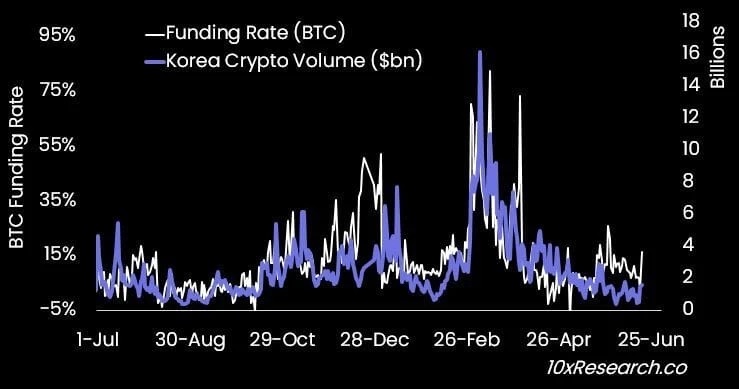
Bitcoin Funding Rate and South Korean Crypto Trading Volume Trends
Holding Through the Downturn May Lead to Eventual Zeroing Out
We occasionally engage with altcoins but primarily focus on high-quality, high-liquidity ones.
We typically use dynamic moving averages as stop-loss benchmarks because managing downside risk is crucial.
Crypto markets are highly cyclical. A conventional buy-and-hold investment strategy is unlikely to succeed over medium to long-term horizons. Instead, analyzing crypto liquidity and macro conditions, and applying a trader’s mindset (risk management) framework to protect capital—so as to be advantageously positioned when the market cycle turns upward—is far more appropriate. This is why our investment approach is usually tactical, allowing us to adopt more proactive strategies when market conditions improve.
On April 4, we introduced the "Bitcoin Self-Reinforcing Mechanism Framework," illustrating how inflows into Bitcoin ETFs fuel positive market sentiment. However, this liquidity stems largely from arbitrage flows driven by retail speculative buying pushing up funding rates.
Now, however, this liquidity is nearly exhausted. Despite low inflation data this month, Bitcoin ETFs have seen significant outflows (a reduction of $900 million over the past seven trading days).
As Bitcoin’s funding rate (and CME futures premium) approaches zero, we may see increased unwinding ahead of the next monthly settlement, when open interest rolls into the next CME contract cycle (expiry June 28). While many now recognize that liquidity in spot Bitcoin ETFs is predominantly arbitrage-driven (we estimate 30%-40%), these flows clearly no longer signal bullish sentiment. With funding rates near zero, a return of such liquidity appears unlikely.
In March, as concerns mounted over higher inflation data, Bitcoin ETF inflows stalled—and most altcoins peaked around that time. Stablecoin issuance slowed shortly after Bitcoin’s halving, failing to provide additional liquidity to altcoins. The subsequent $2 billion in token unlocks across various projects delivered the final blow.
With significantly increased trading activity in March and early April—especially around meme coins—many traders likely accumulated large positions at poor price levels. Altcoin tides ebb and flow, but Bitcoin will remain standing in the next bull market.
As in prior bull runs, many traders may stubbornly hold altcoins hoping for recovery, while savvy traders will protect their capital by rotating into Bitcoin when liquidity dries up.
The difference between retail and institutional traders is that institutional risk managers eventually force their altcoin traders to cut losses at appropriate times; retail traders, unwilling to realize obvious losses, continue holding until their altcoins effectively go to zero.
Join TechFlow official community to stay tuned
Telegram:https://t.me/TechFlowDaily
X (Twitter):https://x.com/TechFlowPost
X (Twitter) EN:https://x.com/BlockFlow_News










