CoinFund Founder's Insights from Singapore SuperAI Conference: The Convergence of Web2 and Web3 AI
TechFlow Selected TechFlow Selected
CoinFund Founder's Insights from Singapore SuperAI Conference: The Convergence of Web2 and Web3 AI
Asia continues to play an increasingly important role in Web3 innovation and adoption.
 Navigating Web3 tides with focused insights
Author: Jake Brukhman
Translation: TechFlow
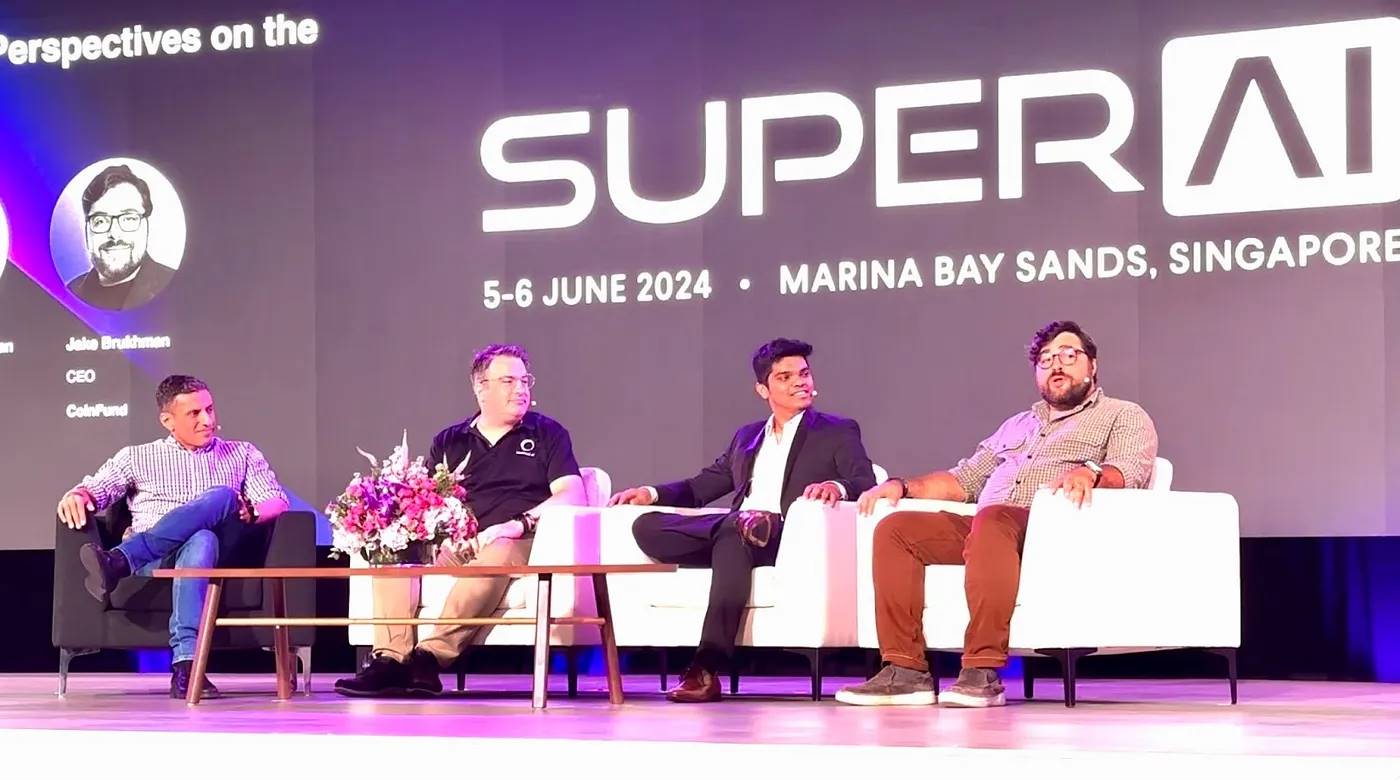
Image credit: Sofia Vaschetto
Since we first wrote about the intersection of Web3 and AI in 2022, this rapidly evolving technological trend has become a centerpiece at crypto conferences this year. Yet it remains uncommon for AI events to emphasize decentralization, and even rarer to see Web3 and AI so tightly integrated within a single event.
SuperAI, the flagship event during Singapore AI Week this June, may have been the first conference I’ve attended that begins bridging the cultural gap between traditional Web2 founders and projects, and developers pioneering new frontiers at the intersection of Web3 and AI.
Well-organized and globally attended, the event felt similar to Token2049—the biannual crypto gathering held in Dubai and Singapore. Attendees flocked to the main stage to hear investor and former Coinbase CTO Balaji Srinivasan speak on the complementarity of Web3 and AI in a talk. This was followed by a robotics demonstration from Boston Dynamics founder Marc Raibert, then former StabilityAI CEO Emad Mostaque announcing his new project, Schelling AI—an AI-powered cryptocurrency. Participants from around the world—primarily from Asia, the Middle East, India, Australia, and numerous Western countries—gathered to absorb a vibrant mix of AI and crypto knowledge.
While speaking with some of the most cutting-edge teams building AI production pipelines on-chain—such as Kiva, Pax, Ritual, Sapien, and Schelling AI—I also connected with seasoned AI entrepreneurs who were pioneers in machine learning and AI at traditional companies like Meta and Microsoft. SuperAI also hosted the Genesis Startup Competition, where early-stage AI startups pitched their products to investors on stage for prizes. Among 700 global applicants, OpenOrigins—a project focused on a blockchain-based trust layer for media sources—took first place.
Theory in Practice
SuperAI demonstrated that our 2022 thesis is not only possible but could provide a more democratic foundation for building this technology. Many startups are already using Web3 primitives to construct AI infrastructure, and funding momentum in the space continues to grow.
At CoinFund, we often say that AI needs Web3—not the other way around. But the success of Web3’s role in AI will depend on how these two communities culturally converge. At this gathering of some of the sharpest minds in cognitive computing, there is real hope that both groups are moving closer together, recognizing their shared ability to build more open, democratic, and ultimately safer AI technologies by combining their strengths.
For developers, Web3 promises to democratize resources and enable broader participation in AI research. It will also ensure that open-source AI remains a primary source of innovation in capability, interpretability, and alignment. For users, Web3 data can ensure agents have self-sovereignty and ownership over their digital identities. In terms of intellectual property, it will verify that creators and copyright holders are protected and fairly compensated.
As someone who has been investing in AI within Web3 since 2020, attending this event was a must. I was excited to bring a crypto-native perspective to the conference and collaborate with Web2 AI founders to bridge cultural gaps within the ecosystem.
Takeaways
Despite significant innovation in decentralized AI over the past two years, the field remains in its early stages. Most progress so far has focused on laying the foundational infrastructure for decentralized AI, while the application layer is still nascent. On the infrastructure side, the most concrete capability today is GPU compute aggregation. For example, io.net, a company creating instant access to GPUs, sponsored SuperAI. Decentralized training is still in its infancy and remains a challenging and contentious topic, although several companies—including GenSyn and Pax—are making important contributions in this area.
Asia continues to play an increasingly vital role in Web3 innovation and adoption. Many tech projects are based in Singapore and Hong Kong, drawing strong machine learning talent from around the world. CoinFund has expanded its team in Asia over the past two years, and about half of our portfolio companies are now located outside the U.S. We’re excited to see more builders joining the global crypto ecosystem every day.
More viable infrastructure will empower people to build applications that unlock new capabilities, pushing AI development to new heights. Leaders like OpenAI and Anthropic frequently discuss artificial general intelligence (AGI), yet the truly practical "danger" of AI in the short term may simply be automation—potentially displacing around 20% of jobs. More broadly, most people I spoke with don’t view AI risks as dramatically apocalyptic. I’ve spoken with leading figures in the field who estimate the likelihood of existential risk from AI in the near term at less than 10%.
Looking back on my week in Singapore, it’s clear that the convergence of Web3 and AI is here to stay—and as both industries work together to form productive collaborations and advance the frontier of decentralization, innovation will continue to accelerate.
Join TechFlow official community to stay tuned
Telegram:https://t.me/TechFlowDaily
X (Twitter):https://x.com/TechFlowPost
X (Twitter) EN:https://x.com/BlockFlow_News
 @coinfund_io