









Can Bitcoin become a "productive asset"?
TechFlow Selected TechFlow Selected
Can Bitcoin become a "productive asset"?
It is unrealistic to expect Bitcoin yield products to disappear completely.
 Navigating Web3 tides with focused insights
Author: Pascal Hügli, Brick Towers
Translation: Luccy, BlockBeats
Editor's Note: As the Bitcoin market matures and various yield-generating products emerge, people are beginning to consider how to advance its financialization while preserving Bitcoin’s native characteristics. From native Bitcoin consensus, assets to yield, this article discusses different categories of Bitcoin yield products and emphasizes the importance of native design in reducing trust dependencies and counterparty risk.
While analyzing existing solutions, Pascal Hügli uses the Brick Towers project as an example to demonstrate how combining native Bitcoin consensus, assets, and yield can achieve near-perfect Bitcoin alignment. This article highlights the importance of balancing innovation and risk management in the financialization of digital currencies. Despite numerous challenges and uncertainties, Bitcoin—as an open and decentralized protocol—will continue to lead the development of financial technology through its native design and foundational features.
Bitcoin is undergoing a remarkable evolution, with multiple perspectives on its essence. Some view it as currency for daily transactions, others see it as modern gold for value storage, while some regard it as a decentralized global platform securing and validating off-chain transactions. While all these views have merit, Bitcoin is increasingly seen as a digital base money.
Functioning similarly to physical gold as an asset holding and inflation hedge, and providing monetary denomination akin to the U.S. dollar, Bitcoin is redefining the concept of monetary base assets. Its transparent algorithm and fixed supply of 21 million units ensure a non-discretionary monetary policy. In contrast, traditional fiat currencies like the U.S. dollar rely on central authorities to manage their supply, raising questions about predictability and effectiveness in volatile, uncertain, complex, and ambiguous (VUCA) times.
This contrast is especially evident in Nobel laureate Friedrich August von Hayek’s critique of centralized monetary decision-making in his work "The Pretense of Knowledge." Bitcoin’s transparent and predictable monetary policy stands in sharp contrast to the opaque and potentially unpredictable nature of traditional fiat currency management.
To Leverage or Not to Leverage Bitcoin
For staunch Bitcoin supporters, the 21 million supply cap is sacred. Changing this limit would fundamentally alter Bitcoin’s nature, making it something entirely different. Consequently, the Bitcoin community generally views leveraged Bitcoin with skepticism. Many believe that any form of leverage resembles fiat practices and undermines Bitcoin’s core principles.
This skepticism toward leveraged Bitcoin stems from Ludwig von Mises’ distinction between commodity credit and circulation credit. Commodity credit is based on real savings, whereas circulation credit lacks such backing, resembling unsecured IOUs. Bitcoin advocates argue that leverage creates economically risky and unstable “paper bitcoins.”
Even more nuanced voices within the community remain cautious about leveraged Bitcoin, aligning with figures like Caitlin Long, who has consistently warned about the dangers of leveraged Bitcoin. The 2022 collapses of leveraged Bitcoin lending firms such as Celsius and BlockFi further reinforced Long’s and others’ concerns about the risks associated with leveraged Bitcoin.
Celsius and Others Proved This Point
The crypto market experienced a Lehman Brothers-style crisis in 2022, triggering a widespread credit crunch that affected multiple players in the crypto lending space. Contrary to assumptions, most crypto lending activities were not peer-to-peer and carried significant counterparty risk, as customers directly lent funds to platforms, which then deployed those funds into speculative strategies without adequate risk management.
During the DeFi summer of 2020, the rise of major DeFi protocols offered promising yield-generation avenues. However, many of these protocols lacked sustainable business models and tokenomics. They heavily relied on inflationary issuance of protocol tokens to maintain attractive yields, creating an unsustainable ecosystem detached from basic economic principles.
The 2022 crypto credit crunch exposed various issues with centralized yield instruments, highlighting concerns around transparency, trust, and liquidity, market, and counterparty risks. It also revealed flaws in centralized and off-chain risk management processes when applied to blockchain-based “banking services,” mirroring the shortcomings of traditional banks.
Despite the optimism brought by the 2020–2021 bull run, due to the lack of necessary safeguards, institutions like Voyager, Three Arrows Capital, Celsius, BlockFi, and FTX ultimately collapsed. The inability to implement transparent and independent checks and balances often led to over-leveraging and recurring failures and frauds, reflecting historical challenges of the traditional banking system. Yet, lack of regulation is not the solution either.
Bitcoin Yield Is Not Optional
So what should we do? Given the events of 2022, an increasing number of Bitcoin supporters are asking: Should we embrace Bitcoin yield products, or are they too risky, similar to fiat systems? While these concerns are valid, expecting Bitcoin yield products to disappear entirely is unrealistic.
As the emerging Bitcoin ecosystem evolves, this question becomes increasingly prominent. More and more projects are building—or claiming to build—financial infrastructure and applications directly on Bitcoin. Will this trigger the same problems we’ve already seen across the broader crypto space?
Very likely. Because that’s the nature of the game. Since Bitcoin is a permissionless protocol, anyone can build on it—including those aiming to establish a Bitcoin-driven financial system. And financial systems inevitably require credit and leverage.
This is a historical fact: In any thriving society, the demand for credit and yield naturally arises, acting as a catalyst for economic growth. Without credit, underdeveloped economies struggle to move beyond subsistence. Only through access to credit can more complex and efficient economic structures emerge.
To realize a Bitcoin-based economic vision, supporters recognize the need to develop credit and yield mechanisms atop the Bitcoin protocol. While Bitcoin’s role as money is often praised, the reality is that to function effectively as money, it needs a native economy to support it.
This underscores the importance of Bitcoin-native yield products in fostering Bitcoin-centric economic growth. Such an ecosystem would use Bitcoin as its digital base money while leveraging yield products to drive adoption and usage.
It’s All About Trust, Anonymously
A Bitcoin-driven financial system will inevitably be built in layers. From a systemic perspective, this isn’t vastly different from today’s financial system, where inherent hierarchies exist even among money-like assets. To properly understand these inevitable trade-offs, we need a high-level framework to distinguish different implementations of Bitcoin.
When offering Bitcoin yield, options can be structured along a three-dimensional trust spectrum. The key aspects to focus on are:
-
Consensus
-
Assets
-
Yield
Evaluating Bitcoin-like assets and Bitcoin yield products according to their degree of Bitcoin nativeness provides a valuable framework for assessing their alignment with the spirit of Bitcoin. Assets and products scoring higher on this spectrum typically minimize trust, reduce reliance on intermediaries, and instead depend on transparent and resilient code.
This shift reduces counterparty risk by moving dependence from off-chain intermediaries to code. The transparency of code enhances resilience compared to trusted intermediaries requiring faith.
This is a worthwhile direction to explore. Creating native yield options for Bitcoin should be the gold standard and ultimate goal for the Bitcoin community.
From the Consensus Perspective
Based on alignment with Bitcoin blockchain consensus, Bitcoin yield products can be categorized into four types.
No Consensus: This category refers to infrastructure remaining off-chain and centralized. For example, centralized platforms like Celsius or BlockFi, which fully control users’ assets, exposing them to counterparty risk and dependency on intermediaries. Although these platforms use Bitcoin, their yield strategies are primarily executed off-chain via traditional financial mechanisms. While they represent a step toward Bitcoin adoption, they remain highly centralized, resembling traditional financial institutions but often lacking regulatory oversight.
Independent Consensus: Here, the infrastructure is decentralized, represented by public blockchains such as Ethereum, BNB Chain, Solana, and other chains. These blockchains have their own consensus mechanisms independent of Bitcoin and are not explicitly tied to Bitcoin’s consensus.
Inherited Consensus: In this category, infrastructure is decentralized and represented by distributed consensus from Bitcoin sidechains or Layer-2 solutions. While these sidechains have their own consensus mechanisms, they aim to align more closely with the Bitcoin blockchain. Examples include federated sidechains such as Rootstock, Liquid Network, or Stacks.
Native Consensus: This category relies on Bitcoin’s own consensus mechanism as the foundational security model. It does not use independent blockchains or sidechains but instead employs cryptographically linked off-chain state channels anchored to the Bitcoin blockchain. The Lightning Network is a key example of this approach, achieving a high degree of trust minimization by fully relying on Bitcoin’s consensus.
The closer a Bitcoin yield product is to Bitcoin’s native consensus, the higher its alignment with Bitcoin and the greater its degree of trust minimization. However, subtle differences in decentralization and security exist between Independent Consensus and Inherited Consensus categories.
Overall, No Consensus offers the lowest level of decentralization and trust minimization, while Native Consensus is considered to provide the highest level of trust minimization, although considerations around consensus security and decentralization still require further analysis.
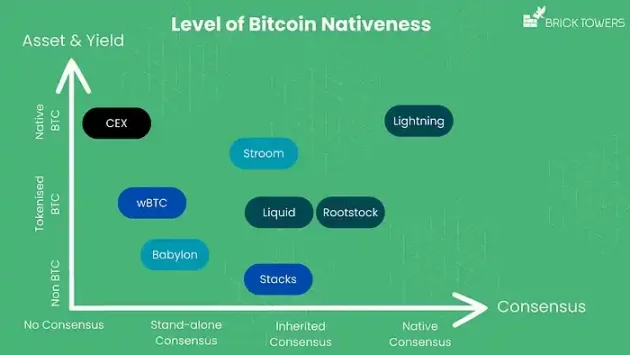
Source: Brick Towers
From the Asset Perspective
When considering the assets used in Bitcoin yield products, their alignment with Bitcoin can be divided into three categories.
Non-BTC: This category includes solutions using assets other than BTC, resulting in lower alignment with Bitcoin. An example is the stacking option on Stacks, where the native STX token is used to generate yield on BTC.
Tokenized BTC: Here, the asset used is a tokenized version of BTC, offering higher alignment with Bitcoin compared to non-BTC assets. Tokenized BTC can be found on public blockchains such as Ethereum (WBTC, renBTC, tBTC), BNB Chain (wBTC), Solana (tBTC), etc. Additionally, tokenized BTC hosted on Bitcoin sidechains with inherited consensus mechanisms, such as sBTC, XBTC, aBTC, L-BTC, and RBTC, also fall into this category.
Native BTC: This category consists of on-chain Bitcoin (BTC), involving no tokenized versions and providing the highest level of Bitcoin alignment. Various CEX solutions and Babylon’s Bitcoin staking protocol directly utilize BTC. Babylon aims to extend Bitcoin’s security by adapting proof-of-stake mechanisms to Bitcoin staking. Moreover, projects like Stroom Network leverage the Lightning Network for liquid staking, allowing users to deposit BTC and mint wrapped tokens such as stBTC and bstBTC on EVM-compatible blockchains to earn Lightning Network income, usable across broader DeFi ecosystems.
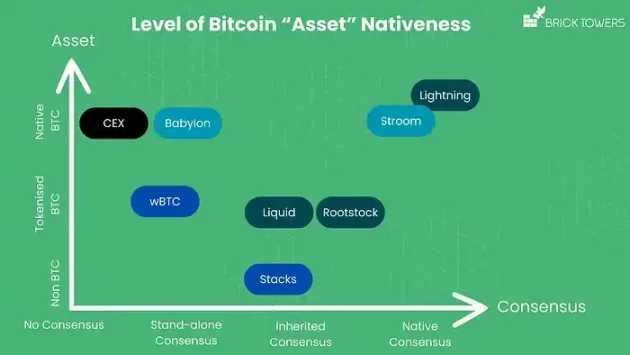
Source: Brick Towers
From the Yield Perspective
Examining the yield aspect of Bitcoin yield products involves similar categorizations regarding Bitcoin alignment: Non-BTC, Tokenized BTC, and Native BTC.
Non-BTC Yield: Babylon provides yield through the native assets of its proof-of-stake (PoS) blockchain, enhancing blockchain security via Babylon’s staking mechanism.
Tokenized BTC Yield: Stroom Network offers yield in the form of lnBTC tokens. Sovryn, operating on Rootstock, facilitates Bitcoin lending using tokenized BTC (RBTC) as yield. On the Liquid Network, Blockstream Mining Notes (BMN) offer yield in BTC or L-BTC upon maturity, providing qualified investors a pathway to gain exposure to Bitcoin mining power via EU-compliant USDT security tokens.
Native BTC Yield: Stacks offers various options, including yield paid in tokenized BTC within certain yield applications, utilizing sBTC. However, for Stacks’ stacking option, yield accumulates in native BTC. Similarly, some CEX-provided centralized yield products distribute native BTC as yield to users.
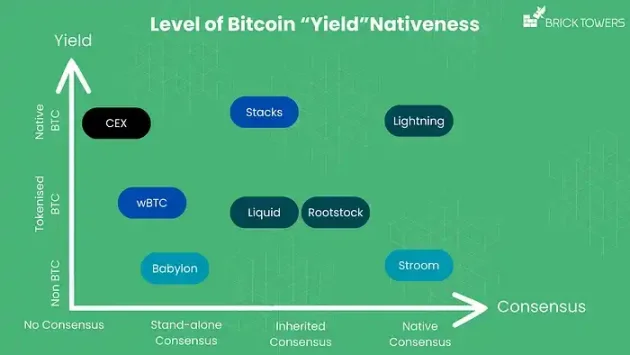
Source: Brick Towers
Bitcoin’s Gold Standard: Fully Native
Considering the ideal Bitcoin-based yield product, the gold standard would combine three characteristics: native Bitcoin consensus, native Bitcoin assets, and native Bitcoin yield. Such a product would achieve near-perfect Bitcoin alignment.
Currently, such solutions are only beginning to emerge. One actively developing project is Brick Towers. Their vision for the ideal Bitcoin-based yield product encompasses near-perfect Bitcoin alignment by integrating native Bitcoin consensus, assets, and yield. Brick Towers focuses on Bitcoin as a long-term savings solution, aiming to provide customers with trust-minimized and native approaches to leverage Bitcoin.
Their planned solution centers on generating native yield within Bitcoin by using Brick Towers’ automated services for other nodes in the Lightning Network. By optimizing algorithms for economic efficiency, capital is strategically allocated to meet liquidity demands from other network participants, thereby optimizing capital efficiency while minimizing counterparty risk.
This approach not only promotes the growth of the Lightning Network but also enhances Bitcoin’s utility as an asset, while offering customers a seamless and secure way to earn yield on their Bitcoin holdings. Importantly, Brick Towers’ solution avoids the use of wrapped coins, further reducing counterparty risk and reinforcing their commitment to the native Bitcoin ecosystem.
Join TechFlow official community to stay tuned
Telegram:https://t.me/TechFlowDaily
X (Twitter):https://x.com/TechFlowPost
X (Twitter) EN:https://x.com/BlockFlow_News
 @BitcoinMagazine









