








Scale, on-chain reputation, and payments: How will the three killer capabilities of cryptocurrency build emerging markets?
TechFlow Selected TechFlow Selected
Scale, on-chain reputation, and payments: How will the three killer capabilities of cryptocurrency build emerging markets?
The token incentives, on-chain trust, and global payment capabilities of cryptocurrencies have the potential to spawn many new types of markets that were previously difficult to exist, fulfilling needs that could not be met before.
 Navigating Web3 tides with focused insights
Author: Li Jin
Translation: Baihua Blockchain
The world’s largest companies are marketplaces built on network effects. Amazon (market cap $1.9 trillion), Meta ($1.2 trillion), and Tencent ($459 billion) all aggregate supply and demand—controlling more of both increases the value of their networks.
The same holds true in crypto. High-value networks like Bitcoin ($1.4 trillion), Solana ($79 billion), and Ethereum ($460 billion) are multi-sided networks composed of developers, users, and network operators that become more valuable as they scale.
But when I look at the landscape of Web2 and Web3 marketplaces, I see not only existing markets but also ones that don’t yet exist.
In my years investing in marketplace startups, I’ve learned there are markets that should exist—helping connect supply and demand while providing meaningful utility to both sides—but currently don’t due to limitations of the systems they’d be built upon. I’ve also seen firsthand how new technologies can unlock opportunities for such markets to emerge and thrive.
Markets represent one of crypto’s most exciting opportunities. By leveraging crypto’s killer capabilities—token-powered scaling and on-chain composability—entrepreneurs can build new markets serving previously unmet needs. This is a leapfrog innovation opportunity, not just incremental progress.
1. Systemic Barriers to Marketplace Innovation in Web2
I’ve previously written about the eras of service marketplaces—specifically, how internet marketplaces evolved from the listing era of the 1990s (epitomized by Craigslist) to the “Uber for X” on-demand apps (2009–2015), then to managed marketplaces (mid-2010s).
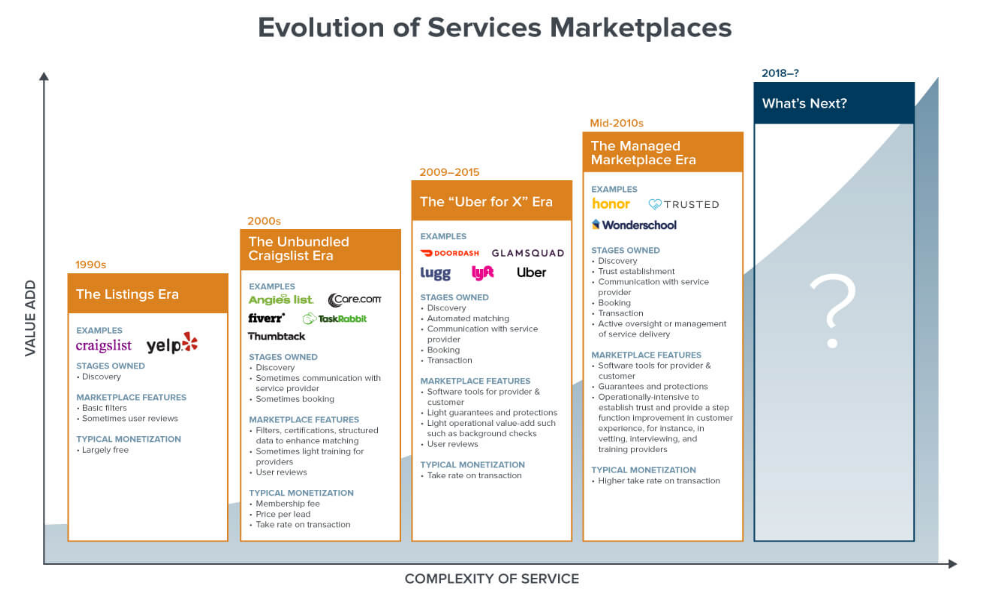
Source: a16z, Li Jin and Andrew Chen
Each era emerged in response to new technologies or emerging user demands. The listing era enabled individuals to post and find listings online. The smartphone-enabled “Uber for X” era offered instant access to various services using real-time location data. Managed marketplaces arose later to meet higher trust requirements in complex verticals as low-friction opportunities diminished.
Yet each era introduced challenges that constrained innovation. In the listing era, lack of trust and standardization limited growth. The on-demand era required massive capital to scale services to near-instant availability. Managed marketplaces faced high operational costs tied to building transactional trust, impacting their business viability.
Many of these challenges persist in Web2 marketplaces, hindering further innovation. Two issues in particular—scaling and trust—have blocked progress, where crypto holds distinct advantages.
2. The Scaling Problem
Traditional Web2 marketplaces often require significant capital to launch and scale, especially when large scale is needed before achieving utility. This capital requirement creates a high barrier to entry for new entrants. It also means entire categories of markets may never form because the cost to reach necessary scale—and thus deliver utility—is too high.
Consider dating apps. A dating network needs substantial user volume on both sides to enable good matches. Traditionally, this meant spending heavily to attract users before the app becomes useful to any individual. Dating apps also face low user retention—users leave once successful, further hampering growth. As a result, few breakout winners have emerged in this category.
3. The Trust Problem
A second persistent challenge in Web2 marketplaces is trust. Certain industry verticals require high levels of trust between participants to transact. For example, some categories involve high-risk matching with providers (e.g., childcare or elder care). Others involve high-order values (e.g., luxury goods, art, real estate).
To establish trust, managed marketplaces have built additional service and operational layers. Childcare platforms, for instance, conduct extensive provider vetting—including in-person interviews and background checks—and develop software tools for real-time visibility and tracking. In real estate, some managed marketplaces take full end-to-end responsibility, from repairs to acting as home traders (“iBuyers”). These added operations incur significant overhead. Moreover, other marketplaces wishing to list similar providers must repeat these efforts, leading to inefficiencies across the ecosystem.
4. The Solution: Crypto’s Killer Capabilities
From this context, crypto offers three killer capabilities that open new frontiers for marketplace innovation: token-powered scaling, on-chain reputation, and payments.
1) Scaling
If there’s one thing crypto excels at, it’s scaling. Token-based incentives have proven to be powerful growth engines.
Compared to Web2, crypto enables marketplaces to grow sequentially—starting with supply, then expanding demand—through token incentives. For example, decentralized physical infrastructure networks (DePINs) like Helium and Hivemapper bootstrap supply by rewarding participants with tokens, while underlying revenue catches up later.
Token incentives can unlock many markets that don’t exist today due to prohibitive startup costs. Imagine hyperlocal social networks requiring dense user engagement (similar to Citizen, but broader for information or real-time events), or next-gen dating apps. In AI, we’re already seeing developers use token incentives to create novel markets with no Web2 precedent. Networks like Vana and Rainfall allow users to contribute data for AI training and earn token rewards. Without smart incentives to mobilize mass user contributions, aggregating long-tail, private, hard-to-access datasets would be nearly impossible.
2) On-Chain Reputation and History
One issue in Web2 is redundant trust-building across isolated platforms. For example, Uber conducts background checks on all new drivers, but when the same driver signs up for Lyft, another check is required—because platforms operate in silos.
Crypto can serve as a portable reputation system. Instead of every app conducting its own checks, what if this data were stored on-chain and moved with the driver across any marketplace? Further, other aspects of provider history—like reliability and quality—could be represented on-chain, enabling markets to compose and leverage a global trust repository. Such a system could eliminate the need for each managed marketplace to implement costly, capital-intensive processes. Many Web2 managed marketplaces offer great UX but ultimately fail as businesses due to high operating costs. Global on-chain reputation could fundamentally transform their cost structures.
We see a microcosm of this idea in the Farcaster ecosystem. This social protocol stores posts, likes, follows, and profiles on a decentralized network. When users switch between different apps built on Farcaster, their social data moves with them. “No-interface” markets are already emerging on Farcaster. One example is Bountycaster, where users can post and discover bounties across any Farcaster client, leveraging rich reputation data from the network. With such portable social data, we can envision new markets forming within the Farcaster ecosystem—from smart contract auditing to expert marketplaces powered by Farcaster’s social graph and reputation.
3) Payments
Payments are a core component of modern marketplaces, but supporting cross-border transactions in Web2 requires integration with multiple local payment systems. This is especially critical for digital marketplaces, where customers and suppliers are often globally dispersed. For example, over 80% of YouTube users are outside the U.S. To support local currency payments in each region, platforms must integrate with international payment gateways—often leaving edge regions underserved, particularly for resource-constrained startups or platforms unable to manage global complexity.
Crypto operates globally from day one, enabling transactions between anyone with a crypto wallet. This allows lean marketplaces to achieve global reach immediately. For example, I recently bought an NFT from a chain-on data community called bytexplorers, which lets me submit data-related questions to an analyst community. Analysts who answer correctly receive token rewards—enabling seamless payments and global participation.
5. Opportunities for the Next Generation of Markets
If I’ve learned one thing from years of investing in marketplace startups, it’s that the best opportunities arise when builders leverage new technologies to deliver transformative improvements for end users. Each generation of marketplace entrepreneurs has used new tech to unlock markets that couldn’t previously exist.
Crypto represents the next phase of this evolution. By using token incentives for scaling, new markets can grow in a far more capital-efficient way. On-chain reputation and history can reduce operational overhead for any given marketplace operator. Crypto-native payments enable seamless cross-border operations from day one. Together, these capabilities won’t just improve existing markets—they will give rise to entirely new markets that can only exist under this new cost structure and scaling paradigm.
Join TechFlow official community to stay tuned
Telegram:https://t.me/TechFlowDaily
X (Twitter):https://x.com/TechFlowPost
X (Twitter) EN:https://x.com/BlockFlow_News
 Variant









