









Galaxy Partner: MEV will play a significant role in the blockspace market
TechFlow Selected TechFlow Selected
Galaxy Partner: MEV will play a significant role in the blockspace market
MEV is a permanent consumer of block space.
 Navigating Web3 tides with focused insights
Author: Will Nuelle, General Partner at Galaxy Ventures
Translation: Luffy, Foresight News
Introduction
In our previous article on the block space business model, we argued that selling block space is one of four segments in crypto capable of achieving repeatable, robust product-market fit. Over time, we expect block space to become the second-largest contributor to gross profit after exchanges—and possibly even the largest as trading volume shifts from CEXs to DEXs. This is a B2B2C business model: blockchains attract application developers, who in turn attract consumers (both individuals and enterprises) to use block space through their applications.
We also believe block space is a network effects-based business, sharply contrasting with centralized cloud computing—a peer business model characterized by economies of scale but lacking network effects. Network effects in blockchains exist across (i) application developers, (ii) application deployments, (iii) users, (iv) protocol liquidity, and (v) raw capital.
Galaxy predicts that consumption of block space—measured by total spending on consumed block space—will accelerate over time, and any future increases in blockchain capacity will be filled by demand.
MEV Economics
In this article, we will assess what proportion of block space is consumed by MEV transactions and discuss why this matters for evaluating block space as a business model.
MEV transactions are fundamentally different from non-MEV transactions. MEV demand originates internally within the system (endogenous), whereas non-MEV transaction demand comes from outside the system (exogenous). MEV is an amplified form of block space demand, generated purely by others using the system.
-
Non-MEV transactions: Users are willing to pay because they have exogenous needs to use applications—e.g., paying fees for stablecoin transfers or depositing into Compound.
-
MEV transactions: Users can capture risk-free (or statistically risk-free) profits based on system state. The exogenous usage of the system creates demand for block space consumption. In other words, this is endogenous demand.
In studying block space as a business model, I’ve been asking: How much of the demand does MEV contribute?
MEV as a Driver of Block Space Demand
As shown in the prior "Block Space Business Model" piece, total annual demand for block space on top-fee blockchains reaches several billion dollars, following a power-law distribution:
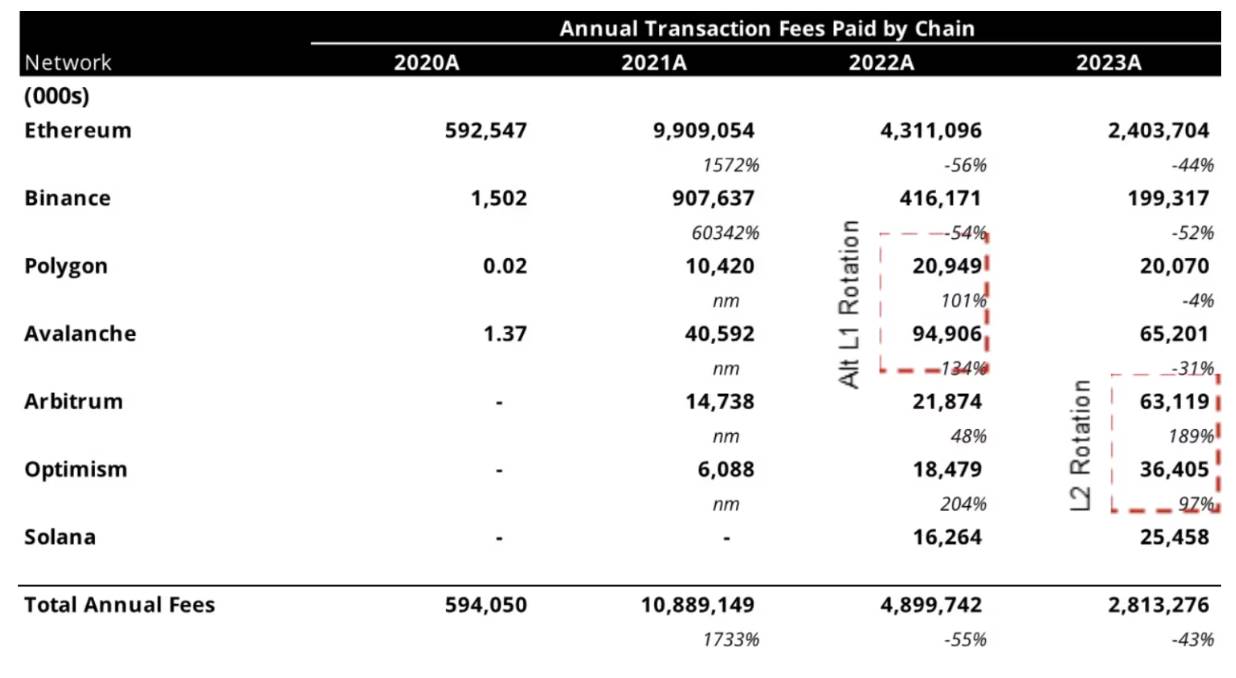
Source: Will Nuelle, Galaxy Ventures
Daily user-paid transaction fees since September 2022 (time series shown on a logarithmic scale):
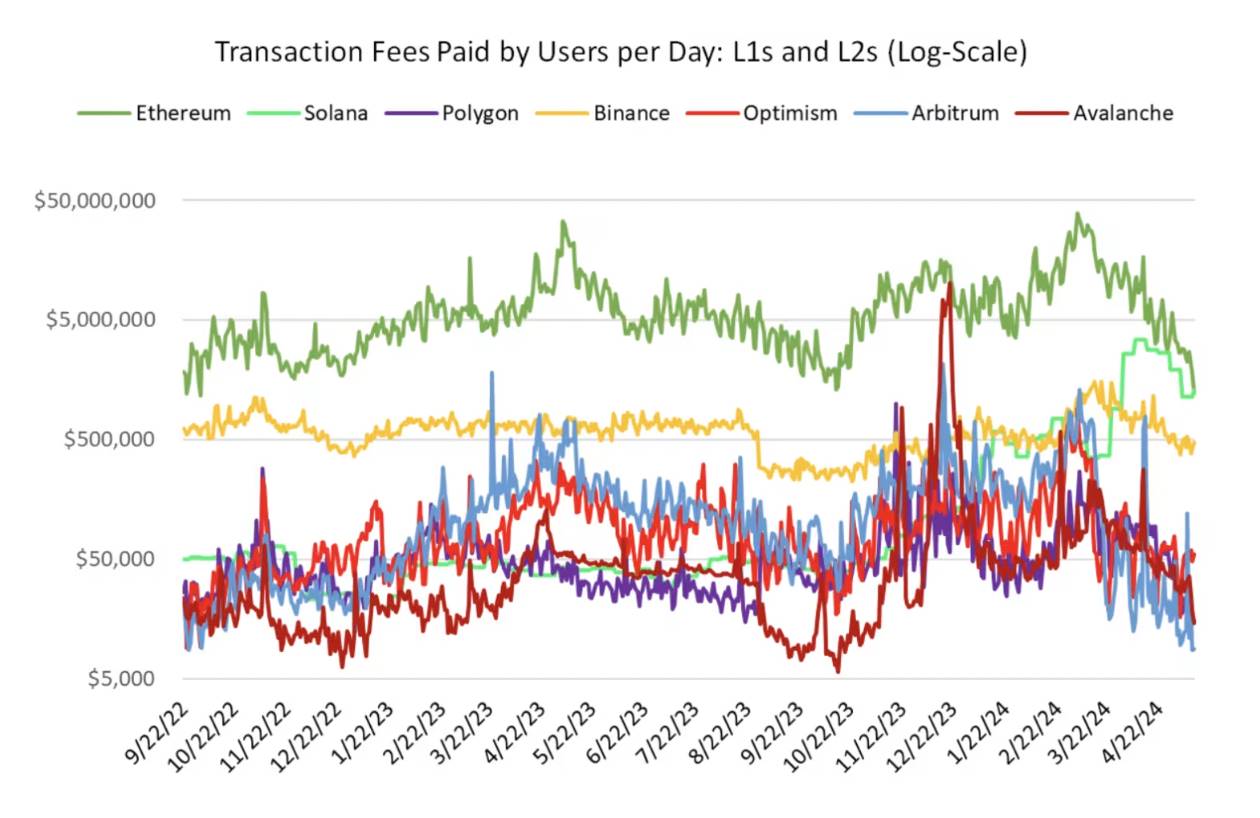
Source: Will Nuelle, Galaxy Ventures
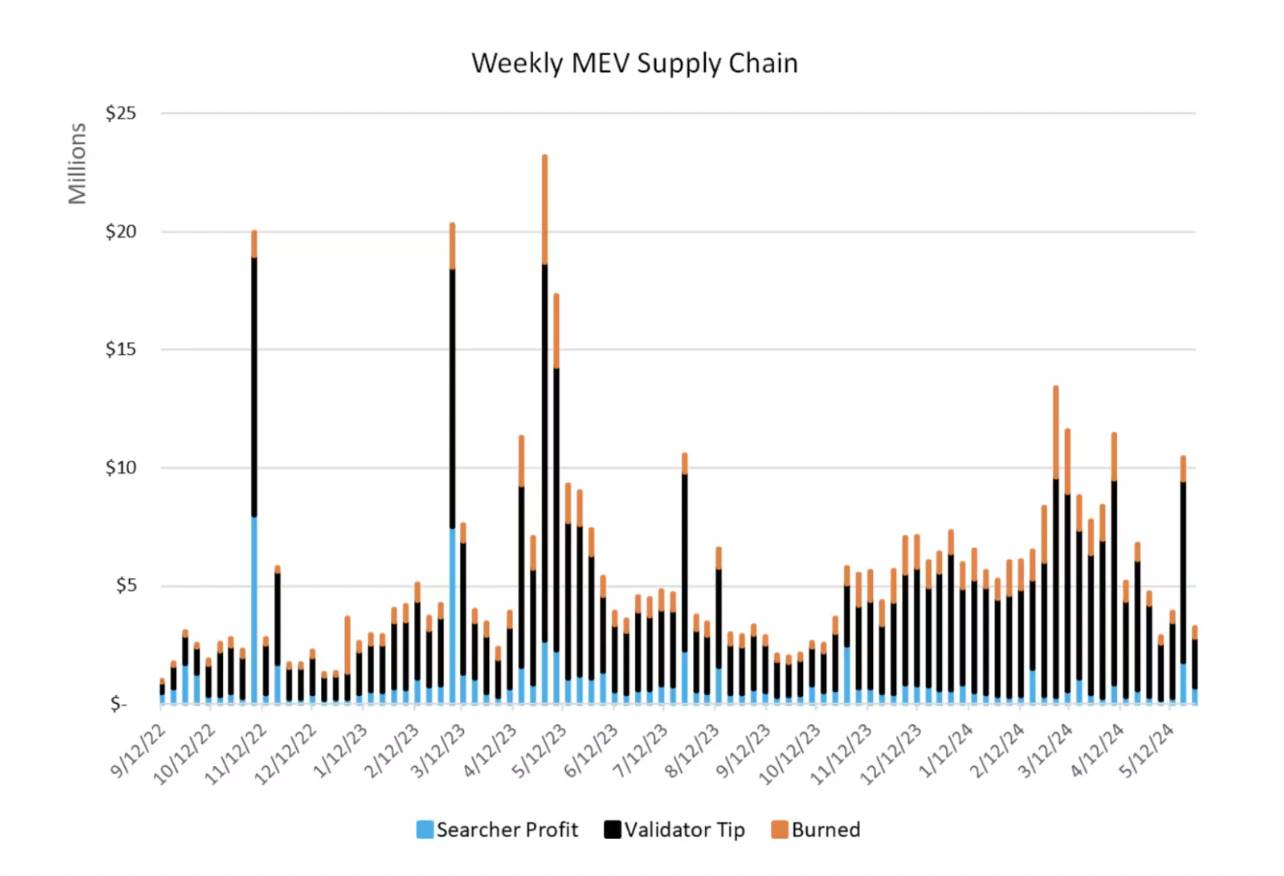
MEV is a permanent feature of blockchains and a permanent consumer of block space. The chart below shows Ethereum's MEV as of the end of February 2024—the only chain with reliable public MEV data—distributed among searcher profits, validator tips, and burned ETH. These figures exclude DeFi-CeFi arbitrage, which is statistical rather than atomic and occurs both on-chain and off-chain.
Source: Will Nuelle, Galaxy Ventures
Searchers identify MEV opportunities and pay transaction fees for inclusion in blocks. Competition among searchers forces them to bid higher than normal blockchain transaction fees to secure inclusion, meaning most of the fees paid for MEV go directly to validators as slightly enhanced yields above standard staking rewards. A portion is burned under EIP-1559, ultimately benefiting all ETH holders; another part becomes profit for the searchers. In 2023, the full MEV supply chain averaged $6.6 million per week in revenue, peaking above $20 million in May (excluding gains from CeFi-DeFi arbitrage).
MEV Strategies
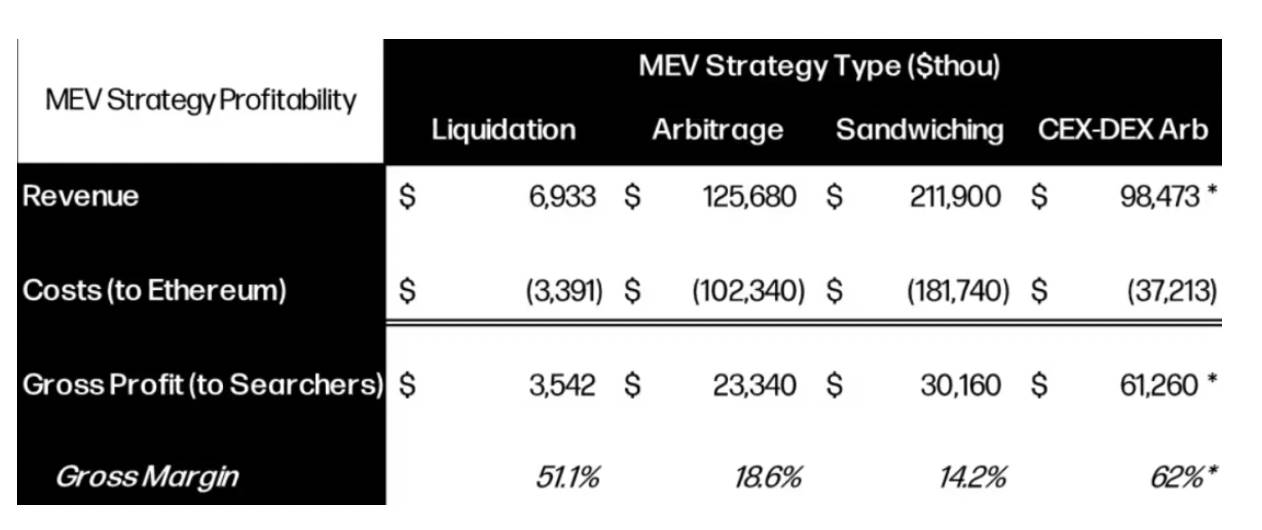
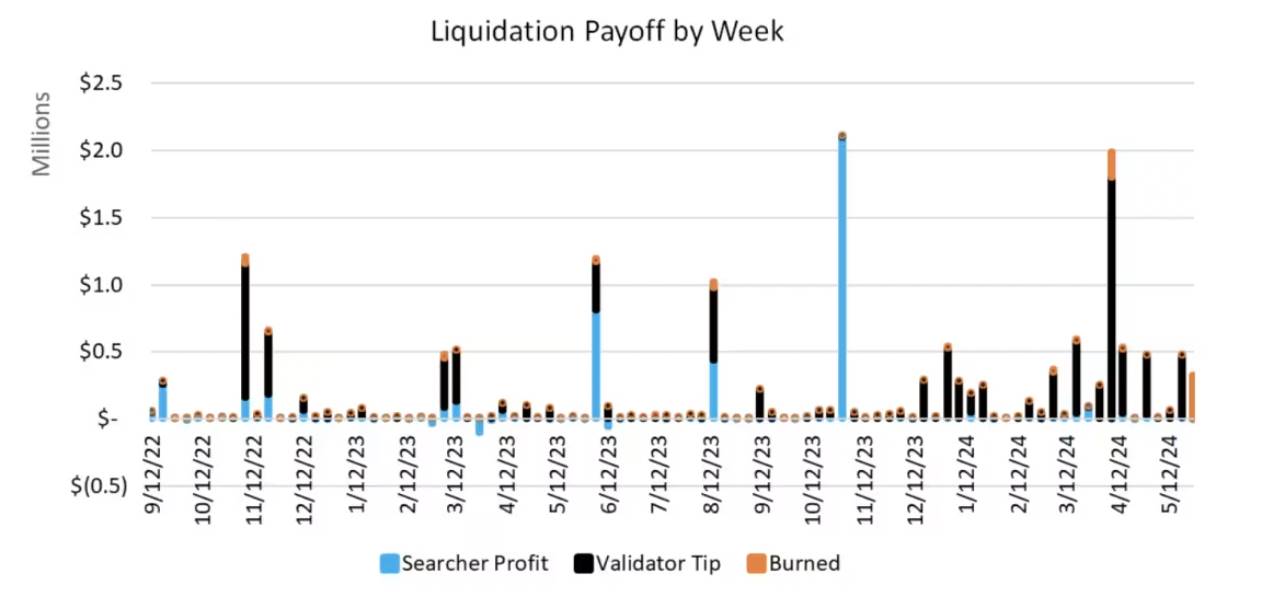
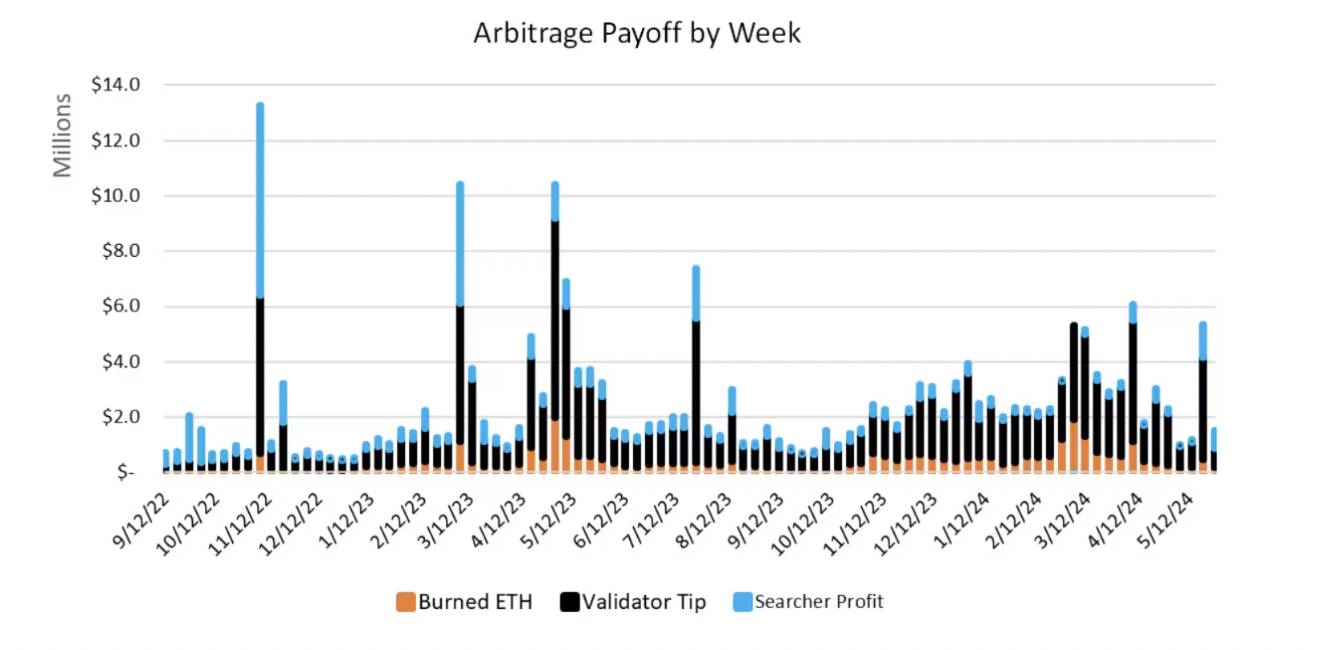
Different MEV strategies yield varying revenues and profit margins. Data shows sandwiching—a parasitic form of MEV involving front-running and back-running careless DEX users—generated $212 million in revenue on Ethereum last year. Atomic arbitrage is more lucrative due to its role in rebalancing DEX pool prices, generating $126 million in total revenue in 2023. Liquidations (rewards for clearing bad debt in lending protocols like Maker, Aave, and Compound) generated only $7 million in revenue in 2024. Other forms of MEV exist but tend to be more customized than systemic.
Source: Will Nuelle, Galaxy Ventures
CeFi-DeFi arbitrage is a harder-to-track strategy, with no public data quantifying its earnings (due to opacity on the CeFi side). Galaxy’s tracked data suggests CeFi-DeFi arbitrage earned approximately $98.5 million in 2023, though this represents only about 60% market coverage. This estimate is based on simulations of CeFi quote data and may vary depending on specific builder strategies. Note that the confidence interval for CEX-DEX arbitrage is large.
More interestingly, the gross margins of different strategies reveal which ones generate more value for Ethereum/validators versus searchers. Arbitrage and sandwiching strategies have gross margins of 18.6% and 14.2%, respectively, indicating these strategies are (i) highly competitive and (ii) accumulate more value for the base layer (Ethereum). In contrast, liquidation strategies have a higher gross margin of 51.1% but lack scalability, making them less competitive (and less relevant in this discussion). CeFi-DeFi arbitrage has some scale but lower competitiveness due to deeper moats in order flow, builder concentration, and general complexity of statistical arbitrage.
Source: Will Nuelle, Galaxy Ventures
Source: Will Nuelle, Galaxy Ventures
A Stable Relationship Between MEV and Block Space Demand
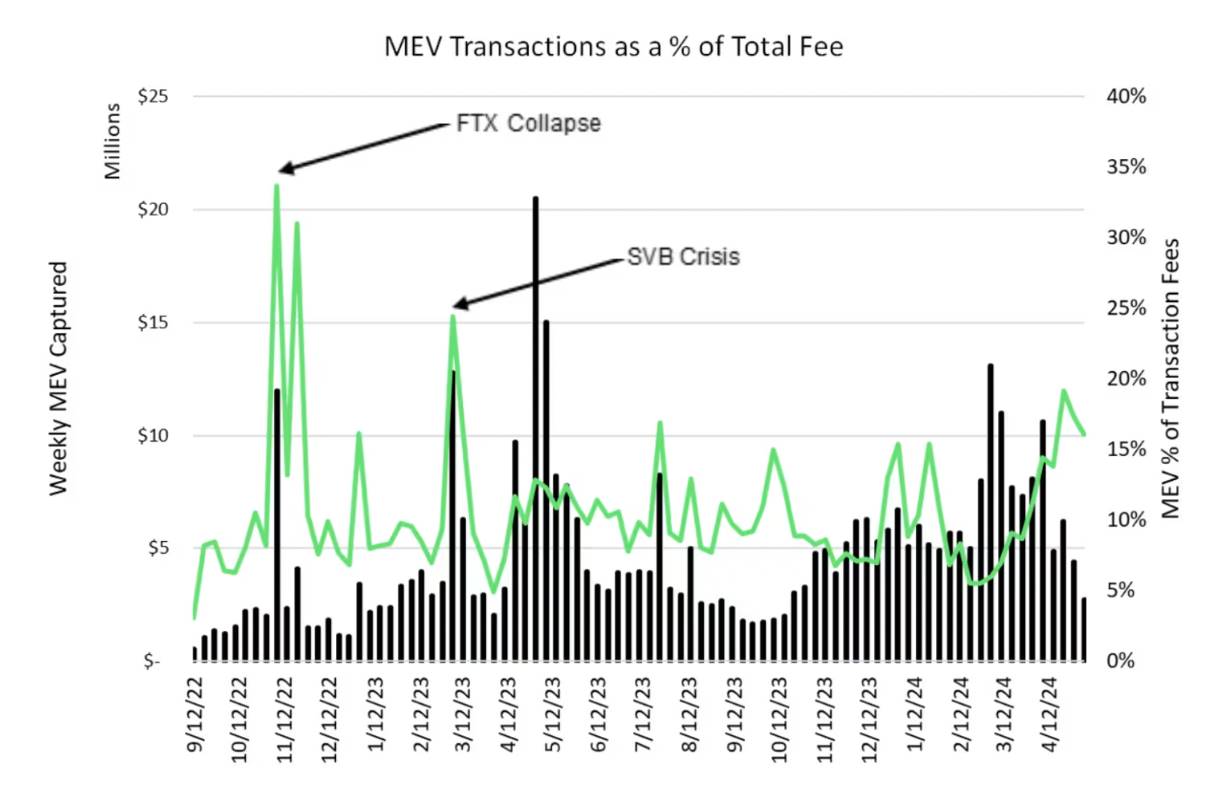
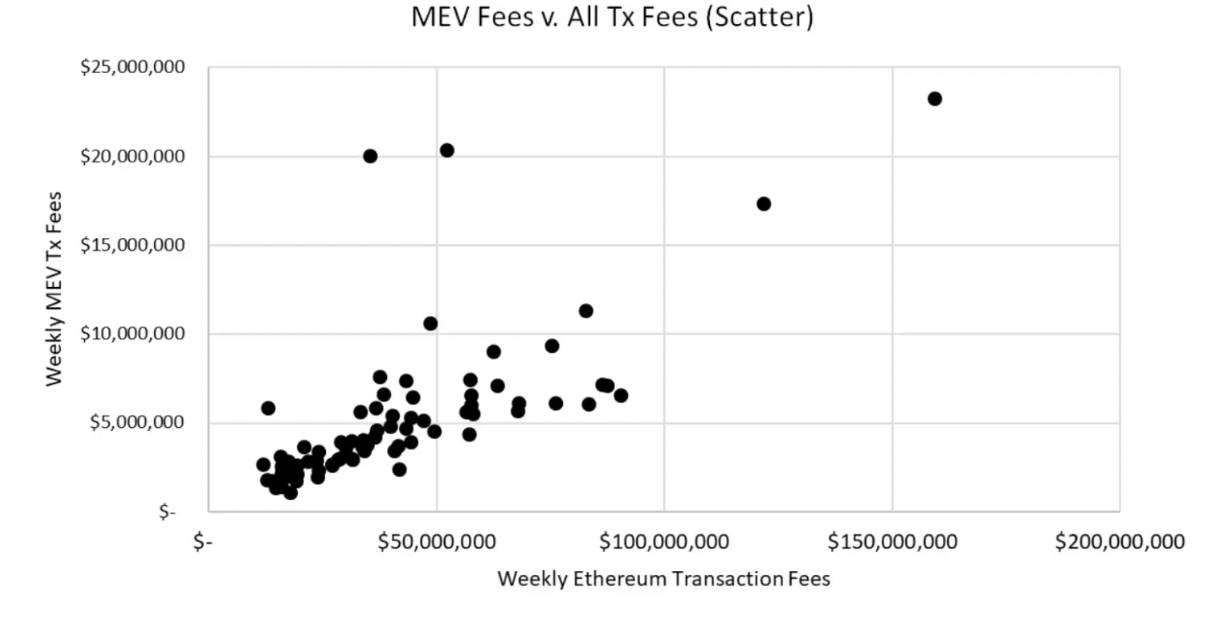
MEV as a percentage of paid transaction fees has remained stable over time—neither rising nor falling. From the charts above, weekly MEV hovers around 10% of block space costs. During weeks of high price and volume volatility—such as the FTX collapse—this share can rise to 30% of transaction fees. The week of the Silicon Valley Bank crisis saw MEV reach 25% of fees. This fluctuation resembles a mean-reverting time series, very similar to financial markets. Indeed, MEV activity may be closely tied to volatility itself.
Source: Will Nuelle, Galaxy Ventures
Source: Will Nuelle, Galaxy Ventures
In other words, if a given week sees $100 million in transaction fee consumption, we can simply assume that 90% stems from exogenous demand (users interacting with applications), while 10% arises endogenously from risk-free profits due to state changes during that week. If MEV accounts for 30% and non-MEV for 70%, it’s reasonable to expect a reversion toward normalcy the following week. We will continue monitoring this dynamic over time.
Notably, this ~10% consistency applies only to financial applications on blockchains (DEXs and lending protocols), which generate MEV—not stablecoin applications or gaming. If the dominance of financial applications declines long-term, then MEV relevance would also diminish unless new forms of stablecoin or gaming-related MEV emerge.
Conclusion: MEV Plays a Minor Role Today, But Could Be Significant Tomorrow
While MEV has the potential to disrupt protocol incentives and is a permanent consumer of block space, its current financial contribution to Ethereum remains relatively small—accounting for only about 10% of transaction fees. During black swan market events such as the FTX or Silicon Valley Bank collapses, this ratio may spike to 25% or higher, but these are exceptions, not the norm, and historically revert to baseline levels. So what role does MEV play in the block space business model? In some ways, it acts as a demand multiplier, amplifying exogenous application usage by a factor of 1.1–1.3x.
Nevertheless, MEV’s impact on future block space consumption could be significant. On blockchains like Solana and Monad, where per-transaction fees are much cheaper, MEV may consume a larger proportion of block space compared to high-fee chains like Ethereum. A simple example illustrates this:
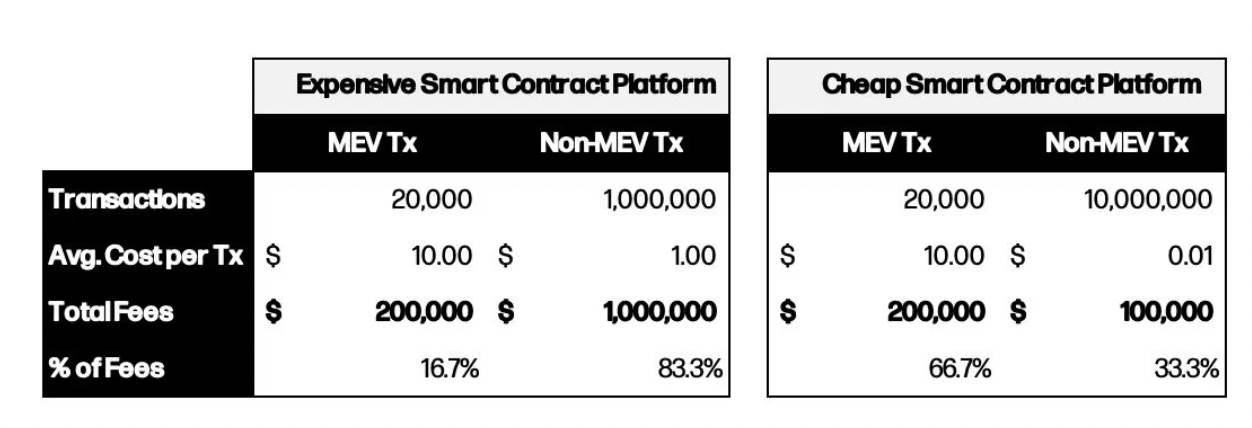
Source: Will Nuelle, Galaxy Ventures
The most profitable blockchains in the future are likely to be those that both (a) reduce transaction fees to stimulate network activity and demand, and (b) effectively capture MEV—via validators, sequencers, or burning—as a function of that activity.
The existence of phenomena like MEV is yet another reason why block space represents an unprecedented business model. Its unique characteristics make it a compelling long-term investment. Finally, we reiterate the strengths and weaknesses of block space:
Strengths:
-
Strong net income margins. Selling block space is the only zero-operating-cost business model. While Ethereum’s net income margin fluctuates, it has averaged 33.9% since January 2023.
-
Ease of generating network effects. Generally, SaaS products lack network effects, while social media apps and marketplaces have them. As more applications and capital join, block space improves, driving transaction fees upward via sustained network effects. These effects can generate additional revenue through MEV.
-
Expanding scale over time. Some block space providers—like L2s—benefit from increasing scale and have further growth potential.
-
Exogenous demand multiplier effect from MEV. MEV is a persistent feature of blockchain systems. Although it may harm consensus in some cases, it contributes significantly to ecosystem fees at scale. For every $1 in transaction fees on Ethereum, approximately $0.10–$0.30 in MEV fees are generated.
Weaknesses:
-
Low gross margins, though improving. The cost of producing a unit of block space (e.g., 1M gas) is high and may require over 66% of its future profits. Block space is a low-gross-margin business.
-
Highly cyclical. Revenue from selling block space is strongly cyclical, dependent on market conditions and closely correlated with market volatility.
Join TechFlow official community to stay tuned
Telegram:https://t.me/TechFlowDaily
X (Twitter):https://x.com/TechFlowPost
X (Twitter) EN:https://x.com/BlockFlow_News
 @galaxyhq









