








TechFlow -同行相轻,Akash founder questions io.net, sparking DePIN controversy
TechFlow Selected TechFlow Selected
TechFlow -同行相轻,Akash founder questions io.net, sparking DePIN controversy
On the surface, it's an objective Q&A about product experience; underneath, it's a rivalry between two similar projects and a battle to protect brand image.
 Navigating Web3 tides with focused insights
By TechFlow
One of the most notable events in recent days has been the token launch of IO.NET.
From Binance's opening price fluctuations to user experiences mining IO tokens using GPUs, nearly all attention has centered on IO’s asset value.
However, there are dissenting voices.
Take Akash Network, another decentralized cloud computing project. Its founder, Greg Osuri, couldn’t stay quiet. While everyone else focused on IO’s price movements, he decided to try out IO.NET’s product firsthand.
The experience, however, turned out less than ideal.
Greg took to Twitter to repeatedly point out various issues with IO.NET’s product—transforming himself from a rival founder into an unofficial “quality inspector” for IO.NET.
In response, IO.NET’s CTO GauravTdhinait replied thread after thread, patiently addressing each of Greg’s concerns.
The back-and-forth exchange was publicly framed as an objective Q&A about product experience, but beneath the surface, it revealed a rivalry between two competing projects fighting for brand credibility.
When a founder from a competing project takes time to test and critique your product at such a sensitive moment, it’s hard to tell whether this is a genuine “casual trial” or a deliberate attempt to pick apart weaknesses.
We’ve compiled the full timeline of the debate between Akash founder Greg and IO.NET CTO GauravTdhinait, reconstructing the incident in detail.
Paid for Apple, Got Nokia?
The controversy began when Akash founder Greg reported an initial technical issue while using IO.NET.
Greg purchased access to a cluster of four A100 GPU instances on IO.NET and paid the corresponding fees.
After completing the deployment and payment process, he discovered a mismatch: upon checking the data, he realized he did not receive four A100 GPUs, but only one RTX A4000.
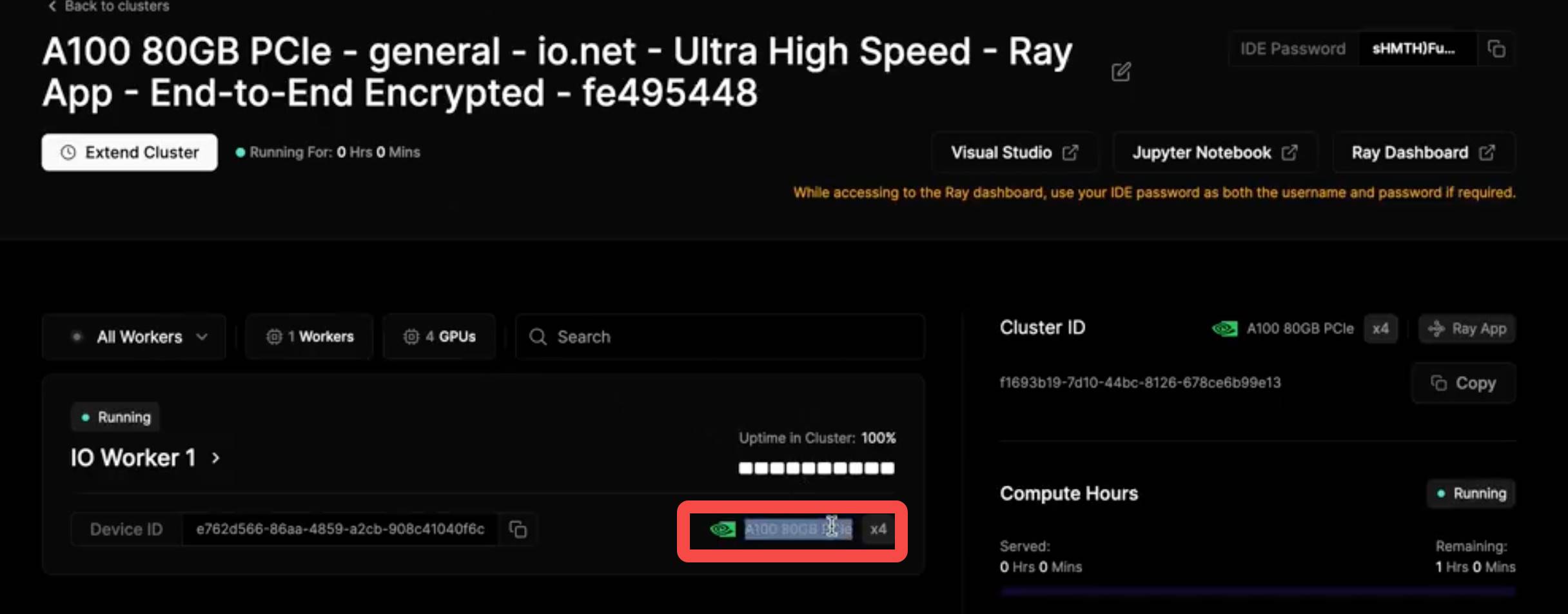
On paper, there was a massive performance gap between what he expected and what he received. Greg compared it to paying for an iPhone but receiving an old Nokia phone instead.
To prove authenticity, Greg tagged IO.NET on Twitter demanding answers—and attached a screen recording showing every step of his purchase and operation.
The post quickly went viral, with others joining in, accusing IO.NET of fraud and calling for accountability.
This immediately prompted IO.NET’s CTO Gaurav (@GauravTdhinait) to respond personally, offering a reasonable explanation.
The so-called “mismatch” in Greg’s video was due to one server (node) in his created cluster being unhealthy, which prevented the entire cluster from functioning properly.
As for why he saw an RTX A4000 instead of A100s: the RTX A4000 shown in Greg’s recording was actually the cluster’s master node (responsible for management and coordination), not the worker nodes that perform high-performance computing tasks.
Moreover, IO.NET does not charge users for such faulty clusters, and they are automatically destroyed afterward.
In plain terms: what you recorded and what actually happened are two different things.
You still got an iPhone—you just encountered a defective unit, leading to your misunderstanding.
More importantly, CTO Gaurav provided additional evidence: Greg had actually created seven clusters on IO.NET, six of which ran successfully.
Yet Greg chose to highlight only the single failed case in his public complaint. While IO.NET didn’t directly comment on this behavior, it’s hard not to suspect that Greg may have deliberately seized on an outlier to nitpick.
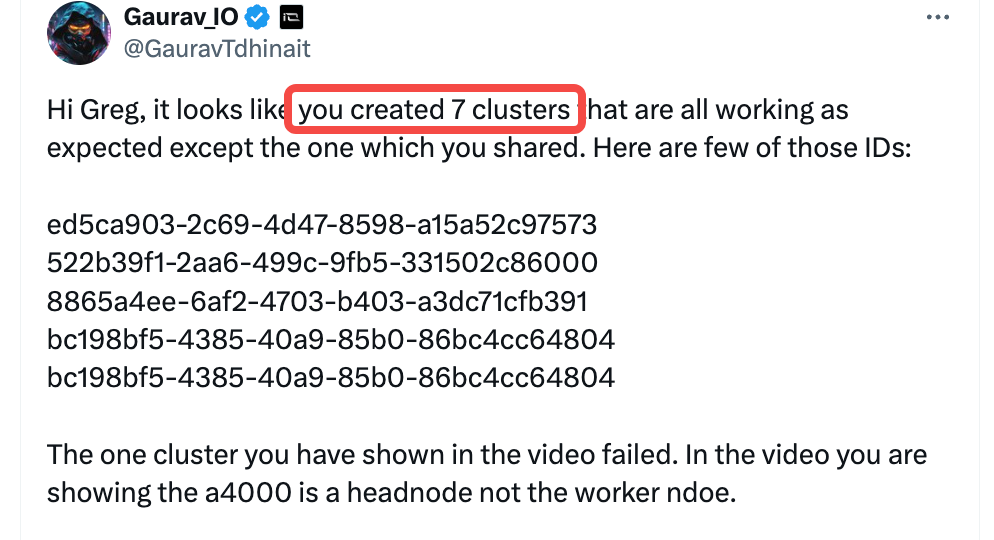
Six successful cases weren’t recorded or mentioned; only the one failure was highlighted and demanded explanation. As one commenter noted:
You don’t seem like someone genuinely trying to use the product...
Playing Quality Inspector to the End
After raising concerns over the hardware mismatch, Greg didn’t stop playing IO.NET’s quality inspector. He continued voicing complaints about other aspects of the product, fixating on various user experience issues.
For example, Greg claimed he deposited $100 worth of USDT into his IO.NET account but wasn’t granted upgraded privileges to purchase more clusters, accusing IO.NET of arbitrary restrictions and censorship against his account;
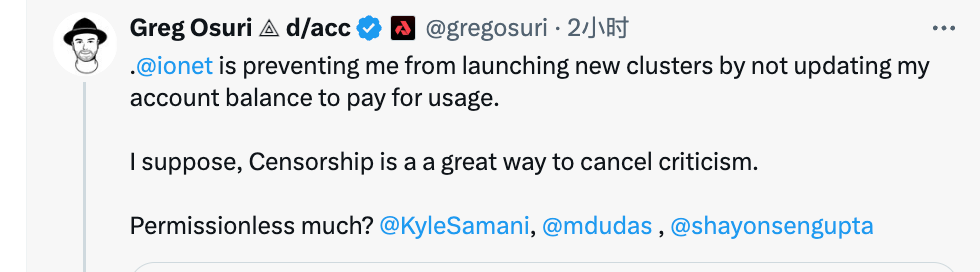
Another dispute arose when IO.NET’s CTO pointed out that Greg’s usage pattern looked unusual—creating a cluster service and deleting it within two minutes. Greg firmly rebutted, insisting he didn’t delete it immediately, but waited a long time because IO.NET’s system kept failing to correctly display GPU information, making it appear unresponsive—justifying his deletion as reasonable.
As of this writing, Greg continues to open new threads on Twitter, compiling multiple issues together, warning others not to trust the “one-sided narrative” from IO.NET’s CTO, while casually praising Akash Network for its smooth operations.
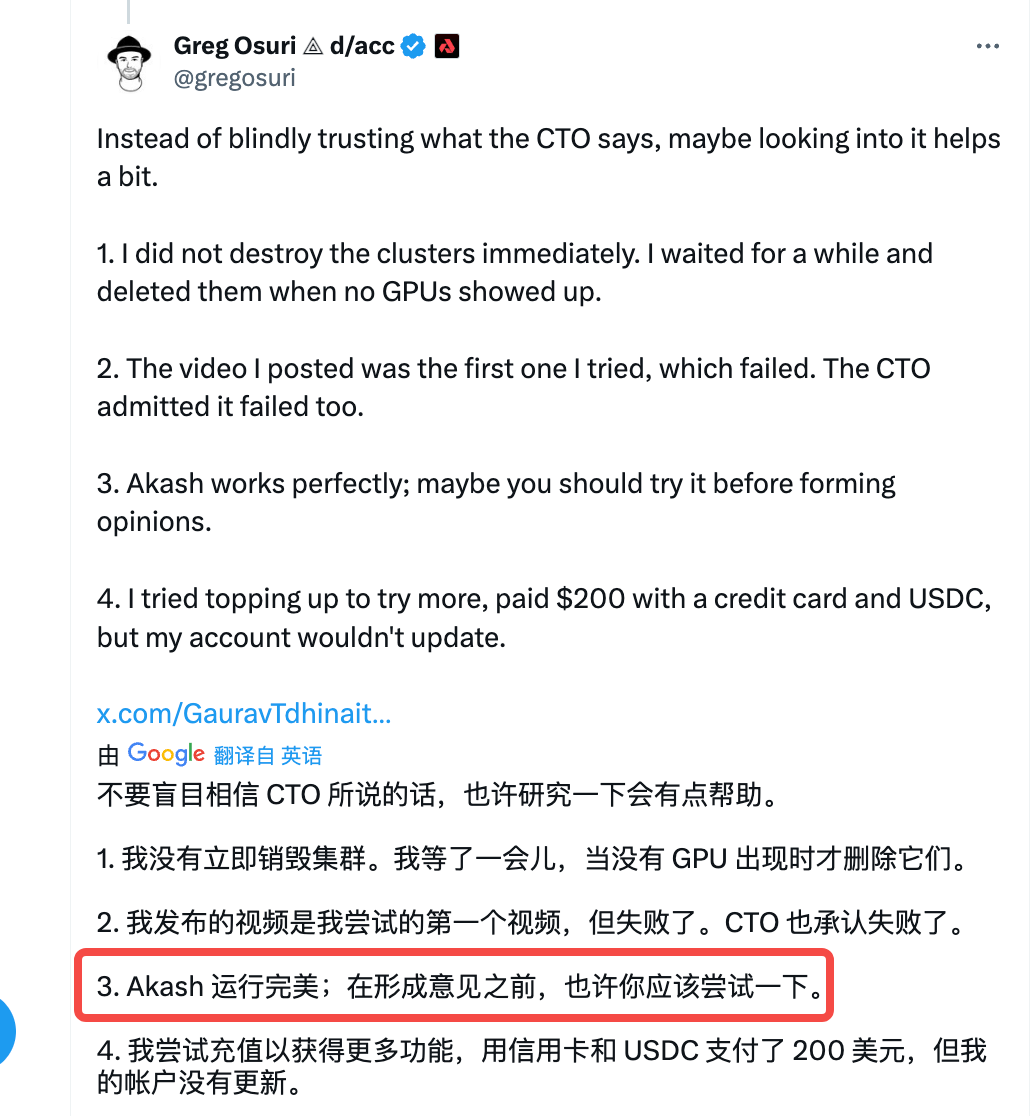
Whether IO.NET truly has usability issues, and how severe they are, becomes almost irrelevant amid these heated exchanges and exposure posts.
Instead, the perception shifts: here is a founder of a competing project spending significant energy to “test” a rival’s product, stubbornly pointing out flaws and refuting every “one-sided claim.”
Is he the CEO of his own company—or a free quality inspector for a competitor?
Focusing so intensely on minor details makes the situation feel less like principled scrutiny and more like a loss of dignity.
Greg’s actions have drawn criticism from the community. Some bluntly said, “Bro, you should spend time improving your own product instead of complaining about competitors,” while some AKT holders expressed disappointment in Greg’s attitude, saying they’re now considering selling their tokens.
Rivals in Name Only
Ancient wisdom speaks of scholars belittling one another—referring often to intellectuals who look down on each other.
It’s easy to understand Greg’s urge to nitpick and his underlying motivations—he’s working on a similar business, so naturally, he can’t tolerate small mistakes from a peer. There’s even a strong temptation to say, “If you can’t get this right, I really need to call you out.”
Thus, Akash’s founder criticizing IO.NET amounts to a form of DePIN elitism.
Everyone thinks they hold the upper hand—but hopes their rivals fall short.
DePIN and decentralized cloud computing projects are multiplying rapidly. Technically, there aren’t many high barriers to entry—these are mostly resource-intensive businesses. What ultimately decides success or failure is often user experience, operational smoothness, and brand strength.
But personally stepping in as a quality inspector, without absolute confidence in identifying real issues, risks damaging your own brand image in the end.
After all, if you harshly scrutinize your competitors, the community will surely bring up your past criticisms the moment your own product hits a minor snag.
Leaving room for yourself and others might be the wisest philosophy in a world where makeshift teams dominate.
Join TechFlow official community to stay tuned
Telegram:https://t.me/TechFlowDaily
X (Twitter):https://x.com/TechFlowPost
X (Twitter) EN:https://x.com/BlockFlow_News
 深潮TechFlow











