








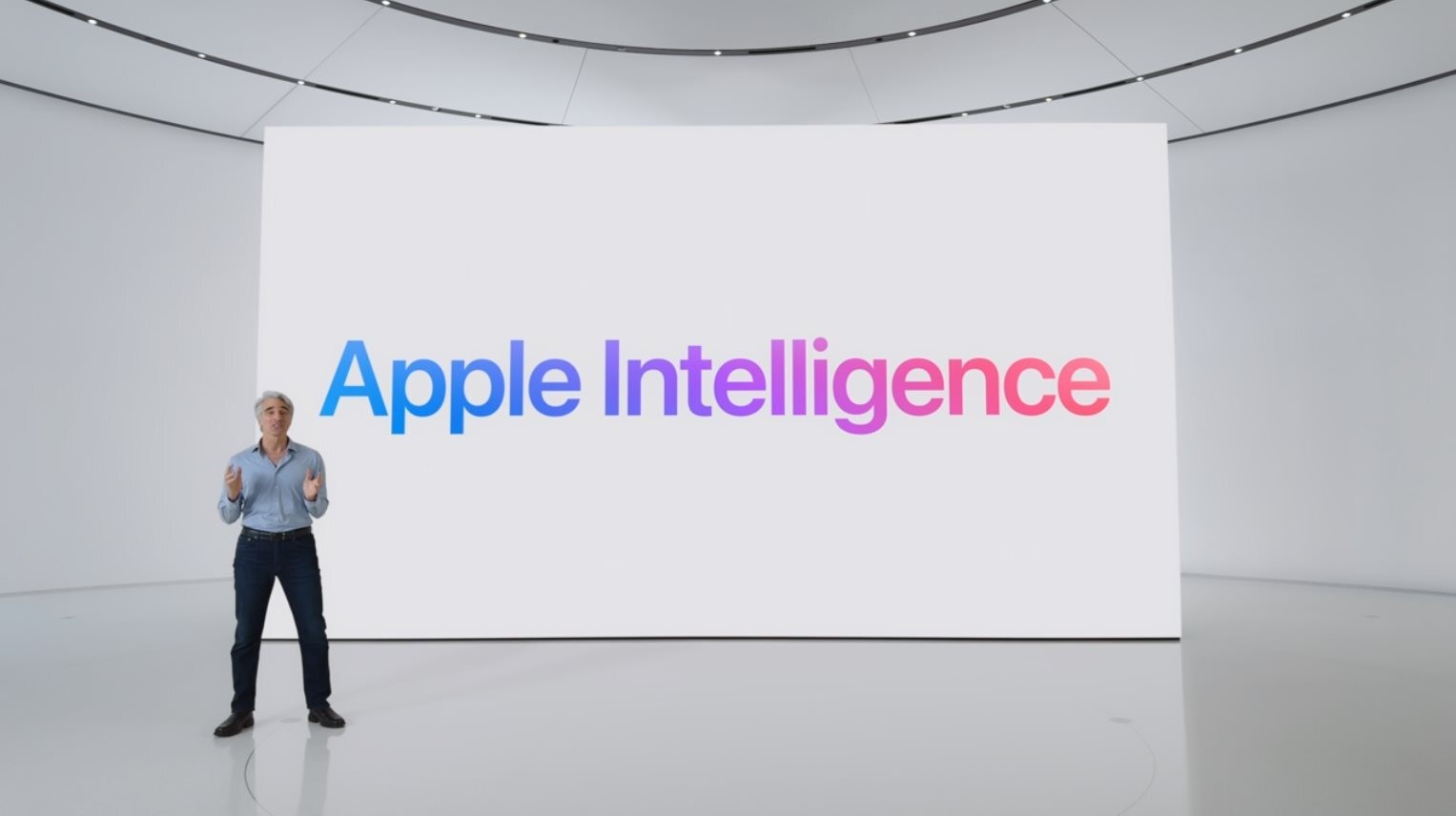
"Apple Intelligence": Focusing on Small Models
TechFlow Selected TechFlow Selected
"Apple Intelligence": Focusing on Small Models
Apple cares more about how to seamlessly integrate AI into the operating system to optimize user experience.
 Navigating Web3 tides with focused insights
Author: Chang Jiayi
Source: Wall Street Insights
At Tuesday's early-morning WWDC event, Apple replaced the term "Artificial Intelligence" with "Apple Intelligence" as its designation for AI, signaling an intent to redefine AI altogether. The much-hyped collaboration with OpenAI turned out to be nothing more than offering a ChatGPT interface—entirely optional at the user’s discretion.
In a way, Apple truly has redefined AI—not by following other tech giants in chasing “bigger is better” models with ever-increasing parameters, but by focusing on seamlessly integrating AI into the operating system to optimize user experience.
Customized Small Models Ensure User Experience
According to information revealed at the WWDC, the key to "Apple Intelligence" lies in numerous small models, each specifically designed for particular needs within the operating system.
As Craig Federighi, Apple’s senior vice president of software engineering, explained during the conference, many of Apple’s AI models can run entirely on devices powered by A17+ or M-series chips, eliminating the risk of sending personal data to remote servers.
These models are trained on customized datasets, have relatively low parameter counts, limited intelligence, and aren’t as versatile as large models like GPT or Claude. For instance, built-in features such as text summarization and rewriting are expected to produce fairly straightforward results.
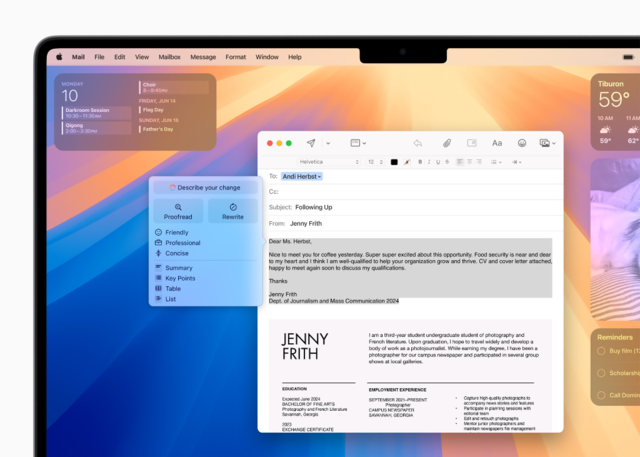
This design reflects a balanced consideration of processing speed and computational demands—most of Apple’s proprietary models can run directly on smartphones without relying on cloud servers, enabling fast response times.
Although individual models are small in scale, Apple Intelligence compensates through sheer quantity. By pre-training a vast number of models for different tasks, Apple Intelligence can meet a wide range of user needs—from managing photos and text to executing complex cross-app operations.
Privacy Comes First
However, for more complex user requests, Apple may bring in third-party models such as OpenAI’s ChatGPT and Google Gemini. In these cases, the system will prompt users whether they agree to share relevant information externally (if no prompt appears, it means the request is being handled by Apple’s own model).
This mechanism helps alleviate user concerns about privacy—a consistent priority for Apple.
As previously reported by Wall Street Insights, when more powerful cloud-dependent models are required, Apple will use specialized servers powered by its own chips. Federighi emphasized that these servers include security tools written in Swift, and Apple’s AI sends only the minimal necessary data to complete the task—without granting full access to device context information.
Moreover, Apple stated that this data will not be stored for future server access or used to further train its server-based models.
Apple has not clearly specified which operations require cloud processing, as this may change over time. Some tasks requiring cloud computing today might eventually be handled locally on the device. On-device computation isn't always the default choice, since speed is just one of many factors the Apple Intelligence system considers when deciding whether to invoke cloud computing.
Nevertheless, certain user requests will always be executed on the device. The most notable example is the on-device AI image generator, Image Playground, which stores the complete diffusion model locally and can generate images in three distinct styles.
Even in its current early testing phase, Image Playground delivers surprisingly fast image generation—typically taking just a few seconds—though the output quality cannot match that of larger models.

[Disclaimer] Markets involve risks; investment requires caution. This article does not constitute investment advice. Users should consider whether any opinions, viewpoints, or conclusions expressed herein are suitable for their specific circumstances. Responsibility for investment decisions rests solely with the reader.
Join TechFlow official community to stay tuned
Telegram:https://t.me/TechFlowDaily
X (Twitter):https://x.com/TechFlowPost
X (Twitter) EN:https://x.com/BlockFlow_News










