









From Token to PointFi: The Ongoing Optimization of User Incentives in Web3
TechFlow Selected TechFlow Selected
From Token to PointFi: The Ongoing Optimization of User Incentives in Web3
Point systems face numerous challenges during implementation, but through continuous optimization and innovation, Web3 projects can find more efficient and equitable incentive mechanisms.
 Navigating Web3 tides with focused insights
Author: HappyBlock
In the Web3 domain, attaching financial attributes to various sectors—such as SocialFi, GameFi, NFTFi, ArtFi, etc.—is primarily aimed at leveraging blockchain technology and decentralized finance (DeFi) to promote assetization, incentive mechanisms, fundraising, liquidity, and user autonomy, thereby enabling new economic models and application scenarios for these sectors.
User incentives in Web3 have evolved from tokens, whitelists, and credentials to points on mission platforms and then to project-specific point systems. In the early years, tokens were commonly used to incentivize participant growth or loyalty, capture value, or deliver core utility for products. Typical token strategies focused on one-time retroactive airdrops to motivate engagement and reward early adopters (e.g., Uniswap, ENS), or ongoing liquidity mining programs that rewarded users for performing specific actions (e.g., LooksRare, Compound). Toward the end of the NFT Summer, whitelists became popular as a way to identify genuine contributors—the so-called "family" members committed to growing with the community. However, the term "whitelist" eventually devolved into a stable, low-cost arbitrage tool and a vehicle for excessive hype by project teams, leaving behind a trail of wreckage in the NFT market when the bear market arrived. The explosion of quest platforms and the rise of SBT (Soulbound Token) concepts marked another evolution in Web3 incentives, turning countless on-chain and off-chain behaviors into verifiable credentials stored within each wallet’s digital space. If not properly utilized, however, these credentials risk becoming nothing more than fleeting cyber signals, like snowflakes melting away.
Point-Based Incentives
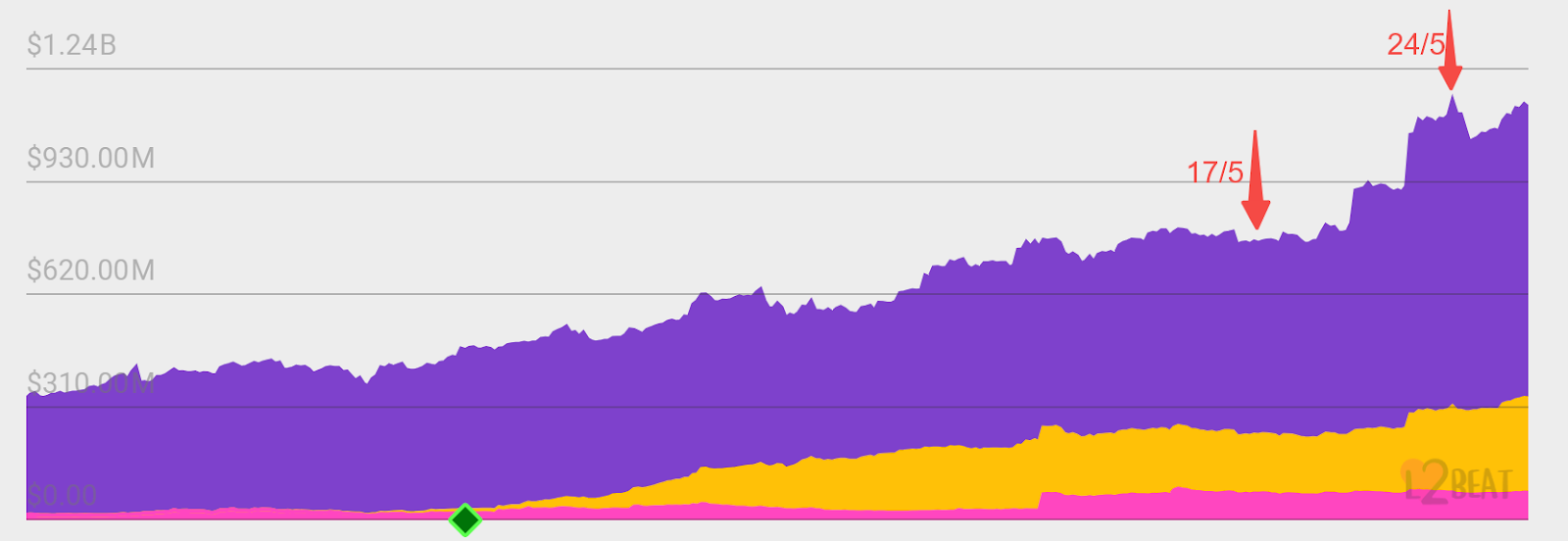
During the last bull-bear transition, the Layer 2 blockchain Blast successfully sparked a trend among projects using Points as user incentives by introducing a points system with real-world value. Recently, Linea appears to be following a similar successful path. On May 17, Linea launched the first phase of its Linea Surge Volt program, aiming to boost ecosystem development by attracting more users and increasing total value locked (TVL) on the network. Linea Surge is a points-driven initiative where users earn LXP-L tokens by holding assets on Linea and deploying them into DeFi protocols across the network. By May 24, Linea's TVL had surpassed $1.1 billion, reaching $1.12 billion—an all-time high—and representing a 42.58% increase over seven days. One of the goals of the Linea Surge program is to grow the network's total value locked to drive ecosystem expansion. Data shows that since launching the Surge initiative, Linea’s TVL has surged past $1.1 billion, achieving one-third of the stated target ($3 billion TVL).
A new sector—PointFi—has even emerged around this form of incentive, with Whales Market emerging as a leading player. Whales Market offers a novel peer-to-peer primary market platform allowing users to pre-trade tokens before official launches. This includes a P2P points marketplace—Whales Market uses smart contracts to enable buyers and sellers to conduct agreed-upon on-chain transactions. After the token launch, Whales Market automatically converts points into corresponding tokens based on foundation announcements. Point orders must be set in advance, but the final conversion ratio to tokens is only revealed at TGE (Token Generation Event). However, some users argue this mechanism could result in sellers receiving far fewer tokens in value than the points they sold. This implies potential risk for sellers, who cannot determine the token's value upfront while the number of points exchanged might vastly exceed the eventual token worth.
The popularity of point-based incentives reflects project teams’ urgent need to improve user retention and engagement. Yet, as more and more point programs complete their token conversions, both users and the market are voicing diverse concerns.
-
Over-saturation of point systems: As an increasing number of projects adopt point schemes, questions arise about whether such models are truly effective. Some worry that these systems lead to “toxic TVL”—drawing large amounts of capital without bringing in genuine users or builders. Others believe point systems shift user behavior toward chasing points rather than making meaningful contributions to the project.
-
Speculation and bot manipulation: Critics point out that point systems attract significant speculation and bot activity, creating bubbles and unhealthy market conditions. Projects exploit these systems to rapidly accumulate users and transaction data, which may be neither authentic nor sustainable.
-
Regulatory and compliance challenges: With rising regulatory scrutiny over crypto markets, projects face greater compliance hurdles. Some argue that the lack of clear regulatory frameworks leads to misuse and confusion around point systems, leaving investors unaware of what they’re actually accepting and the risks involved.
-
User attention fragmentation: As more projects roll out point systems, user attention becomes fragmented, making it harder to focus on any single project or ecosystem. While points serve as a tool to retain users, they don’t necessarily foster long-term value or loyalty.
-
Questions about input-output ratios: Points simplify traditional interaction-based airdrop logic, but as project metrics and user dashboards grow, users develop expectations based on accumulated points—only to face ambiguous return calculations or arbitrary judgments by project teams. The common disclaimer “points do not guarantee rewards” often leaves communities filled with noise and frustration during the gap between campaign completion and actual reward distribution.
While point systems may bring short-term attention and capital to projects, ensuring these incentives genuinely support healthy and sustainable ecosystem development remains a challenge requiring joint efforts from project teams, investors, and regulators.
Solutions—Long-Term Incentive Mechanisms
Staged Rewards: Distribute rewards across multiple phases, requiring users to complete tasks in each stage to unlock full benefits. For example, many recent projects—including Ether.fi, Renzo, and UXLINK—have adopted phased airdrops. These projects typically announce the initial airdrop allocation alongside vague future plans upon revealing eligibility criteria, maintaining sustained community interest while encouraging early users (those covered in the first round) to further spread awareness about the project and profit expectations.
Case Study: Renzo Project
Renzo implemented a phased airdrop model, distributing rewards across stages where users must fulfill tasks to receive full allocations.
Season One
-
Acquisition Method: Users earn points by minting and holding ezETH or providing liquidity.
-
Reward Mechanism: Earn 1 point per hour for every ezETH held; earn 4 points per hour for depositing 1 ezETH and 1 ETH into a DEX pool.
-
Bonus Rewards: Early participants receive additional bonuses.
Season Two
-
Start Date: April 26
-
Acquisition Method: Continue holding or increase ezETH balance; stake REZ to earn points.
-
Reward Mechanism: Additional point rewards for ezETH holders in wallets and those using supported ezETH integrations in DeFi. Staking 5,000 REZ earns 1 point per hour.
-
Bonus Rewards: Season One participants who maintain or increase their ezETH balance in Season Two receive a 10% bonus. Holders of the Season One airdrop who keep their average daily REZ staking balance above the airdrop amount qualify for a 50% bonus. All multipliers take effect at the end of Season Two.
This approach not only incentivizes long-term contributions but also boosts project visibility through continuous news cycles.
Time-Weighted Loyalty Programs: Develop time-weighted loyalty programs distinct from traditional ones, where long-term participation and contribution allow users not only to accumulate points but also enjoy higher redemption multipliers.
Design Proposal for Time-Weighted Mechanism (using a SocialFi project as example):
Due to high social migration costs and strong first-mover advantages of centralized platforms, few projects in this sector have achieved success. SocialFi projects must rely on alternative methods to attract users and boost engagement. Platforms like Lenster, friend.tech, and Farcaster clearly show that financial incentives such as airdrops, rewards, and fundraising play a far greater role than inherent social features. How can we more reasonably unlock the financial aspects of social applications? Perhaps we can envision a user contribution tracking system tailored for early-stage SocialFi projects, recording all on-chain activities including frequency and duration of participation, along with specific contributions such as content creation, discussion involvement, and suggestions made. A user’s contribution count and time span proportionally affect the number of points earned. Frequent and sustained long-term engagement yields more points, whereas infrequent or short-term participation results in fewer rewards.
Additionally, a time-weighting factor should be designed to determine how much a user’s engagement duration impacts their point rewards. For instance, points earned early on might represent only a fraction of those gained through full-cycle participation. This weighting can be adjusted according to specific needs to balance user motivation and project objectives.
Example Scenario:
User A participates continuously for one year, publishing content and actively engaging in discussions each month.
User B only participates for one month, publishing one piece of content. Upon learning of an upcoming airdrop snapshot, they resume regular posting and active discussion participation.
Suppose both User A and User B generate nearly equal points during July, August, and September due to active community interaction and content output. However, because User A’s total contribution period is significantly longer than User B’s, under the time-weighted mechanism, User A receives a substantially higher conversion rate when redeeming points, reflecting their higher engagement frequency.
Research also suggests that project economic models, especially in GameFi, can use social rules (e.g., achievement systems, ranking systems) and economic rules (e.g., point rewards, NFT rewards) to encourage user participation and contribution. Specifically, this can include:
1. Task and Achievement Rewards: Users earn rewards for completing specific tasks or achieving milestones, motivating deeper gameplay engagement.
2. Social Interaction: Encourage players to earn rewards through teamwork and competition, strengthening community stickiness.
3. Virtual Asset Trading: Allow players to trade NFTs and other virtual assets, generating point or token earnings from transactions.
A player’s in-game behavior and contribution directly impact the quantity and value of rewards received—that part is certain. But the key research question is how to ensure highly active and high-contributing players receive proportionally greater rewards, thus securing a more favorable position within the economic system.
Moreover, mechanisms akin to VC-style vesting (where points can only be converted to tokens after a certain period or condition) or gradual unlocking designs (where users gradually unlock points over time post-launch) could also be considered to help preserve point value.
Conclusion
Although point-based incentive systems face numerous challenges—including speculation, regulatory uncertainty, and fragmented user attention—ongoing optimization and innovation may enable Web3 projects to discover more efficient and equitable incentive models. We propose innovative approaches such as staged rewards and time-weighted loyalty programs. When well-implemented, these methods not only encourage long-term user contributions but also enhance project visibility through recurring engagement highlights. Furthermore, combining social and economic rules allows project teams to design incentive structures that genuinely foster participation and contribution. Moving forward, through collaborative efforts across stakeholders, the Web3 ecosystem can achieve healthier and more sustainable growth, delivering greater value and opportunities for users and developers alike.
Join TechFlow official community to stay tuned
Telegram:https://t.me/TechFlowDaily
X (Twitter):https://x.com/TechFlowPost
X (Twitter) EN:https://x.com/BlockFlow_News










