A Closer Look at Aave V4's Key Features: "Unified Liquidity Layer"
TechFlow Selected TechFlow Selected
A Closer Look at Aave V4's Key Features: "Unified Liquidity Layer"
Prototype design is expected to start in Q4, with coding completed in Q2 next year.
 Navigating Web3 tides with focused insights
Author: Madiha, Backlash Developer
Translation: Azuma, Odaily Planet Daily
Editor's Note: Veteran DeFi leader Aave is actively advancing the protocol upgrade to version V4. Based on previously disclosed information, the core of Aave V4 lies in building a "Unified Liquidity Layer" (ULL), aiming to aggregate liquidity from multiple networks within a single protocol.
In terms of timeline, The Defiant previously reported that Aave planned to begin prototyping the V4 protocol in Q4 and finalize the code by Q2 2025. This morning, Aave founder Stani Kulechov’s latest X post further confirmed—and even shortened—this timeline. Stani first revealed that Aave will launch Aave Network following the V4 release, and when responding to community inquiries about timing, stated: “I’m certain this will happen next year, or even earlier.”
Below is Backlash developer Madiha’s overview and analysis of Aave V4’s key upgrade—the Unified Liquidity Layer—translated by Odaily Planet Daily.
The main upgrade in Aave V4 is the "Unified Liquidity Layer," which essentially extends the Portal concept introduced in Aave V3.
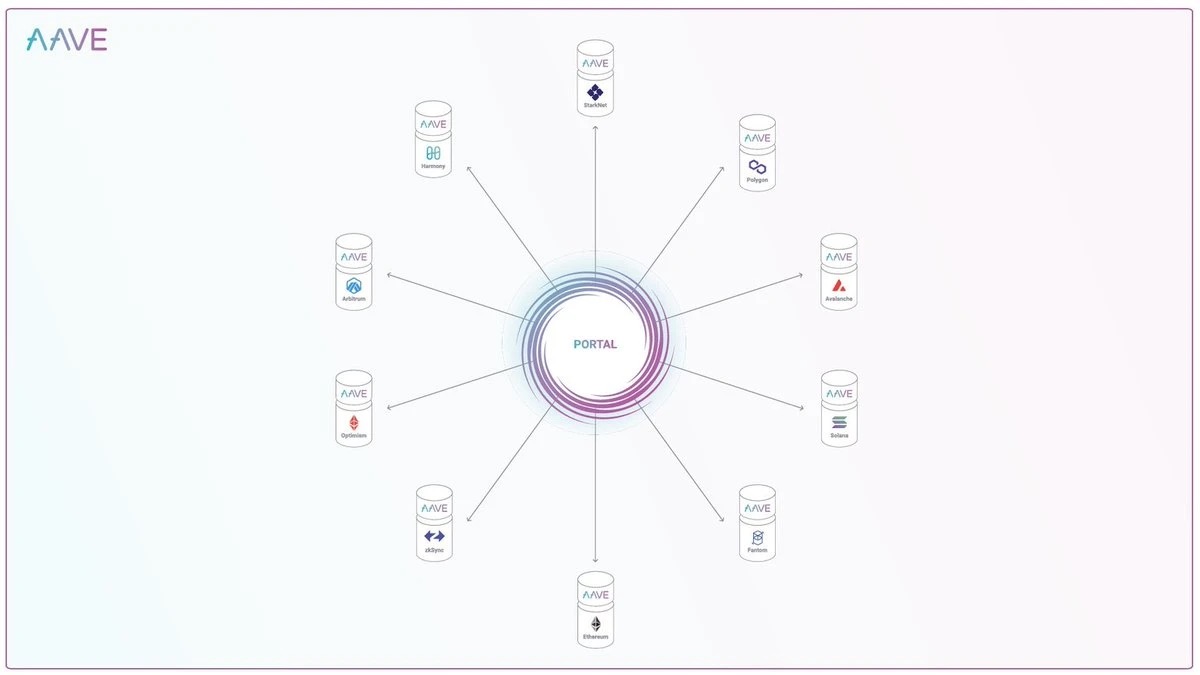
Portal was originally a cross-chain functionality within Aave V3, but in reality, most users have neither understood nor used it. Let's walk through how Portal evolved into the Unified Liquidity Layer.
Portal was initially designed to enable bridging of supplied assets across different blockchains supported by Aave. This feature allows whitelisted bridge protocols to burn aTokens on the source chain while instantly minting aTokens on the destination chain.
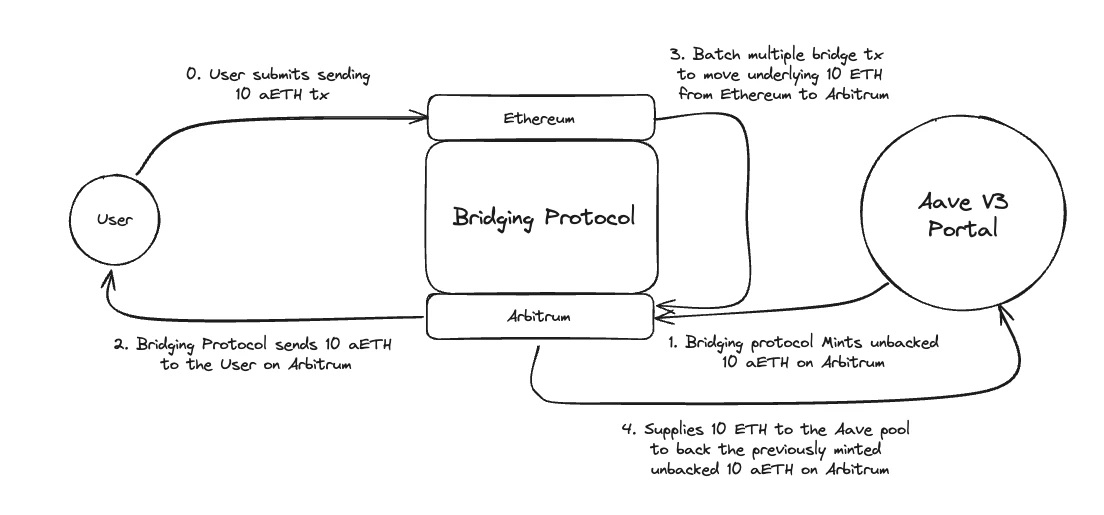
For example, Alice holds 10 aETH on Ethereum and wants to move them to Arbitrum. Once Alice submits this transaction to a whitelisted bridge protocol, the bridge executes the following steps:
-
Mint 10 aETH on the target chain (Arbitrum in this case) via an intermediary contract—these are temporarily uncollateralized (though collateral exists, it hasn’t yet been transferred to the target chain).
-
The intermediary contract then transfers the 10 aETH to Alice on Arbitrum.
-
Batch process multiple bridging transactions and transfer the underlying 10 ETH to Arbitrum.
-
Once funds are available on Arbitrum, the whitelisted bridge contract supplies the 10 ETH into the Aave pool on Arbitrum to back the previously minted 10 aETH.
In this example, Aave effectively moves Alice’s 10 aETH from Ethereum to Arbitrum. In practice, however, the functionality can handle various scenarios—such as general asset bridging or allowing Alice to directly withdraw 10 ETH on the Arbitrum network.
The Portal function enables users who seek higher yields across different blockchains to execute cross-chain operations more easily. For instance, if Optimism has a relatively small pool but offers higher deposit rates than Ethereum at a given time, users can leverage Portal to simply migrate their deposits from Ethereum to Optimism and earn better returns.
However, despite enabling Aave V3 to operate as a chain-agnostic DeFi protocol, Portal relies on certain trust assumptions. Simply put, users must submit bridging transactions to whitelisted bridge protocols (e.g., Connext) rather than directly through the core Aave V3 protocol. To reiterate: end users currently cannot access Portal solely via Aave’s core protocol.
This leads us to the concept of the Unified Liquidity Layer—the most significant architectural shift from Aave V3 to V4. As illustrated below, the Unified Liquidity Layer adopts a modular design to centrally manage “supply/borrow caps,” “interest rates,” “assets,” and “incentives,” allowing individual modules to draw liquidity from it.
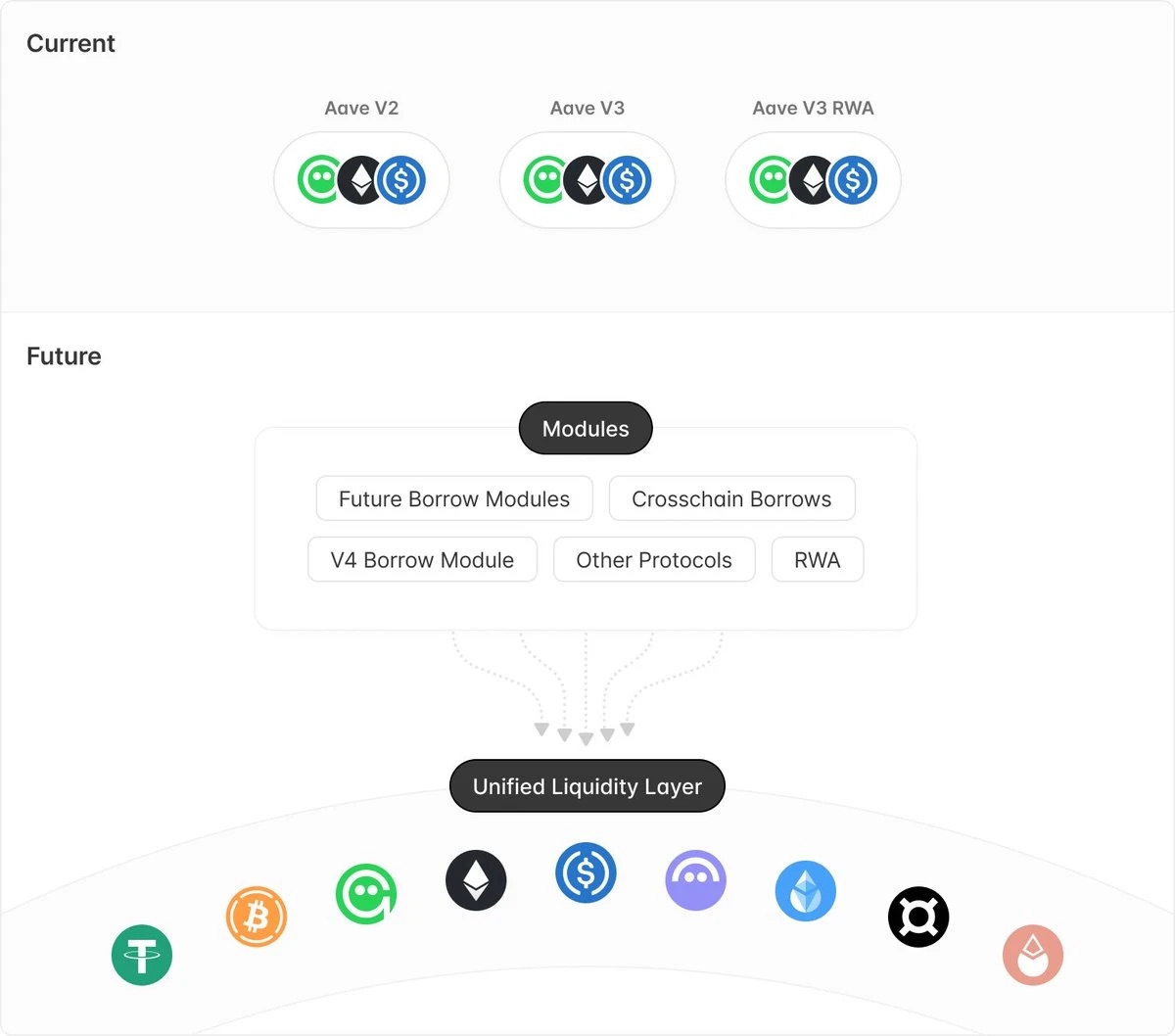
By consolidating liquidity management, the Unified Liquidity Layer will allow Aave to use all available assets more efficiently—meaning liquidity can be dynamically allocated where it is most needed, thereby improving overall capital efficiency.
Moreover, the modular design means Aave can add new modules or features—such as isolated pools, RWA modules, or CDPs—while maintaining system stability, and can seamlessly introduce new modules or retire old ones without requiring liquidity migration.
In Aave V3, Portal enabled asset movement across different networks covered by the Aave protocol, thus activating cross-chain liquidity functionality. The Unified Liquidity Layer builds upon this by creating a more flexible and abstracted infrastructure that not only encompasses this capability but also supports a wider range of liquidity provisioning needs.
Under the Unified Liquidity Layer framework, Aave will leverage Chainlink’s Cross-Chain Interoperability Protocol (CCIP) to build a Cross-Chain Liquidity Layer (CCLL), enabling borrowers to instantly access all available liquidity across every network supported by Aave. This enhancement has the potential to evolve Portal into a full-fledged cross-chain liquidity protocol. I am excited to see how Aave V4 leverages this new infrastructure to unlock novel revenue streams.
The above constitutes Madiha’s complete analytical piece on the Unified Liquidity Layer.
Notably, beyond the Unified Liquidity Layer, Aave is expected to introduce additional improvements in the V4 upgrade, including dynamic interest rate mechanisms, liquidity premium mechanisms, smart accounts, dynamic risk parameter configurations, expansion into non-EVM ecosystems, and more. It also plans to build Aave Network with its stablecoin GHO and the Aave lending protocol itself serving as central hubs.
As a veteran DeFi leader, Aave has consistently held around 50% of the DeFi lending market share over the past three years. When including forked projects, approximately 75% of the value locked in the DeFi lending sector resides in projects utilizing versions of Aave’s codebase.
Regarding the V4 upgrade, Aave has set high expectations in its related proposals: “These improvements aim to significantly drive further adoption of the Aave ecosystem and help DeFi expand further, ultimately serving a potential new user base of up to one billion.”
Join TechFlow official community to stay tuned
Telegram:https://t.me/TechFlowDaily
X (Twitter):https://x.com/TechFlowPost
X (Twitter) EN:https://x.com/BlockFlow_News
 PANews