









Facing "exclusion" from the Base community and a significant decline in user data, Friend.tech confronts multiple challenges
TechFlow Selected TechFlow Selected
Facing "exclusion" from the Base community and a significant decline in user data, Friend.tech confronts multiple challenges
On one side is a significant loss of its own users, and on the other, attacks from competitors and exclusion from the Base ecosystem—Friend.tech is caught in a difficult predicament.
 Navigating Web3 tides with focused insights
Author: Nancy, PANews
Recently, Racer, co-founder of Friend.tech, sparked market concerns after claiming he felt "excluded by the Base community" and hinting at potentially migrating the protocol off the Base network. As a result, its native token FRIEND briefly dropped below $1. In addition to apparent tensions with Base's official ecosystem, Friend.tech is also facing internal challenges.
Protocol migration plans due to unstable Base relationship cut top whale’s position in half
Over the weekend, Racer tweeted: “System design bounty: If you can find a way to migrate Friend.tech off Base without causing major issues for users, and it performs well enough that we decide to adopt it, we’ll pay you $200,000.”
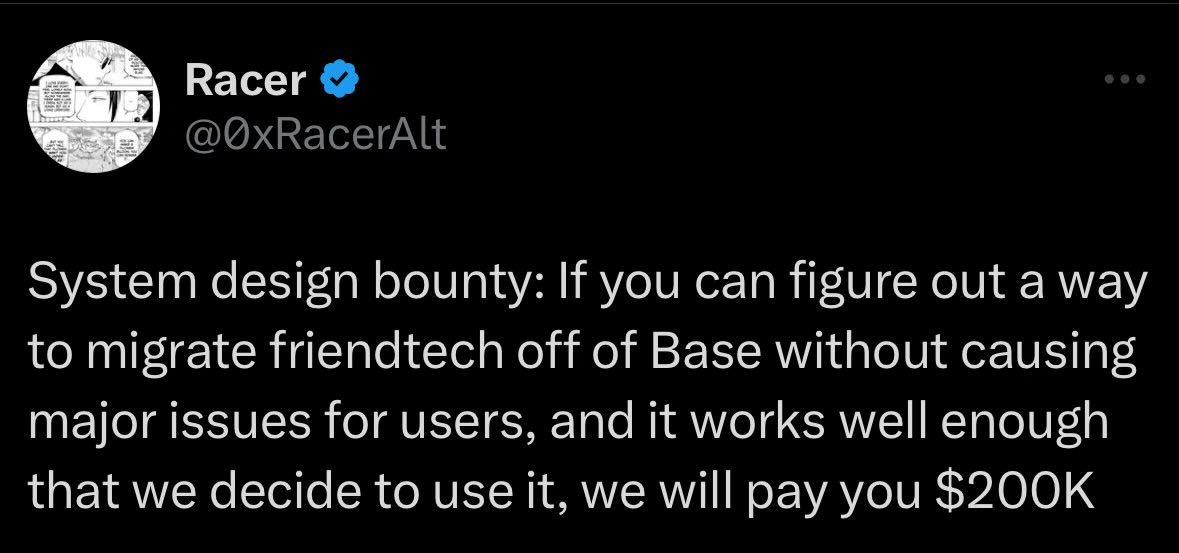
In another post, Racer elaborated on the reasons, stating that the relationship between Friend.tech and Base has long been unstable. “Farcaster’s investors aggressively attacked us at launch because they misunderstood what we were building. They exerted significant pressure on both our team and users, and since then, our relationship has deteriorated—we’ve been excluded by the ‘Base community.’” Racer has since deleted these tweets, and the posts are no longer accessible due to account deletion.
In response, Jesse Pollak, head of Base, noted that during its early stages, Friend.tech was incorrectly labeled by certain groups as representing “negative speculation,” leading the project to feel “isolated and disconnected” from Base and parts of the Ethereum ecosystem. He emphasized that Friend.tech is pioneering innovation and setting directions for the entire industry, and expressed hope that the broader Ethereum or Base ecosystem would work to mend relations with the project. Should Friend.tech choose to leave Base, he said he would regret it but ultimately respect and support their decision—highlighting the beauty of decentralization and on-chain economies.
Affected by this news, CoinGecko data shows that FRIEND fell over 35.1% in the past 24 hours. Since its launch, FRIEND has declined approximately 66% from its peak. According to monitoring by Yujing, Melo Ming (Lai Tai-cheng), the top holder known as the “number one whale,” has accumulated 4,873 ETH (worth about $15.35 million) worth of FRIEND tokens since listing, at an average price of $1.90. Based on current prices, Melo Ming is now sitting on an unrealized loss exceeding $6.94 million.
Investors backing competitors; key metrics sharply decline
Not long ago, Franklin Templeton’s Base Season report highlighted a significant rise in Base’s activity over recent months. Beyond meme coin trading, SocialFi applications like Friend.tech have driven growth, enabling Base to capture around 46% of all SocialFi-related transactions and securing a large share of SocialFi activity.
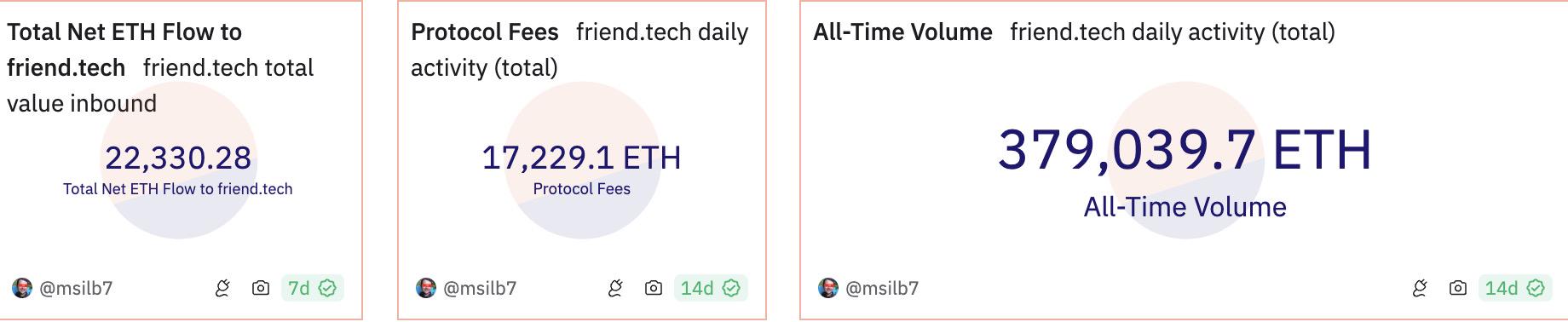
Dune data shows that as of May 27, Friend.tech’s historical trading volume reached 379,000 ETH, with protocol revenue totaling approximately 17,000 ETH and total ETH inflows surpassing 22,000 ETH. Earlier this month, Friend.tech reignited market enthusiasm with its V2 version airdrop plan, particularly due to the popularity of its new Club feature. Dune数据显示 shows that since the V2 launch, over 232,000 Clubs have been created, with lifetime trading volume exceeding 42.62 million FRIEND tokens.
At the same time, Farcaster—another SocialFi project on Base—has drawn significant market attention and recently announced a $150 million funding round led by Paradigm, a16z crypto, Haun Ventures, and USV. According to Dune, as of May 27, Farcaster has generated nearly $1.47 million in total revenue and has amassed 409,000 total users.
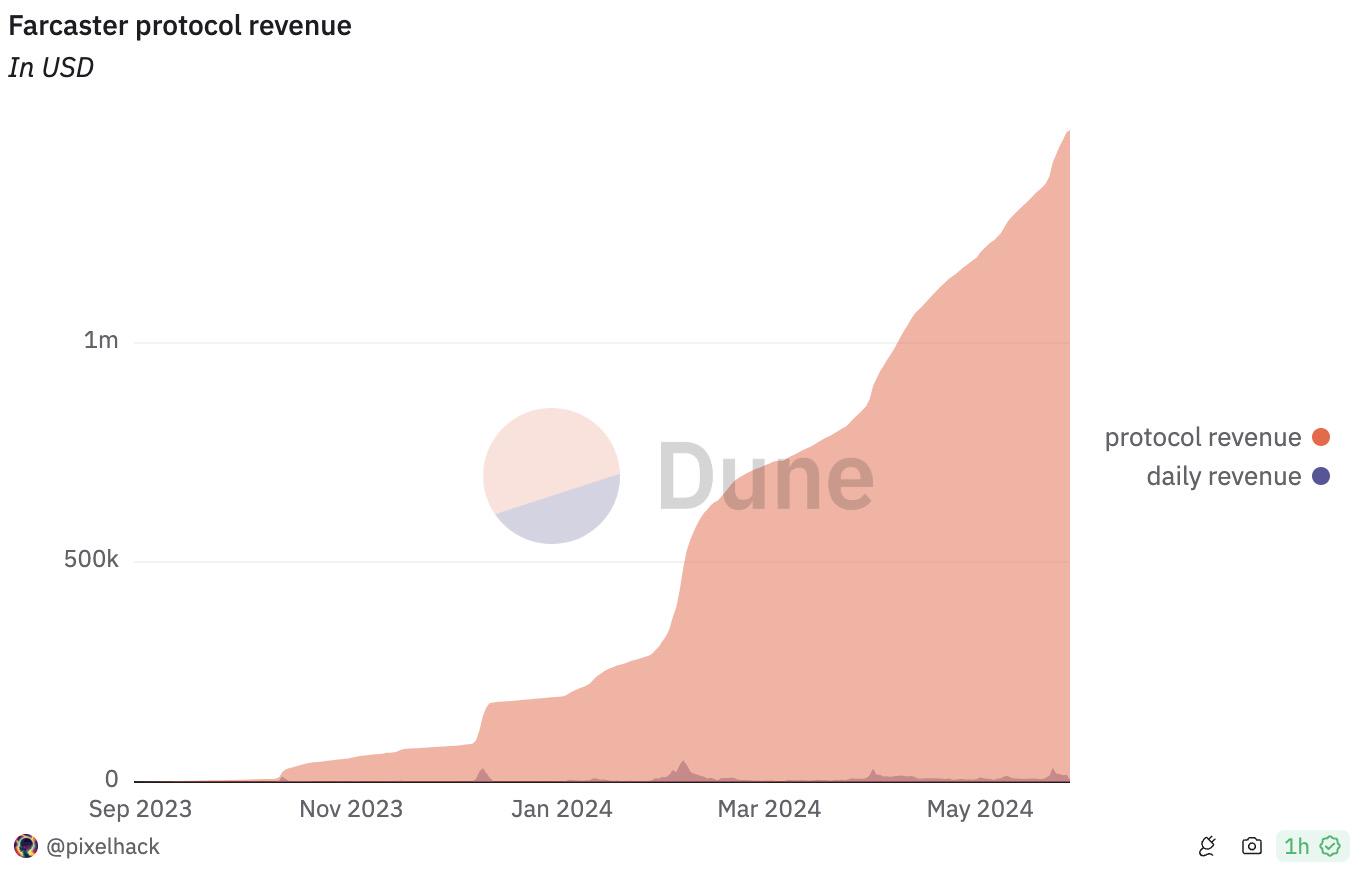
Notably, Paradigm—the same firm that invested in Friend.tech—is also the lead investor in Farcaster’s massive funding round. However, Friend.tech had previously persuaded its venture backers to forgo token allocations entirely, distributing 100% of tokens to the community instead.
As Farcaster gains traction, Friend.tech has repeatedly posted on social media promoting itself while subtly criticizing rivals like Farcaster to attract attention—examples include questions like, “What crypto social app would you recommend for users who can’t afford Friend.tech?” and statements such as “Friend.tech is only for the wealthy—please self-identify accordingly.” The two leaders in the social space are now engaged in direct competition.
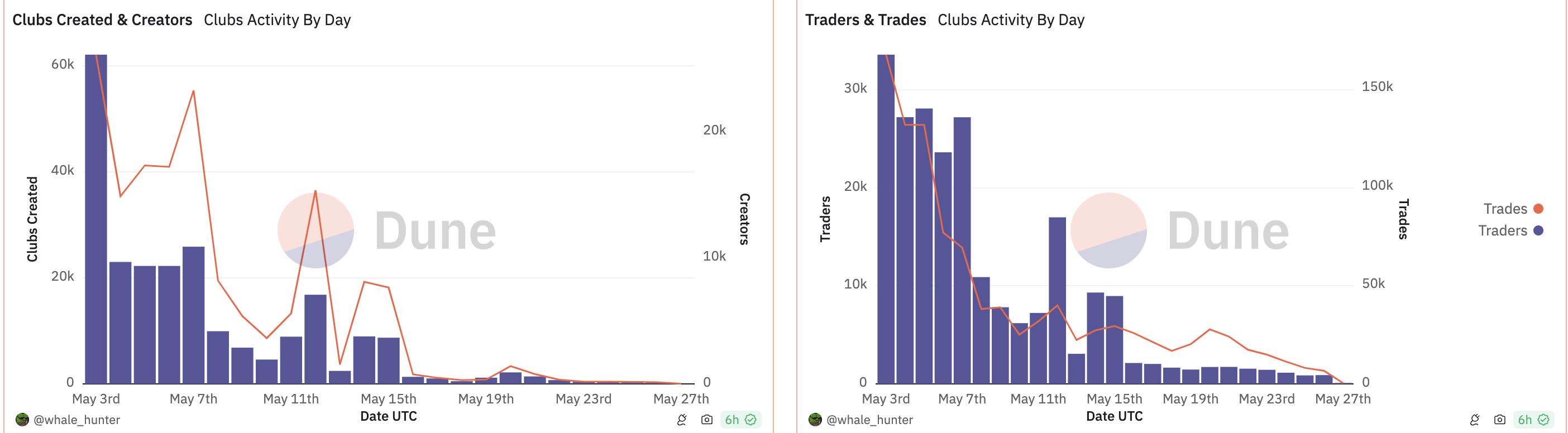
From a data perspective, although Farcaster’s profitability still lags far behind Friend.tech, the latter is experiencing sharp declines across multiple key metrics. DefiLlama data shows that Friend.tech’s TVL has dropped nearly 67.4% over the past 30 days. Additionally, Dune数据显示 indicates that as of May 26, daily Club creation on Friend.tech has fallen over 99.6% from launch levels, while daily trading volume has declined by approximately 90%. To counter this, Friend.tech has rolled out features such as Keydrops, Memeclubs, and Pinned Rooms over the past few months and plans to return two-thirds of Club Key redemption fees back to users.
With significant user attrition on one side and competitive pressure plus ecosystem “exclusion” on the other, Friend.tech finds itself in a difficult predicament.
Join TechFlow official community to stay tuned
Telegram:https://t.me/TechFlowDaily
X (Twitter):https://x.com/TechFlowPost
X (Twitter) EN:https://x.com/BlockFlow_News
 PANews









