Coin Metrics: Decoding the Adoption Characteristics of Stablecoins
TechFlow Selected TechFlow Selected
Coin Metrics: Decoding the Adoption Characteristics of Stablecoins
Exploring the growth, diversity, and usage patterns of the $160 billion stablecoin market.
 Navigating Web3 tides with focused insights
Authors: Matías Andrade, Tanay Ved
Translation: Luffy, Foresight News
Key Takeaways:
-
Market Growth: The stablecoin market has grown from less than $10 billion in 2020 to over $160 billion today, with USDT and USDC making significant contributions.
-
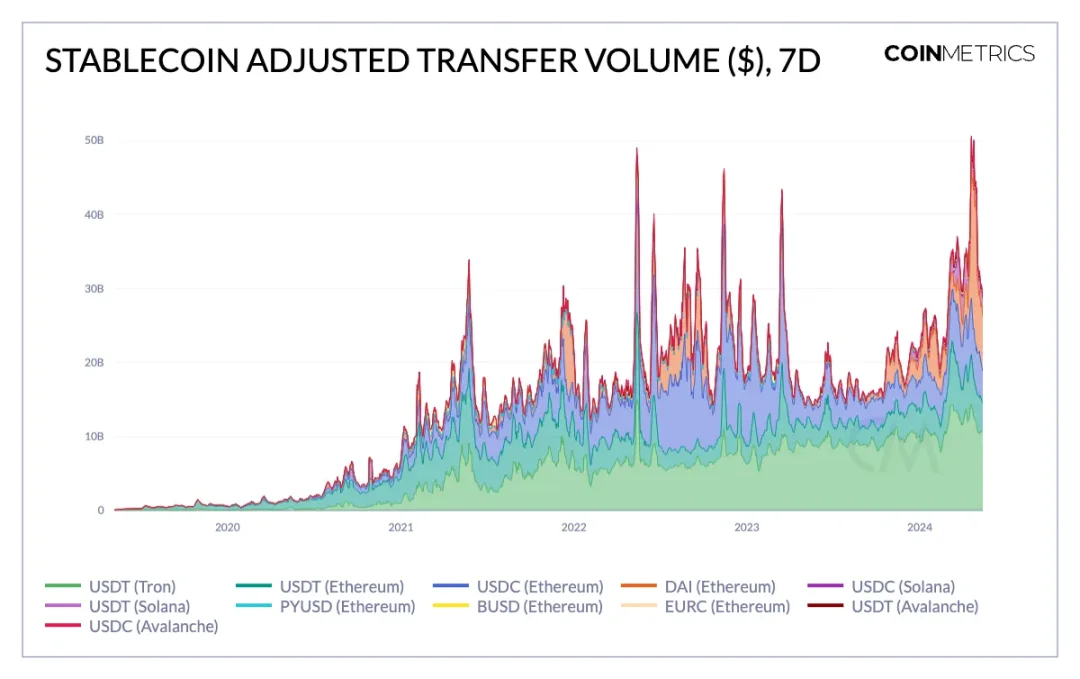
Usage and Adoption: Stablecoins are widely used for trading, and transfer volumes are influenced by blockchain transaction fees. As of April, weekly adjusted transfer value exceeded $50 billion.
-
Global Utility: Ethereum-based USDC shows moderate activity during Hong Kong Stock Exchange (HKSE) and London Stock Exchange (LSE) trading hours. In contrast, Tron-based USDT exhibits higher and more evenly distributed transaction activity.
Introduction
The U.S. dollar has long served as the world’s reserve currency. However, this status is being challenged as BRICS nations like China, Brazil, and Russia explore alternatives for international trade, while central banks diversify their reserves into assets such as gold instead of U.S. Treasuries. In contrast, stablecoins—digital tokens issued on blockchains and backed by fiat currencies, cash equivalents, or crypto assets—are increasingly driving demand for both dollars and U.S. Treasuries across the financial ecosystem.
Stablecoins are not only critical for the United States but also vital for economies with limited access to dollars and emerging markets facing currency instability or restricted financial services. Currently, the market exceeds a staggering $160 billion, supporting various consumer and commercial applications such as cross-border payments, along with infrastructure. Demand for U.S. Treasuries from stablecoins ranks just behind the top 15 countries, surpassing most nations globally.
In this week’s State of the Network report, we assess the growth and usage patterns of stablecoins through an in-depth analysis using our newly developed dashboard.
Overview: Diversity and Expansion of Stablecoins
The global influence of stablecoins continues to expand, with total market capitalization growing from under $10 billion in 2020 to over $160 billion today. Despite experiencing a contraction in stablecoin supply during 2023 due to central bank tightening policies and the ripple effects of the Terra Luna collapse, recent rebounds may reflect renewed demand for crypto assets, driven in part by the launch of spot Bitcoin ETFs in the United States.
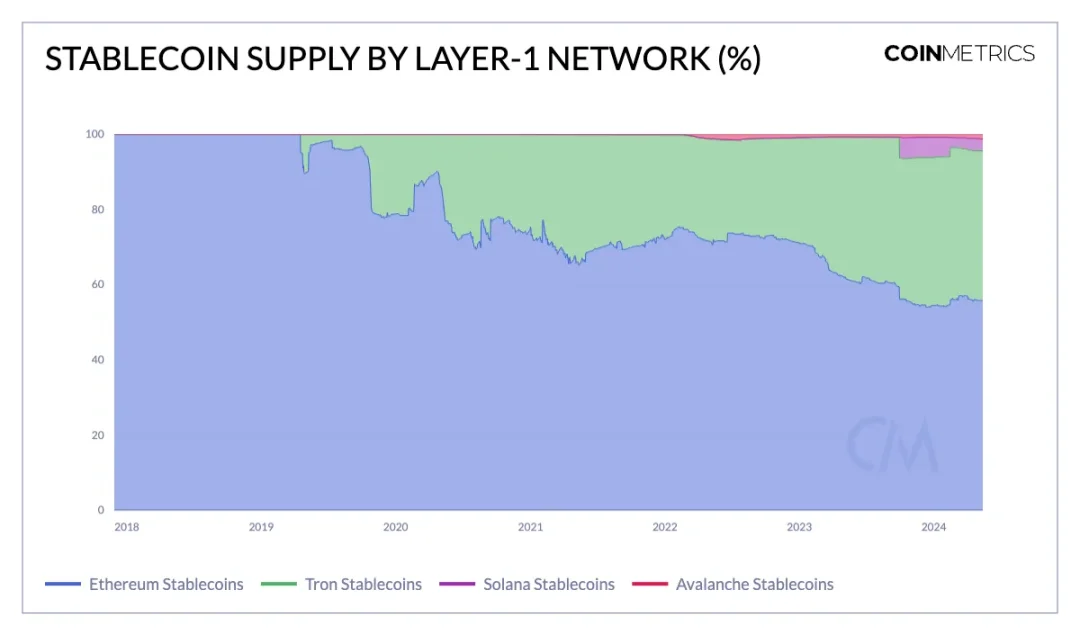
Fiat-backed stablecoin USDT, issued by Tether, maintains its dominant position, with $51 billion (44%) circulating on Ethereum and $58 billion (52%) on the Tron network, and the remainder on Solana and Avalanche. Tether’s Q1 2024 earnings report revealed a net profit of $4.52 billion—double the previous quarter. This impressive performance highlights the advantages of business models employed by stablecoin issuers like Tether and Circle, which issue tokens backed by low-risk reserve assets such as U.S. Treasury bills and cash, while also holding income-generating investments like Bitcoin or gold that perform well in the current interest rate environment.
As of March 2024, Tether and Circle held $10 billion and $74 billion in U.S. Treasuries respectively as part of their reserves. Tether’s Treasuries are custodied by Cantor Fitzgerald, while Circle’s Treasury holdings are managed by BlackRock through money market funds.
Source: Coin Metrics Network Data Pro
Offshore entity Tether has leveraged regulatory ambiguity within the U.S. framework—a challenge Circle faced last year—while USDC has had a strong start in 2024. USDC’s growth appears driven by its deep strategic integration with Coinbase and cross-chain expansion onto networks such as Solana and Ethereum Layer 2s, enhancing its market reach and liquidity. Furthermore, Circle’s integration with BlackRock’s BUIDL tokenized fund allows investors to convert their shares into USDC, potentially broadening USDC’s ecosystem and accelerating broader adoption.
The stablecoin market remains dominated by fiat-collateralized products like USDC and USDT, meeting widespread demand for dollar-pegged assets. The success of established issuers has attracted prominent new entrants, such as PayPal issuing PYUSD on Ethereum. Crypto-backed stablecoins backed by baskets of crypto and real-world assets (RWA), such as MakerDAO’s DAI, have also gained traction. Additionally, synthetic or algorithmic stablecoins like Ethena’s USDe have emerged, employing dynamic hedging strategies to maintain dollar parity without requiring over-collateralization. This category includes stablecoins issued by DeFi protocols that have become core to their business models, such as Aave’s GHO and Curve’s crvUSD. These diverse stablecoins span a range of reserve backing models, each with unique risk-return profiles.
Source: Coin Metrics Network Data Pro (Note: This chart excludes stablecoins issued on Ethereum Layer 2s)
Currently, Ethereum hosts the largest stablecoin market, accounting for 55% ($81 billion in circulating supply). The most widely adopted and liquid stablecoins gained early traction on Ethereum, leveraging its security and the extensive developer base around the Ethereum Virtual Machine (EVM) ecosystem to strengthen their network effects.
Tron has established a strong foothold in the stablecoin market, capturing 39% of the market share, while other chains such as Solana and Avalanche are also gaining ground. Features such as faster transaction speeds and lower fees on chains like Solana make them attractive for high-frequency, low-value stablecoin use cases, such as payment systems highlighted in Stripe’s recent announcement. Similarly, Ethereum Layer 2 solutions such as Arbitrum and Base are seeing increased stablecoin activity as lower fees drive user adoption toward these scalable platforms.
Characteristics of Stablecoin Adoption
While the growth of stablecoins is evident, questions remain about the nature of their usage and adoption. To what extent do stablecoins facilitate real economic value? Are they held as stores of value or primarily used for transactions? What are typical transfer sizes, and who are the primary users? While definitive answers remain elusive, the transparency of blockchain data can help illuminate the characteristics of stablecoin activity.
Source: Coin Metrics Network Data Pro
In April, weekly adjusted transfer volume between different stablecoin addresses exceeded $50 billion. Of this, 48% came from USDT on Ethereum and Tron, while DAI hit a record transfer volume of $22 billion on April 19. Although this metric has seen several spikes, it underscores the utility of stablecoins as settlement mechanisms.
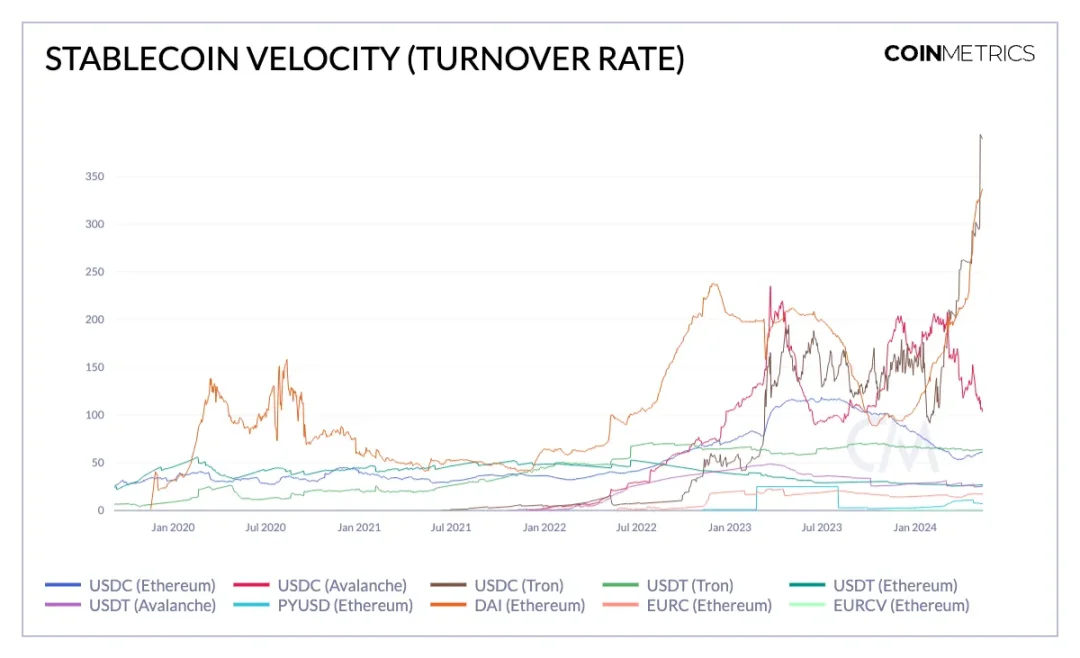
When comparing transfer volume against circulating supply, we gain insight into the velocity—or turnover—of stablecoins. However, interpreting this metric requires context. USDC on Tron shows the highest velocity, likely due to Circle’s decision to phase out support, which reduced supply but increased transfers of USDC to other blockchains.
Despite declining supply, DAI’s usage continues to rise due to its strong on-chain footprint and the DAI Savings Rate (DSR)—a smart contract that effectively functions as a savings account for deposited DAI—resulting in a clear peak in velocity. MakerDAO governance frequently implements strategic adjustments to encourage DAI usage, such as recently increasing the interest earned via DSR. Velocity for USDC on Ethereum and USDT on Tron currently sits at similar levels, though USDC may see higher turnover rates on networks like Avalanche, Solana, and Layer 2s.
Source: Coin Metrics Network Data Pro
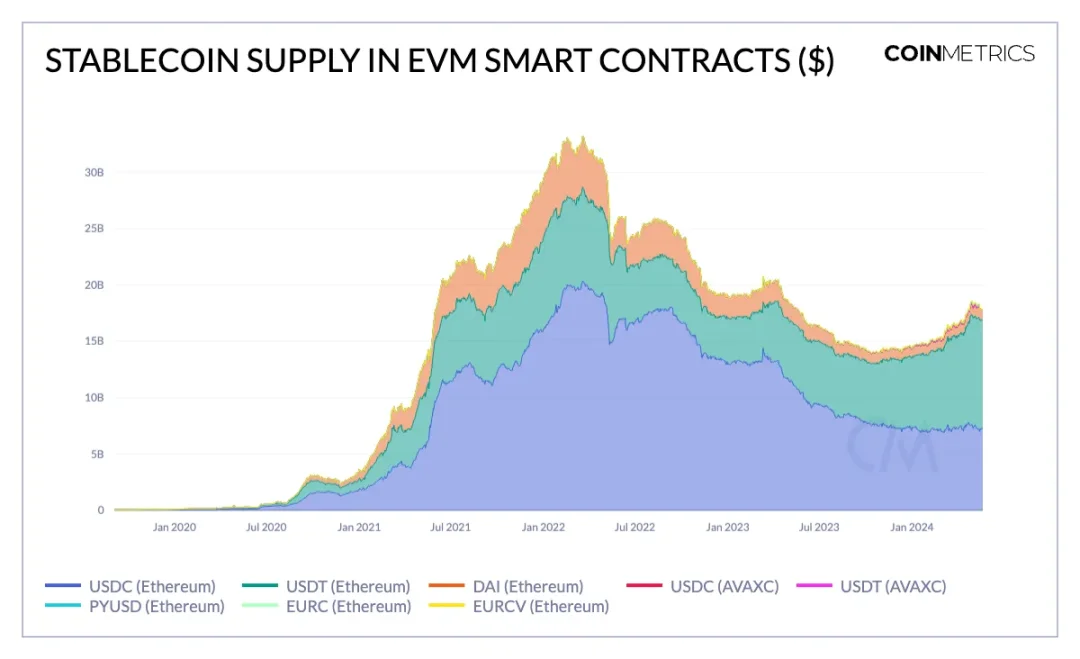
We can also assess the degree to which stablecoins serve as stores of value versus on-chain utility by examining the supply held by smart contracts versus externally owned accounts (EOAs). For example, while EOAs hold $41 billion in USDT (on Ethereum), the amount stored in smart contracts has more than doubled since January 2023 to $9.6 billion. In fact, the value of USDC held in smart contracts now exceeds $2.3 billion. This suggests stablecoins are playing an increasingly important role beyond value storage or inflation hedging—facilitating transactions on public blockchain infrastructures such as decentralized finance (DeFi) applications.
Source: Coin Metrics Network Data Pro
The median transfer value of stablecoins helps reveal typical transaction sizes. This metric is highly influenced by the fee structure and transaction capacity of the underlying blockchain. For instance, USDC and USDT on Ethereum have the highest median transfer values, averaging $500 per transaction. In contrast, USDT on Tron has a median transaction size of $230, while stablecoins on Solana show the smallest transfer values, indicating prevalent high-frequency, low-value transactions due to Solana’s transaction fees as low as $0.01.
Temporal Patterns of Stablecoin Activity
One of the most compelling value propositions of stablecoins is their global utility, enabling 24/7 value transfer. Our past analyses of geographic preferences showed North America and Western Europe favor USDC, while USDT sees heavier trading volume in Asia, Africa, and Latin America. However, using Coin Metrics ATLAS hourly transaction data, we can now identify temporal patterns, revealing the most active time periods.
Source: Coin Metrics ATLAS, Coin Metrics Stablecoin Dashboard
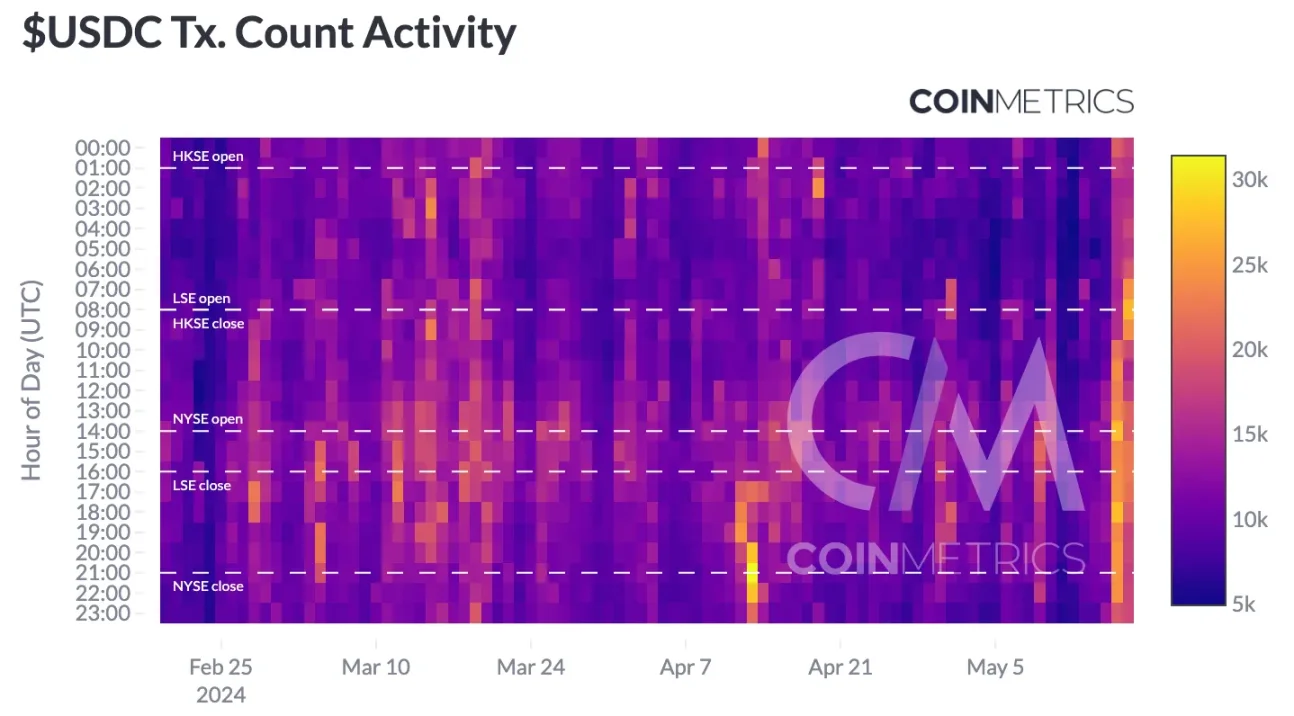
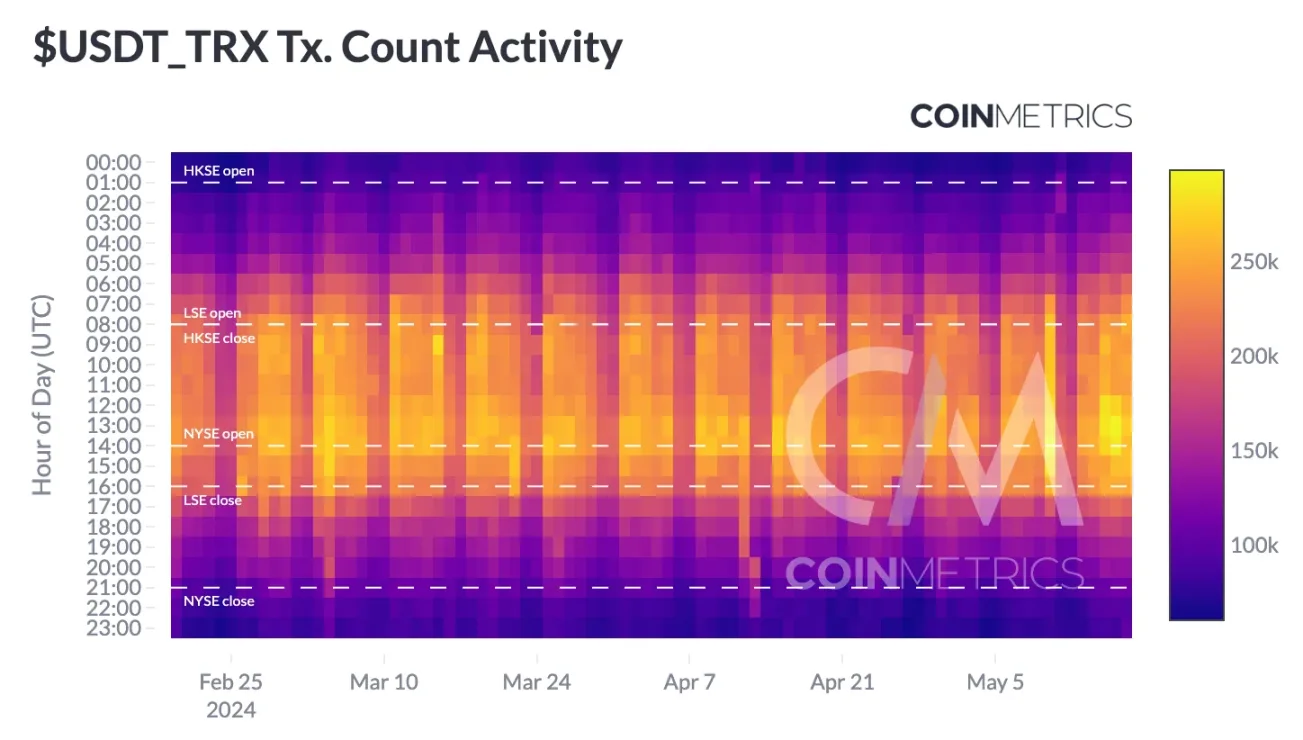
The heatmap displays hourly transaction counts for USDC on Ethereum and USDT on Tron over the past three months, overlaid with major stock market trading hours. USDC activity appears relatively dispersed, with moderate activity during HKSE and LSE trading sessions. The most pronounced peaks occur around the opening and closing of the New York Stock Exchange (NYSE), suggesting stronger influence in U.S. markets.
Source: Coin Metrics ATLAS, Coin Metrics Stablecoin Dashboard
In contrast, USDT on Tron shows significantly higher transaction volumes and more uniform distribution. Starting from the opening of HKSE, USDT transaction activity steadily increases, intensifying further throughout LSE hours and peaking around NYSE close. Notably, both stablecoins exhibited higher concentration of transaction activity over the past week.
Role in Centralized and Decentralized Trading Markets
As the primary base currency for digital asset trading, stablecoins play a crucial role in both traditional spot and derivatives exchanges and decentralized exchanges (DEXs). In March 2024, stablecoin spot trading volume on trusted centralized exchanges increased by $75 billion (7-day average). Today, USDT accounts for 90% of spot volume, with USDC and FDUSD each taking 5%, while BUSD's market share has declined.
First Digital USD (FDUSD), a stablecoin issued by Hong Kong-based digital asset custodian First Digital Trust Limited, has gained significant market share and liquidity on Binance. With the launch of Coinbase International Exchange, USDC-related trading pairs have also seen enhanced visibility and liquidity, increasing its spot market share from 0.6% in October to nearly 5% today.
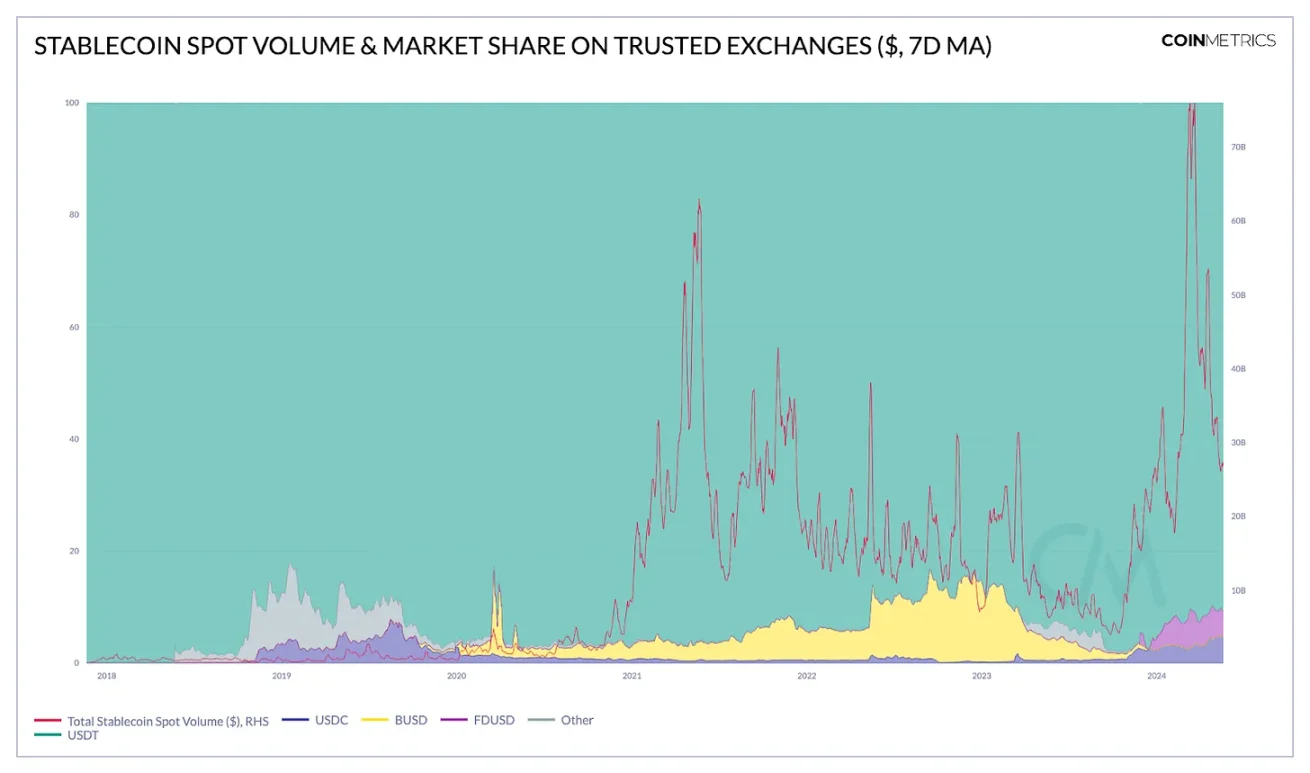
Source: Coin Metrics Market Data
Although stablecoin trading volumes are lower than traditional fiat, they form a key component of DEX liquidity pools and transaction activity on Layer 1 and Layer 2 networks. Uniswap v3’s ETH-USDC market and Curve Finance’s 3Pool stablecoin liquidity pool facilitate a substantial portion of on-chain trading. Compared to traditional exchanges, USDC holds a 45% market share on DEXs, while USDT’s share has recently risen to 42%.
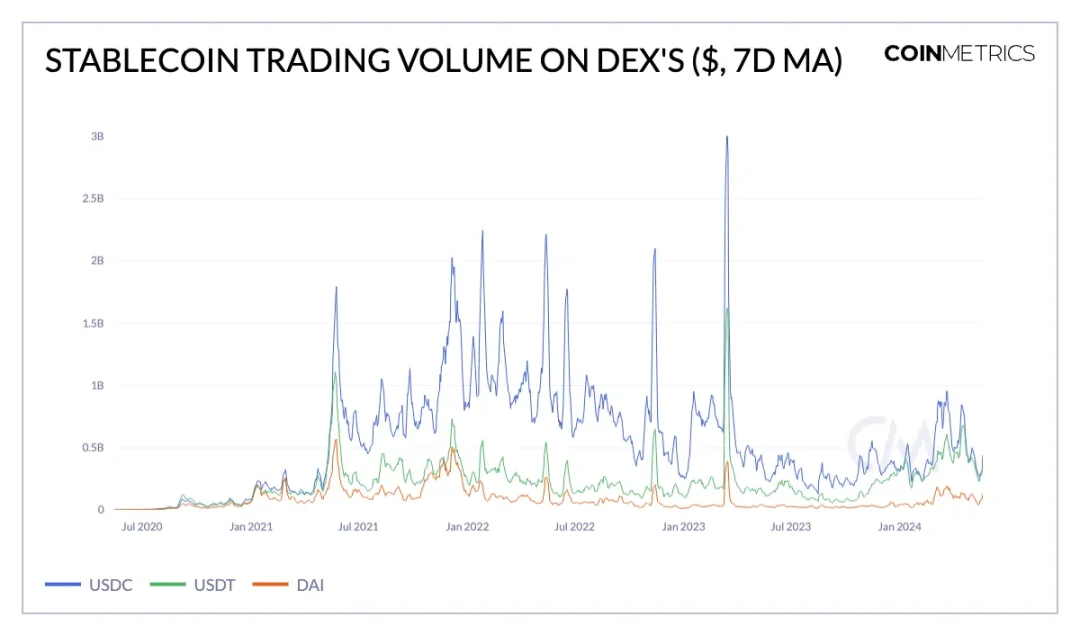
Source: Coin Metrics DEX Market Data
Conclusion
Stablecoins are becoming integral components of the global financial system, facilitating transactions and serving as stores of value. Their adoption patterns are shaped by blockchain transaction fees, highlighting their utility in cross-border payments and DeFi applications. As stablecoins continue to evolve, their significance in the financial landscape will only grow.
Join TechFlow official community to stay tuned
Telegram:https://t.me/TechFlowDaily
X (Twitter):https://x.com/TechFlowPost
X (Twitter) EN:https://x.com/BlockFlow_News
 @coinmetrics