

Understanding OrangeLayer: A New Staking Platform Bringing Bitcoin Security to the Ethereum Ecosystem
TechFlow Selected TechFlow Selected
Understanding OrangeLayer: A New Staking Platform Bringing Bitcoin Security to the Ethereum Ecosystem
OrangeLayer was created to address the challenge of establishing economic security for infrastructure beyond smart contracts.
 Navigating Web3 tides with focused insights
Author: Three Sigma
Compiled by: TechFlow
Restaking is a practice of sharing security across other networks. Ethereum was the first blockchain to adopt this technology with @eigenlayer, but an untapped chain may surpass it in providing security. Let's dive deeper into @orangelayerxyz.
The Problem
Ethereum’s expanding ecosystem faces security challenges as it integrates various applications and infrastructure, highlighting vulnerabilities within the blockchain’s consensus mechanism.
Additionally, the increasing use of staking protocols weakens Ethereum’s security, proving that liquidity is never enough. Since we’re discussing restaking, be sure to check out our thread on the state of restaking.

Existing security solutions often add complexity without addressing core vulnerabilities, underscoring the need for robust and sustainable alternatives in blockchain infrastructure security—this is where #OrangeLayer comes in.
Introducing OrangeLayer
@orangelayerxyz is a staking infrastructure platform that brings Bitcoin’s cryptoeconomic security into the Ethereum ecosystem. This approach extends Ethereum’s security advantages to a broader range of Bitcoin-protected services (BPS).
Unlike protocols such as @EigenLayer and @babylon_chain that rely solely on $ETH or $BTC for security, OrangeLayer converts all forms of Bitcoin (native, wrapped, or pegged) into yield-generating assets.

This approach helps prevent consensus mechanism overload—a risk in many layered security protocols—by injecting new layers of liquidity into the consensus process. OrangeLayer was created to address the challenge of establishing economic security for infrastructure beyond smart contracts. Traditionally, securing other types of infrastructure—such as cross-chain bridges and sequencers—requires developers to bootstrap their own security, a complex and resource-intensive process.
OrangeLayer addresses these challenges by: • Connecting stakers with infrastructure developers to enable pooled security • Enabling $BTC staking to protect diverse infrastructure • Offering stakers new rewards to incentivize participation in novel infrastructure
Protocol Architecture
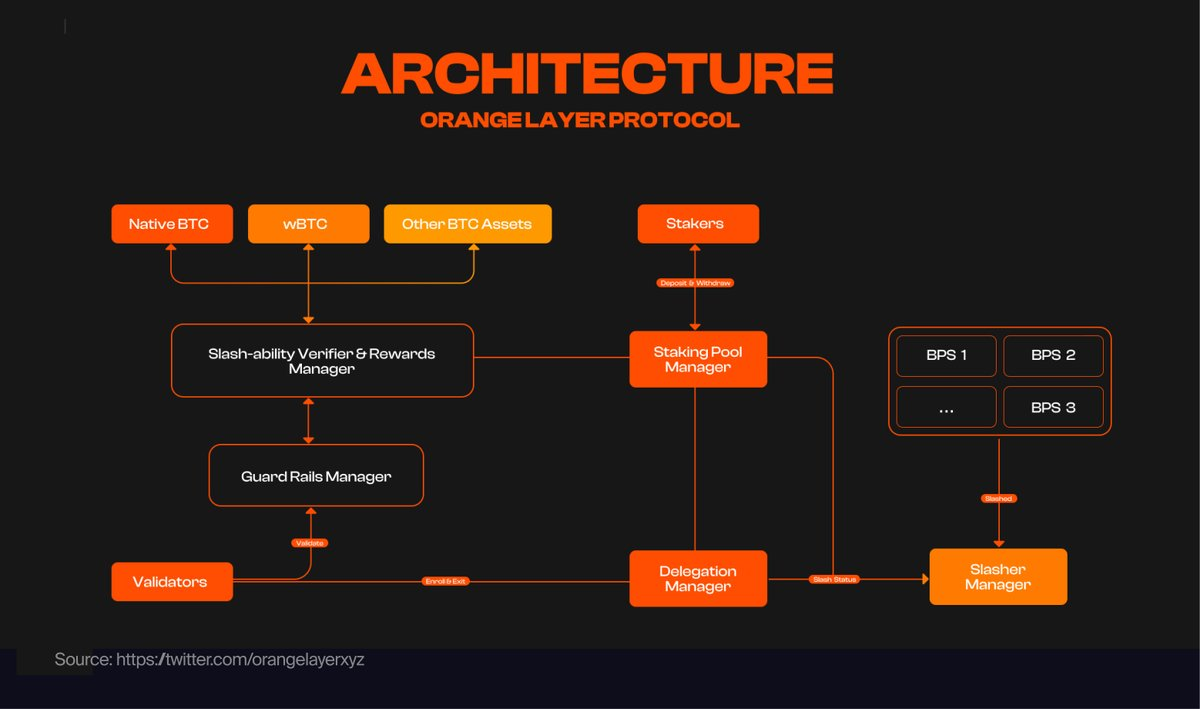
To support Bitcoin staking across various infrastructures, OrangeLayer utilizes four key components:
• Staking Pool Manager
• Delegation Manager
• Slashing Manager
• Guardrail Manager
-
Staking Pool Manager streamlines the staking process by organizing and managing pooled BTC assets.
-
Delegation Manager assigns and oversees network validators, ensuring seamless operation of the consensus mechanism.
-
Slashing Manager identifies and penalizes malicious behavior.
-
Guardrail Manager is an essential security module overseeing the staking of Bitcoin assets within OrangeLayer. It manages both $wBTC and native $BTC staking, meets unique security requirements, and minimizes risks by implementing control measures to limit the impact of potential issues.
CoStaking
CoStaking introduces a decentralized cross-chain staking protocol that leverages Bitcoin’s liquidity across multiple chains.
It provides a framework for efficient yield-generation opportunities through advanced cryptographic methods and interoperability solutions.
CoStaking offers users:
-
Staking rewards across multiple blockchains
-
A collective staking mechanism powered by Bitcoin’s security
-
A unified platform for staking native BTC and its representations
CoStaking allows users to stake in three ways:
-
Stake native BTC on the Bitcoin chain.
-
Stake wBTC on the Ethereum chain.
-
Stake native BTC assets on other chains, from L1s to other BTC Layer 2s.
Final Thoughts
@orangelayerxyz emerges as a significant innovator, bringing an additional layer of security to the entire blockchain ecosystem by sharing it from the largest and strongest chain in the ecosystem. Specifically, the benefits for @Ethereum are clear, as the chain has become the largest security provider due to a growing number of staking protocols—ironically weakening its own security in the process.
In future updates, OrangeLayer will introduce TimeStamping DA, a BPS designed to enhance PoW security, and integrate Bitcoin assets from ecosystems such as @Stacks, @Cosmos, and @Solana. This expansion will enhance decentralization, inclusivity, utility, and cross-chain interoperability.
Three Sigma has audited OrangeLayer and is excited to collaborate closely with the team to maintain protocol security.

Join TechFlow official community to stay tuned
Telegram:https://t.me/TechFlowDaily
X (Twitter):https://x.com/TechFlowPost
X (Twitter) EN:https://x.com/BlockFlow_News
 @threesigmaxyz




![In-depth Analysis of Trade[XYZ]: How Were 92 Markets and 98% HIP-3 Trading Volume Established?](https://upload.techflowpost.com/upload/images/20260716/20260716061117965147.jpeg?x-oss-process=image/resize,p_50/quality,q_80)

















