








AML Law Overhaul: How Should Web3 Entrepreneurs Respond? (II)
TechFlow Selected TechFlow Selected
AML Law Overhaul: How Should Web3 Entrepreneurs Respond? (II)
The premise of anti-money laundering compliance is that Web3 startups have fertile ground to take root and grow within China.
 Navigating Web3 tides with focused insights
Author: Shao Shiwei
For entrepreneurs in the Web3 industry, against the backdrop of China's first major revision of its Anti-Money Laundering Law, it is essential to fully understand potential money laundering and other security risks, legal risks within the industry, and their potentially severe consequences, taking corresponding measures to prevent and mitigate these risks. This not only concerns the stable operation of projects and the healthy development of the entire industry but also touches upon national security, public interests, and financial order.
The prerequisite for anti-money laundering compliance is that Web3 startups have fertile ground to take root domestically. Otherwise, compliance becomes water without a source or a tree without roots. We must first understand relevant domestic laws, regulations, and policies. This is Part One of our series → "With the Major Revision of the Anti-Money Laundering Law, How Should Web3 Entrepreneurs Respond? (Part One)"
Overview of Domestic Regulatory Policies
1. Blockchain-Related Regulatory Policies
Regulations regarding blockchain are scattered across various notices, announcements, alerts, and initiatives, with relatively low legal hierarchy, narrow scope, primarily focused on virtual currencies, generalized regulatory content, and many provisions lacking practical enforceability.
On December 3, 2013, the "Notice on Preventing Bitcoin Risks" stated that "Bitcoin should be considered a specific type of virtual commodity, does not have legal status equivalent to currency, and cannot and should not circulate as currency in the market." It further noted: "Branches of the People's Bank of China shall closely monitor developments and trends related to Bitcoin and other similar virtual commodities featuring anonymity and convenient cross-border circulation, carefully assess money laundering risks, and develop targeted preventive measures."
On September 4, 2017, the "Announcement on Preventing Risks Associated with Token Issuance Financing" declared that "token issuance financing is an illegal public fundraising activity conducted without approval," targeting all kinds of illegal financial activities using terms like "coin."
On January 12, 2018, the "Risk Alert on Disguised ICO Activities," on January 26, 2018, the "Alert on Risks of Overseas ICOs and 'Virtual Currency' Trading," and on August 24, 2018, the "Risk Alert on Illegal Fundraising under the Names of 'Virtual Currency' and 'Blockchain'" pointed out that raising funds through issuing so-called 'virtual currencies,' 'virtual assets,' or 'digital assets' exhibits clear networking and cross-border characteristics, along with strong deception, inducement, and concealment.
On September 3, 2021, the "Notice on Rectifying Virtual Currency 'Mining' Activities" mentioned "seriously investigating and rectifying unauthorized virtual currency 'mining' activities nationwide." Additionally, on September 15 of the same year, the "Further Risk Alert on Virtual Currency Trading Activities" was issued.
On February 18, 2022, the "Risk Alert on Illegal Fundraising under the Name of 'Metaverse'" highlighted that activities exploiting the "metaverse" banner possess high appeal and strong deceitfulness.
On April 13, 2022, the "Initiative on Preventing Financial Risks Related to NFTs" noted that NFTs carry potential risks such as speculation, money laundering, and illegal financial activities.
In December 2023, the People's Bank of China released the "China Financial Stability Report (2023)," which stated: "The governance mechanisms of decentralized finance (DeFi) essentially exhibit 'centralized' features, making them prone to control by a few insiders, harming the interests of other investors; the anonymity and irrecoverability of assets lead to risks in anti-money laundering and counter-terrorism financing." It added: "In recent years, regulators in multiple countries and international organizations have begun assessing risks associated with crypto assets, introducing regulatory policies and response measures. Overall, they follow the principle of 'same business, same risk, same regulation,' applying supervision commensurate with risk levels to crypto asset activities, striving to minimize regulatory data gaps, reduce fragmentation, eliminate regulatory arbitrage."
2. Legislative Evolution of Anti-Money Laundering Crimes
In 1997, China’s Criminal Law established the crime of money laundering, which has since been continuously refined through subsequent criminal law amendments. Over the past decade since the implementation of the Anti-Money Laundering Law, China's anti-money laundering framework has gradually improved, with nearly one hundred departmental rules and normative documents at the ministerial level addressing anti-money laundering and counter-terrorism financing (roughly categorized into comprehensive, identity verification, suspicious transaction reporting, risk classification, and administrative investigation cooperation).
In 1997, the Criminal Law defined the offense of money laundering, with only three upstream offenses: drug crimes, organized crime of a mafia nature, and smuggling crimes.
In 2001, the Third Amendment to the Criminal Law made the first revision to the money laundering offense, mainly adding terrorist activities as an upstream crime, bringing the total number of upstream crime categories to four, and increasing penalties for individuals when entities commit money laundering.
In 2006, the Sixth Amendment to the Criminal Law made the second revision, incorporating embezzlement and bribery crimes, disruption of financial management order, and financial fraud into the scope of upstream crimes for money laundering, expanding the list to the current seven types.
On January 1, 2007, the Anti-Money Laundering Law officially took effect. On June 28 of the same year, China joined FATF (Financial Action Task Force).
In 2020, the Eleventh Amendment to the Criminal Law made the third revision to the money laundering offense, reflected in four aspects: First, removing the terms "knowingly" and "assisting," thereby criminalizing self-laundering; Second, changing the phrase "other settlement methods" to "other payment settlement methods," broadening the means of transferring funds via payment methods for money laundering; Third, expanding the scope of combating cross-border money laundering; Fourth, modifying provisions on fines, replacing proportional fines with unlimited fines to enhance punitive measures.
On January 22, 2024, Premier Li Qiang presided over a State Council executive meeting reviewing the draft revision of the People's Republic of China Anti-Money Laundering Law.
On April 23, 2024, the draft revision of the Anti-Money Laundering Law of the People's Republic of China (hereinafter referred to as the "Draft Revision") was submitted for deliberation at the ninth session of the 14th National People's Congress Standing Committee. The draft includes provisions for "timely monitoring emerging money laundering risks."
Under the Context of Domestic Blockchain and Anti-Money Laundering Regulations, Can Web3.0 Still Be Developed Domestically?
First, it must be clarified that domestic policy crackdowns on virtual currencies do not equate to rejection of blockchain entrepreneurship in China. Virtual currencies are merely one application of blockchain technology. According to Attorney Shao, the primary reasons why Chinese regulators have maintained a negative stance toward virtual currencies include:
1. Used for money laundering. Due to the anonymity, untraceability, inability to link transactions to specific individuals, and lack of oversight from banks and other authorities inherent in virtual currency transactions, coupled with recent concentrated efforts by public security departments in the "Card-Cutting" campaign, criminals have been forced to upgrade their methods, increasingly using virtual currencies as tools for illicit transactions and concealing criminal proceeds.
2. Prone to speculation. Reviewing China's historical policies on virtual currencies reveals that prohibitions on ICOs, mining, warnings against metaverse-related illegal fundraising, and NFT-related financial risks share a common goal: preventing speculative bubbles triggered by these concepts from harming public interests.
3. Foreign exchange outflows. Given the convenience of cross-border virtual currency transactions, a common recent trend involves criminals profiting from service fees by conducting foreign exchange offsetting operations using virtual currencies for cross-border remittances, resulting in massive capital outflows from within China or preventing foreign exchange from entering the country.
However, technology itself is innocent—it is how people use it that matters.
In China, there are numerous application scenarios for blockchain. On February 22, 2024, guided by the Informatization Development Bureau of the Cyberspace Administration of China and led by the Data and Technology Assurance Center of the Cyberspace Administration of China, the "China Blockchain Innovation Application Development Report (2023)" (hereinafter referred to as the "Report") was officially released during the summary and exchange meeting for national blockchain innovation application pilots. Simultaneously, the Data and Technology Assurance Center launched a nationwide collection of blockchain innovation application cases for 2023. After preliminary review, re-evaluation, and public announcement, 66 exemplary blockchain innovation applications were selected and compiled into the "Collection of China Blockchain Innovation Application Cases (2023)" (see image below), providing reference and guidance for deepening blockchain innovation and development across regions and industries.
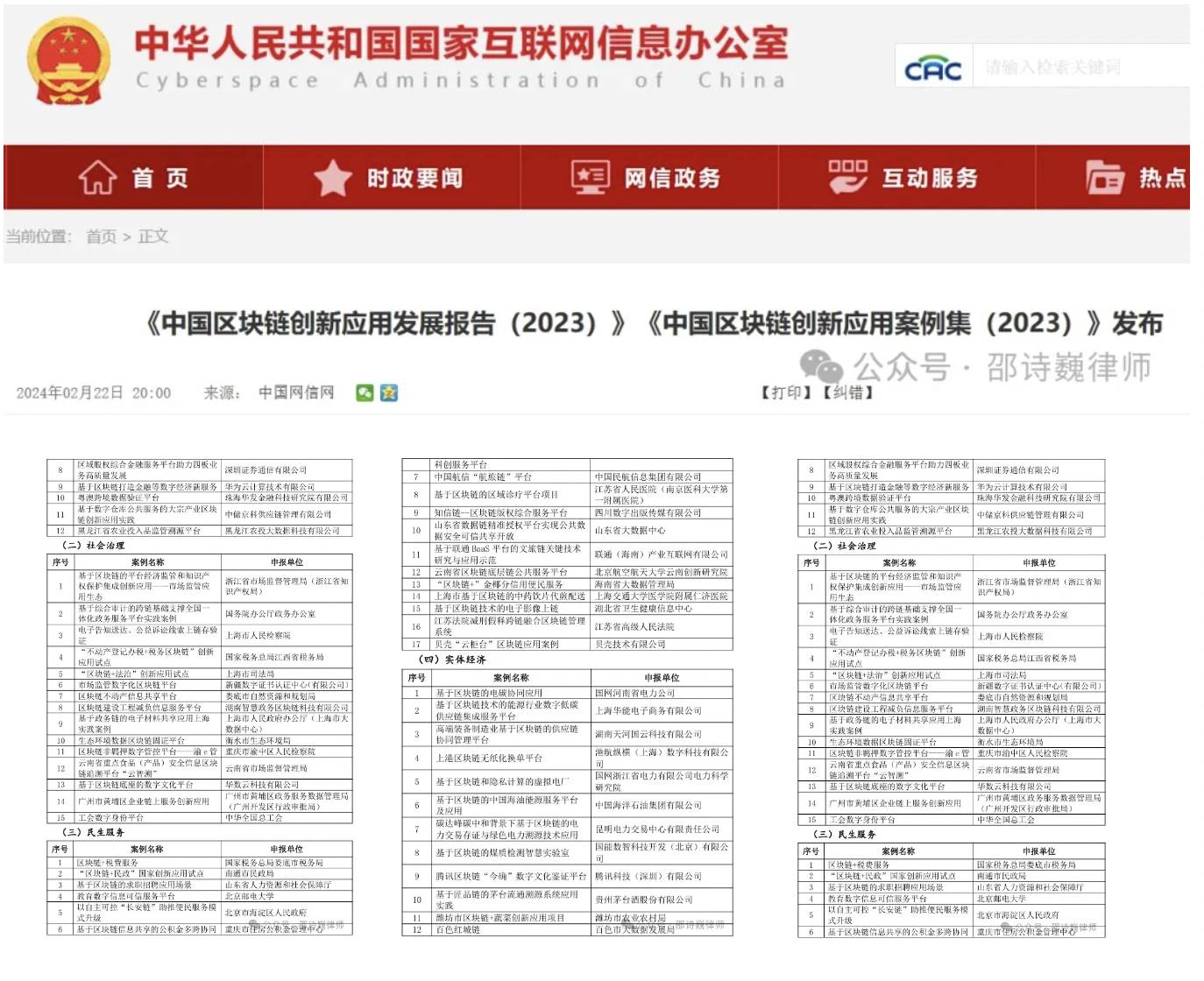
The Cyberspace Administration of China emphasized in releasing the "China Blockchain Innovation Application Development Report (2023)": "When presiding over the study, General Secretary Xi Jinping stressed that 'the integrated application of blockchain technology plays an important role in new technological revolutions and industrial transformations. We should regard blockchain as a key breakthrough point for core technological innovation, clarify strategic directions, increase investment, focus on overcoming key core technologies, and accelerate the innovative development of blockchain technology and industry.'"
This shows that despite the negative regulatory stance toward virtual currency trading in China, the government continues to encourage exploration and application of blockchain technology domestically.
International Regulatory Trends on Anti-Money Laundering in the Web3.0 Industry
Domestic Web3 industries are constrained by various factors and remain generally in early developmental stages. In practice, many Web3 entrepreneurs choose to operate overseas due to various real-world considerations. However, while some foreign countries offer more inclusive and open environments for the Web3 industry, their regulatory frameworks tend to be stricter and more detailed.
1. Regulatory Frameworks in Major Global Countries
According to ZeroPoint Technology statistics, major national regulatory policies affecting the global Web3 industry in 2023 are illustrated as follows:
Regarding stablecoin regulation:
Governments worldwide increasingly recognize the vast prospects and immense potential of stablecoins. In May 2023, the European Parliament approved the Markets in Crypto-Assets Regulation (MiCA), becoming the world's first major jurisdiction to introduce comprehensive cryptocurrency regulation. In August 2023, the Monetary Authority of Singapore (MAS) announced the final version of its regulatory framework for stablecoins. According to PwC's "2023 Global Cryptocurrency Regulation Report" published on December 19, 2023, up to 25 countries/regions had enacted legislation or regulations on stablecoins in 2023, including France, Germany, Japan, and others.
Regarding compliance operations of crypto platforms:
In the United States, regulation is primarily handled by the Financial Crimes Enforcement Network (FinCEN), focusing on fund transfers and anti-money laundering (AML). Under the Bank Secrecy Act (BSA), FinCEN regulates money services businesses (MSBs). In March 2013, FinCEN issued guidelines identifying cryptocurrency exchange service providers as MSBs. Under this framework, cryptocurrency exchanges must obtain FinCEN licenses and implement comprehensive AML risk assessments and reporting mechanisms.
On February 7, 2023, Dubai introduced a new Virtual Asset Rulebook requiring crypto companies to obtain authorization and relevant licenses to operate in Dubai. Specific activities such as issuance, advisory, custody, and exchange services must be authorized and licensed.
In June 2023, the Securities and Futures Commission (SFC) of Hong Kong released the "Guidelines for Virtual Asset Trading Platform Operators" and the "Anti-Money Laundering and Counter-Terrorist Financing Guidelines (Applicable to Licensed Corporations and SFC-Licensed Virtual Asset Service Providers)," establishing a licensing regime for virtual asset service providers.
Regarding sector-specific regulation within the Web3 industry:
For example, DeFi: In October 2021, the international organization Financial Action Task Force (FATF) updated its virtual asset AML guidelines, recommending that DeFi be included as a Virtual Asset Service Provider (VASP) subject to AML obligations. On April 6, 2023, the U.S. Department of Treasury released the 2023 DeFi Illicit Finance Assessment Report—the world’s first assessment report on illicit financial activities based on DeFi.
For example, NFTs: The U.S. Department of Treasury released a study titled "Money Laundering and Terrorist Financing Through Art Market Transactions," classifying NFTs as part of emerging online art markets and noting associated risks. The report indicated that NFTs could facilitate self-laundering—criminals can use illicit funds to purchase NFTs and conduct self-trading to create sales records on the blockchain; subsequently, the NFTs are sold to unsuspecting buyers, allowing criminals to profit from clean funds unrelated to the original crime.
2. Enforcement Actions and Anti-Money Laundering Sanctions
In 2023, the U.S. Securities and Exchange Commission (SEC) and Commodity Futures Trading Commission (CFTC) initiated over 200 enforcement actions against cryptocurrency companies. The intensified regulatory scrutiny occurred amid widespread bankruptcies, fraud, deceptive practices, and illicit fund flows in the industry.
On August 24, 2023, according to a press release from the U.S. Department of Treasury, the Department of Justice filed charges against Roman Semenov and Roman Storm, co-founder of Tornado Cash, who was arrested by the FBI and IRS. They were charged with conspiracy to commit money laundering, conspiracy to operate an unlicensed money transmitting business, and conspiracy to violate sanctions. The Treasury stated that despite knowing the Lazarus Group used its mixing service to launder hundreds of millions of dollars in stolen virtual currency for North Korea's benefit, Tornado Cash’s founders continued developing and promoting the service without implementing any meaningful measures to reduce its misuse for illegal purposes.
On November 29, 2023, the U.S. Department of Treasury sanctioned the cryptocurrency mixer Sinbad for facilitating transactions linked to North Korean hacking groups. Sinbad.io (Sinbad) is a virtual currency mixer serving as a primary tool for the Lazarus Group to launder funds for North Korea. Sinbad assisted in laundering millions of dollars worth of stolen virtual currency and was the Lazarus Group’s preferred mixing server. Operating on the Bitcoin blockchain, Sinbad indiscriminately facilitated illegal transactions by obfuscating sources, destinations, and counterparties.
Relevant Jurisdictional Provisions Between Domestic and International Legal Systems
Whether operating domestically or internationally, Web3 entrepreneurs must prioritize anti-money laundering compliance. In China, token issuance, fundraising, and trading related to virtual currencies have long been banned. So, if a project chooses to launch offshore, can it avoid criminal liability?
1. Domestic Criminal Jurisdiction Rules
Legally speaking, Chinese judicial authorities have jurisdiction over any crime committed by Chinese citizens.
Articles 6–9 of China's Criminal Law establish legal provisions on criminal jurisdiction, covering territorial, personal, protective, and universal jurisdiction principles. Therefore, if either the criminal act or its consequence occurs within Chinese territory, if a Chinese citizen commits a crime stipulated by law outside Chinese territory, or if the crime falls under international treaties to which China is a party, Chinese judicial authorities have jurisdiction.
2. International Jurisdictional Rules
Currently, regulation of the Web3 industry remains under continuous exploration globally. At the international level, in 2019, the Financial Action Task Force (FATF) issued guidance on virtual assets and virtual asset service providers (VASPs) to ensure compliance with anti-money laundering / counter-terrorism financing (AML/CFT) requirements. Specifically, different jurisdictions exhibit regional characteristics: the U.S. regulates through enforcement actions, while the EU, UK, and Asia-Pacific regions regulate through consultation and legislation. Taking the U.S. as an example:
1. The U.S. employs dual-level regulation involving both federal and state authorities for the Web3 industry;
2. Due to differing understandings of virtual currencies among regulatory bodies, multiple agencies oversee different areas, including the SEC (Securities and Exchange Commission), CFTC (Commodity Futures Trading Commission), FinCEN (Financial Crimes Enforcement Network), and IRS (Internal Revenue Service), each responsible for distinct regulatory domains.
3. Long-arm jurisdiction allows courts to assert authority over cases originally outside their jurisdiction. Originating from the 1945 International Shoe Co. v. Washington case, this doctrine established the "minimum contacts" principle—meaning that if a defendant purposefully engages in activities within a state connected to the plaintiff's claim, the court may exercise jurisdiction. The vagueness and flexibility of the "minimum contacts" principle have allowed its interpretation to expand broadly in practice, extending from interstate to international contexts. Antitrust, anti-money laundering, and corporate financial compliance are common pretexts for U.S. long-arm jurisdiction. In the field of anti-money laundering, Section 317 of the USA PATRIOT Act states: "If a foreign person or a financial institution established under foreign law participates in money laundering activities, U.S. courts may exercise long-arm jurisdiction provided legal process is served according to the U.S. Federal Rules of Civil Procedure or applicable foreign laws." Based on the PATRIOT Act, U.S. authorities can arbitrarily examine bank account details of foreign banks holding correspondent accounts in the U.S. Courts may issue subpoenas to any foreign bank maintaining correspondent accounts, inspecting or freezing funds both inside and outside the U.S., often combined with financial sanctions.
3. Relevant Cases
Cross-chain bridge project Multichain ceases operations; CEO detained by Kunming police.
At the end of May 2023, the cross-chain interoperability protocol Multichain experienced abnormal delays in cross-chain transactions. In July 2023, Multichain officially disclosed that its CEO Zhaojun was taken away by Chinese police from his home on May 21 and subsequently lost contact with the global team. Later, the team contacted Zhaojun’s family and learned that all his computers, phones, hardware wallets, and recovery phrases had been confiscated by authorities. Lacking alternative information sources and operational funding, the team was forced to cease operations.
Public information indicates that Multichain (formerly Anyswap) was founded in July 2020, securing a $60 million investment from Binance Labs. Beyond funding, Multichain also formed a partnership with Binance Smart Chain (BSC). Although the project operated overseas, it was fundamentally a Chinese-led initiative.
No official police statement has yet revealed the specific reasons for the case, but there is no dispute that Chinese judicial authorities have jurisdiction.
Binance founder sentenced to four months in prison by U.S. court.
On April 30, 2024, Changpeng Zhao (CZ), founder of Binance—the world’s largest cryptocurrency exchange—was sentenced to four months in prison by a federal court in Seattle, USA. Born in Lianyungang, Jiangsu Province, CZ holds Canadian and UAE citizenship. Under a plea agreement, CZ admitted violating the Bank Secrecy Act (BSA) by failing to maintain an effective anti-money laundering program.
Binance is registered in Malta, an offshore financial center. To avoid regulatory oversight, CZ managed company operations remotely online and acquired Emirati citizenship. As the UAE lacks an extradition treaty with the U.S., American authorities cannot apprehend him abroad as long as he remains in the UAE.
Under the U.S. Patriot Act, foreign entities involved in money laundering may fall under U.S. jurisdiction if transactions occur in the U.S. or involve U.S.-based bank accounts. Despite Binance's decentralized transaction model, a significant portion of its transactions occurred within the U.S., including those between Americans and individuals from sanctioned jurisdictions, giving the U.S. jurisdiction. Under U.S. anti-money laundering laws, transferring funds from abroad into the U.S. or vice versa to conceal illegal activities constitutes money laundering. Thus, the judge in the Seattle District Court stated during sentencing that CZ bore responsibility to comply with U.S. laws regardless of his wealth.
Join TechFlow official community to stay tuned
Telegram:https://t.me/TechFlowDaily
X (Twitter):https://x.com/TechFlowPost
X (Twitter) EN:https://x.com/BlockFlow_News


