
Cobie: When low-circulation, high-FDV tokens run rampant, the profits from price increases have already been privately divided up
TechFlow Selected TechFlow Selected
Cobie: When low-circulation, high-FDV tokens run rampant, the profits from price increases have already been privately divided up
Newly issued tokens become non-investable.
 Navigating Web3 tides with focused insights
Author: Cobie
Translation: TechFlow
This article will discuss the topic of new token launches, focusing on common questions and misconceptions in the market regarding these tokens—often referred to as "low float, high FDV."
Before we begin—if you're confused by any of the concepts discussed here, I recommend reading my 2021 piece titled "The Meme of Market Caps and Unlocks", which might help clarify things.
As always, remember: I am not a financial advisor. I’m biased, flawed, brainwashed, an idiot, mentally past my peak into senescence, stumbling through the world trying to understand everything and rarely succeeding. I am actually a participant in the crypto industry, meaning my IQ may not even be double digits. I try not to write about tokens I hold, but I will disclose holdings where relevant. Have you heard that RoaringKitty (the legendary figure from the GME stock saga) is back, posting fifty super cool Avengers clips? Well, regardless, let’s get started.

Three years ago when I wrote that article, I thought it would be the last time I’d have to talk about circulating supply, FDV, and market cap games. Maybe I was naive—I assumed market participants would become more sophisticated about these important dynamics.
Yet instead, they’re selecting these new tokens as “best long-term holds” based on reasons like “locked for a year” or other novelties such as the new coin’s chart patterns or concentrated attention on it.
Worse still, other market participants have become more adept at exploiting these dynamics. Teams, exchanges, market makers, and financiers have adapted to these mechanisms and often leverage them for massive advantage.
Therefore, in my view, most new token launches today are effectively non-investable in the current market, and market participants’ understanding of these issues remains extremely immature—mostly spending their time blaming surface-level symptoms.
In this multi-part series, I’ll explore some of the problems with today’s new token launch markets and explain why I generally choose to avoid new token launches entirely—unless you know what you’re doing and are willing to do thorough research and analysis.
The upside profits have already been privately divided
In modern markets, “price discovery” for nearly all assets happens off-market—the pricing has already been privately allocated before the token even exists. Due to private market dynamics, much of this price discovery is artificially inflated.
Looking back at 2024, people actually miss the ICO (Initial Coin Offering) era. When comparing opportunities then versus now, it's hard to disagree: in some ways, the ICO era was far fairer than today’s market dynamics.
Looking Back at ICOs: The Downsides
To avoid misunderstanding, I must emphasize that ICOs had many flaws. It’s easy to look back at successful ICOs, but in reality, hundreds of projects raised eight-figure sums and either disappeared or slowly imploded. (Additionally, most major jurisdictions likely considered ICOs illegal.)
Retail investors wasted hundreds of millions funding impractical junk projects enabled solely by the ICO craze.
Even for successful products, their ICOs left investors worse off. Many companies that should have succeeded ended up with worthless tokens, while the company received non-dilutive funding and gradually ignored the token altogether.
(This even happened with Binance’s ICO—investors raised $15 million to build Binance without receiving equity. Of course, Binance ICO participants today won’t complain since each BNB was priced at $0.15 and became one of the best-performing ICOs in history.)
Benefits of ICOs
Alright, we know ICOs had drawbacks, but they also had benefits—ones easier to illustrate.
-
Ethereum raised $16 million in its ICO, selling 83% of the initial supply (60 million ETH) at $0.31 per ETH.
-
The effective valuation of this public token sale was approximately $26 million (slightly more complex due to mining and staking issuance, but roughly accurate).
-
Investors who bought ETH during the ICO received about a 10,000x USD return at today’s prices (~70x in BTC terms).
-
If you missed the ETH ICO, the cheapest market purchase was $0.433 in October 2015—just 1.5x higher than the public sale price. At that time, Ethereum was valued around $35 million.
Although it’s now almost impossible to find crypto investments comparable to Ethereum’s $26 million valuation—even seed rounds for the dumbest ideas rarely come close. The key point is that price discovery and upside were open to all participants.
Price discovery from $26 million to $350 billion happened publicly, accessible to ordinary people. No KOL rounds, no unlock schedules—buying at the cheapest market price yielded returns very similar to the ICO.
The Shift Toward Private Funding
After regulatory crackdowns on ICOs by major global regulators, crypto token issuers stopped raising funds from the public and turned to private fundraising via venture capital firms.
Compare Solana’s first funding round in 2018 with Ethereum’s ICO—you’ll notice some interesting contrasts.
-
Solana raised about $3.2 million in this round, selling ~15% of the supply at $0.04 per SOL. The effective valuation was ~$20 million—similar to ETH’s ICO valuation.
-
Seed round investors in SOL achieved ~4,000x USD returns at current prices. (With staking rewards factored in, actual returns could be higher.)
-
If you couldn’t access limited funding rounds, the cheapest market purchase was $0.50 in May 2020—about 12x higher than the seed round.
-
Purchasing at the cheapest market price yielded ~300x returns. At that time, Solana was valued at ~$240 million with less than 5% circulating. Solana only had about 10 months of low float—rapidly unlocking from minimal circulation, with most tokens released in bulk in January 2021.
Early privileged rounds allowed investors to privately capture ~10x of Solana’s upside (from $0.04 → $0.50).
(Solana also conducted other privileged/private funding rounds around $0.20. Additionally, there was a limited public auction-style token sale on CoinList, which I recall also priced at $0.20.)
The 2021 Frenzy
Solana launched in 2020, almost exactly at the post-COVID crash lows for BTC and ETH. Their large unlocks coincided perfectly with a wave of new users entering crypto. This pattern repeated across various tokens, leading to “bullish unlocks” and massive increases in private market valuations.
Both ETH and SOL had initial sale valuations around $20 million. By 2021, seed rounds became fiercely competitive, with major VCs bidding against each other. Seed round valuations reached hundreds of millions.
(I remember rejecting a $100 million seed round recommendation in disgust. Later, the project opened trading at a $4 billion FDV—I missed out on a 40x gain. After learning my lesson, I invested in the next $100 million seed round. It failed, went to zero, and became inactive.)
As private market valuations soared, traders in liquid markets claimed “FDV is a joke,” while nearly every chart turned green.
Axie Infinity reached a ~$50 billion valuation with only ~20% of tokens circulating. Filecoin hit a ~$475 billion FDV while having only a $12 billion market cap. Increased supply from high-FDV tokens was masked by a flood of new entrants.
As fully diluted valuations grew larger, VCs became increasingly willing to pay higher private round prices—“If this project trades at a $15 billion valuation, paying $300 million is acceptable—the risk of missing out is greater!”
Founders were naturally happy to accept these offers—they could raise more money while giving up fewer tokens. Previously, they needed to sell 10% of tokens at a $20 million valuation to raise $2 million. Now, they could sell 1% to raise $2 million and retain extra tokens for incentives, community, or (...surprise!) themselves.
If a reputable VC funded a promising project at a $100 million valuation, lesser-known VCs would rush to imitate. If a project’s last round was $100 million, follower VCs without clear investment thesis would quickly fund a new round at $300 million–$500 million. Slightly worse entry prices didn’t matter because these projects were already trading at multi-billion dollar valuations.
Founders easily accepted these deals. Without market forces, their personal net worth “watermarked” higher, and they added new team members to help product success. Most of these hires ultimately proved net-negative, but founders didn’t know that at the time.
Through this model, over time, more value and price discovery were privately captured.
Private Capture
Let’s compare earlier examples like Ethereum and Solana with recent project launches. I’ll pick two comparable projects: Optimism and Starknet.
Consider these metrics: initial sale valuation, lowest market valuation, % circulating at that time, public vs. private returns.
Ethereum ICO Valuation: $26 million
-
Ethereum’s Lowest Market Valuation: $35 million FDV
-
Date of Lowest Market Valuation: October 2015
-
Circulating Supply at That Time: 100% of supply—market cap $35 million
-
Public Sale Return: 10,000x
-
Market Return: 7,500x
Solana Seed Round Valuation: $20 million
-
Solana’s Lowest Market Valuation: $240 million FDV
-
Date of Lowest Market Valuation: May 2020
-
Circulating Supply at That Time: 2% of supply—market cap $4 million
-
Seed Round Return: 4,000x
-
Market Return: 300x
Optimism Seed Round Valuation: $60 million
-
Optimism’s Lowest Market Valuation: $1.7 billion FDV
-
Date of Lowest Market Valuation: June 2022
-
Circulating Supply at That Time: 6% of supply—market cap $95 million
-
Seed Round Return: 183x
-
Market Return: 6x
StarkNet Seed Round Valuation: $80 million
-
StarkNet’s Lowest Market Valuation: $11 billion FDV
-
Date of Lowest Market Valuation: Today
-
Circulating Supply at That Time: 7.5% of supply—market cap $800 million
-
Seed Round Return: 138x
-
Market Return: None
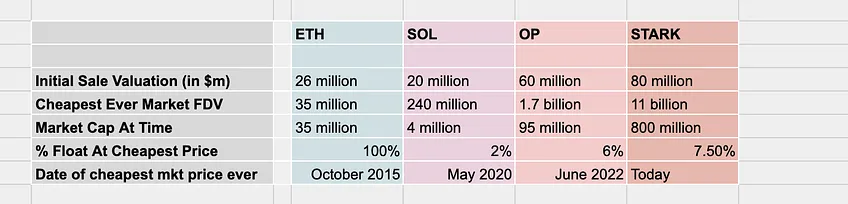
Looking at these metrics, several things are clear. First, seed valuations have dramatically increased over time.
-
Ethereum’s ICO valuation was ~$26 million.
-
Solana’s seed round valuation was ~$20 million FDV.
-
Optimism’s seed round valuation was ~$60 million FDV.
-
StarkNet’s seed round valuation was ~$80 million FDV.
-
Currently, seed rounds for similar projects exceed $100 million FDV.
As seed valuations rise, teams benefit from these multiples since they own the full supply until the first funding round. If StarkNet had the same valuation as Ethereum, early investors would still have worse financial returns because their entry price was four times higher.
Honestly, I think this in itself is somewhat acceptable.
I believe it's reasonable that as crypto becomes more mainstream and Bitcoin/Ethereum returns prove valuable over time, founders have better fundraising options. Demand for early crypto investments is enormous, so prices naturally adjust upward.
But the most glaring trend from the data above is the massive gap between public market returns and private market returns.
-
Ethereum’s ICO return was 1.5x higher than what was available on the open market.
-
Solana’s seed round return was 10x higher than the market return.
-
OP’s seed round return was 30x higher than the market return.
-
STRK’s seed round return is infinitely higher because today marks STRK’s all-time low—meaning all public market buyers are underwater, while seed investors enjoy a 138x return.
As you can see, gains are increasingly being captured privately.
To visualize, consider the private fundraising rounds for the tokens mentioned earlier:
-
Ethereum had an ICO selling 80% of tokens, with no other funding rounds.
-
Solana’s seed round sold 15% of tokens, plus additional private rounds pre-TGE reaching ~$80 million FDV.
-
OP’s seed round was ~$60 million, followed by private rounds at ~$300 million and ~$1.5 billion FDV pre-TGE.
-
STRK’s seed round was $80 million FDV, followed by additional rounds at ~$240 million, ~$1 billion, and ~$8 billion FDV pre-TGE.
Imagine each asset’s price chart and try overlaying private market prices onto it. (Use logarithmic scale for valuation.)
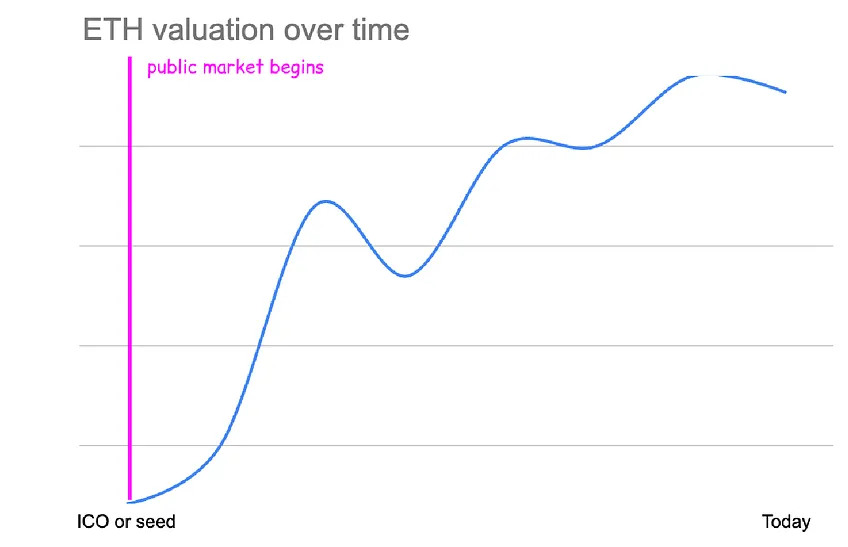
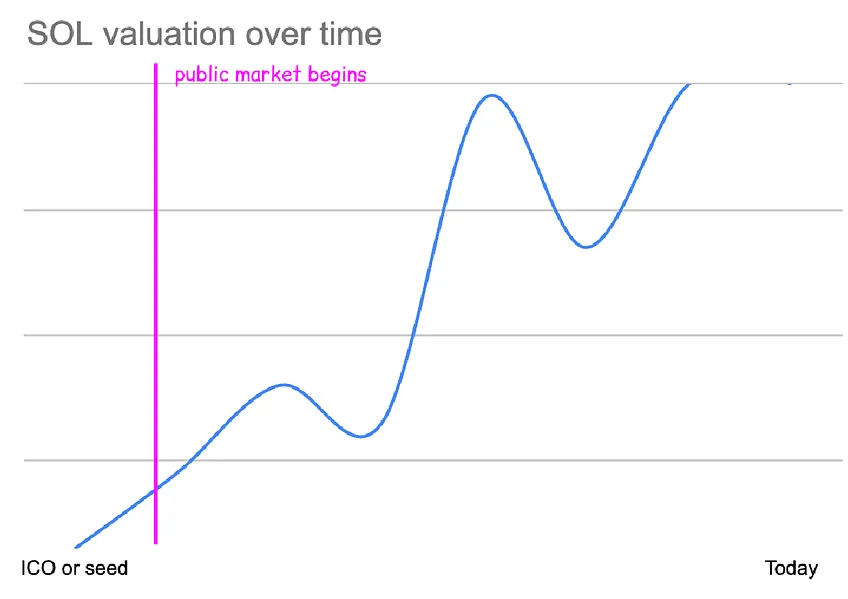
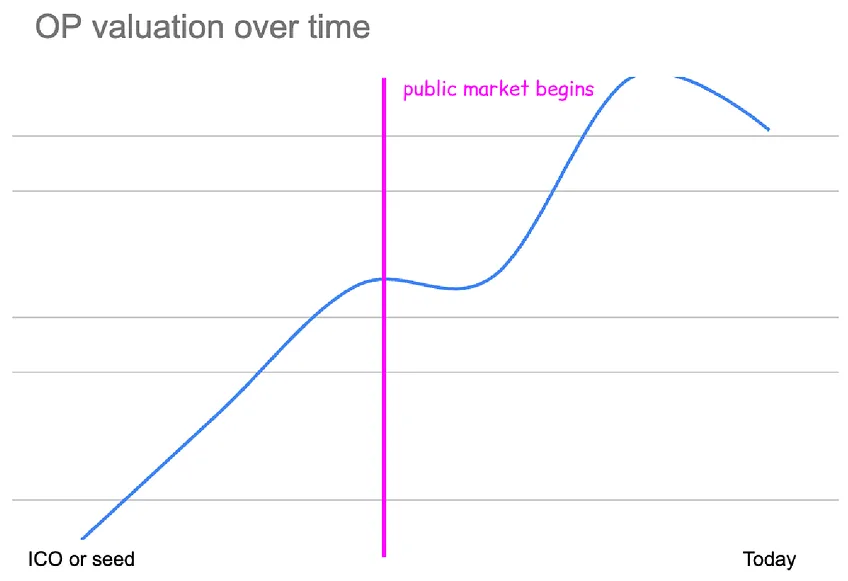
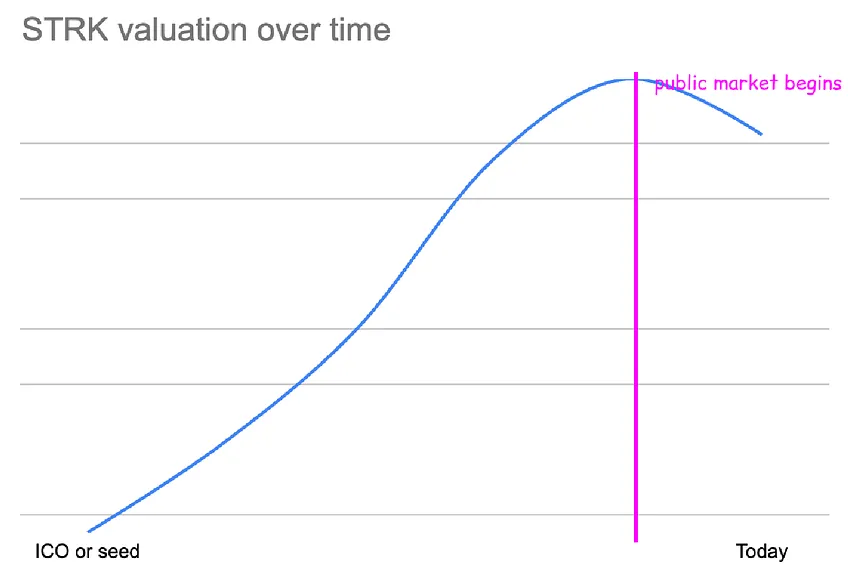
All charts start roughly in the same range ($20M–$80M), but more and more upside is captured by private markets.
OP and STRK currently have similar market caps (~$11B), yet OP required a 6x increase in public markets to reach $11B, while STRK dropped 50% to get here.
To reach $11B, SOL needed a 50x public market gain; Ethereum needed a massive 450x public market return.
Investment opportunities similar to Ethereum’s ICO remain common—but are now almost entirely dominated by private markets.
High FDV partly due to natural demand growth
Expecting current launch FDVs to match those from four years ago is unrealistic.
Capital in this space has grown 100x, stablecoin supply has grown 100x, demand for quality new crypto tokens has grown 100x, etc. New tokens will launch at higher prices because market demand is higher and comparable projects are valued much more highly.
When evaluating FDV, consider whether they align with the rest of the market.
-
Solana’s launch FDV was ~$500 million.
-
At that time, Solana ranked among the top 25 cryptos.
-
It was valued at 1/4 of BNB’s valuation, which was a top-10 crypto.
-
It launched when ETH was $150 per coin.
-
It launched when the ETHBTC ratio was 0.02.
I use the ETHBTC ratio here to show market confidence and demand for Ethereum and smart contract chains—both historically low. Skepticism toward “alt L1s as Ethereum killers” was even greater. There had been a string of failed “ETH killers.”
Since then, ETH is up 20x, BTC up 10x, SOL up 138x, and overall markets have surged—with confidence in smart contract chains as Ethereum alternatives at an all-time high.
Today:
-
A top-25 crypto would have a market cap exceeding $5 billion—about 10x higher than Solana’s launch.
-
1/4 of BNB’s current valuation is ~$9 billion market cap—about 20x higher than Solana’s launch.
-
ETH is $3,100—about 20x higher than Solana’s launch.
-
ETHBTC ratio is 0.046—over 2x higher than Solana’s launch.
If Solana launched today using these comparable metrics as proxies for demand, its launch FDV might be ~$10 billion—possibly even conservative, as these proxies don’t account for alt L1 popularity.
Similarly, when Avalanche launched in September 2020:
-
Avalanche’s launch FDV was ~$2.2 billion.
-
At that time, AVA ranked among the top 15 cryptos.
-
It was valued at half of BNB’s valuation, which was a top-5 crypto.
-
It launched when ETH was $350 per coin.
-
It launched when the ETHBTC ratio was ~0.03.
Recalculating launch FDV using modern prices, Avalanche’s launch would be $15–20 billion.
Post-Crisis Pricing
Another way is to consider Solana’s lowest valuation during the 2022 downturn—after the FTX collapse and investor confidence shattered.
In a severely depressed market, Solana’s lowest valuation was ~$5 billion. This represented one of the best liquidity investment opportunities in years—only possible after absolute purging of fraud and leverage in the market.
Since then, markets have rebounded significantly. If an Ethereum ICO happened today, it wouldn’t just raise $16 million. If a Solana seed round happened today, there would be billions in demand.
Wanting to buy things at 5–10-year-old prices is understandable—but akin to saying “I want to buy Ethereum at $150.” Yes, who wouldn’t?
Earlier rounds and prior launch FDVs were priced relative to risk levels, confidence in these assets, and overall crypto sentiment. Demand for earlier funding rounds was much lower, so pricing reflected that demand.
Even in late 2020, I struggled to fill $2–3 million funding rounds for projects I backed. Now, absurd projects get oversubscribed simply by calling themselves “gamefi.”
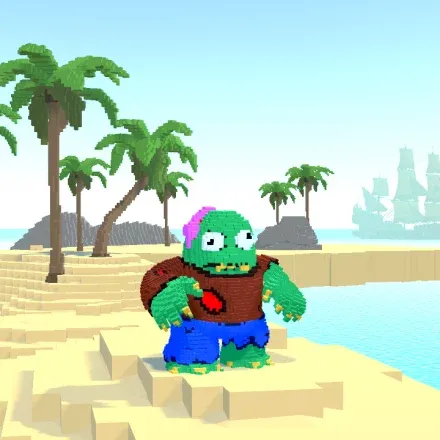
Imagine: if Solana’s founders launched a new blockchain tomorrow, at what price would you buy? Would you pay at least a quarter of Solana’s current valuation ($25B FDV)? Maybe even half ($50B FDV)?
Even 10% of Solana’s current valuation would result in a very high FDV due to immense market demand. So yes, FDVs are higher now because the entire market is worth far more and demand is vastly greater. Of course, high FDV doesn’t always reflect real demand for a specific asset. High FDV isn’t always justified or deserved.
Especially recently, this is often not the case. Market participants have found ways to exploit these levers, keeping valuations artificially high.
One of the bigger problems in the market isn’t that FDVs are generally higher—it’s that many new projects have high FDVs disconnected from the asset’s reality, merely trying to fit into other high FDVs.
Launching projects at multi-billion dollar valuations has become normal—even when no real data supports such valuations—and for many market participants, projects clearly indistinguishable from better ones may never justify these valuations.
Low float isn’t the sole culprit
Low float itself isn’t inherently bad. Low float alone doesn’t cause unhealthy markets or indicate poor behavior—it’s just another variable investors must consider. Many low-float tokens have healthy launches and solid market dynamics.
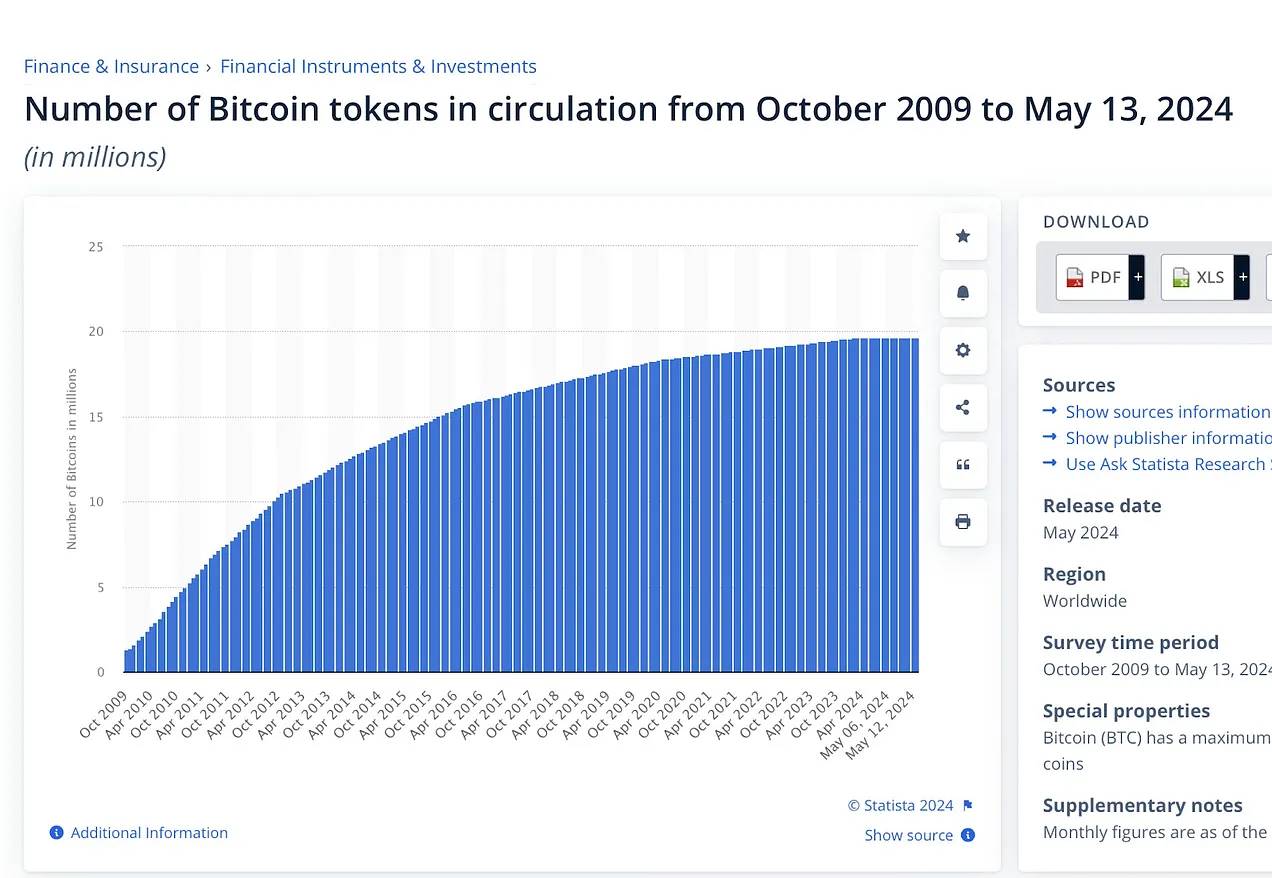
Bitcoin’s issuance schedule is famously deflationary—halving every four years, reducing new coin supply. Bitcoin’s “float” was less than 10% of total supply during its first full year after genesis.
Solana also had very small float in its first year, unlocking only after about 10 months.
To be clear, I’m not defending low float.
I believe higher float is always healthier for tokens, and I respect projects attempting to rapidly reach 100% float. (Currently, there seems no good way to introduce more float without short-term harm to the project.)
I’m simply stating that low float alone isn’t an obvious problem if other key factors check out. Similarly, high float doesn’t automatically mean green flags or make something a “better investment.”
Low float dynamics become problematic when combined with other issues: unjustified and inflated FDV, improper agreements with market participants, or active manipulation by bad actors.
When misused by bad actors, low-float markets are easier to manipulate—e.g., lower float requires less dollar demand to price tokens at high valuations.
Yes, low float can lead to disconnects between valuation and reality—especially when float or FDV are misunderstood or ignored by uninformed buyers. I think the chance of buyers acting independently of valuation is very small. More likely, token buyers simply don’t review or consider these metrics.
To protect and inform yourself, token buyers must assess the balance between float, FDV, and demand for unlocked tokens. Consider: What’s the cost basis of locked supply? What’s OTC demand like for locked tokens in private markets? How willing are existing holders to sell their locked tokens?
Finally, reported high float might actually be low float.
An example illustrating this might be a recent popular token launch:

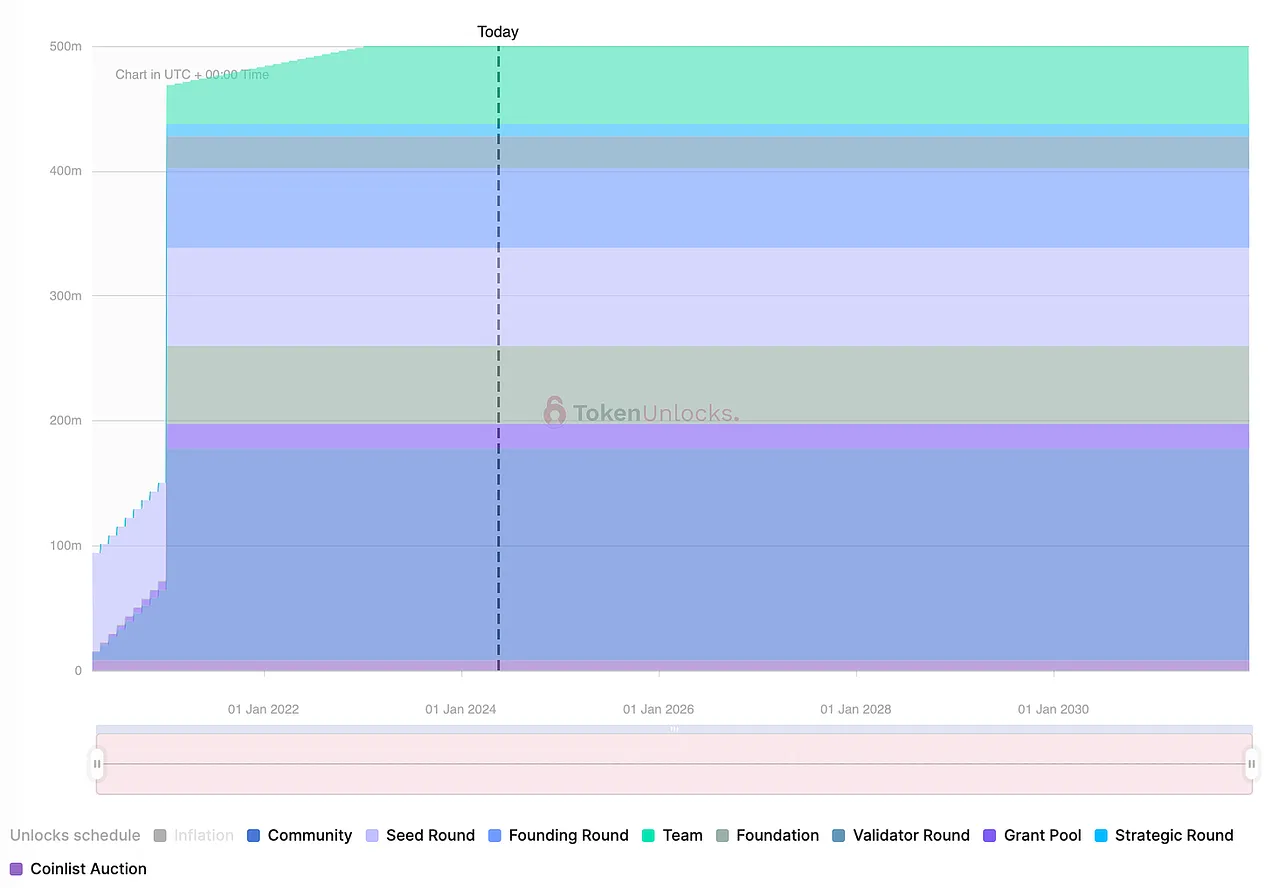
From this chart, ~15% of supply appears unlocked.
Upon closer inspection, only ~2% comes from “community sales.” The remaining unlocked supply belongs to the “ecosystem growth fund”—set aside for growth incentives (like airdrops) and contributors to the project ecosystem (including developers, educators, researchers, and strategic contributors).
As outsiders, we don’t know how this ecosystem portion will be distributed. We don’t even know if it’s been allocated. The actual (sellable) float may only be ~2–3%, despite reporting 15% unlocked. This could mean the real market cap is nearly 90% lower than reported due to inactive supply and OTC tokens included in float.
This shows that assessing only the percentage of unlocked supply is insufficient. In fact, from a bad actor’s perspective, obscuring and inflating actual (tradable) float size may be a more effective tactic—especially if market participants default to thinking “low float = bad.”
Token buyers should investigate who holds unlocked supply, how it’s used, and whether they can distribute it.
This “private price discovery” occurs in a manipulated market—the resulting valuations are deceptive
In my view, one core issue behind the low-float/high-FDV debate lies here. The real problem with “low float” or “high FDV” isn’t the metrics themselves—it’s that price discovery happens in a manipulated, delusional private market, or both.
Let me introduce—the ghost market. (I wanted to call it Shadow Realm, but I’m trying to stop obsessing over Yu-Gi-Oh.) Imagine a market where one person—call him Kain—controls all new token supply. In this market, anyone can bid, but only Kain can sell.
Kain sells some tokens to a new investor Adam at a $50 million valuation. Adam’s tokens are locked and non-transferable. Kain sells more tokens to Eve at a $300 million valuation. Eve’s tokens are also locked.
Adam and Eve are well-regarded investors (maybe thanks to biblical fame?), so others become interested in Kain’s tokens. Kyle, Bob, and Taylor Swift all bid for the next round at a $1 billion valuation—Kain picks Bob as the best fit, and Bob buys locked tokens. Rejected, Kyle panics, fearing missing out, and bids at a $2.5 billion valuation—Kain sells him some locked tokens.
Now Adam’s investment is up 50x. He desperately wants to sell—he’s been tweeting for years and finally has a big win. Even at the previous round’s $1 billion valuation, he’d be happy to exit.
Eve’s position is up ~10x—she’d gladly sell at any price above $1 billion.
But since holders can’t sell and only Kain—who has no reason to sell lower—can sell, this is a manipulated, perpetually rising market.
This pre-launch “ghost market” is an illusion. It doesn’t discover natural prices based on supply-demand—it only finds the highest price VCs are willing to pay. This dynamic pushes valuations beyond what markets can sustain—as seen in the graveyard of 2020–2022 tokens trading far below private valuations.
When Kain’s token reaches
Join TechFlow official community to stay tuned
Telegram:https://t.me/TechFlowDaily
X (Twitter):https://x.com/TechFlowPost
X (Twitter) EN:https://x.com/BlockFlow_News
 @cobie