








When the OP Stack Evolves into the OP "Superchain" Concept
TechFlow Selected TechFlow Selected
When the OP Stack Evolves into the OP "Superchain" Concept
This article will introduce the current state and vision of Superchain.
 Navigating Web3 tides with focused insights
Author: LXDAO
Introduction
Last month, the WorldCoin Foundation announced the launch of World Chain, a blockchain built on the OP Stack. This blockchain will join Optimism’s Superchain and interoperate with other chains such as Base, Mode, OP Mainnet, and Zora.
Many may have heard of OP, OP Stack, and Superchain. The curious ones might be asking: What? Why? Where? This article will answer all these questions about the current state and vision of the Superchain. At the end, we’ve also thoughtfully compiled a step-by-step guide for easily launching your own L2 or L3 chain.
Starting with Optimism
You’re probably familiar with Optimism—an Ethereum Layer 2 (L2) solution designed to deliver fast, stable, scalable, and low-cost blockchain services. By operating atop Ethereum’s mainnet (Layer 1), it helps alleviate network congestion, reducing transaction costs and processing times.
Optimism leverages a technology called Optimism Rollups, bundling numerous transactions off-chain and submitting them to Ethereum’s mainnet only once, paying fees collectively. This method not only speeds up transactions and lowers costs but also maintains high security by relying on Ethereum’s foundation. Later, the Optimism Rollup code was open-sourced, becoming OP Stack—an open-source blockchain framework released by the Optimism Collective.
OP Stack can be understood as a toolkit for one-click L2 deployment, greatly simplifying the process of building L2 chains. These independently developed OP Stack-based L2s share security, communication layers, and an open-source tech stack—forming the vision of the OP Superchain.
Status Quo — OP Stacks Deployed Across Multiple Domains
Currently, OP Stacks has been adopted by several well-known projects, including Base—the leading L2 in NFT trading volume; Debank Chain, launched by the asset management app Debank; and Farcaster Stack, from the social protocol Farcaster. The diversity of these applications reflects how OP Stack was designed from the start to support the OP Superchain concept.
What is the "Superchain"?
The "Superchain" is a multi-chain network architecture based on Layer 2 (L2) technology, aiming to solve traditional blockchains’ challenges in horizontal scalability. Conventional multi-chain architectures often face difficulties in interoperability and incur high overheads. The "Superchain" treats each chain as "interchangeable computing resources"—commoditizing blockchains—allowing developers to build cross-chain applications without systemic risk.
In the "Superchain" model, individual chains (such as OP Chains) are standardized and integrated into a network formally managed by the Optimism Collective. These chains share not only security and communication layers but also an open-source technology stack. This design enables developers to focus on building applications across the entire Superchain without worrying about the technical specifics of any single chain.
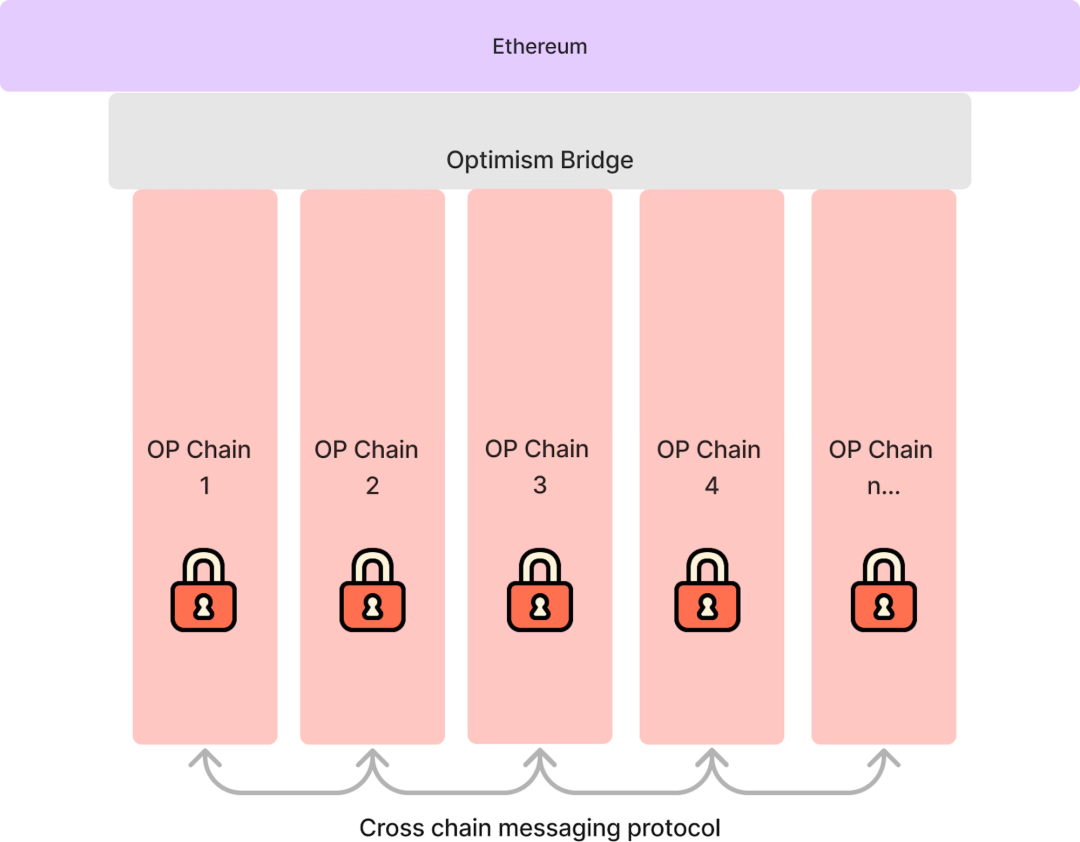
Furthermore, this design philosophy makes the concept of blockchain itself more abstract. Developers can treat the entire interoperable blockchain network as a unified unit, enabling more efficient development and deployment of new solutions. In this way, the "Superchain" not only optimizes resource utilization but also opens new possibilities for the future of blockchain.
How Do OP Chains Achieve Security?
In the "Superchain" bridging security model, both security (i.e., validity) and liveness (i.e., censorship resistance) are guaranteed. Security is ensured by a proof system, while liveness is maintained by users' ability to directly submit transactions to L1. Together, security and liveness mean that if an OP Chain sequencer fails, users can always submit their transactions to L1, which will migrate their usage to a new OP Chain with a properly functioning sequencer.
Below is the official definition of the "Superchain" by Optimism—any chain meeting the following criteria qualifies as part of the "Superchain":
Attribute Purpose Shared L1 Blockchain Provides a complete transaction ordering (i.e., sequencer) for all OP Chains. Shared Bridge Among OP Chains Standardizes security properties across OP Chains. Low-Cost OP Chain Deployment Enables deployment and transactions without incurring high L1 fees. Configurable Options for OP Chains Allows configuration of data availability providers, sequencer addresses, etc. Secure Transactions and Cross-Chain Messaging Enable safe data migration between OP Chains.
OP's Technical Decentralization Roadmap
As the supporting team behind the framework, OP Labs has done extensive work to enable broader technical decentralization within OP Stack. For example, the Bedrock version supports multiple proof schemes and multiple clients. Multi-client fault proofs are a fundamental component of technical decentralization, and Bedrock’s modular framework has significantly influenced the community’s ability to develop OP Stack in a decentralized manner.
Strategy – Stay Honest
In pursuing decentralization, maintaining intellectual honesty about challenges is crucial. Specifically, writing complex, bug-free code is extremely difficult yet vital—because any vulnerability could have catastrophic consequences for any L2.
Tactic – Parallel Development of Protocol Upgrades
OP advocates being intentional, pragmatic, and cautious during the on-chain fault proof process. Achieving full proofs takes time, but Optimism believes several protocol upgrades can be developed in parallel—allowing meaningful progress toward decentralization for OP Stack even before fault proofs are ready.
Frequent updates to technical solutions recently led Arbitrum to discover two bugs in OP [1]. As a provider of widely used open-source infrastructure, OP Stack must constantly face scrutiny from the market and community—and bear greater responsibility.
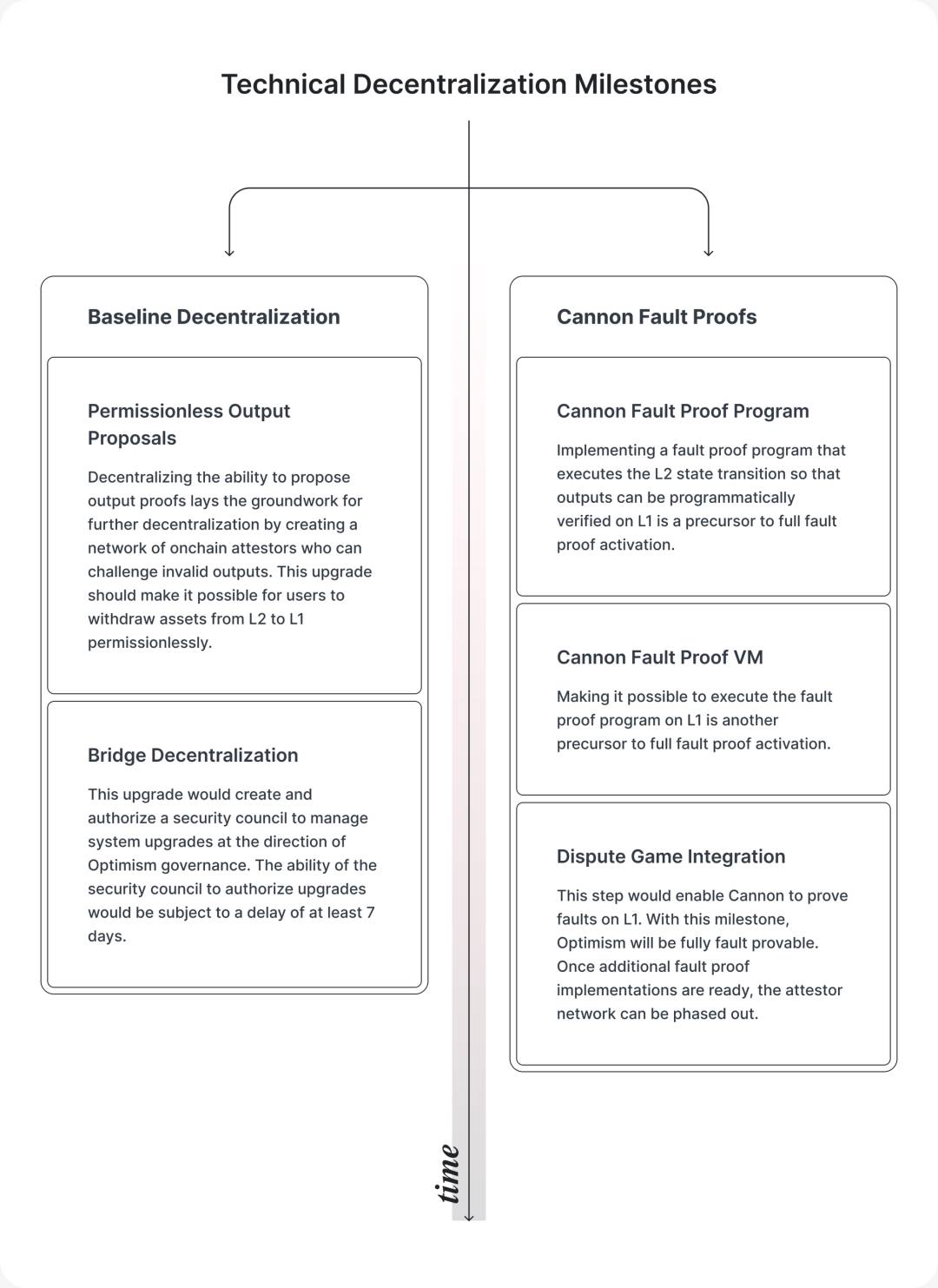
Timeline and Milestones for Technical Decentralization
Commercial Success of OP Stack Superchain Deployment
According to L2Beat data, as of May 4, 2024, the total value locked (TVL) across Layer 2s reached $39.98 billion, with OP Stack accounting for $18.61 billion—nearly half of the total and ranking first. Optimism’s Stack service has seen widespread adoption, with increasing numbers of projects using the OP Stack framework to quickly launch new L2s—such as Optimism, Base, Mode, Zora, Frax, Lyra, Ancient, Redstone, Worldcoin, Mint, and Lisk. This highlights the narrative value of Stack services in the market.
How Does OP Stack Evolve Into a Superchain?
From a technical perspective, let’s break down some code and official information to explain.
Introducing the SystemConfig Contract
Bedrock, the technical platform behind OP Stack, introduced the SystemConfig contract, allowing L2 chains to be defined directly via L1 smart contracts. This can be extended so that all configuration data for an L2 chain resides on-chain—including unique chain IDs, block gas limits, and other key parameters. Below is an excerpt from the SystemConfig contract [2]:
/**
* @title SystemConfig
* @notice The SystemConfig contract is used to manage configuration of an Optimism network. All
* configuration is stored on L1 and picked up by L2 as part of the derivation of the L2
* chain.
*/
contract SystemConfig is OwnableUpgradeable, Semver {
/**
* @notice Enum representing different types of updates.
*
* @custom:value BATCHER Represents an update to the batcher hash.
* @custom:value GAS_CONFIG Represents an update to txn fee config on L2.
* @custom:value GAS_LIMIT Represents an update to gas limit on L2.
* @custom:value UNSAFE_BLOCK_SIGNER Represents an update to the signer key for unsafe
* block distribution.
*/
/*
* @notice Minimum gas limit. This should not be lower than the maximum deposit gas resource
* limit in the ResourceMetering contract used by OptimismPortal, to ensure the L2
* block always has sufficient gas to process deposits.
*/
uint64 public constant MINIMUM_GAS_LIMIT = 8_000_000;
/**
* @notice Identifier for the batcher. For version 1 of this configuration, this is represented
* as an address left-padded with zeros to 32 bytes.
*/
bytes32 public batcherHash;
/**
* @notice L2 gas limit.
*/
uint64 public gasLimit;
CREATE2 Generates Deterministic Chain Addresses
Based on the SystemConfig design, once all data is placed on-chain, a factory (Chain Factory) can be created to deploy configurations and all required contracts for each chain. By using CREATE2 to generate deterministic contract addresses, we can extend this further: given a chain configuration, we can determine all associated bridge addresses. This allows interaction with a chain without deploying bridge contracts, making chain deployment nearly free and enabling chains to inherit standard security properties.
Inter-OP Chain Communication — “Chain Factory” Reuses OP Chain Data
Bedrock introduced a method to derive L2 chains from L1, where all chain data stays synchronized with L1 blocks. As the L1 chain factory expands to place all configurations on-chain, Optimism nodes can deterministically sync any OP chain using just an L1 address and connection to L1.
Note that when OP chain synchronization completes, chain state is computed locally. This means determining an OP chain’s state is fully permissionless and secure. Since all invalid transactions are filtered out during local node execution, derived chains do not require a proof system. However, a proof system is still needed to guarantee withdrawals on Superchain chains.
Modular Sequencer Design Using SystemConfig
Bedrock introduced the ability to set the sequencer address within the SystemConfig contract. With multiple chains each having their own SystemConfig contract, OP chain deployers can now configure the sequencer address. This configurable sequencer design is known as modular sequencing—a key step toward sequencer decentralization.
Modular sequencing enables permissionless experimentation with different sequencing models. Developers can adopt various protocols such as round-robin sequencing, sequencer consensus, price-gas auctions (PGA), or FIFO sequencing. Over time, user-friendly sequencing standards are expected to emerge.
OP Chains Share a Unified Upgrade Path
To launch the initial Superchain with high confidence in security and decentralization, a decentralized security council should be introduced to manage upgrades. The security council should have the authority to update the chain prover set, delay contract upgrades, and in emergencies, pause the bridge and cancel ongoing upgrades.
The ability to pause the bridge in emergencies means that in worst-case scenarios—such as compromised private keys of council members—withdrawals would be indefinitely suspended and upgrades permanently canceled. In other words, the L1 bridge would be frozen. This follows the principle of prioritizing security over liveness—always preventing loss of ETH or tokens (enforced security), even at the cost of locking funds (sacrificed liveness).
Challenges Facing OP Stack on the Road to Becoming a "Superchain"
Of course, becoming a Superchain still involves significant challenges before achieving the full vision of scalable blockchains. Expected pain points include:
-
Withdrawal requests depend on a set of trusted chain provers.
-
Cross-chain transactions are slow, requiring a challenge period.
-
Limited scalability in submitting transactions to the Superchain—transaction data must be submitted to the limited-capacity L1.
-
Cross-chain transactions are asynchronous, breaking the ability to execute atomic cross-chain operations like flash loans.
-
This has improved somewhat after EIP-4844.
-
Lack of developer-friendly frameworks for building scalable applications leveraging multiple OP chains.
-
Absence of a simple wallet to manage tokens and apps across multiple OP chains.
We envision that once these pain points are resolved, we may finally be able to build decentralized alternatives capable of replacing even the most complex Web2 applications.
Mass Adoption of the Superchain After EIP-4844?
The rollout of EIP-4844 coincided almost perfectly with Optimism’s Delta upgrade—an ideal alignment.
Data availability (DA) solutions like Celestia aim to reduce rollup data submission costs to L1, while EIP-4844 provides a native solution that reduces operational costs (OPEX) for OP chains by over 90%.
Before EIP-4844, OP Stack’s main expense was L1 gas costs, as shown below:
OP Stack L1 activity data (Chain / L2 Revenue / L1 Cost / Gross Margin / L1 Cost Ratio):
-
OP Mainnet: 2k ETH / 1.97k ETH / 30 ETH / 98.5%
-
Base: 1.7k ETH / 1.37k ETH / 330 ETH / 80%
After EIP-4844, OP Stack and the Superchain ecosystem stand to benefit greatly, encouraging more projects to adopt L2 as a technical solution. We hope reduced blockchain costs will create more business opportunities for teams and pave the way for mass adoption.
How to Easily Deploy an L2 on the Superchain
How do you actually do it? The Superchain offers a platform called the Superchain Dev Console [3][4], which supports Ethereum, Base, Fraxtel, Mode, OP Mainnet, Redstone, Lisk, and Zora as either L1 or L2 chains.
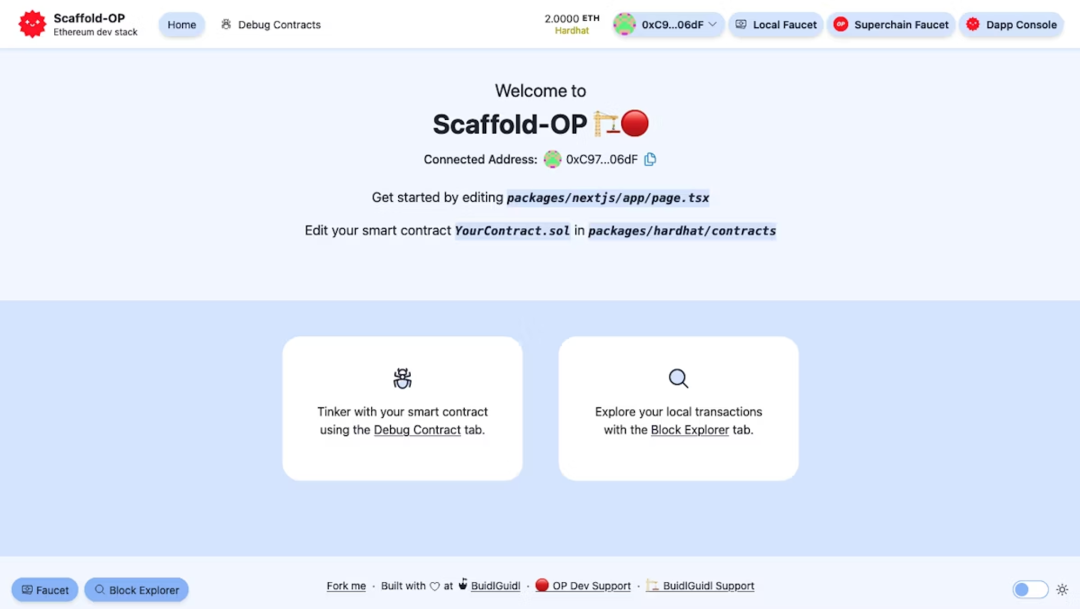
Additionally, the Superchain community has developed several one-click L3 deployment tools, such as Mode Flare by the Mode team, which uses infrastructure from Pyth, Blockscout, and Goldsky [5].
Final Thoughts: We’ve seen Optimism’s strategic positioning and commercial success with the Superchain. OP Stack has drastically lowered the barrier to launching a chain, benefiting countless teams who use it to quickly deploy their own L2s and L3s. Could OP Stack eventually become like AWS or Alibaba Cloud—industry-leading infrastructure providing convenient tools for developers to build their projects? Indeed, such decentralized technical solutions offer a degree of openness and security. But from a design standpoint, does the Superchain also carry potential risks of industry monopolization?
Only time will tell.
Join TechFlow official community to stay tuned
Telegram:https://t.me/TechFlowDaily
X (Twitter):https://x.com/TechFlowPost
X (Twitter) EN:https://x.com/BlockFlow_News
 @LXDAO_Official









