









Markets await inflation data for a "surprise," BTC edges higher
TechFlow Selected TechFlow Selected
Markets await inflation data for a "surprise," BTC edges higher
Market participants are awaiting U.S. inflation data to help determine whether the Federal Reserve will cut interest rates in 2024.
 Navigating Web3 tides with focused insights
By Mary Liu, TechFlow
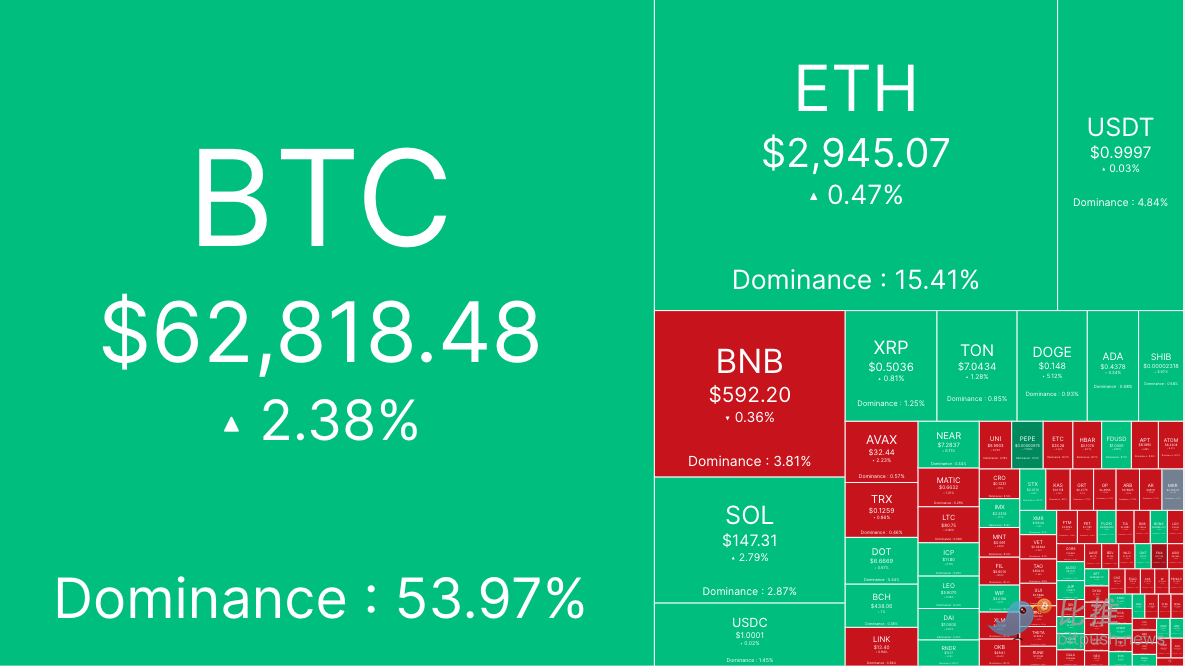
After struggling to break above the $61,500 resistance level for two consecutive days, Bitcoin prices rebounded. According to Bitpush News data, BTC briefly reached $63,269 during Monday's U.S. market session, trading at $62,907 at press time—an increase of 2% over the past 24 hours.
Markets Await Inflation Data
Market participants are awaiting U.S. inflation data to help determine whether the Federal Reserve will cut interest rates in 2024. The Producer Price Index (PPI) is scheduled for release on May 14 local time, followed by the Consumer Price Index (CPI) on May 15.
According to CME's FedWatch tool, market analysts estimate a 72% probability that interest rates will remain unchanged at the July FOMC meeting, while expectations for rate cuts later this year have increased—probability of a rate cut at the September meeting stands at 48.6%. Traders assign a 91.1% chance to unchanged rates at the June meeting.
A Reuters poll conducted from May 7 to 13 found that nearly two-thirds of surveyed economists (70 out of 108) expect the federal funds rate to be cut for the first time in September, to a range of 5.00%-5.25%. Last month, slightly more than half expected a September rate cut. Only 11 forecast a July rate cut, and none predicted a June cut—compared to 26 who expected a cut in July and 4 who anticipated a June cut in the April survey.
Analyst Tedtalksmacro commented on this week’s market dynamics, saying, "Inflation data is the focus, and volatility is expected. However, this may be the first time in a while we could see inflation data slowing down."
He explained that lower inflation would be "favorable for risk assets like Bitcoin," putting markets on the "edge of moving higher."
Analyst Seth shared the following chart in an X post, noting that the Relative Strength Index (RSI) has broken above the downtrend line on the daily timeframe.
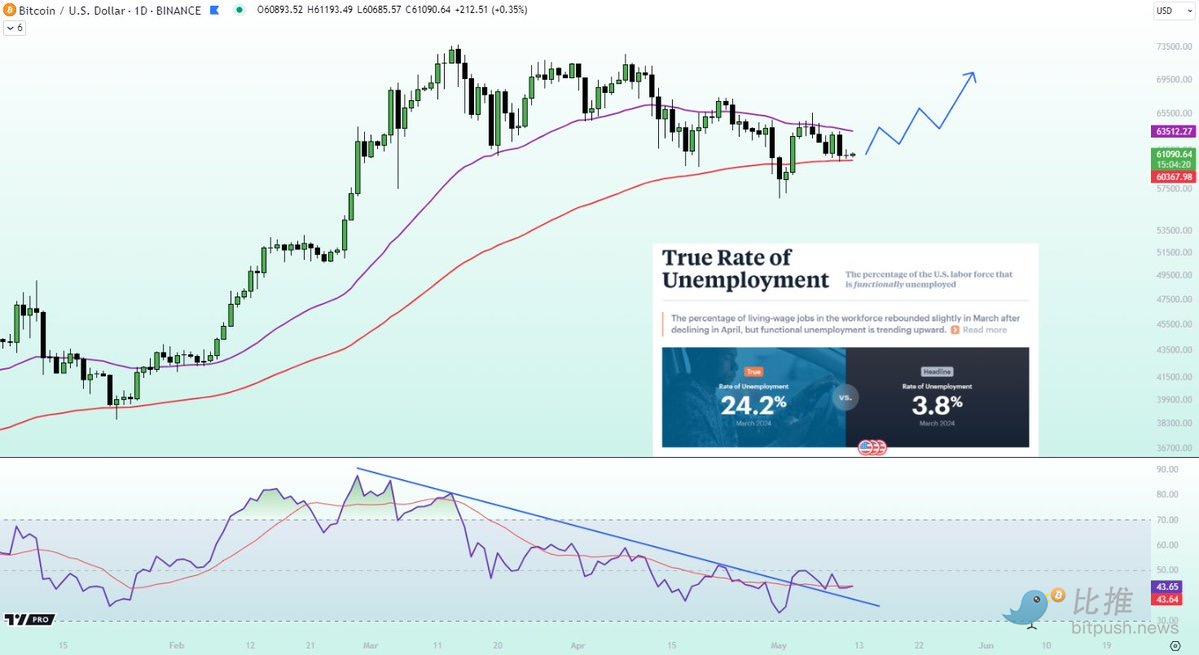
The analyst acknowledged that this week's "CPI, core CPI, PPI, and Fed Chair comments" could influence BTC price direction, stating: "Jerome Powell might help restore our confidence. The U.S. economy isn't as strong as the data suggests. The Ludwig Institute reported a real unemployment rate of 24.2%, compared to the official Labor Department figure of 3.8%."
Bitcoin Price Could Rebound If Coinbase Premium Turns Negative
Since reaching its all-time high of $73,835 on March 14, Bitcoin has been in a prolonged downtrend. According to CryptoQuant data, the Coinbase Premium Index—which reflects BTC price movements—has declined from 0.08 to near zero over the same period.
The Coinbase Premium Index represents the percentage difference between the BTC/USDT pair on Binance and the BTC/USD pair on Coinbase Pro.
CryptoQuant analysts explain that the Coinbase Premium Index is a significant "leading" indicator for predicting BTC price movements.
Historically, whenever this indicator turned negative and reversed from a downtrend to an uptrend, BTC prices always rebounded, as shown in the chart below.
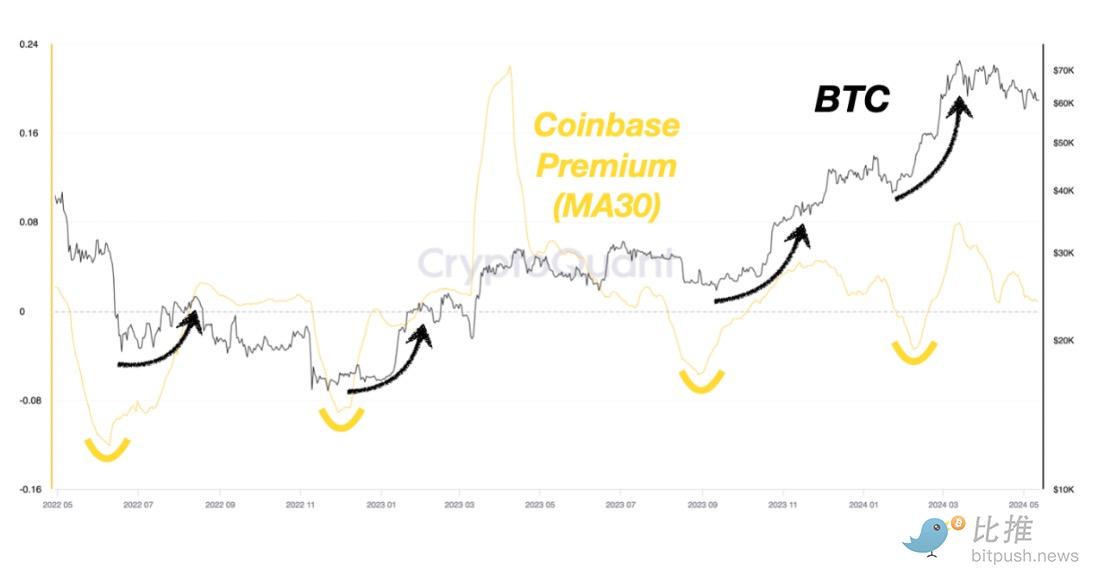
The analyst added that although the Coinbase Premium Index remains positive at press time, it is currently "close to zero." "If historical patterns repeat, if we wait a bit longer until the trend turns negative before investing in a rebound, we may have a better chance of success."
Crypto trader Mustache expressed optimism, suggesting that the current movement should lead to more sustained gains similar to previous halving cycles.
In an X post on May 13, he commented: "Before BTC rises to $80,000, weak hands need to be shaken out of the market. This has always been the case. The structure is the same—only the price is different."
Short-Term Holders May Influence Movement
On the other hand, analysts at cryptocurrency investment firm Ryze Labs noted in their weekly report that the behavior of short-term Bitcoin holders (those holding tokens for less than 155 days) could significantly impact the market in the coming months.
Ryze Labs pointed out three instances where 94% of both long-term and short-term Bitcoin holders were profitable: from mid-November 2017 to mid-April 2018, from mid-February to mid-April 2021, and most recently, from late February to early April 2024.
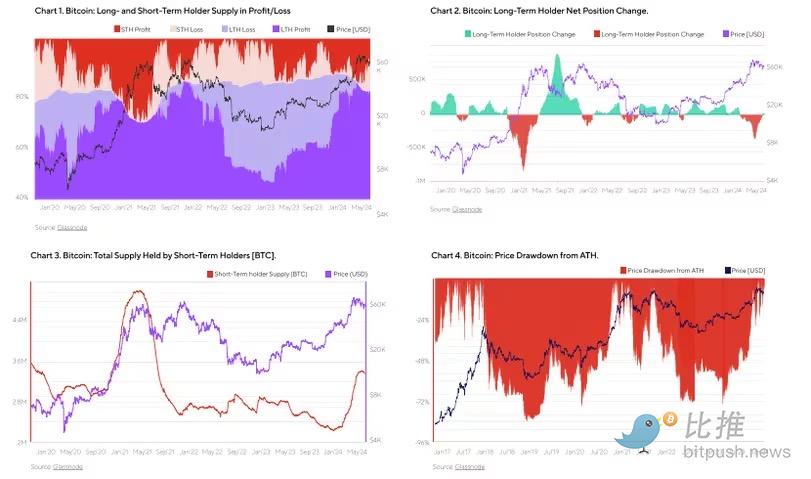
The value of Bitcoin held by short-term investors peaked at $117.8 billion in 2017 and $289.9 billion in 2021. During these periods, long-term holders and miners sold Bitcoin to short-term holders with holding periods under 155 days.
However, after these peaks, losses among short-term holders rapidly increased, leading to a reversal in the cycle—short-term sellers began selling back to long-term holders. The team observed that historically, such shifts have led to sharp declines in Bitcoin prices over the subsequent four to six months.
Analysts stated: "In the recent cycle, the value of Bitcoin held by short-term holders reached $218.9 billion. While most were initially profitable, they began actively selling. About one month after this phase, the maximum drawdown relative to the peak was approximately -6%. Supported by improving macroeconomic conditions and institutional demand, the current cycle may differ from prior ones. However, if these supportive factors weaken, Bitcoin prices could experience a downturn similar to past cycles."
FxPro strategist Alex Kuptsikevich said in a Monday report that price action has exhibited a series of lower lows and lower highs—a sign that investors are selling into rallies.
Kuptsikevich believes that a drop below $60,000 could trigger panic selling, but currently, the greater likelihood is for prices to rise above $65,000. He highlighted the 50-day moving average from early May as a key technical level to watch.
Join TechFlow official community to stay tuned
Telegram:https://t.me/TechFlowDaily
X (Twitter):https://x.com/TechFlowPost
X (Twitter) EN:https://x.com/BlockFlow_News
 比推 BitpushNews









