









What Does Grayscale's Withdrawal of Its Ethereum Futures ETF Application Signal Ahead of SEC Approval?
TechFlow Selected TechFlow Selected
What Does Grayscale's Withdrawal of Its Ethereum Futures ETF Application Signal Ahead of SEC Approval?
Behind Grayscale's withdrawal of its Ethereum futures ETF application: Is it aiming to increase the chances for approval of a spot ETF, modify and reapply, or following GBTC's path in preparing for litigation?
 Navigating Web3 tides with focused insights
Compiled by: Felix, PANews
On May 7, Grayscale Investments, the world's largest digital asset management firm, withdrew its application for an Ethereum futures ETF that had been filed with the U.S. Securities and Exchange Commission (SEC).
Grayscale did not explain the reason for this move but noted that since its initial filing on September 19, 2023, the SEC has repeatedly delayed reviewing the application, citing the need for additional time on November 15 and December 18 of last year, as well as March 22 this year.
This decision has sparked widespread speculation.
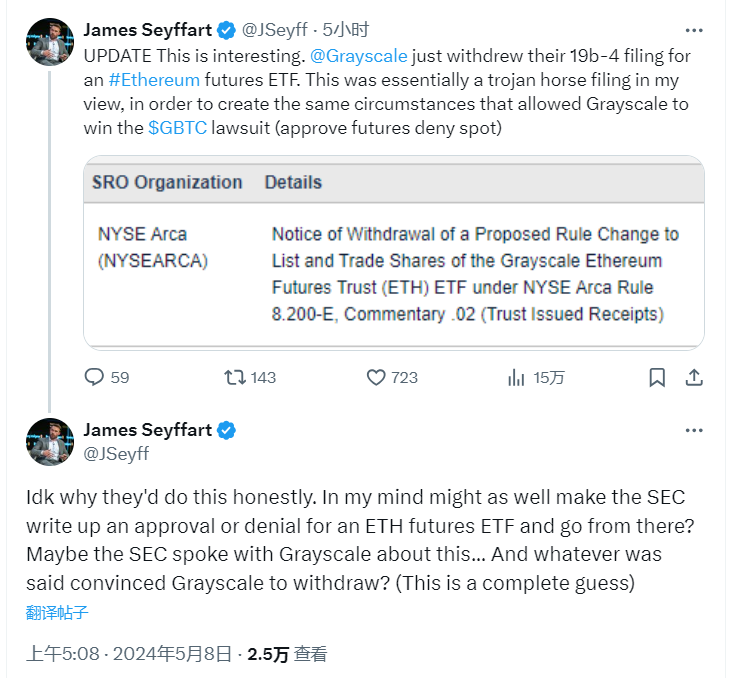
James Seyffart, senior ETF analyst at Bloomberg, suggested the application might have been a strategic maneuver—using the Ethereum futures ETF as a "Trojan horse" to create a scenario similar to Grayscale’s successful GBTC lawsuit, where futures and spot approvals were inconsistent. In August last year, a U.S. federal appeals court ruled in favor of Grayscale, criticizing the SEC for approving Bitcoin futures ETFs while rejecting Bitcoin spot ETFs.
Therefore, Seyffart expressed confusion over why Grayscale would now withdraw, especially since the SEC must make a decision—approval or denial—on at least one spot Ethereum ETF application by May 23 (Note: The SEC must rule on VanEck’s application by May 23, while ARK 21Shares and Hashdex face final deadlines of May 24 and May 30, respectively).
“Wouldn’t it be better to let the SEC first approve or reject the ETH futures ETF and then build from there? Perhaps the SEC and Grayscale discussed this, and the SEC convinced Grayscale to withdraw voluntarily? (Pure speculation.)” added Seyffart.
Others speculate that Grayscale may be trying to increase the chances of approval for a spot ETF, as the SEC could potentially approve an Ethereum futures ETF while rejecting a spot version.
Seyffart did not rule out the possibility that Grayscale might resubmit a revised application, which would reduce the SEC’s workload but eliminate the grounds for litigation.
“Withdrawing and re-filing reduces the burden on the SEC, but also means neither Grayscale nor anyone else can file a lawsuit now.”
Meanwhile, some crypto commentators on X speculated that Grayscale withdrew because the SEC is about to approve a spot Ethereum ETF, a notion Seyffart dismissed.
“I don’t think that’s going to happen (though not impossible), so I believe it’s something else. That said, if I were Grayscale, this would indeed be one of the very few reasons I’d voluntarily withdraw such an application.”
Notably, on May 7, SEC Chair Gary Gensler stated in an interview with CNBC that the commission is still weighing its decision on spot Ethereum ETFs and reiterated concerns about fraud in the crypto market.
“The question of a spot Ethereum ETF is one currently before our commission. We are a five-member commission, and these filings will be addressed in due course.”
Recently, analysts from JPMorgan, Standard Chartered, and Bloomberg have all indicated that approval for a spot Ethereum ETF is unlikely in May. Grayscale’s withdrawal further diminishes the likelihood of a spot Ethereum ETF being approved this month.
Join TechFlow official community to stay tuned
Telegram:https://t.me/TechFlowDaily
X (Twitter):https://x.com/TechFlowPost
X (Twitter) EN:https://x.com/BlockFlow_News
 PANews









