









A New Framework for Blockchain Scaling: Horizontal and Vertical Expansion
TechFlow Selected TechFlow Selected
A New Framework for Blockchain Scaling: Horizontal and Vertical Expansion
Why are horizontal scaling and vertical scaling better frameworks for Ethereum's scalability?
 Navigating Web3 tides with focused insights
Author: Avi Zurlo
Translated by: Block unicorn
Since the rise of Rollups, blockchain scaling has centered on the debate between modularity and monolithicity. Initially, this dichotomy served as a useful mental model for reasoning about blockchain scalability, but now both camps have moved beyond it.
Today, the contrast between modular and monolithic architectures imposes unnecessary constraints on our mental models of scalability.
So, what alternatives exist?
In this article, we will show that horizontal and vertical scaling have always been the fundamental framework for blockchain scalability, and explain how embracing both approaches leads to better scaling solutions.
Understanding Modularity vs. Monolithicity
First, some definitions:
Modular blockchains separate core blockchain functions into distinct layers.
Monolithic blockchains integrate all core functions into a single, interconnected layer.
We can think of "layers" as "machines"—a monolithic chain has one validator node performing all tasks, while a modular chain has multiple (2–3) full nodes handling different tasks.

For example, rollups typically involve two running nodes: a rollup full node for execution, and an Ethereum full node for settlement and data availability (DA). A validium might use three nodes: a rollup full node for execution, an Ethereum full node for settlement, and a separate DA layer full node for data availability.
Modularity distributes blockchain tasks across at least two full nodes. By doing so, modular blockchains can leverage the computational power of multiple machines when building blocks.
This is a form of horizontal scaling.
Modularity is useful when thinking about blockchain scalability because it represents a type of horizontal scaling.

On the other hand, most monolithic chains choose to scale through software optimizations, parallel virtual machines, data pipelining, faster networking protocols, and—most notably—more powerful hardware. Essentially, monolithic chains attempt to extract as much computational power as possible from individual full nodes.
This is a form of vertical scaling.
Critics argue this approach tends toward centralization: if scaling relies on increasing individual node power, it inevitably hits physical hardware limits and forces higher hardware requirements for further scaling.
However, this criticism is incorrect because not all monolithic chains rely solely on vertical scaling.
For instance, Near is a monolithic L1 blockchain built on a sharded network architecture. This means Near’s full nodes handle all tasks (execution, settlement, and data availability), but each only manages a small portion of Near’s global state. Thus, Near leverages the computing power of multiple machines by partitioning work based on state rather than tasks—similar to modular chains.
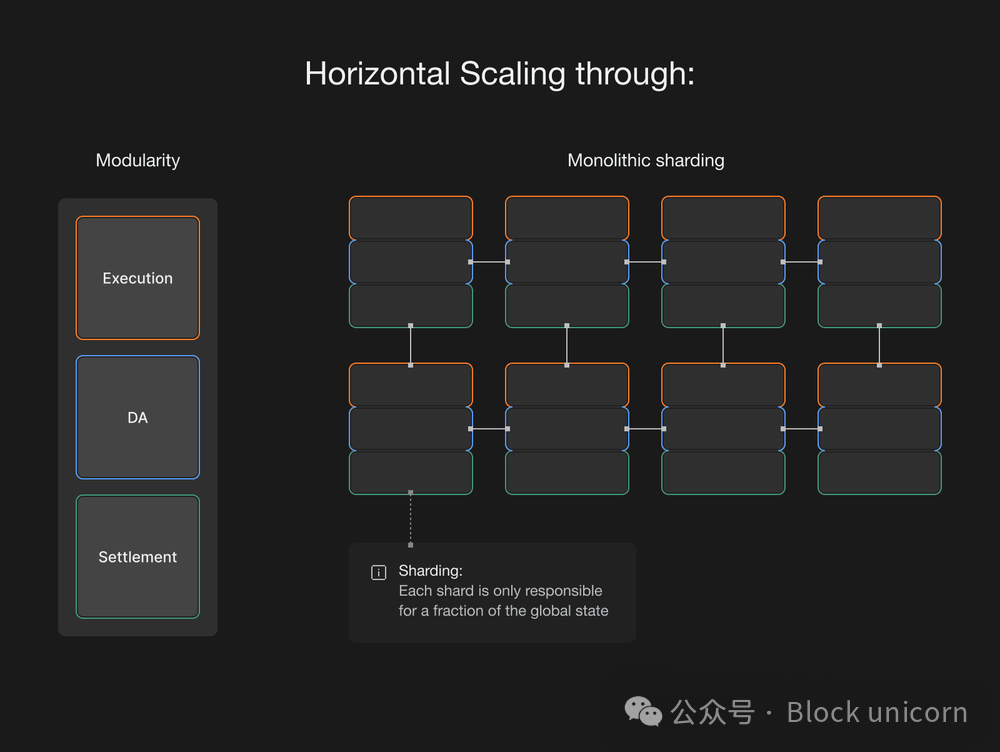
We see that neither monolithic nor modular chains are technically limited in their choice of scaling techniques. Both can employ horizontal and/or vertical scaling.
Moreover, the modularity vs. monolithicity debate has always been rooted in the framework of horizontal versus vertical scaling. From a strict technical standpoint, modularity inherently leans toward horizontal scaling by design, whereas monoliths tend toward vertical scaling.
Now that modular chains are live, additional scalability gains no longer come simply from being “more modular.” The focus is now on how chains utilize horizontal or vertical scaling techniques.
Adopting the horizontal vs. vertical scaling framework allows us to clearly reason about the trade-offs each chain makes along the way.
Reframing the Conversation: Horizontal vs. Vertical Scaling
Before diving deeper into the horizontal vs. vertical scaling framework, it's important to acknowledge its origins trace back to the 1970s, when distributed computing research laid the foundation for horizontal scaling. Today, all scaling techniques can be classified as either horizontal or vertical scaling.
Vertical Scaling
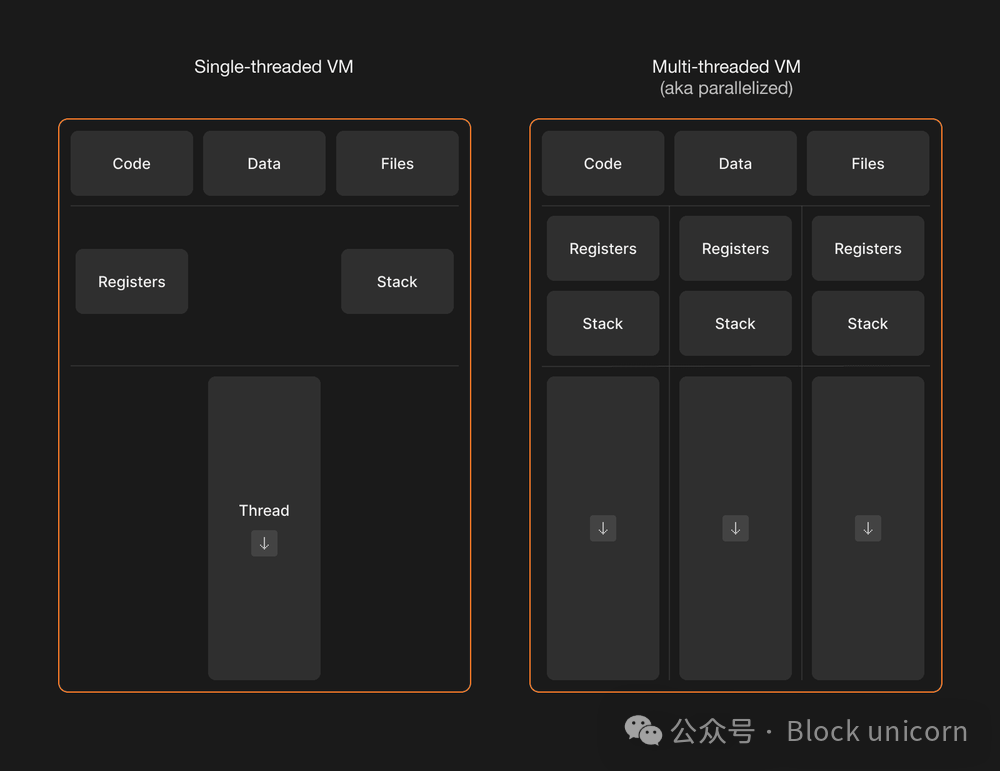
Vertical scaling increases the hardware utilization or hardware requirements per node. In blockchains, this is typically achieved through software optimizations like parallel virtual machines (i.e., multithreaded processing).
A common example is the EVM vs. SVM.
The EVM executes transactions sequentially, while the SVM executes them in parallel. The SVM achieves this by leveraging more CPU cores, allowing it to process more transactions per second than the EVM. Note: This type of vertical scaling underpins Eclipse L2s.
In terms of trade-offs, vertical scaling is limited by available hardware, tends toward centralization due to increasing hardware demands, and offers lower scalability compared to horizontal scaling.
Horizontal Scaling
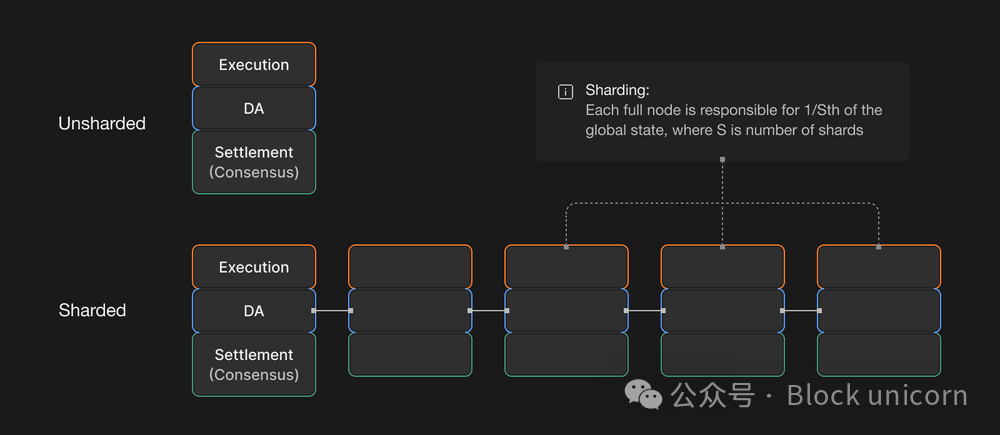
Conversely, horizontal scaling increases the number of machines accessible to the system by distributing the workload across multiple nodes. As noted earlier, modular chains inherently distribute tasks across multiple machines. However, chains can achieve even greater horizontal scaling through sharding.
=nil; provides a useful example.
In November last year, the =nil; Foundation launched a verifiable sharding architecture called zkSharding, which serves as the foundation for a new Ethereum L2. At the core of =nil;’s design is the partitioning of its global state across multiple shards. Each shard is operated by a decentralized committee within =nil;, responsible for block production and cross-shard transaction management. Additionally, each shard generates validity proofs that are sent to a main shard for aggregation, then published and verified on Ethereum. =nil; leverages horizontal scaling in two ways:
-
First, =nil; is a modular blockchain that leverages Ethereum’s strong consensus and data availability guarantees, distributing tasks across multiple full nodes.
-
Second, =nil; is a sharded blockchain, distributing portions of state across many full nodes.
Both techniques reduce the load any single machine must bear, enhancing the network’s overall scalability.
What are the trade-offs of horizontal scaling? They boil down to two points: increased complexity in networking and consensus, and asynchronous communication between machines or shards.
The Endgame for Ethereum Scalability
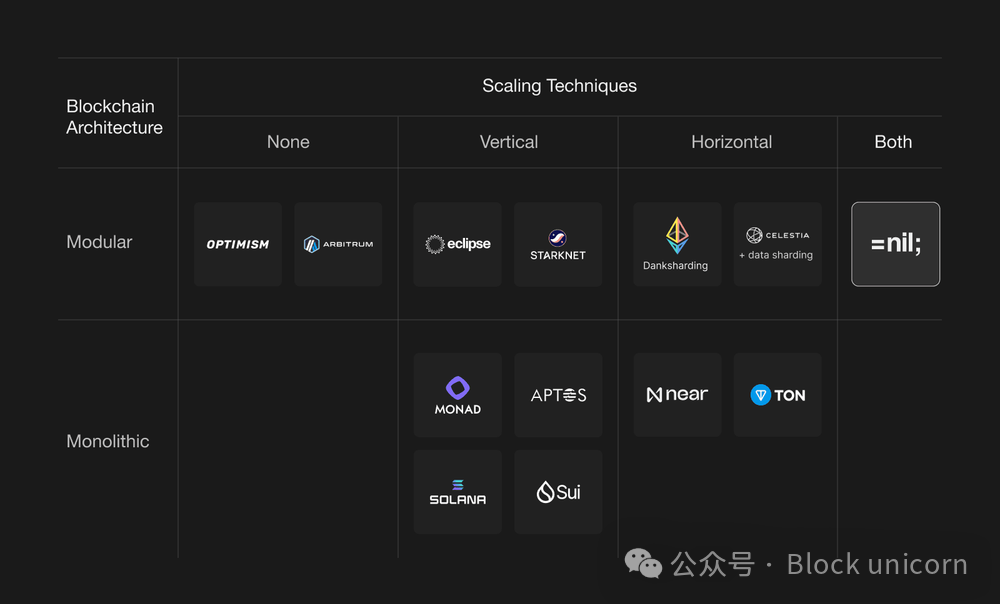
Neither horizontal nor vertical scaling is restricted to modular or monolithic architectures. This is why the horizontal vs. vertical scaling framework opens up more room to explore novel solutions, enabling modular blockchains to become even more scalable.
For example, one option is vertically scaling a layer within a modular stack. A common method is implementing a parallel virtual machine to boost execution throughput. As mentioned above, Eclipse is leveraging the SVM, and other rollups like Starknet are implementing BlockSTM for parallelization.
However, vertical scaling is always constrained by the limitations of individual machines—we cannot break the laws of physics.
A solution may lie in opting for horizontal scaling via sharding.
Current modular designs are only beginning to tap into the full potential of horizontal scaling. With sharding, we can harness the computational power of an arbitrary number of machines—not just 2–3 machines sharing tasks.
In other words, many machines can run the same type of task in parallel. This is exactly what Ethereum and Celestia aim to achieve through Danksharding and data sharding, respectively. But sharding isn't inherently limited to data availability layers—it can also be combined with execution, as in the case of the =nil; L2.

If we combine the horizontal scaling enabled by modular stacks with the horizontal scaling offered by sharding, we unlock a massive increase in available computational capacity.
But we can do even better…
The ultimate goal for blockchain scalability will merge horizontal and vertical scaling, resulting in sharded blockchains equipped with parallel virtual machines.

At the =nil; Foundation, we are systematically designing toward this end state. =nil;’s L2 follows an aggressive scaling roadmap by combining a modular, horizontally scalable architecture (zkSharding) with vertically scaled validators (via intra-shard parallelization).
As a result, =nil;’s design enables global-scale throughput without sacrificing state, liquidity, or user fragmentation.
Join TechFlow official community to stay tuned
Telegram:https://t.me/TechFlowDaily
X (Twitter):https://x.com/TechFlowPost
X (Twitter) EN:https://x.com/BlockFlow_News
 @nil_foundation









