








Does Bitcoin need liquid staking to improve capital efficiency?
TechFlow Selected TechFlow Selected
Does Bitcoin need liquid staking to improve capital efficiency?
By "locking" BTC, its economic security can be exported to nearly any crypto application.
 Navigating Web3 tides with focused insights
Author: Mikhil Pandey
Translation: TechFlow
Introduction
This article is the result of a deep dive into today’s Bitcoin landscape by Mikhil Pandey, co-founder and Chief Strategy Officer at Persistence Labs.
Through this piece, Mikhil Pandey aims to guide readers through Bitcoin's role in cryptocurrency, the current Bitcoin ecosystem, the significance of BTC liquid staking, and his outlook on what comes next.
Understanding Bitcoin
Is Bitcoin a store of value? The largest peer-to-peer payment network? A global remittance system? Digital gold? A hedge against traditional finance? The first proof-of-work blockchain?
What exactly is Bitcoin? Which of these descriptions fits? In short, I believe all of them—and more.
Bitcoin is a Layer 1 blockchain originally designed for trustless and transparent movement of monetary value, conceived during the 2008 global financial crisis.
Its native digital asset, BTC, has evolved from one of the boldest financial experiments of our time into the largest cryptocurrency by market cap.
Today, both the Bitcoin network and its asset have become playgrounds for finance, mechanism design, and hope.
-
The brightest minds are pushing Bitcoin toward a more useful, capital-efficient, and programmable future
-
The world’s largest institutions are launching BTC ETFs to provide public exposure
-
A new generation of builders is discovering unique ways to use Bitcoin block space—including Ordinals, NFTs, BRC-20, Runes, staking, and more
-
Bitcoin network activity has reached record highs, generating more value (fees) for miners than ever before
Bitcoin is for everyone. The best part? These diverse perceptions of BTC are a feature, not a bug.

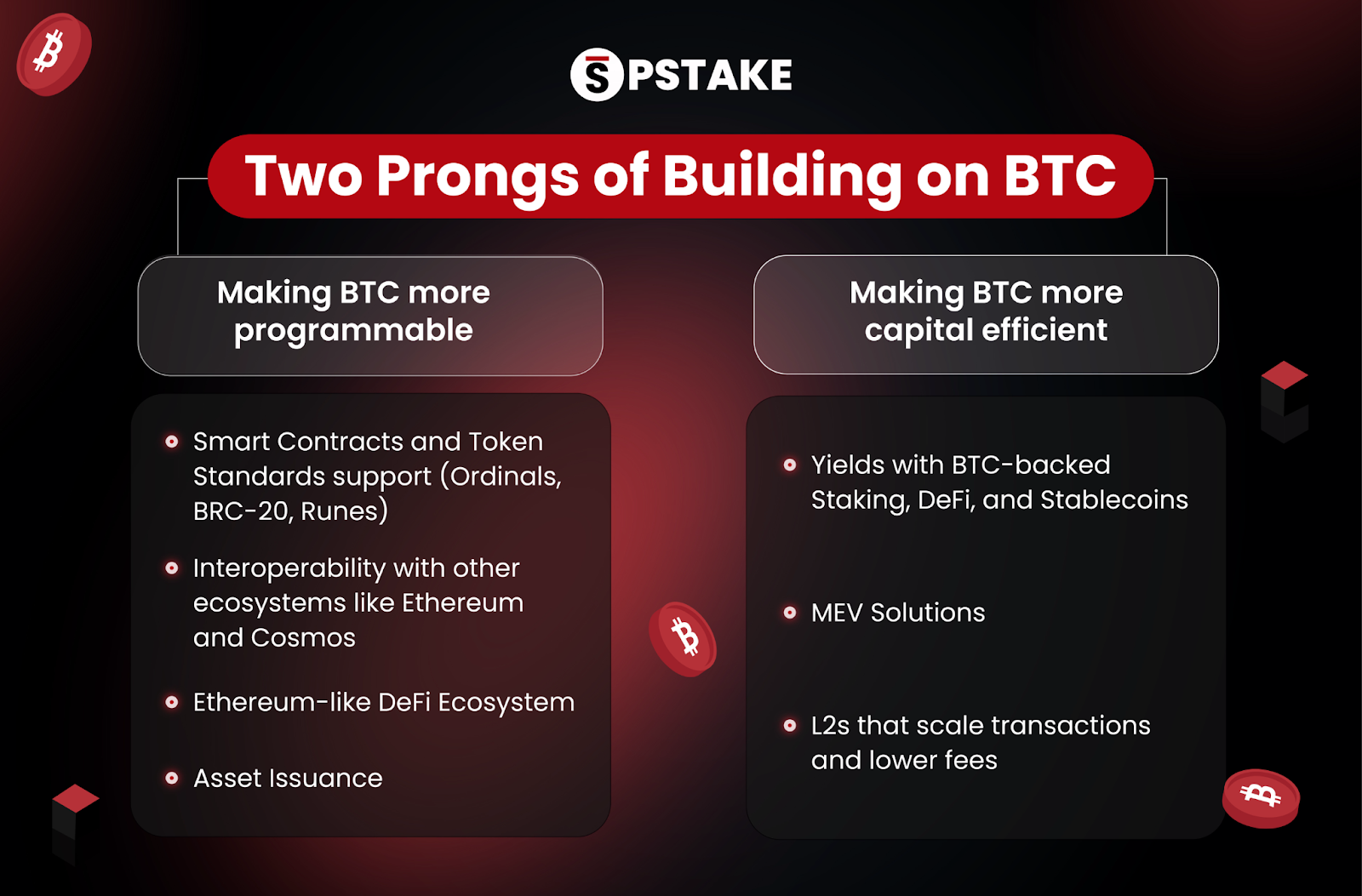
Two Pillars of Building on Bitcoin
To the general public, Bitcoin is gradually transitioning from being seen as just a "network" to a full-fledged "ecosystem." Recently, the ecosystem built on top of Bitcoin has seen exponential growth.
But this isn’t unprecedented. Beyond community-driven network upgrades, multiple stakeholders have long attempted to build atop Bitcoin. In fact, it was part of Satoshi Nakamoto’s original vision.
Satoshi once said: "This design supports various possible transaction types I designed years ago—escrow transactions, margin contracts, third-party arbitration, multi-signature setups, etc. If Bitcoin gains widespread adoption, these are things we’ll want to explore in the future, but they must be designed from the start to ensure they remain possible later."
Since 2012, there have been continuous efforts to expand Bitcoin beyond payments:
-
Decentralized domain services (Namecoin)
-
Broader asset representation (Colored Coins, MasterCoin, Counterparty)
-
Scaling Bitcoin via sidechains, rollups, and Layer 2 solutions (Taproot, Stacks, Liquid Network, Merlin, Urbit, Lightning, bitVM, etc.)
-
Extending BTC functionality via Ordinals and Runes (Memes, NFTs, BRC-20, BRC-420) and yield generation (Babylon, BounceBit, Stroom Network, Trustless Machines, etc.)
But where are these developments leading Bitcoin? Portal Ventures’ essay on Bitcoin summarizes it best:
-
Make Bitcoin more programmable—addressing smart contract and scalability limitations to enable deployments on the Bitcoin network
-
Make BTC more capital-efficient—super-financializing everything built with BTC
Where Does BTC Liquid Staking Fit In?
Bitcoin is a proof-of-work network where miners solve computational puzzles to produce blocks and earn newly minted bitcoins as rewards.
So how does staking come into play—let alone liquid staking? Let’s revisit some blockchain fundamentals.
Consensus requires ongoing agreement on the state of the network—data, transactions, balances, etc. While PoW relies on computing power (mining) to achieve and maintain consensus, PoS introduces the concept of economic security. Staking involves locking tokens to participate in consensus, contribute to network security, and earn staking rewards.
We typically require collateral when we need to trust that counterparties will behave honestly—like landlords collecting deposits from tenants.
In short, PoS is driven by trust in the economic security of an asset. What asset has greater economic credibility than one backed by tens of billions of dollars? And what better asset than Bitcoin?
By “locking up” BTC, its economic security can be exported to nearly any crypto application. Imagine a world where financial applications across blockchains of all shapes and sizes can leverage BTC, bringing vitality and security to each.
Trustless BTC staking—and thus liquid staking—opens up vibrant possibilities for BTC-dominated DeFi, making BTC far more capital-efficient. Money markets, stablecoins, economic security, insurance—the applications are limitless.
What Is the Future of Bitcoin?
One might argue that BTC is already capital-efficient given its market cap growth, adoption, and status as the premier store of value in crypto?
That raises the question: What exactly is capital efficiency? Wall Street defines it as “how effectively a company uses capital to operate and grow.” By that measure, BTC largely sits idle in the hands of retail holders, miners, and institutions most of the time.
This stems from several factors:
-
Lack of sustainable yield opportunities
-
Friction for risk-averse holders to “move” BTC
-
Absence of institution-friendly yield products
-
Unknown security risks of moving BTC off the Bitcoin network
-
Opposition from some OG Bitcoiners
Recently, the entire industry has been working to overcome these barriers facing BTC in order to unlock its liquidity and capital efficiency within the crypto world.
While the Bitcoin community may appear somewhat divided—which is often healthy—keep a close eye on key developments in the Bitcoin ecosystem such as Bitcoin L2s, minimal-trust BTC staking, Ordinals and Runes, and virtual machines.
BTC liquid staking is not just a buzzword. It’s here and could define yield in crypto. With simple BTC-first financial products expected to bring much-needed liquidity and utility to today’s DeFi landscape, the future of Bitcoin has never looked brighter.
We’ve already seen the exponential rise of liquid staking on Ethereum and the subsequent boom in on-chain finance. Just imagine the possibilities—and doors opened—when the same happens to the very asset that first created the “crypto” asset class.
Join TechFlow official community to stay tuned
Telegram:https://t.me/TechFlowDaily
X (Twitter):https://x.com/TechFlowPost
X (Twitter) EN:https://x.com/BlockFlow_News
 @pStakeFinance


