









The ezETH Depeg Unfolds: Whales Profit from Bottom-Fishing, Projects Rush to Adjust Airdrop Rules
TechFlow Selected TechFlow Selected
The ezETH Depeg Unfolds: Whales Profit from Bottom-Fishing, Projects Rush to Adjust Airdrop Rules
Within 24 hours of the new token mining announcement, ezETH became depegged, dropping as low as $2,262, causing individuals holding leveraged positions in ezETH to lose over $50 million.
 Navigating Web3 tides with focused insights
Author: Mia, ChainCatcher
With Binance's official launch of its 53rd New Coin Mining project, the liquid restaking protocol Renzo (REZ) quickly became a focal point within the crypto community. The Binance listing was initially expected to bring significant positive momentum for Renzo, yet the actual outcome proved quite different. Instead of a surge in Total Value Locked (TVL), the narrative was quickly overshadowed by news of Renzo’s derivative token ezETH losing its peg. Within 24 hours of the listing announcement, ezETH briefly de-pegged, dropping as low as $2,262, resulting in liquidations for some users.
This sudden de-pegging event unexpectedly provided a buying opportunity for certain users. One whale seized the moment, using 2,400 ETH to purchase 2,499 ezETH worth $6.98 million, netting a profit of 99 ETH. Meanwhile, an account linked to the wallet address 0xaa1 (czsamsunsb.eth) earned approximately 193 ETH, equivalent to around $600,000.
The incident quickly drew widespread attention and raised questions across the crypto community: “If this was supposed to be good news, why did it turn negative?” So, what exactly happened to Renzo following the listing announcement?
A Coincidental Timing
Data indicates that ezETH de-pegging was detected at 11:17 AM on April 24—just 17 hours after Binance announced the new coin mining program for the liquid restaking protocol Renzo (REZ). What occurred during those 17 hours that could have caused ezETH to lose its peg? The answer lies in Renzo releasing its REZ tokenomics model and airdrop details, which sparked significant backlash within the crypto community.
Tokenomics Spark Community Backlash
According to the published tokenomics, only 5% of tokens were allocated to the first season of the ezPoints airdrop, and just 2.5% to the Launchpool. Additionally, under the airdrop rules, the top 5% of addresses would receive immediate unlocking of 50% of their tokens at Token Generation Event (TGE), with the remainder linearly vested over the next six months. This structure meant that most liquidity remained under the control of the project team at TGE.
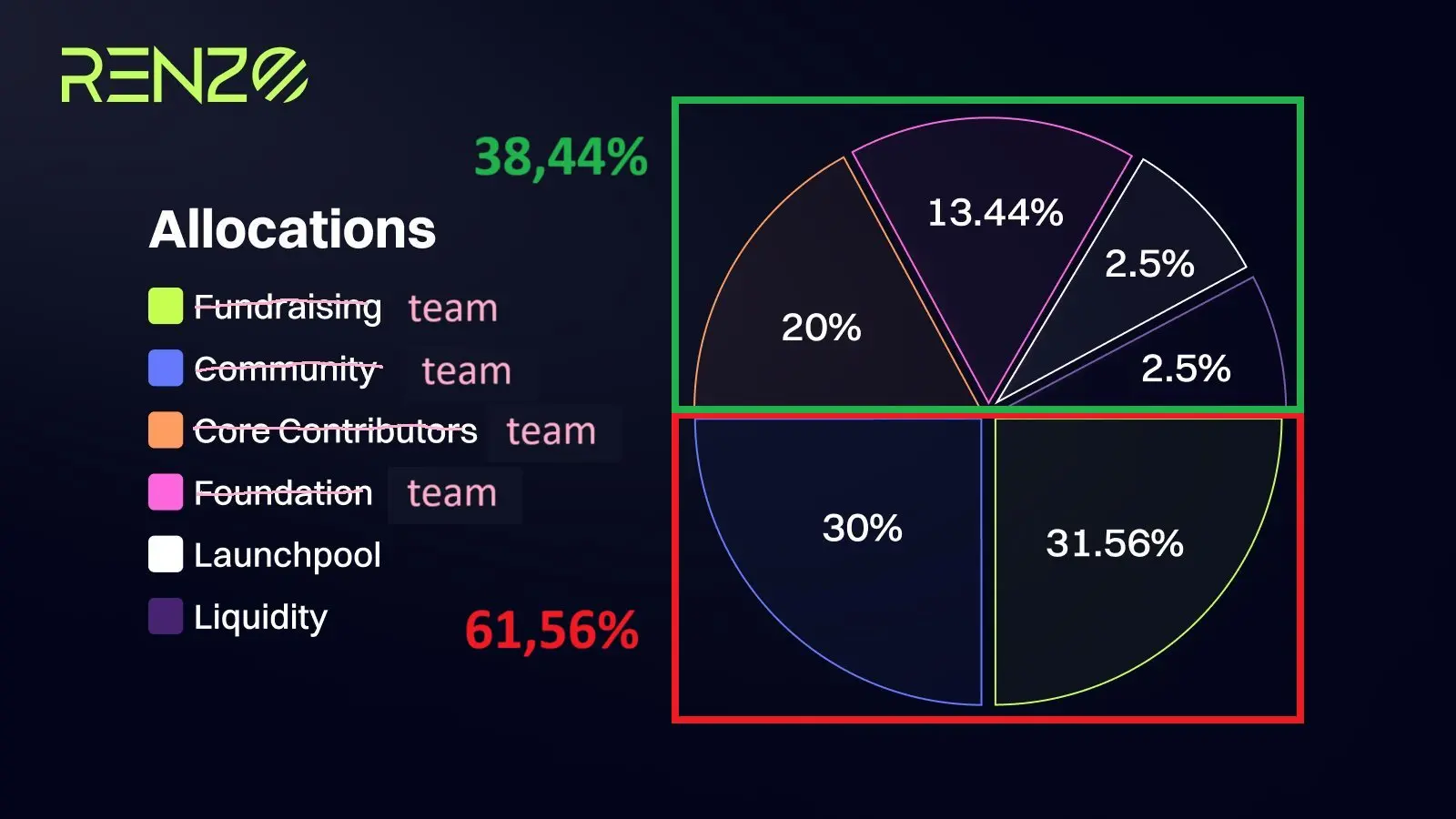
This reality triggered concerns among investors, who questioned the project’s claims of “protocol decentralization,” arguing that there was a clear contradiction between rhetoric and practice. Critics pointed out the absurdity of promoting decentralization while only airdropping 5% of the total supply, with up to 70% of tokens still held internally—hardly a decentralized distribution.
This discontent rapidly spread throughout the community, fueling ongoing discussions about “Renzo (REZ) tokenomics” and becoming the primary catalyst behind ezETH’s de-pegging.
Some users expressed concern that Binance Launchpool participants might sell their tokens before ezETH holders could unlock their airdropped tokens, prompting selling pressure from existing ezETH stakers. Some began offloading ezETH to reallocate ETH into other liquid restaking projects.
Users on X noted that Renzo used a misleading pie chart on X with disproportionate slices to represent token allocation, causing confusion about where REZ tokens were actually going. After adjusting the scale, the chart revealed that over 60% of tokens were allocated to the team, investors, and advisors.
Moreover, the airdrop rules indicated that 2% of the first-season 5% airdrop (0.1% of total supply) had already been distributed to NFT communities such as Milady Maker and SchizoPosters—groups seemingly unrelated to the Renzo protocol—sparking suspicions of insider allocations.
The "Death Loop"
In fact, prior to this, Renzo’s airdrop reward program allowed a leveraged strategy known as “looping,” where farmers could sell ezETH for ETH and then redeposit the ETH back into the protocol to accumulate more rewards. This incentivized users to exit their positions by aggressively selling ezETH.
Thin on-chain liquidity failed to absorb the sell-off pressure, exacerbating large-scale dumping of ezETH, leading to a sharp decline in token value and triggering massive liquidations across lending markets. It is reported that individuals holding leveraged ezETH positions suffered losses exceeding $50 million.
Renzo Adjusts Airdrop Rules in Response to Community Feedback
The de-pegging of ezETH caught the attention of the Renzo team. In response to community criticism, the project issued a rapid clarification yesterday: eligibility for the airdrop depends solely on ezPoints at the time of snapshot, not on ezETH balances (regardless of whether they were sold or not). Users whose Pendle YT matured before the snapshot are still eligible if they meet the minimum score threshold. NFT-related airdrops will be calculated based on NFT quantity rather than wallet count. However, this explanation failed to calm community concerns, and ezETH remained de-pegged.
Recognizing that the root issues lay in tokenomics and airdrop design, the Renzo team made several adjustments aimed at stabilizing community sentiment and supporting the token price.
To address dissatisfaction with tokenomics, the team increased the first-season airdrop allocation from 5% to 7% of the total supply. Overall, Renzo raised the total airdrop amount to 12% of the 10 billion token supply, with 7% distributed in the first phase (at launch by month-end) and 5% in subsequent phases. Additionally, the first airdrop claim date has been updated to April 30.
Under the revised criteria, participants with at least 360 Renzo points qualify for the airdrop, receiving allocations proportionally at TGE. Previously, the top 5% of eligible wallets were set to receive half their airdrop immediately, with the rest vesting over six months. Under the new rules, 99% of qualifying addresses will have full access upon TGE; wallets holding over 500,000 ezPoints will unlock 50% at TGE, with the remainder linearly vested over three months.
Additionally, the project has eliminated the previous “looping” leverage strategy to help stabilize ezETH liquidity.
According to CoinGecko data, ezETH is currently trading between $3,056 and $3,121 across platforms. While still de-pegged, prices are steadily recovering, and the discount relative to ETH is narrowing.
Join TechFlow official community to stay tuned
Telegram:https://t.me/TechFlowDaily
X (Twitter):https://x.com/TechFlowPost
X (Twitter) EN:https://x.com/BlockFlow_News
 ChainCatcher 链捕手









