









Base Social Protocol Kingdom: Consumer apps accumulating massive user bases and billions in TVL
TechFlow Selected TechFlow Selected
Base Social Protocol Kingdom: Consumer apps accumulating massive user bases and billions in TVL
Base, as an L2, has unique advantages and community appeal that give it the potential to attract a massive number of new users and achieve widespread adoption.
 Navigating Web3 tides with focused insights
Author: IOSG Ventures
Special Thanks: We thank Fiona, Ray, Jocy, and Mitu for their valuable suggestions on revising this article!
TL, DR
-
Background: Base has recently seen significant growth in both on-chain data and ecosystem development. This growth is driven by multiple factors: the Cancun upgrade drastically reduced L2 transaction fees, lowering user interaction costs; strong backing from Coinbase, which provides comprehensive support in funding, users, and projects—Coinbase Ventures and top-tier funds are highly active in investing across the Base ecosystem; and a mutually beneficial collaboration with the OP Superchain strategy.
-
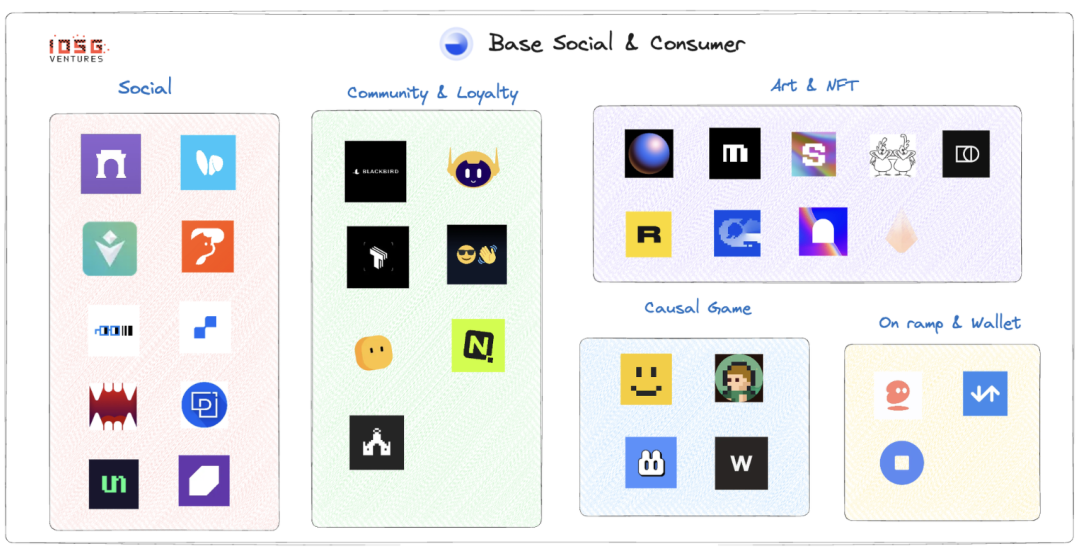
Base focuses on distinctive social and consumer applications as key traffic drivers to capture users. This article explores Base’s social and consumer application ecosystem, categorizing popular projects into areas such as social/community platforms, user loyalty programs, art & NFTs, and casual games, while providing overviews of select projects.
-
Summary: Due to regulatory compliance requirements, it is unlikely that Base will issue its own token. Nevertheless, it has achieved ecosystem prosperity without relying on token incentives. With solid infrastructure, Base's consumer and social applications hold strong potential to onboard new users and achieve mass adoption.
Background: The Cancun Upgrade and EIP-4844 – A Major Reduction in L2 Fees
The successful completion of the Cancun upgrade has significantly benefited Layer 2 (L2) networks. The most impactful component of this upgrade for L2s is EIP-4844, which introduces a new data storage structure called "blobs." Blobs are specifically designed to store transaction data submitted by L2s to Layer 1 (L1). After implementation, L2 transaction data is directly stored in blobs, fully downloadable by consensus nodes and deletable after a short delay—reducing unnecessary long-term storage burdens. This results in dramatically lower transaction fees on L2s. Additionally, blobs effectively expand block space for L2s, significantly increasing transaction throughput. EIP-4844 serves as an interim upgrade paving the way toward full Danksharding—the final phase of Ethereum’s "Surge" roadmap.
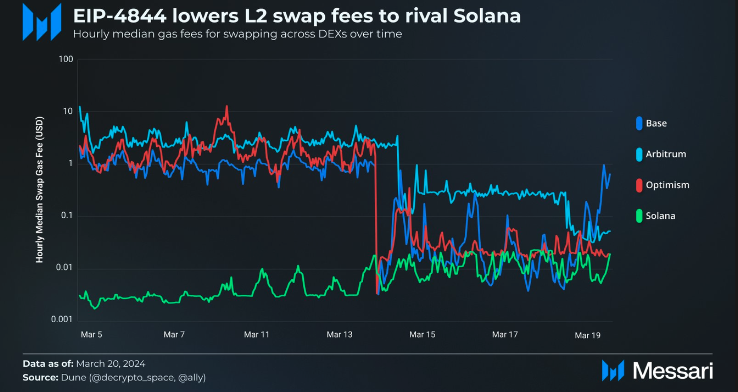
On Ethereum’s mainnet, data availability is provided via calldata (data generated during contract calls). All data sent back from L2 to L1 was previously stored in calldata, and because every step requires gas for security reasons, this led to high gas costs. However, once verified, calldata serves little further purpose—historical data can be downloaded when needed and does not need to reach the execution layer. Before the Cancun upgrade, nearly 80% of transaction costs on Optimism-based chains came from L1 data fees. For example, on Base, swap transaction fees dropped from $0.59 to $0.01 post-upgrade—just 1.6% of the original cost—while send transaction fees fell from $0.178 to $0.003, or about 2% of prior levels. Thanks to EIP-4844, Base’s fees during low network congestion now rival those of Solana.
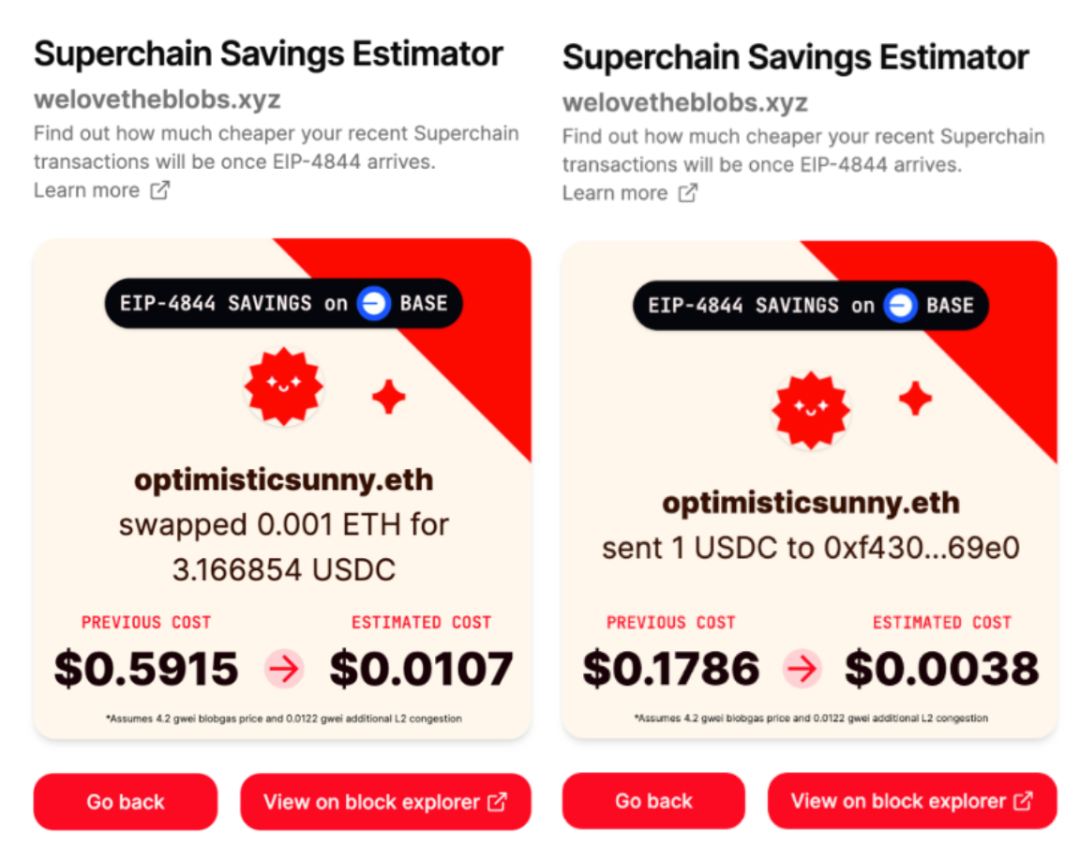
source: welovetheblobs.xyz
With L2 gas fees sharply reduced, Base has experienced substantial growth in total value locked (TVL) and on-chain activity (the green dots in the chart mark Base’s mainnet launch and blob adoption timeline). Over the past thirty days, on-chain interactions exceeded 64 million. Its TVL has surpassed $500 million, reaching an all-time high and ranking third among L2s after OP and Arbitrum.
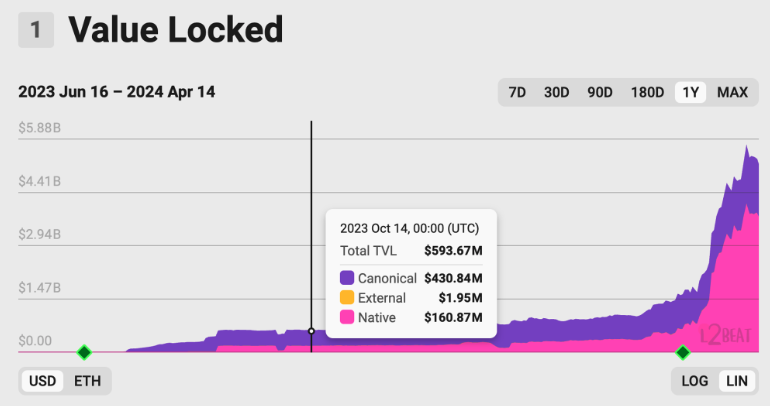
Source: https://l2beat.com/scaling/projects/base
Comprehensive Support from Coinbase
As an L2 developed by the Coinbase team, Base benefits uniquely from being backed by the largest publicly traded U.S. exchange. One of Base’s greatest strengths lies in leveraging Coinbase’s massive user base and deep asset reserves. Essentially, Coinbase only needs to build a bridge connecting Base with its exchange and wallet ecosystems. On March 27, Coinbase Vice President Max Branzburg announced on social media: “Going forward, Coinbase will store more corporate and customer USDC balances on Base. This enables us to manage and safeguard customer funds with lower fees and faster settlement times, without compromising the user experience. Coinbase is excited to continue moving operations on-chain and hopes other companies follow our lead.”
Recently, Coinbase Wallet launched an Account Abstraction (AA) wallet (http://smart-wallet.xyz), allowing regular users to create accounts easily using mobile devices, computers, Touch ID, or Google accounts—without complex procedures. Users can also directly link their Coinbase accounts, laying a solid foundation for Base to attract large-scale users and capital.
Coinbase Ventures is also highly active within the Base ecosystem, with many portfolio projects choosing to build on Base. The Base Foundation actively invests in and incubates dozens of projects across various sectors including social apps and DeFi. Leveraging Coinbase’s industry standing and the network effects of Coinbase Ventures, numerous Base-based applications have attracted strong interest from Tier-1 investors. Projects like Farcaster and FriendTech have received backing from renowned firms such as Paradigm, a16z, Multicoin, Dragonfly, Variant Funds, and 1confirmation—all of which are actively investing in the Base ecosystem.
Superchain Strategy: A Win-Win Partnership with OP
The “Superchain” refers to a network of L2 chains. The OP Chain is one individual chain within this Superchain. Any chain formally governed by the Optimism Collective, regardless of specific attributes, is considered an OP Chain and thus part of the Superchain—sharing security, communication layers, and open-source tech stacks. Unlike traditional multi-chain designs, OP Chains are standardized and designed as interchangeable resources, enabling developers to build applications targeting the entire Superchain while abstracting away the underlying chain running the app.
Base and OP have formed a strategic win-win partnership:
-
Base commits to contributing 2.5% of its sequencer revenue to OP, or 15% of its total profit if that exceeds 2.5%.
-
In return, OP allows Base to participate in ecosystem development and grants it the “opportunity” to receive 2.75% of the total OP token supply.
Built on the OP Stack, Base currently has its sequencer operated by Coinbase, with plans to gradually decentralize. According to DefiLlama data, Base ranks second among L2s in daily revenue, trailing only Arbitrum.
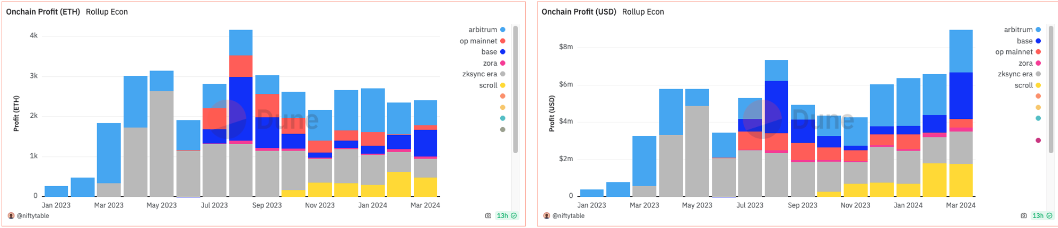
Source: https://dune.com/niftytable/rollup-economics
In the short term, this collaboration helps integrate Optimism Mainnet, Base, and other L2s into an initial Superchain structure with shared bridging and sequencing. More L2s are expected to join the Superchain ecosystem in the future. In the long run, the Superchain could evolve into a vast network that maximizes interoperability, shares decentralized protocols, and standardizes core primitives—facilitating chain abstraction and fluid movement between ecosystems.
Farcaster-Led Sustainable Social Universe
Farcaster is a decentralized social networking protocol enabling direct connections between users. Developers can access public data permissionlessly, supporting diverse and flexible client and application development, encouraging innovation and experimentation, and offering users rich social experiences and choices. Farcaster manages user identities on Ethereum and OP chains but stores messages and posts off-chain in a Hub network to improve speed and reduce costs. As an open social protocol, Farcaster supports the creation of various applications built atop it. Currently, Warpcast is the most popular Farcaster client. Frames—a newly developed feature akin to embedded mini-apps—allow developers to embed interactive experiences directly within Farcaster posts (casts). These interactive features range from voting and minting NFTs to building games and even integrating instant checkout links into social feeds, meeting diverse platform needs.
As a core component of the Base ecosystem, Farcaster has spawned numerous derivative products such as Paragraph (a creator platform), Jam (a content monetization client), Bountycaster (a community task platform), and Neynar (developer tools).
Source: @vahidsuperstar
Beyond top-down project development, Farcaster fosters a vibrant meme culture and wealth-generation effect, playing a crucial role in attracting users and enriching the ecosystem. Take $Degen, Base’s leading meme coin, as an example—it has evolved beyond a simple meme to become a pivotal element in Base’s social ecosystem. Initially launched on Farcaster’s /degen channel through an airdrop to active participants, $Degen gained widespread attention following Farcaster’s introduction of Frame functionality and Warpcast’s open registration in February. The first airdrop distributed 15% of the total supply, and users can still earn rewards by providing liquidity on Uniswap, participating in meme contests on Farcaster, or receiving tips. The team raised 490.5 ETH in a seed round led by 1confirmation, with angel investors primarily consisting of Ethereum OGs. According to the team’s website, Degen has also launched its own L3 with $Degen as the base token. $Degen currently has a market cap of $1.24 billion.
A notable emerging trend is that many new Base ecosystem projects are adopting $Degen as a functional token, leveraging its large holder base for cold starts. For instance, perl_xyz rewards everyday gamers with $Degen, allowing them to deposit/withdraw or convert $Degen into $perl within the app, and has received a 10 million $Degen ecosystem grant. DrakulaApp, dubbed “Web3 TikTok” or “video FriendTech,” received a 20 million $Degen incentive to reward creators on its platform, with each creator’s price quoted in $Degen. Superfluid_HQ developed a framework called StreamYoink, also using $Degen for payments. BracketHQ is a sports betting game where users trade votes for teams across leagues like NFL, NBA, and NCAAB. http://Rounds.wtf, initiated by Nouns, also uses $Degen as its token.
As Base and Farcaster continue to grow, $Degen is clearly evolving from a meme into an indispensable part of the social graph. A healthier meme culture will further support the ecosystem’s long-term sustainable development.
Other Social Products: Numerous Innovative Experiments
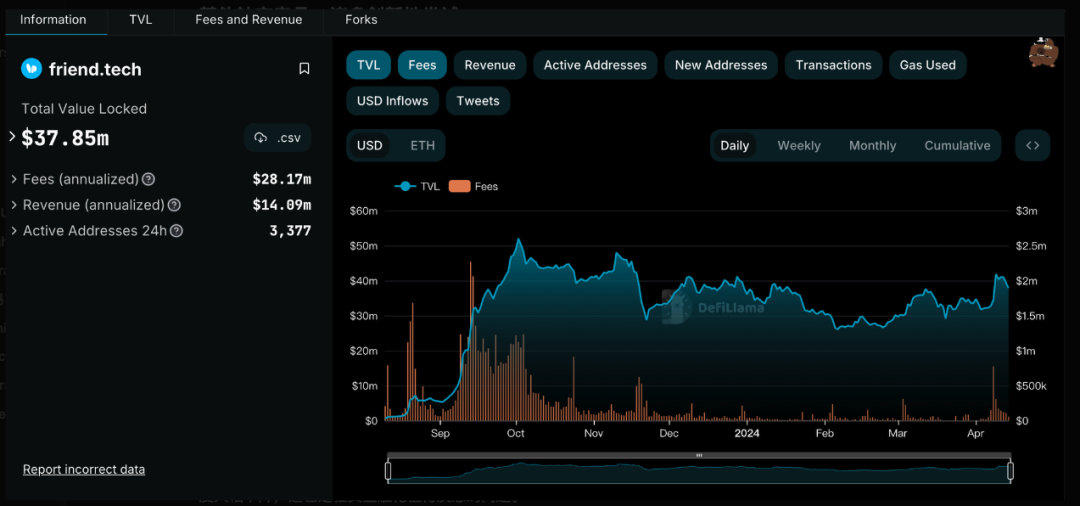
Beyond Farcaster, Base hosts many innovative social product experiments. Friend.Tech, for example, gained nearly $30 million in transaction fees over the past six months and maintains a TVL close to $40 million. Friend.Tech is a decentralized social app built on Base that combines fan economy mechanics with on-chain speculation. Users buy “KEY” tokens to enter specific rooms and view content. As more keys are purchased, the price increases, and transaction fees are split evenly between the platform and room owner.
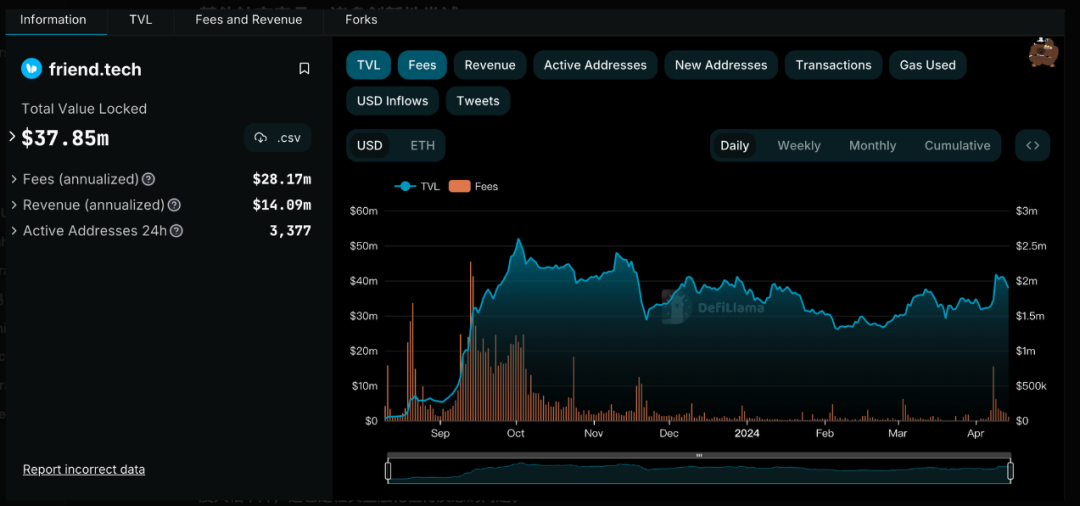
Due to high fee friction, heavy speculation, and suboptimal user experience, FriendTech’s trading activity declined significantly for a period—an important lesson on the risks of over-financializing social interactions.
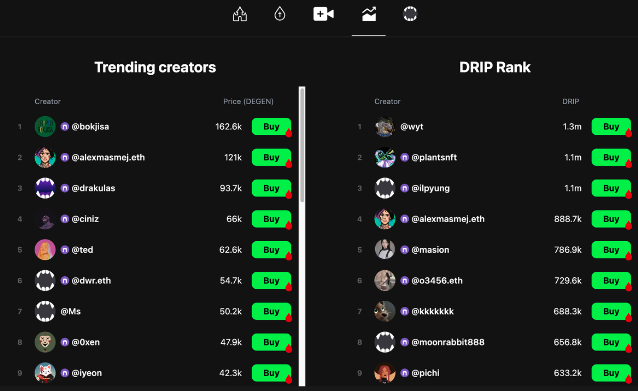
Recent trending projects include Web3 TikTok Drakula and live-streaming platform Unlonely. Drakula is a Web3 short-video platform where users can upload videos or watch others’ content. Platform points called “Drip” are earned by creating videos, sharing referral links, completing tasks, or buying other creators’ tokens, and can also be used to tip creators. Similar to FriendTech, each creator has their own token priced in $Degen—the more popular the creator, the higher the token price. Users can browse top creators based on token prices and tip amounts.
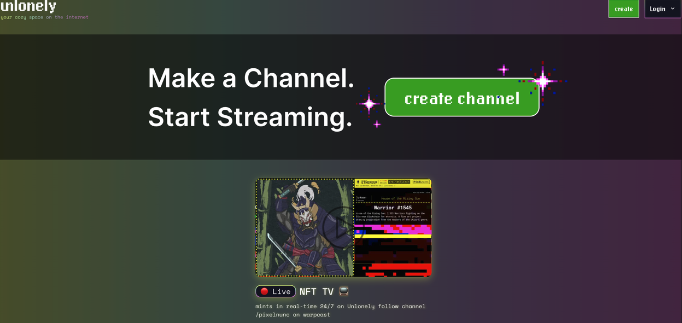
Unlonely is a Web3 live-streaming platform where users can create their own channels or watch others stream. The platform’s token is $VIBES, used for tipping. Users can view upcoming events on Unlonely’s calendar, search for streamers, and watch replays.
Community Management and User Loyalty
Alongside social apps, community management and user loyalty platforms are also developing rapidly. Blackbird, a loyalty and membership platform that raised $24 million, aims to deepen relationships between restaurants and their most loyal customers. Blackbird allows patrons to create NFT memberships for their favorite restaurants. These NFTs unlock rewards such as earning $FLY tokens, concierge SMS services, and “kitchen surprises” during meals—offering diners new engagement and value. Blackbird is decentralizing restaurant loyalty programs, enabling users to earn points not confined to a single system. Users can then freely trade $FLY tokens and accumulated NFTs on-chain. This system offers customers more flexible and valuable rewards, marking a shift from traditional loyalty models.
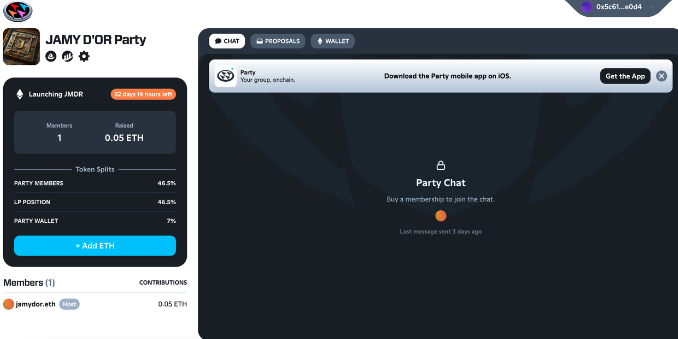
Projects like QuestN assist with advertising and promotion—projects can publish tasks and tests via QuestN to improve outreach, enhance user understanding, and provide reward mechanisms. PartyDAO is a community crowdfunding platform where users can propose projects, raise funds, and discuss ideas with interested builders in forums to drive development.
-
NFTs and Art
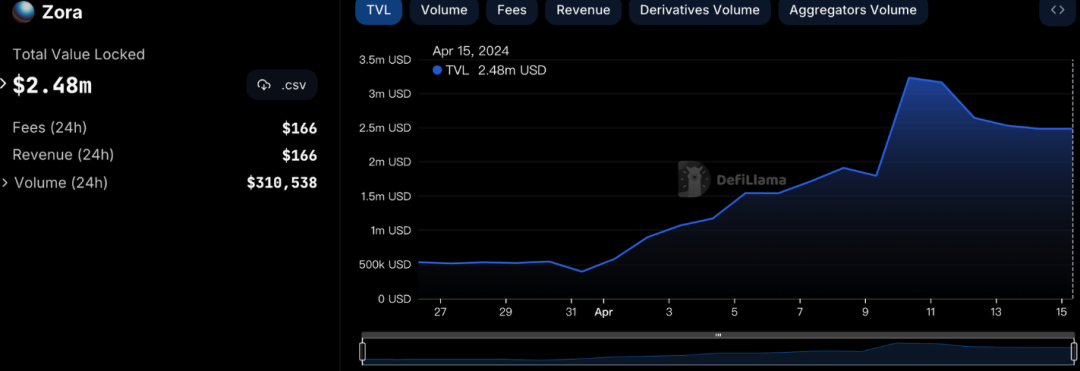
As Jesse, head of Base, stated: “Onchain is the next online.” Base is committed to bringing art and creative content on-chain. Zora, an NFT creation and issuance platform, provides creators with powerful tools and operates its own chain. Benefiting from Base’s vibrant ecosystem, Zora has seen clear growth in TVL. Creators can also choose to mint projects on platforms like Manifold and Rarible. Base’s NFT trading volume has grown noticeably over the past two months, averaging hundreds of thousands to over a million dollars daily, with nearly 10,000 unique transacting addresses per day.
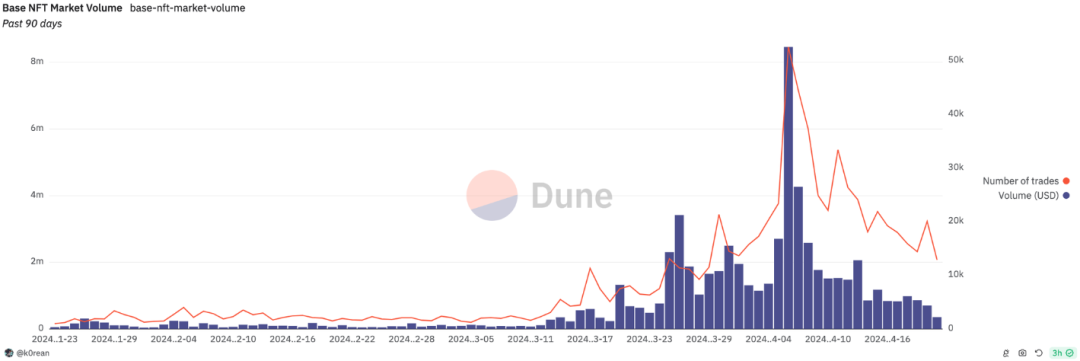
Source: https://dune.com/k0rean/base-nft-market
-
Casual Games
Unlike other blockchains focused on 3A/high-TPS gaming, Base appears more interested in mobile-first casual games. Frenpet, for example, is a digital pet game built on Base. Players purchase FP tokens to buy items and earn points by feeding pets and battling others. Higher points lead to better leaderboard rankings and ETH rewards. For distribution, Frenpet uses an invite-only model to generate viral growth—referrers earn 10% of all FP spent by invitees inside the app, achieving zero-cost user acquisition and activation. Thus, the game is sometimes called “FriendTech-style GameFi.” A 4% fee is charged on FP trades: 2% goes to players, 1% to the team, and 1% to LPs. The game currently has around 8,000 cumulative users, with the Fren Pet token valued at $70 million.
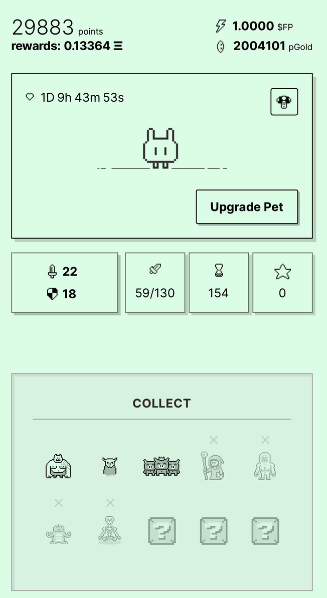
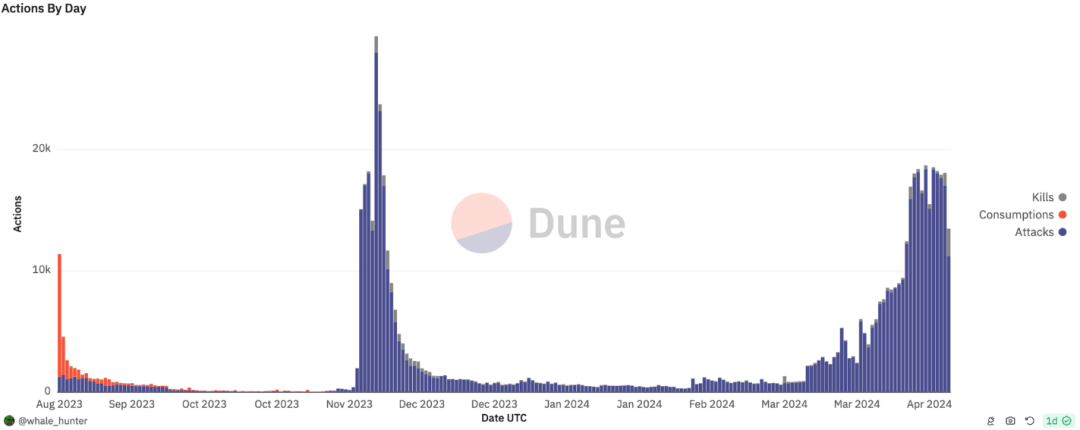
Source: https://dune.com/whale_hunter/fren-pet
Sofamon, a Telegram sticker financialization platform, is currently building a personal chat sticker marketplace on Telegram. Users can manage sticker packs, invite friends, and access Sofamon’s private group chats. Similar to Friend.Tech, each sticker has a bonding curve—earlier buyers pay less, and later entrants push up prices, allowing early holders to profit upon selling. Shortly after launch, Sofamon reached nearly 7,000 ETH in trading volume, with protocol revenue approaching 300 ETH.
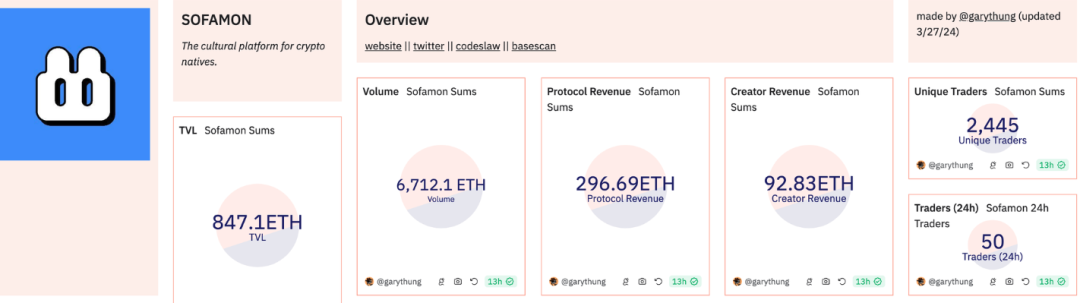
Source: https://dune.com/garythung/sofamon
-
On-Ramps and Wallets
Most consumer and social apps place strong emphasis on lowering user onboarding barriers, making meaningful improvements to user experience. Privy, a wallet solution that raised $18 million, aims to resolve the tension between poor multi-wallet UX and privacy risks in integrated login systems. Privy allows users to log into Web3 apps using traditional accounts like Google or Apple ID, automatically generating a crypto wallet address—greatly reducing entry friction.
-
Meme
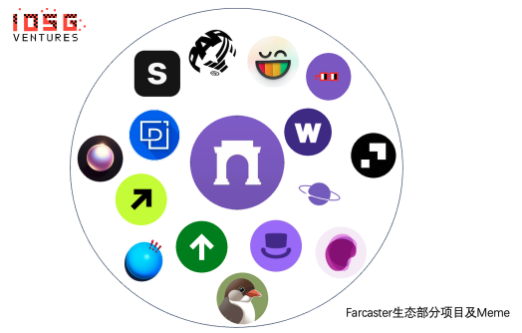
Memes have become an integral part of social and consumer applications. The current state of memecoins remains controversial due to their gambling-like mechanics. Yet mimicking online behaviors is a widely popular form of internet entertainment. Airdrops from Farcaster channels have birthed several memecoins with market caps exceeding tens of millions of dollars, whose subsequent spread and development feed back into the broader social ecosystem, increasing user activity. It is evident that memes have become a vital tool for launching communities and projects.
As Blockchain Capital analyst Kinjal Shah noted: “Although still in early stages and far from final form, a toolkit for Web3 creators is gradually emerging. Mechanisms like points and airdrops reward protocol usage. We still have much room to mature in airdrop design—for example, improving whitelists and vesting mechanisms, which could lead to more nuanced reward systems. Growth can be further driven through existing communities, on-chain referral rewards, and ‘social proof tokens.’” Pantera partner Paul Veradittakit also expressed enthusiasm for memecoins: “I’m certain memecoins aren’t going away. I see the next generation treating memecoins as a fascinating social activity. While they may look like toys, they’re crypto’s Trojan horse—the simplest path for the next generation to experience cutting-edge DeFi apps and enter Web3.”
Conclusion
Social and consumer applications are undoubtedly the most promising avenue for achieving mass blockchain adoption. Based on current developments, we believe the Base ecosystem is leading the pack. The Cancun upgrade has drastically reduced L2 fees, nearly eliminating gas friction and greatly lowering user interaction costs—perfectly meeting the high-interaction, low-gas demands of consumer applications. Several apps have already achieved substantial revenue solely from transaction fees. As an L2, Base possesses unique advantages and community appeal, positioning it well to attract massive new user bases and achieve mass adoption. An increasing number of users are expected to join the Base ecosystem, inching closer toward the goal of mainstream Web3 adoption.
Join TechFlow official community to stay tuned
Telegram:https://t.me/TechFlowDaily
X (Twitter):https://x.com/TechFlowPost
X (Twitter) EN:https://x.com/BlockFlow_News
 IOSG Ventures









