AirPuff Points Maximization Guide: How to Leverage for Higher Expected Returns
TechFlow Selected TechFlow Selected
AirPuff Points Maximization Guide: How to Leverage for Higher Expected Returns
Airpuff will integrate a new vault, launch more on-chain projects, and release the $APUFF token.
 Navigating Web3 tides with focused insights
Authors: THOR AND HYPHIN
Translation: TechFlow
Introduction
In current DeFi activities, leveraging exposure to farm airdrop points is likely the optimal strategy. Participants in Ethena's first season received returns of 100–500%, depending on their leveraged exposure to Ethena "shards." Many anticipate similar rewards from Eigenlayer and its LRT ecosystem, with EIGEN points currently valued between $0.2 and $0.4. One way to gain exposure to these point farming opportunities is through Airpuff.
Airpuff is a multi-chain money market that provides leveraged exposure to point farming projects such as Eigenlayer, Renzo, Etherfi, Kelp, and Ethena. Users can obtain up to 12.75x leverage on points or earn over 50% APY by lending assets. Airpuff is preparing for the $APUFF TGE, with the Foundry LBP running until 12:00 UTC on April 11. Today’s report will break down the Airpuff protocol, the $APUFF token, and conclude with specific strategies and projected returns.
Leveraged Airdrop Farming with Airpuff
At its core, AirPuff consists of two key components that work together to enable leveraged point farming.
1. Lending
All lending operations are executed through lending pools, which allow depositors to earn high yields across multiple networks by providing liquidity to the platform.
Deposits incur no fees, but a fixed 0.2% fee is charged when withdrawing assets from the lending pool.
Interest earned on provided assets is determined by the utilization rate of the collateral pool, meaning it fluctuates continuously based on demand. Accrued interest is snapshotted hourly and compounded into the value of lent tokens, enabling efficient compounding.
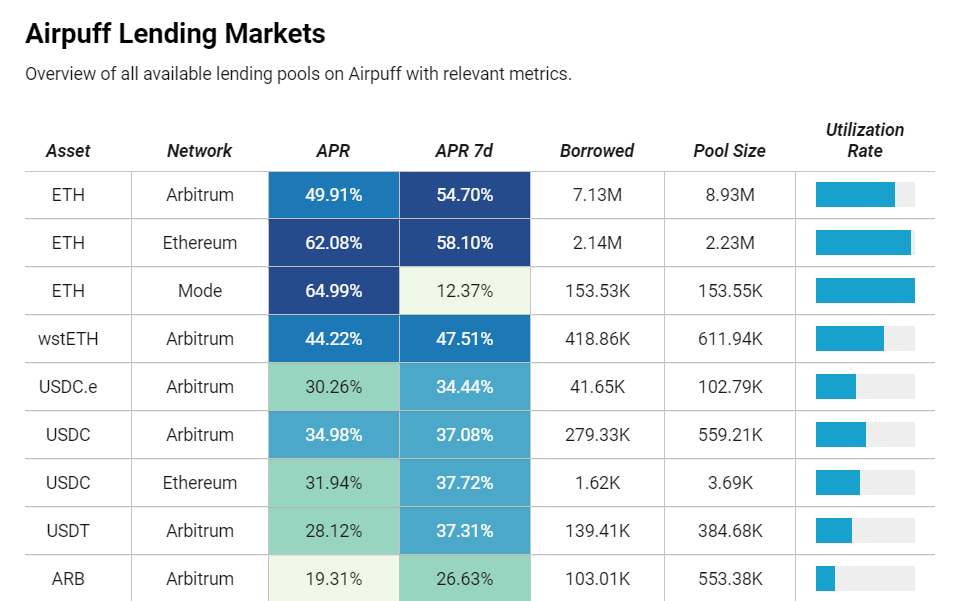
In most cases, ETH has high demand and offers the most attractive yield—mainly because borrowing non-ETH assets automatically converts collateral into ETH upon opening a position, effectively creating a long exposure and introducing additional price risk for borrowers.
An additional benefit of participating in the lending market is that users receive a share of all points generated from the use of their collateral.
According to WhalesMarket data, liquidity providers have collectively earned approximately $77,000 in points across all lending pools.
Borrowers also qualify for AirPuff points rewards based on the specific asset provided (with higher rewards for ETH and stETH), duration, and amount supplied.
2. Airdrops
Users can amplify their airdrop rewards using the protocol’s native boosting strategy called Buffs.
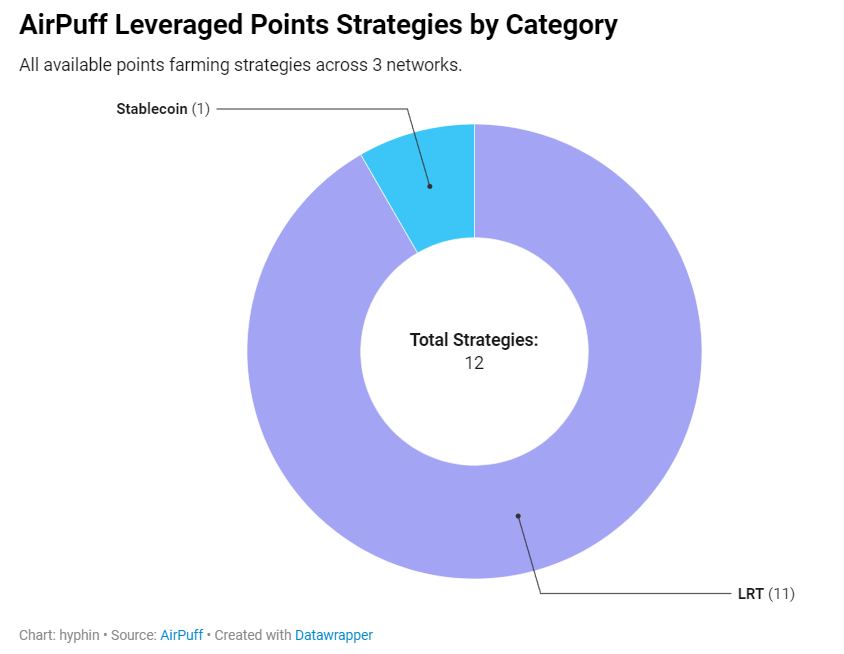
Currently, there are 12 different buffs available across three distinct networks. Most strategies are tied to LRTs that offer EigenLayer points, along with native protocol incentives. However, some include additional unique ecosystem rewards (e.g., Mode points for strategies on Mode).
Depending on the strategy, users can utilize various collateral options to maximize potential rewards from farming activities—including AirPuff—with leverage reaching up to 15x. When borrowing any asset, be mindful of above-normal interest rates and the added complexity of using non-ETH collateral.
10% of all points earned from leveraged positions are distributed to lenders, and an additional 5% goes to veAPUFF holders. Closing a position also incurs a fixed 0.2% fee.
For more risk-averse participants, non-leveraged airdrop farming options are also available, while still benefiting from platform rewards and incentives.
Projected Returns
To illustrate the potential returns of this strategy, let’s examine rsETH, a liquid restaking token from Kelp. The image below shows the vault on Airpuff. Although it is nearly full now, capacity is likely to increase in the future.
In this example, 5 ETH is used as collateral to borrow wstETH at 10x leverage. Each cycle then converts wstETH into rsETH. Since Airpuff allocates a portion of points to veAPUFF holders and lenders, the effective points leverage is 8.5x. Interest rates for various assets are visible in the bottom left corner.
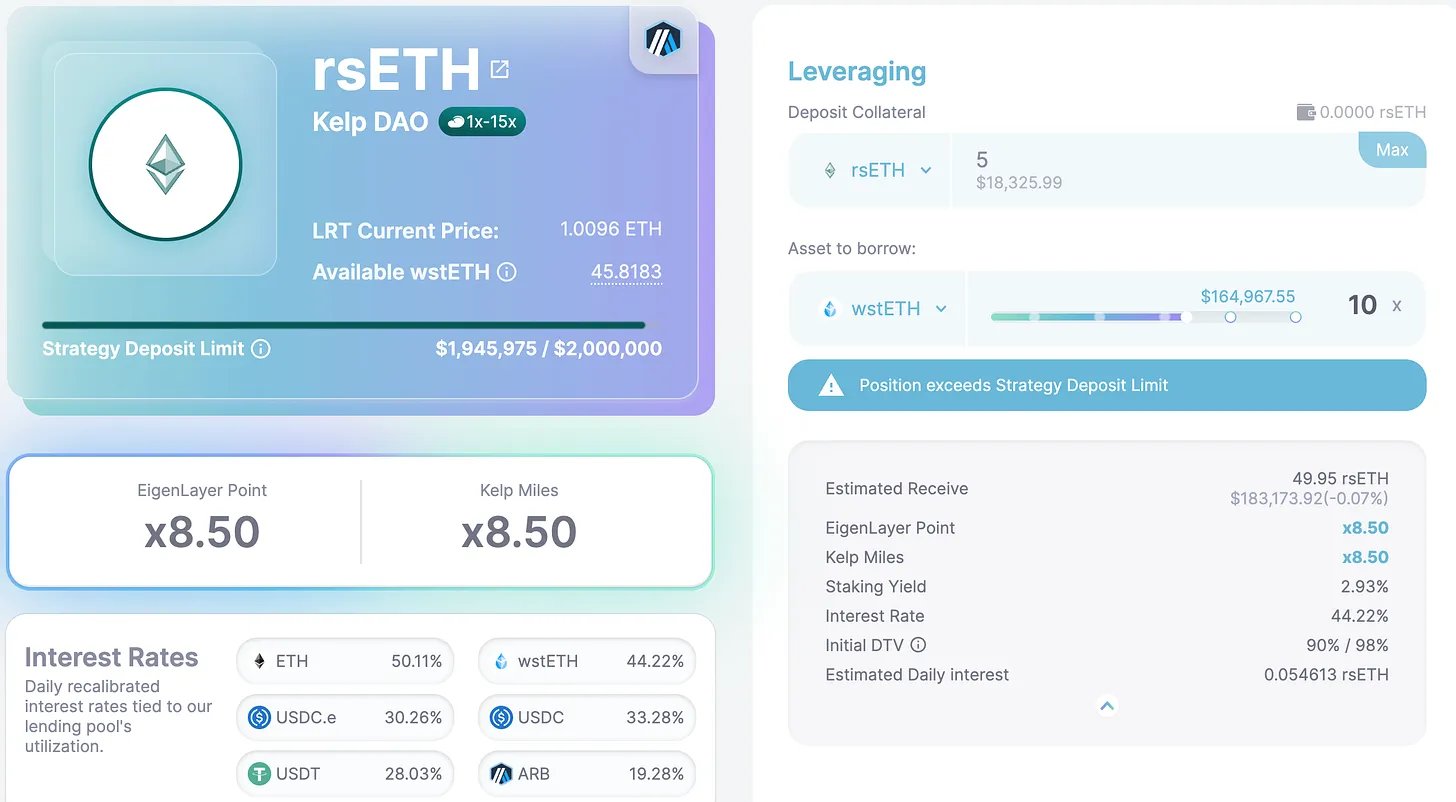
Below is the return calculation for this strategy. Eigen points and Kelp Miles valuations are based on predictions from another post regarding TVL and airdrop percentages and should be taken with caution (though these estimates lean conservative). As shown, by depositing 5 ETH with 10x leverage over a 30-day period while borrowing wstETH, the strategy yields a 16.94% ROI, equivalent to approximately 206% annualized yield. Keep in mind that many assumptions are involved, so actual returns may differ from estimates.
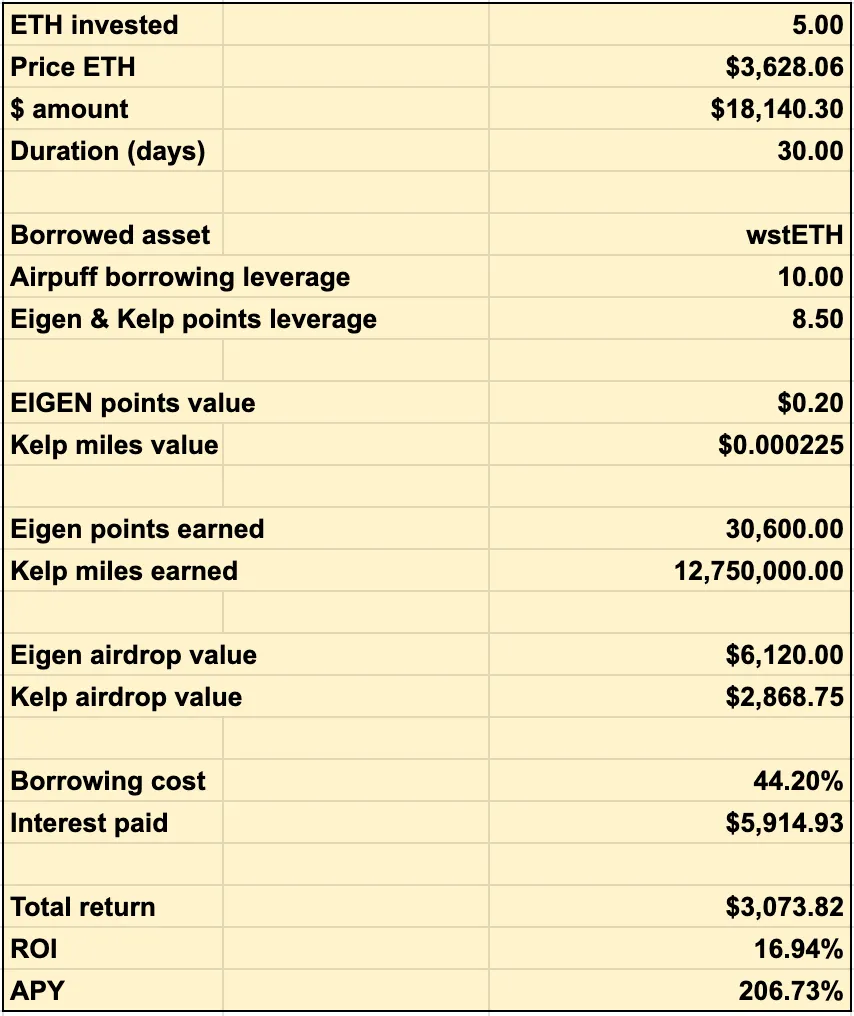
Since utilization rates across various markets exceed 80%, borrowing rates are currently very high, negatively impacting returns (nearly $6,000 in interest paid). More details below:
-
0–80% utilization: Rates increase linearly from 5% to 15%.
-
80–100% utilization: Rates increase linearly from 15% to 45%.
Given much lower borrowing rates, why not borrow in USDC or ARB? Because doing so introduces significantly higher liquidation risk. If rsETH loses value against USDC or ARB, you could be liquidated and lose your entire deposit. Liquidation risk increases with leverage. Borrowing wstETH carries much lower risk since both track ETH, though you could still be liquidated if rsETH depegs. Below is a comparison of returns when borrowing ARB versus wstETH:
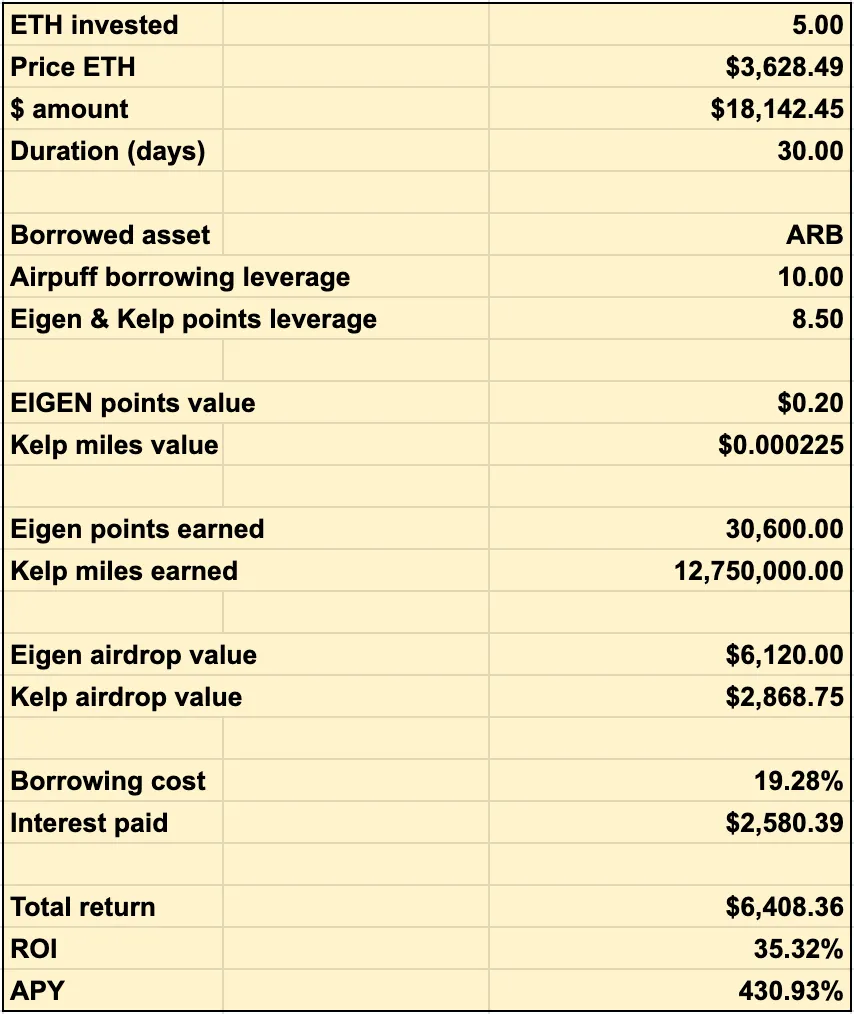
As seen, returns are higher. However, note that liquidation risk is also significantly greater.
TGE & $APUFF
Early depositors on Airpuff earn not only base points from Eigenlayer and LRTs but also “Airpuff Points,” which will convert into a $APUFF airdrop in May. A total of 7% of the $APUFF supply will be distributed to protocol users over two seasons—4% in the first season and 3% in the following season. For more information on eligibility, visit this page.
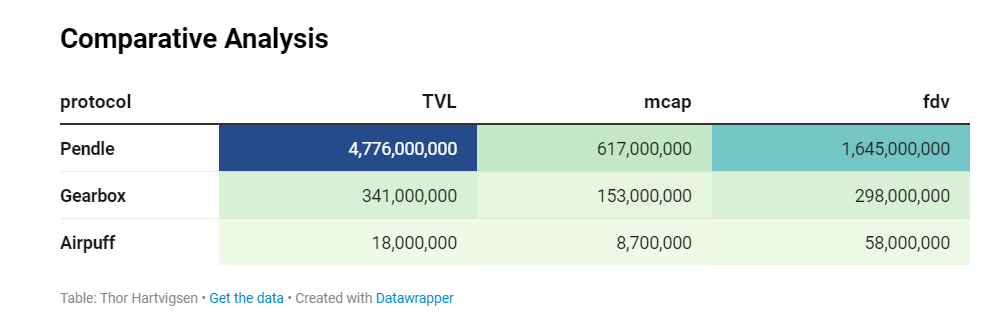
Additionally, the $APUFF Liquidity Bootstrapping Pool (LBP) is currently live on Fjord Foundry from 12:00 UTC on April 8 to 12:00 UTC on April 11. At the time of writing, Airpuff has raised $2.5 million worth of $APUFF in the LBP, resulting in a market cap of $8.7 million and an FDV of $58 million. Click here to access the LBP site:
Once the LBP concludes, the $APUFF token will launch. Initial circulating supply will be 16% (15% from LBP and 1% from private sale). Below are comparative metrics among Airpuff, Pendle, and Gearbox.
APUFF Tokenomics
Airpuff employs a dual-token model with $APUFF. Users can lock $APUFF to receive veAPUFF (similar to vePENDLE), granting them voting rights over token incentive distributions across various markets and earning bribes. These bribes come from protocols paying Airpuff to direct vault strategies and from direct revenue issuance as a means to promote protocol growth and adoption.
To further align token holders and qualify for $APUFF emissions, users must lock at least 5% of their holdings in veAPUFF. Finally, Airpuff takes a 5% cut from all points earned by lenders and borrowers (Eigen points, LRT points, etc.) and distributes it to veAPUFF holders, further enhancing the token’s utility.
Conclusion
2024 is the year of points trading, and Airpuff uniquely enables this through its money market and built-in leverage. In the coming months, Airpuff will integrate new vaults, launch projects on additional chains, and release the $APUFF token, expanding user access to a wide range of points farming opportunities.
Join TechFlow official community to stay tuned
Telegram:https://t.me/TechFlowDaily
X (Twitter):https://x.com/TechFlowPost
X (Twitter) EN:https://x.com/BlockFlow_News
 @hyphinlol