









The Case Within the 61,000 Bitcoin Scam: 130,000 Victims Defrauded, $6.3 Billion Involved, with a Mysterious Chinese Operator Pulling the Strings Behind the Scenes
TechFlow Selected TechFlow Selected
The Case Within the 61,000 Bitcoin Scam: 130,000 Victims Defrauded, $6.3 Billion Involved, with a Mysterious Chinese Operator Pulling the Strings Behind the Scenes
One case after another: where did the 61,000 bitcoins go?
 Navigating Web3 tides with focused insights
By Tuoluo Finance
Living in a luxury mansion with monthly rent as high as 155,000 RMB, traveling around the world in luxury cars or spending hundreds of thousands at high-end malls, with jewelry scattered everywhere, and purchasing not just one but multiple villas at once...
Judging solely from this description, it’s hard to imagine this lifestyle belongs to an ordinary British delivery worker. Yet, this is exactly what happened to Wen Jian, a Chinese-British woman. Without much thought, one can tell that such abnormal wealth must have a dark origin—and naturally, the police soon took notice.
On March 18, a UK court found 42-year-old Wen Jian guilty of money laundering. She will be sentenced on May 10. During the investigation, authorities seized over 61,000 bitcoins—worth approximately £3.4 billion ($4.3 billion) today—the largest single haul of cryptocurrency in history. The mastermind behind the case was involved in transactions totaling a staggering $6.3 billion, making this the biggest money laundering case globally.
Like all rags-to-riches stories that end in disaster, Wen Jian met who she believed to be her "benefactor." Had it not been for the UK police investigation, she might have continued living in the dream of sudden wealth and gratitude toward her savior. Sadly, instead of freedom, she now faces prison time—while her so-called benefactor has vanished without a trace. Unbeknownst to many, this dramatic “rich CEO falls for me” tale also ties back to a major financial fraud case in China seven years ago—the Lantian Gerui illegal fundraising scandal involving 43 billion RMB.
This nested case involving 61,000 bitcoins thus becomes even more complex and mysterious.
01 Case Origin: Meeting the 'Benefactor,' a Delivery Worker Suddenly Becomes Rich
Wen Jian's background is unremarkable—she even lived in poverty for much of her life. Born in 1982 into a working-class family in China, she later met her husband Marcus Barraclof. In 2007, pregnant and holding a spousal visa, Wen Jian moved to the UK.

Photo of Wen Jian, source: public network
But the small family quickly fell apart. Shortly after giving birth, Wen Jian divorced her husband and became a single mother struggling financially. Despite hardship, she didn’t give up—eventually earning a bachelor’s degree in law and economics in Leeds. In 2017, she relocated to London and lived in the basement of a Chinese takeaway restaurant in Abbey Wood, Southeast London, working as a delivery driver earning £5,979 annually (about 54,000 RMB)—a pittance for a single mother in the UK. To make ends meet, Wen Jian took on multiple odd jobs. Given her relatively high education level, she occasionally engaged in freelance work related to cryptocurrency.
The turning point came via a job posting. Wen Jian stumbled upon a WeChat advertisement seeking a “housekeeper” from a woman claiming to run international diamond and antique trading businesses—with a highly attractive salary. Without hesitation, Wen Jian contacted the mysterious recruiter.
That moment marked the emergence of Wen Jian’s future “benefactor”—Qian Zhimin (alias Zhang Yadi).
They met at the five-star Royal Garden Hotel in Kensington and hit it off immediately. Qian Zhimin quickly hired Wen Jian as her personal caretaker and housekeeper, offering a monthly salary of 30,000 RMB and bonuses reaching millions. As a display of wealth and trust, Qian paid Wen Jian 40,000 pounds on the very first day. Overnight, Wen Jian moved out of the basement and into a luxurious mansion in Hampstead with rent exceeding 150,000 RMB per month—her life of rags-to-riches had begun.
Her duties were simple: open cryptocurrency accounts to conduct transactions and keep records; and spend money on behalf of her employer.
According to Wen Jian, Qian Zhimin—who claimed to have suffered injuries in a car accident—had mobility issues, labored breathing, and poor health, spending over 20 hours a day in bed. She frequently woke up from nightmares and would then use her laptop to play games, shop online, and sell Bitcoin.
Soon, the two posed as jewelry traders, using aliases to travel across Europe, converting Bitcoin proceeds into high-end jewelry—including splurging over a million pounds at Van Cleef & Arpels. Funds flowed continuously through Wen Jian’s accounts into Qian Zhimin’s hands, and in return, Qian fulfilled her promises: Wen Jian enjoyed the affluent life she had always dreamed of. Her son was enrolled in Heathside Preparatory School next to their mansion, costing 6,000 pounds per term. Wen Jian bought a 25,000-pound Mercedes E-Class and became a VIP at Harrods, the luxury department store, where she spent over 90,000 pounds (about 810,000 RMB) on designer clothes, jewelry, and shoes within just three months.

The luxury home shared by Wen Jian and Qian Zhimin in the UK, source: public network
Beyond jewelry and daily expenses, real estate became another major expenditure. In Dubai, Wen Jian purchased an apartment for 500,000 pounds. In Italy, she won an auction for a historic seaside villa in Venice valued at 10 million pounds. Later, she acquired a London property worth 4.5 million pounds.
In 2018, when she attempted to buy a 7-bedroom mansion with a swimming pool in Hampstead for 23.5 million pounds (about 200 million RMB), along with a nearby 12.5 million pound (about 100 million RMB) property, the unusually large real estate purchases caught regulators’ attention. Under UK anti-money laundering regulations, authorities demanded proof of legitimate fund sources—but Wen Jian could not provide any. The transaction was ultimately canceled, raising red flags for the police.
02 Case Turn: Police Shatter the Dream, 61,000 Bitcoins Surface
On October 31, 2018, police executed a search warrant at Wen Jian and Qian Zhimin’s residence, seizing 69,000 pounds in cash, along with laptops, tablets, a pink USB drive, and private keys stored in metal cans. The next day, they discovered additional electronic devices hidden in a safe. However, possibly due to insufficient evidence at the time, neither woman was arrested. Half a year later, authorities even returned their passports.
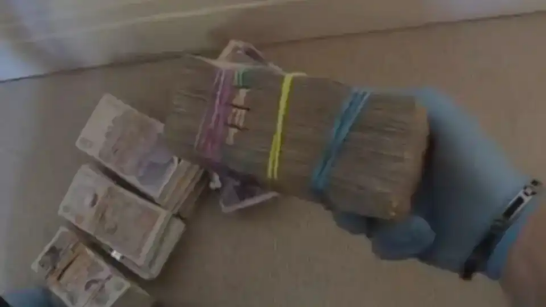
Cash seized by police from Wen Jian’s home, source: Phoenix News
After nearly two years of investigation, in 2020, police conducted another raid on the luxury home. One month later, sensing danger, Qian Zhimin disappeared from the UK.
In 2021, after three years of decryption efforts, UK police confirmed the devices contained over 61,000 bitcoins—the largest amount of cryptocurrency ever seized by British law enforcement. At the time, the stash was worth £1.4 billion (about 12.7 billion RMB); today, its value exceeds £3.4 billion (about 31 billion RMB).
In May 2021, Wen Jian was formally arrested. Surprisingly, during interrogation, she claimed complete ignorance of the funds' origins, saying she merely followed instructions. Initially, she insisted the cryptocurrency came from legal mining operations, later changing her story to claim it was a “love gift” from Qian Zhimin, whom she described as a wealthy businesswoman earning money through jewelry trading, real estate investment, and legitimate Bitcoin mining. In short, she portrayed herself as an innocent scapegoat.
Under these circumstances, Wen Jian’s first trial in 2023 resulted in acquittals on 10 of 12 charges, with two undecided. However, subsequent investigations revealed she controlled one of three wallets holding illicit funds, indicating criminal intent. Thus, in the March retrial, Wen Jian was convicted of money laundering and classified as a high-risk Category A offender due to the massive sum involved. She awaits sentencing in May this year.
A fleeting dream shattered into prison tears. While Wen Jian’s story largely ends here, Qian Zhimin’s remains unfinished.
Where did the hundreds of billions of yuan in illicit funds come from? How did an ordinary middle-aged woman bring such vast wealth to the UK? All roads lead back to a seven-year-old case.
03 Case Conclusion: Revisiting a Seven-Year-Old Fraud, the Mysterious Woman Flees Again
In March 2014, Tianjin Lantian Gerui Electronic Technology Co., Ltd. was established with registered capital of 30 million RMB, officially engaging in electronic circuit design and product development. On the surface, the company appeared legitimate—but in reality, it operated a pyramid scheme under the guise of technology, falsely claiming Bitcoin mining side businesses and luring investors with promises of high returns.
Specifically, the company used slogans like “high returns,” “risk-free profits,” and “three generations of prosperity” to promote various so-called “short-term investment products” with terms ranging from six months to 30 months, minimum investments from 6,000 to 60,000 RMB, and guaranteed annual yields of 100%–300%. Through multi-level recruitment typical of pyramid schemes, Lantian Gerui rapidly expanded nationwide, establishing over 30 branches, primarily targeting elderly victims.
On August 17, 2016, Linghai Public Security Bureau detained more than 20 people suspected of illegal pyramid activities at a business hotel. These individuals were all employees of Lantian Gerui. Authorities realized the severity of the situation and determined the company was engaged in illegal fundraising, leading to the immediate criminal detention of then-General Manager Wu Xiaolong. Later, Lantian Gerui allegedly bribed investigators with 15 million RMB to secure Wu’s release on bail—a move that sparked widespread controversy.
In 2017, Lantian Gerui’s investment products collapsed, prompting formal police立案 (case registration). By 2019, 50 company personnel across different levels had been arrested, including the legal representative and general manager. Not until December 2022 did partial repayment begin. According to disclosures, the scheme defrauded over 128,000 investors of a total of 43 billion RMB.
Behind it all was Qian Zhimin (also known as “Huahua”), the actual mastermind. Throughout the case, however, she remained almost entirely invisible. From the start, she had planned ahead—appointing Ren Jiangtao as legal representative with a monthly salary of 26,948 RMB and a one-time bonus of 997,000 RMB, while instructing him to set up a Huobi account and assuring him she’d handle any legal issues.
Yet as soon as Ren Jiangtao was investigated by police, Qian Zhimin swiftly transferred the Bitcoin holdings and began her fugitive journey. Her escape route was meticulously planned: using a Myanmar passport under the name NAN YIN, she obtained a second passport from Saint Kitts and Nevis under the alias Zhang Yadi. From Myanmar, she fled to the UK, arriving in London in 2017.
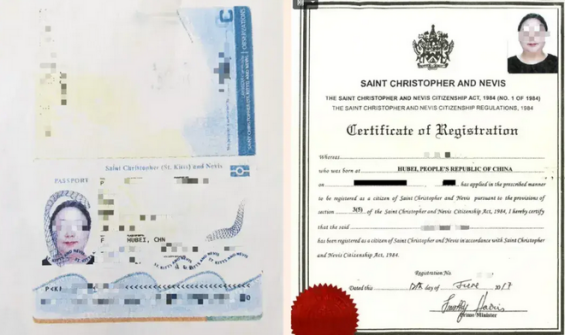
Qian Zhimin’s fake passport, source: public network
It is said that Qian Zhimin kept detailed notes in her personal journal outlining an audacious escape plan: buying citizenship in the micronation of Liberland, building Europe’s largest Buddhist temple there, and having religious leaders crown her as a reincarnated goddess and Queen of Liberland—to gain diplomatic immunity. After swindling billions, she aimed to become a deity. The entire scheme was astonishingly brazen.
Unable to speak English and in poor health, she decided to find an intermediary in the UK to manage the illicit funds. That’s when Wen Jian entered her radar. Being foreign-born, isolated, and financially desperate made Wen Jian easy to manipulate—likely why Qian chose her. As expected, just like Ren Jiangtao before her, Wen Jian unknowingly became complicit under temptation.
Even in daily interactions with Wen Jian, Qian Zhimin never let her guard down. All countries they visited lacked extradition treaties with China, and Qian never appeared in photos to avoid exposure—her counter-surveillance skills were top-tier. It’s no surprise she vanished every time trouble loomed. To date, Qian Zhimin remains at large and has been placed on Interpol’s Red Notice list.
04 Case Aftermath: Will the Fortune End Up in Someone Else’s Hands?
Looking at the full picture, while the main culprit remains at large—which is infuriating—the bigger concern lies in the distribution of the seized assets. Clearly originating from Chinese victims, this £3.4 billion fortune may ultimately end up in British hands.
Currently, the UK Crown Prosecution Service has initiated civil recovery proceedings in the High Court to determine if there are other legitimate claimants.If no claims are made, the entire sum will be confiscated—half going to UK police, the other half to the Home Office.
Cross-border asset recovery is extremely difficult. Individual claims are nearly impossible, and even with involvement from Chinese government agencies, judicial bodies, or police, success rates remain low. Historical precedents show few successful cross-border recoveries, especially involving cryptocurrencies, where ownership verification, valuation, and technical capabilities are still lacking—even within China, comprehensive handling mechanisms are absent. Although international asset sharing is standard practice, diplomatic coordination between China and the UK offers little hope for significant repatriation of funds.According to Caixin, based on current progress in the Lantian Gerui repayment process, less than 5% of domestic funds are expected to be recovered.
The only possible breakthrough is capturing Qian Zhimin. If both China and the UK cooperate as FATF members in recovering assets, China could gain greater share. But ethically speaking—and regardless of difficulty—for the UK, perhaps it's simpler if Qian Zhimin remains uncaptured. After all, a windfall of 31 billion RMB is a massive sum, even for a nation.
For those involved, it’s all been for nothing. No matter how cunning, most of the stolen money will eventually go to others. One wonders what Qian Zhimin—still on the run with a failing body and likely no happy ending—thinks now, or if she’s already searching for her next scapegoat. And where should the anger of 130,000 defrauded victims be directed?
For Wen Jian, now behind bars, fate played a cruel game—greed and desire stripped her of necessary caution. Whether she truly knew nothing about the origins of Qian Zhimin’s wealth or simply chose not to know may no longer matter.
Yet amid the sorrow, a warning stands clear: don’t become the next Wen Jian. Sudden wealth is tempting, but unexplained riches often lead straight to prison bars forged from chains and bloodshed.
Join TechFlow official community to stay tuned
Telegram:https://t.me/TechFlowDaily
X (Twitter):https://x.com/TechFlowPost
X (Twitter) EN:https://x.com/BlockFlow_News










