








Bankless: Is Chinese capital flowing into Bitcoin?
TechFlow Selected TechFlow Selected
Bankless: Is Chinese capital flowing into Bitcoin?
Bitcoin serves as an escape hatch from economic collapse, attracting Chinese investors.
 Navigating Web3 tides with focused insights
Written by: Jack Inabinet
Translated by: Kate, Mars Finance
Chinese investors are rushing to buy foreign assets—are they coming for your cryptocurrency?
Real estate panic! The Chinese market continues to underperform, prompting investors in the world's second-largest economy to flee and sell onshore assets, turning instead to seemingly uncorrelated hedge instruments. Where are Chinese citizens now storing their wealth, and could these capital flows impact your investment portfolio?!
Last year, outbound capital from Chinese businesses and households exceeded inbound flows for the first time in five years—and this trend is unlikely to reverse in the short term.
While broader risk markets performed well in 2023 and 2024, China’s CSI 300 Index—a benchmark comparable to the S&P 500—remains 40% below its February 2021 peak, a stark contrast to U.S. equities, which hit record highs earlier this year.
Meanwhile, China’s largest real estate developers teeter on the edge of default, burdened with trillions of dollars in debt, while Hong Kong has already begun liquidation proceedings.
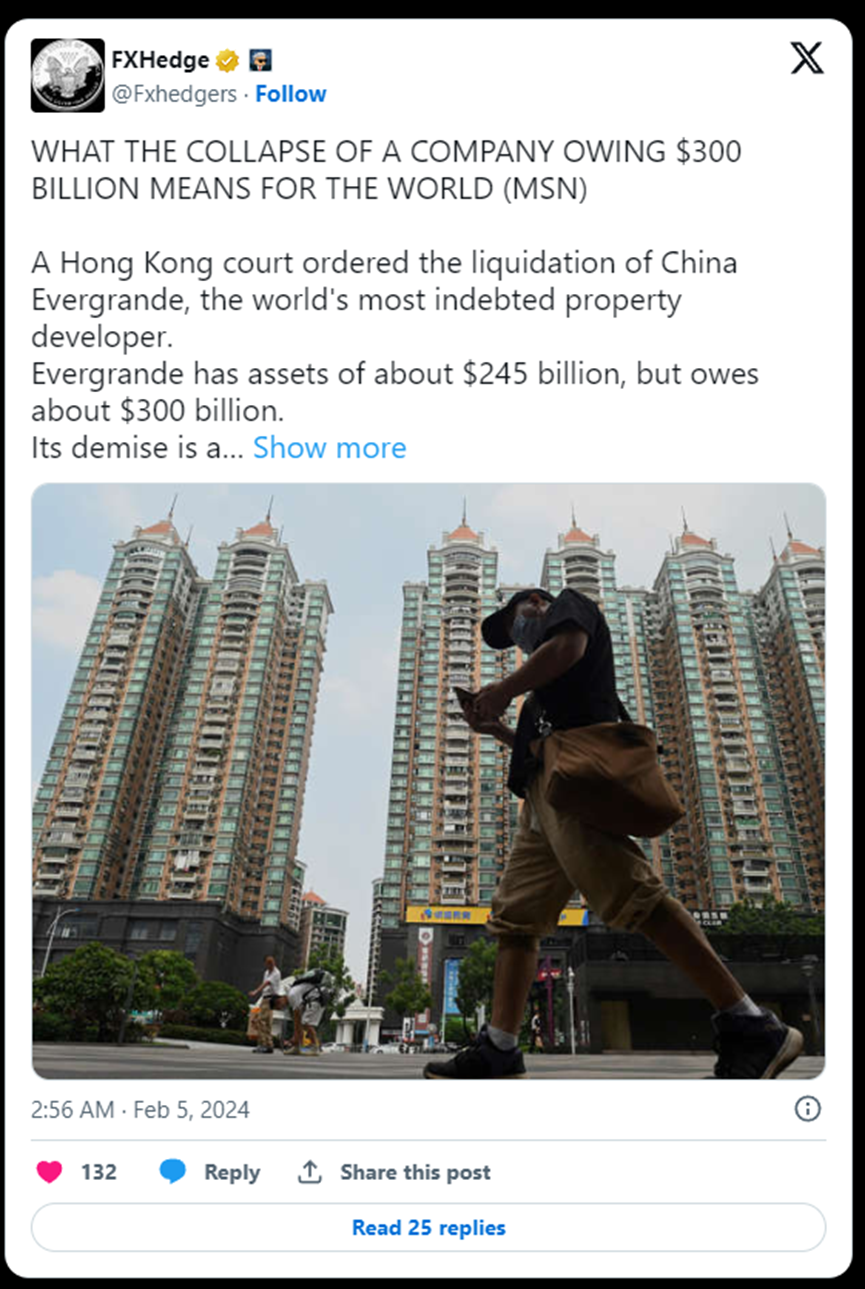
https://x.com/Fxhedgers/status/1754217483274264609
Despite the Chinese authorities’ best efforts so far to contain economic downturn, China still faces an inevitable deleveraging process.
Private real estate already accounts for 70% of Chinese household wealth. According to some estimates, developers hold enough unsold inventory to house an additional 3 billion people, making it unclear where future demand for property will come from.
Strict capital controls and regulatory frameworks make moving money out of China extremely difficult, restricting Chinese companies and individuals to only a few state-approved investment vehicles—but those seeking to divest still have some options.
Possibly sensing an imminent collapse in China’s real estate market, Chinese investors are now flocking to gold. As a proven store of value and globally decentralized commodity, gold has driven premiums on a popular gold ETF to as high as 30%, forcing trading halts.
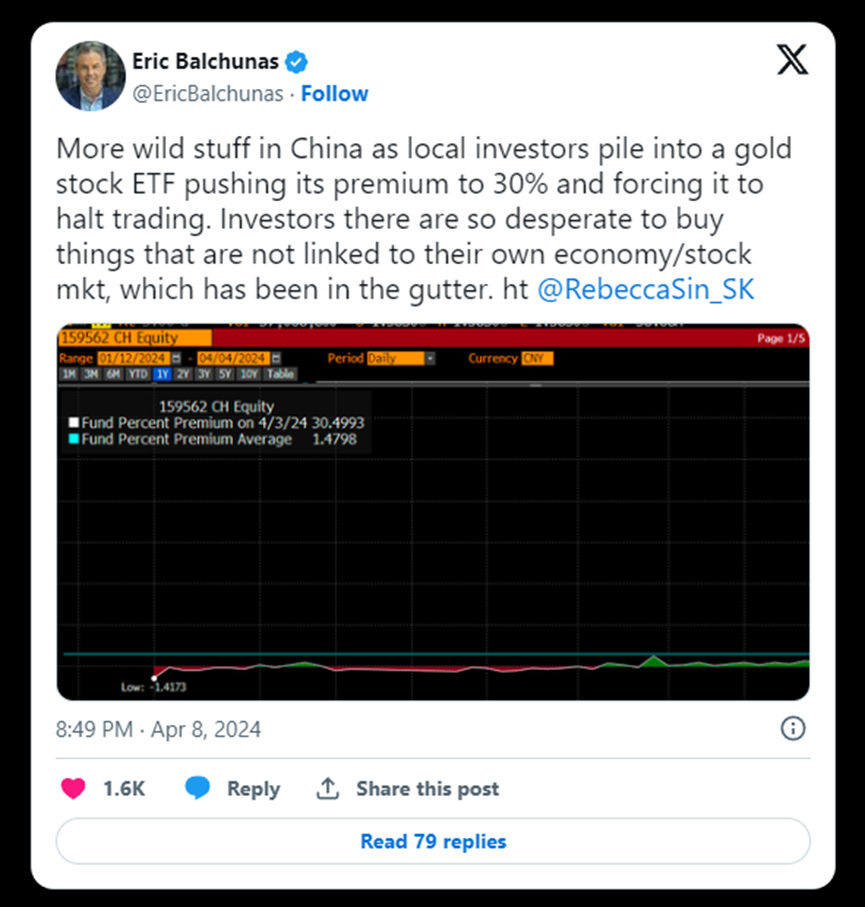
https://x.com/EricBalchunas/status/1777317832079921165
Although the Chinese government has historically made accessing cryptocurrencies extremely difficult, two subsidiaries of Chinese asset management firms recently announced they will apply to offer spot Bitcoin ETFs in Hong Kong, bringing the total number of applications to three.
The Hong Kong Monetary Authority (HKMA) and the Securities and Futures Commission (SFC) stated last year that they would accept applications for crypto-based ETFs. Although some restrictions will still apply to Chinese investors attempting to move funds into the semi-sovereign territory, approval of these products would open a direct channel for Chinese capital to flow into Bitcoin.
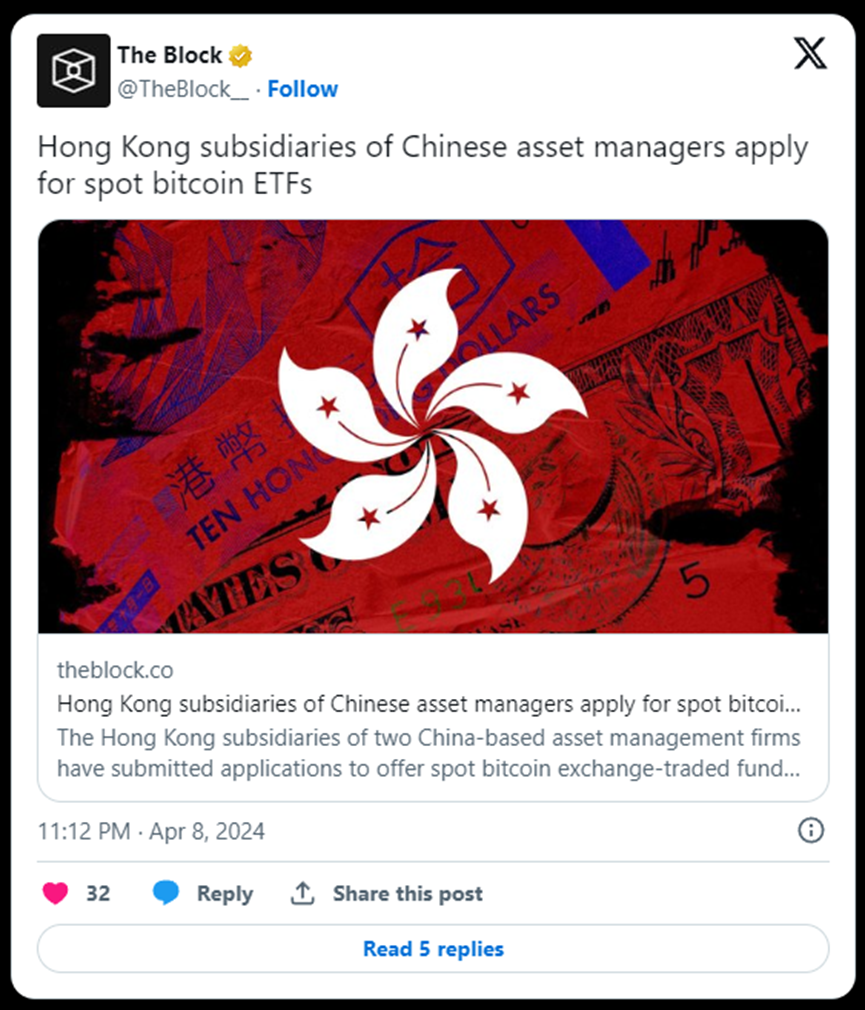
https://x.com/TheBlock__/status/1777353796642852930
Clearly, China is in trouble. One of Bitcoin’s primary purposes is to serve as an escape hatch during economic collapse—an especially attractive feature for investors heavily exposed to China’s real estate sector.
If the Chinese government chooses not to support developers through monetary stimulus, the shockwaves of deleveraging will almost certainly severely impact the global economy. Alternatively, if Beijing opts to print money to prop up developers, structural inflation would follow—creating a massive tailwind for Bitcoin prices.
Join TechFlow official community to stay tuned
Telegram:https://t.me/TechFlowDaily
X (Twitter):https://x.com/TechFlowPost
X (Twitter) EN:https://x.com/BlockFlow_News
 Bankless









