








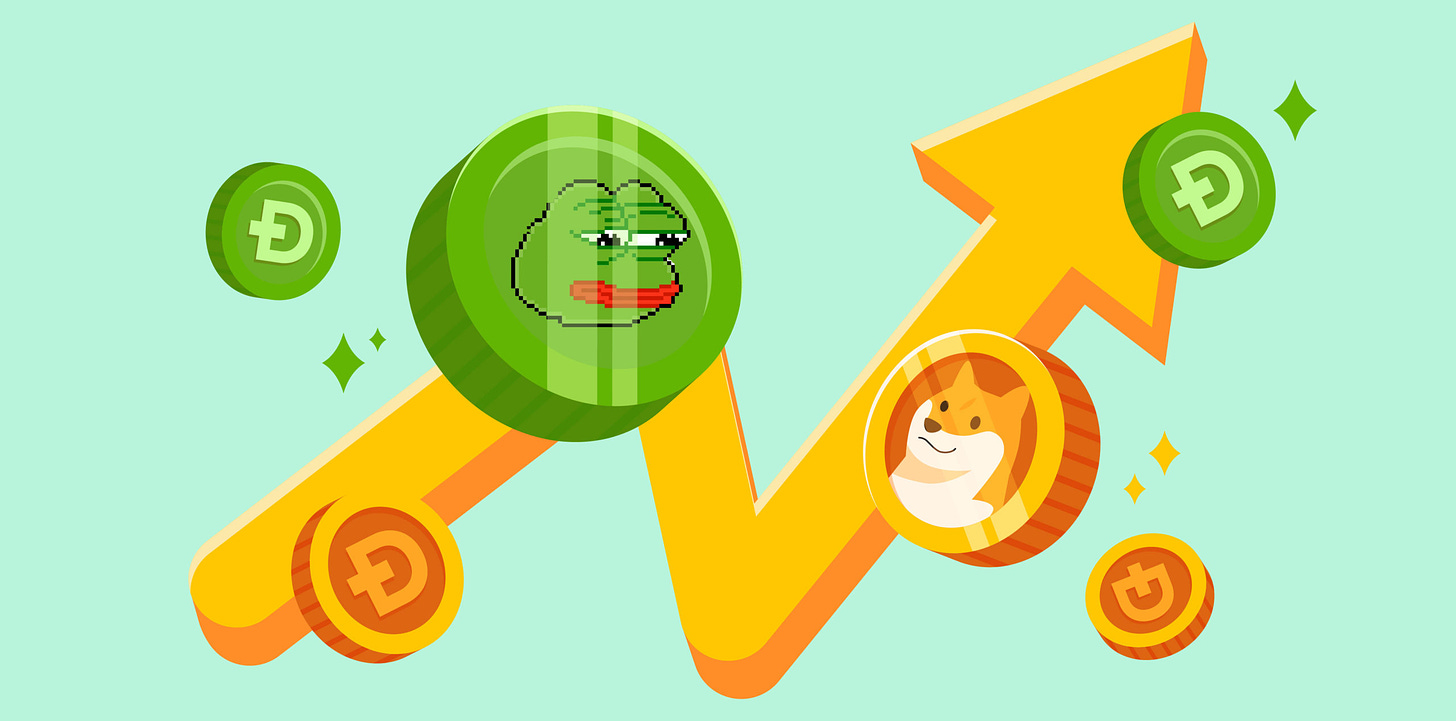
Meme Coins: Representing the Crypto Industry
TechFlow Selected TechFlow Selected
Meme Coins: Representing the Crypto Industry
If someone asks you what the crypto industry is, just tell them it's meme coins.
 Navigating Web3 tides with focused insights
By: Jennie Liu
Working in the crypto industry, one question I'm frequently asked by family and friends is: how exactly does this industry operate? Why would anyone pay for these seemingly intangible concepts floating in the air?
These are excellent questions—so good that sometimes I struggle to find a consistent answer. To outsiders, the industry remains clouded by biases of being "on the edge of regulation" and a "source of human greed." Yet its wealth creation myths continue to draw crowds like moths to flame. No wonder our parents and friends worry about what we do—and no wonder we often can't come up with a clear use case to justify or explain the crypto world we inhabit.
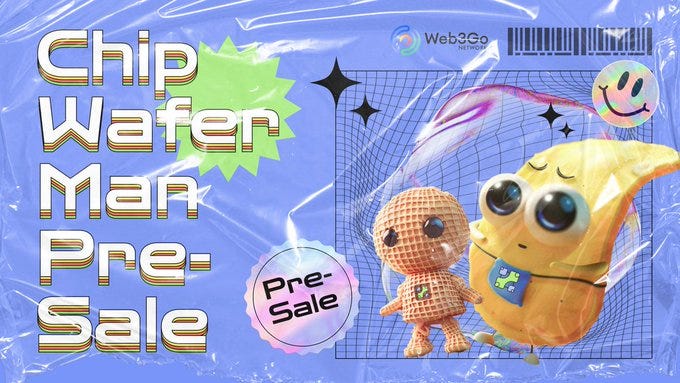
In the recent meme coin frenzy, whether it's Jupiter’s $WEN, satirizing crypto users’ uncontrollable FOMO; or Darkfarms’ $BOME, a chaotic blend of crypto aesthetics and meme absurdity; or even $Slerf, which exploded after an accidental token burn, completing in one day what takes other tokens months or years—we’re starting to see common patterns emerge. And these patterns may just be the best explanation and representation of the crypto industry itself, and of why we work here.
As a Movement
Let me first tell a story unrelated to meme coins.
One summer afternoon in 2018, I received a long private message on WeChat from a junior at my university. She shared that she had been sexually assaulted by a professor at our school for a long time. Due to various concerns, she was unsure whether she should come forward and report him, so she reached out to ask for my advice. At the time, the #MeToo movement was gaining momentum globally. Perhaps seeing other women speak out on social media—and seeing my own public discussions on such issues—she found the courage to consider taking action. I told her, “You’re brave. If you’re ready, I’ll fully support you.”
Later, she posted detailed evidence and accusations on her WeChat Moments. I reposted it on Weibo with the hashtag #MeToo. That post went viral—tens of thousands of shares and comments, millions of views. As a result, the university issued an official statement and launched an investigation into the matter. Many old friends and strangers reached out to me, sharing their own past experiences of sexual assault and harassment, feeling a sense of relief they’d never known before.
Now, let me tell a more recent story—one about meme coins.
Within two days of $Slerf launching, its X (formerly Twitter) Spaces room remained open nearly 24/7. Beyond the project founder tearfully apologizing, many others stepped in to help. One woman offered to write press releases and connect with journalists. A man suggested crowdfunding to repay debts and avoid legal or personal risks. A prominent figure even appeared live, announcing that all trading fees collected by his exchange for the token would be donated back to the founder—as charity.

All of this happened because the birth of this meme coin itself was a mistake—an error that resonated deeply with people. This “mistake” created a truly people-owned token, free from whales or centralized manipulation. For crypto users who’ve long felt like “韭菜” (chopped韭菜), finally, here was a place of belonging, a shared cause worth supporting. People created promotional content, provided funding, built partnerships, and promoted the project—all while holding the token and earning substantial financial returns.
#MeToo, as a movement against sexual assault and harassment, naturally possesses virality, narrative power, consensus-building, and strong community bonds. Even as just a social media hashtag, it awakened long-dormant resistance among survivors and formed a network of mutual support and encouragement.
The emergence and evolution of the crypto industry and meme coins are similarly movements—bringing together strangers from around the world across time, uniting them in shared struggle or defense. Crypto influencer @thecryptoskanda wrote in a tweet that what brings people together and motivates them to join a movement are, in order: emotion, then incentives, and finally, a sense of achievement.
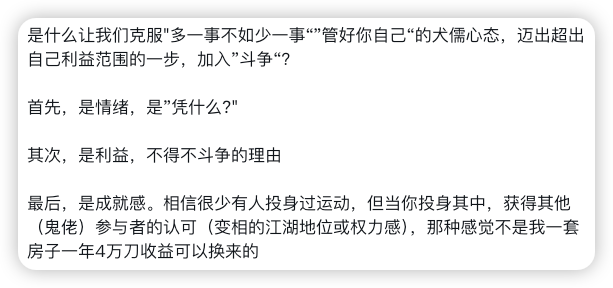
The crypto industry is a movement resisting centralized financial power and defending decentralized nodes. Meme coins are a movement resisting unfair, opaque manipulation and upholding a culture where collective effort fuels success. You read Satoshi Nakamoto’s whitepaper and couldn’t sleep—you saw the dawn of change. You discussed it online, collaborated with others, created liquidity, brought freedom. You were hailed as leaders, and you defined the movement.
As a Dark Forest
Fans of Liu Cixin’s *The Three-Body Problem* will recognize the concept of the “dark forest”—the idea that once a civilization is discovered in the universe, it will inevitably be destroyed by others. This creates a space where caution is paramount: when entering the dark forest, you must move carefully, knowing others like you may be lurking everywhere. In this forest, others are hell—eternal threats.

When your social media feed suddenly floods with random strings of letters and numbers—accompanied by phrases like “launch,” “airdrop,” “presale,” “leave your address”—the dark forest of crypto opens a time portal for you. Especially when these messages come from “influencers” you’ve followed and trusted for a long time, you’re irresistibly drawn in, beginning your stealthy journey through the woods.
The forest is home to all kinds of creatures—each with unique names, appearances, and behaviors. As humans—the apex species—we instinctively feel affinity toward them, showering them with care. Just as modern people treat cats and dogs as life essentials, the crypto industry has a particular fondness for animal-themed branding.
Even if you're not part of the crypto world, you've likely heard of Dogecoin—the meme coin Elon Musk claimed Tesla might accept as payment, and the original spark of the meme coin craze. Since its creation in 2013, Dogecoin has now spanned a decade. Every time Musk or other celebrities mention it on social media, it surges sharply in price. From its inception to each viral celebrity endorsement, we’ve been repeatedly pulled into Dogecoin’s dark forest.
On one hand, Dogecoin itself began as a stealthy intruder into the crypto dark forest. Upon entry, it launched a fierce attack—directly competing with Litecoin for mining power. Its explosive spread overwhelmed Litecoin, allowing Dogecoin to survive and establish its own territory within the forest. On the other hand, once established, Dogecoin sought influencers to strengthen its ecosystem and attract more participants. Thus, figures like Elon Musk became its guardians—from Musk declaring “Dogecoin might be my favorite cryptocurrency, it’s so cool” to Ethereum co-founder Vitalik Buterin joining the Dogecoin Foundation as a blockchain advisor—each public appearance or news event acts as a massive gravitational pull, creating huge buy-sell volume. The resulting leverage and high-stakes gambling allow lucky and bold individuals to reach financial freedom, while others—equally brave but less fortunate—plunge into the forest’s black hole.
Since then, Shiba Inu ($SHIB), Pepe ($PEPE), Bitcoin-based Rats ($RATS), earlier mentioned $WEN featuring a space kitten, and $Slerf modeled after a sloth—have all evolved from stealthy newcomers into full-fledged dark forests themselves, locked in endless battles, forever moving silently.
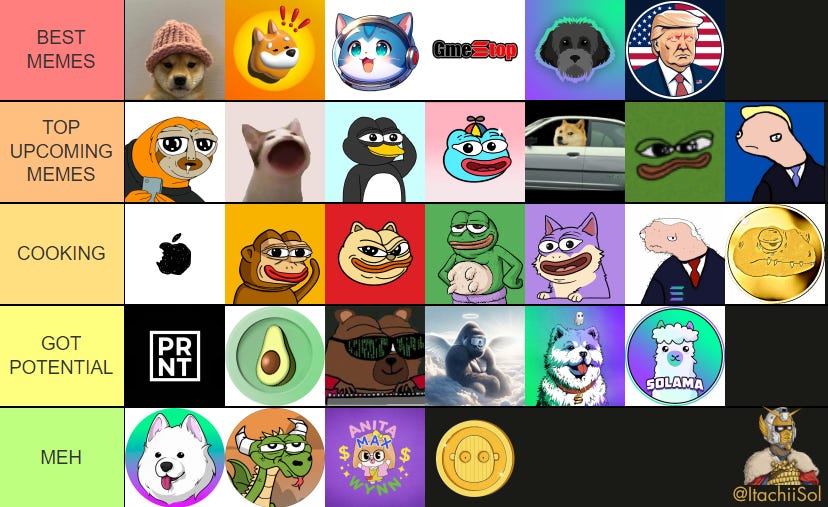
The most fascinating part? Those who guide you into the dark forest always give the same advice: “After you arrive, tell your friends to follow you quickly.” But sometimes, you eventually realize that once you enter, you’re immediately attacked by those ahead. So, wounded and scarred, you fire a bullet at your friend too—creating an endless cycle. In this dark forest, only those with temporal and spatial advantage survive.
Movements embody truth, goodness, and beauty. The dark forest spreads falsehood, evil, and ugliness. In the birth, evolution, and demise of each meme coin, we witness both sides in full display—and realize this duality mirrors human nature itself. When we try to explain why we’re obsessed with meme coins, why we’re so immersed in crypto, we discover we’re really just explaining humanity.
So I tell my family and friends: this is an amplifier of truth, beauty, and evil. I’m merely a messenger of it.
Join TechFlow official community to stay tuned
Telegram:https://t.me/TechFlowDaily
X (Twitter):https://x.com/TechFlowPost
X (Twitter) EN:https://x.com/BlockFlow_News
 @jenniekusu









