What Are Public Goods? Summary of GCC's "Web3 Public Goods Ecosystem Research Report"
TechFlow Selected TechFlow Selected
What Are Public Goods? Summary of GCC's "Web3 Public Goods Ecosystem Research Report"
Public Goods should possess non-excludability, non-rivalry, and positive externalities, and should be moderately decentralized.
 Navigating Web3 tides with focused insights
Author: Baiding, Geek web3
Abstract: • In traditional Western economic theory, public goods must possess non-excludability and non-rivalry. Excludability refers to the difficulty of allowing many people to use an item simultaneously; rivalry means that when one person uses a good, the quantity and quality available to others diminish (i.e., it is consumed).
-
Beyond non-excludability and non-rivalry, public goods should also exhibit positive externalities. Positive externality means that a good benefits the public but does not charge fees equivalent to those benefits.
-
Vitalik proposed the "Revenue-Evil Curve" as a framework for assessing how commercializing or monetizing a public good harms its positive externalities. According to this theory, open-source software that is freely available most urgently requires donations, while ordinary product sellers need them least;
-
The primary goal of donating to public goods is to achieve "Pareto Optimality" as closely as possible, a state in which overall societal or industry-wide welfare is maximized. To reach this state, moderate donations to providers of public goods—or allowing limited monetization/commercialization—can align the interests of suppliers and users for maximum mutual benefit.
-
In Web2, building a product typically involves creating barriers through products, data, and technology to increase excludability and rivalry. In contrast, Web3’s product logic is entirely opposite: products gain advantage only through strong user connections, requiring high degrees of non-excludability and non-rivalry. Thus, open-source public goods will drive new business models in Web3, centered on openness rather than closure.
Main Text
Public goods are a classic concept in Western economics concerning overall social and market welfare. From a macro perspective, blockchain introduces new modes of production, giving “public goods” meanings not present in traditional economics. From a micro perspective, many foundational elements in Web3—such as public blockchains and smart contracts—naturally embody key characteristics of public goods due to their decentralized nature.
Given these two aspects, clarifying the concept of public goods within the context of Web3 is essential, and research into Web3 public goods is growing. However, clarifying the concept of public goods requires addressing two fundamental issues first:
First, with rapid advances in productivity, the global economic system has undergone transformative changes compared to when classical Western economics was established. Therefore, definitions of public goods from that era no longer fully apply today and require updating;
Second, Web3 represents a revolutionary leap beyond traditional economic systems—decentralized and trustless—spawning numerous new economic actors and behaviors. Under such conditions, methods for identifying public goods warrant reevaluation.
In this article, we present a summary after reading, drawing upon the author's professional background as an economics master’s graduate, introducing the 76-page "Web3 Public Goods Ecosystem Research Report", co-authored by Ray and Tiao from LXDAO, Twone from Uncommons, Hazel and Yuxin from GCC. Below, we briefly outline the core content and theoretical framework of the report.
Overall, GCC’s report begins with the definition of public goods, explains how to identify Web3 public goods, analyzes the current Web3 public goods ecosystem in depth, and offers outlooks on future development and challenges. It can be said that this is one of the most valuable references currently available on Web3 public goods, especially rare and precious for the Chinese-speaking world where public goods ecosystems remain underdeveloped.
Introduction to Basic Concepts of Public Goods
1. Traditional Economic Definition of Public Goods
As mentioned at the beginning, definitions of public goods must evolve alongside developments in productivity and relations of production. To study the Web3 public goods ecosystem, we must first understand what constitutes a public good.
Mankiw’s Principles of Economics (Microeconomics) represents traditional Western economics. In this textbook, all goods are categorized into four types based on excludability and rivalry: private goods, club goods, public goods, and common resources. Hence, we must first define excludability and rivalry.
Excludability: When a good is used, there exists the ability to prevent others from using it (similar to locks in operating systems or databases).
Rivalry: When one party uses a good, it reduces the amount or quality available to others (i.e., it is consumed).
For example, any item in a mall—you purchase it and have exclusive rights, excluding others from using it—this is excludability. In a fruit-picking garden, total fruit is limited. When you pick some, others can still pick remaining fruit, but the total decreases. The more you pick, the less remains for others—this competition among pickers illustrates rivalry.
Based on the presence or absence of these two properties, goods are divided into four categories in traditional economics:

Here we see that the traditional Western economic definition of public goods is items possessing both non-excludability and non-rivalry. However, with advances in productivity and globalization, this definition faces two problems:
First, changing reference standards may transform contradictions—for instance, national defense is non-excludable for citizens of that country but excludable for foreigners.
Second, whether a good has excludability or rivalry is not a simple binary distinction, but rather forms a two-dimensional “broad spectrum” between private and public goods (as shown in Figure 1).
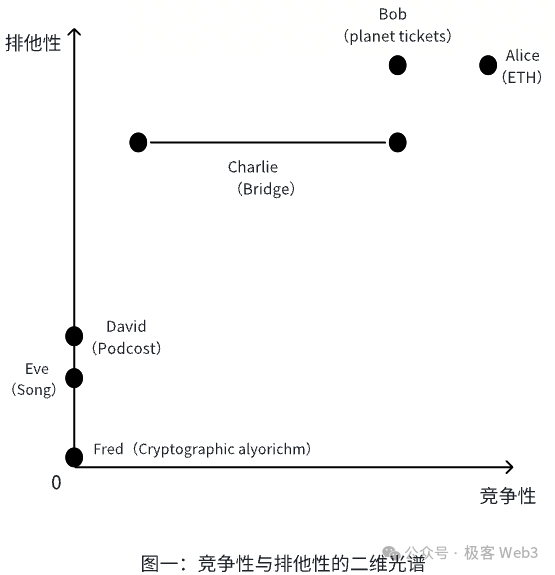
In the above diagram, Alice owns 1,000 ETH to sell, Bob runs an airline selling tickets, Charlie builds a bridge charging tolls, David publishes a podcast, Eve releases a song, Fred invents a better cryptographic algorithm.
These six examples cannot be neatly classified using a crude binary model of excludability and rivalry, but instead fall across a spectrum based on varying degrees of these traits (Charlie is particularly special—the rivalry of his bridge depends positively on traffic congestion). Clearly, the traditional binary model fails to effectively classify them or determine which qualify as public goods.
2. Evolution in Understanding Public Goods
The traditional economic definition of public goods has shortcomings. Many economists have attempted improvements, but all face temporal limitations and potential contradictions. Of course, this isn’t the fault of economists—any “absolute truth” weakens into relative truth over time. For public goods, we need definitions and scopes relevant to our current era to guide practical actions.
In the "Web3 Public Goods Ecosystem Research Report", considering the significance of public goods for Web3 builders, integrating various perspectives, the report ultimately proposes two reference points for defining public goods: increasing marginal returns and positive externalities.
2.1 Increasing Marginal Returns
This is a complex criterion. Due to space constraints, the original report doesn't elaborate extensively, but references Vitalik Buterin, Zoë Hitzig, and E. Glen Weyl’s paper “A Flexible Design for Funding Public Goods,” which defines public goods as follows:
By “public goods” we refer to any activity with increasing returns in the sense that the socially efficient price to charge for the activity (marginal cost) is significantly below the average cost of creating the good.
(By “public goods,” we mean activities exhibiting increasing returns—where the socially optimal price, i.e., marginal cost, is far lower than the average cost of producing the good.)
This paper is closely linked to the rise of public goods funding in Ethereum; notably, the authors do not rely on the framework of non-excludability and non-rivalry, but instead define public goods by the contradiction between increasing returns and marginal cost, thereby broadening the scope of public goods. Given its complexity, this article won’t expand further here—interested readers are encouraged to consult the original report by GCC and LXDAO.
2.2 Positive Externalities
“Externality” is a crucial concept in economics, referring to impacts of economic activities on third parties not reflected in prices or value exchanges.
For example, a paper mill polluting water harms nearby residents’ health but provides no compensation or tax payment—this negative impact without redress constitutes a “negative externality.” Conversely, someone vaccinated pays for it and gains personal immunity, but also reduces infection risk for unvaccinated individuals without charging them—this positive effect without seeking return creates a “positive externality.”
Public goods do not charge users or restrict access, yet generate societal benefits (economic rather than accounting gains). Combined with additional returns brought by technological progress like blockchain, we can define: if an activity generates positive externalities, it qualifies as a public good.
3. Pareto Optimality
Pareto optimality is an ideal state of resource allocation where, given current productive capabilities, overall societal benefit is maximized. At this point, no adjustment to internal parameters or structure can improve society further—it represents an idealized social condition.
Public goods are closely tied to overall social benefit, and Pareto optimality serves as a key benchmark. This concept is critical for understanding subsequent discussions, so we illustrate it with an example.
The main obstacle to understanding Pareto optimality is the intuitive belief that lower prices always benefit individuals and thus enhance overall social welfare. In reality, such low-price states fall far short of Pareto optimality because economic roles divide into producers (supply) and consumers (demand)—low prices ignore producer returns.
Conversely, high prices are also suboptimal. Only the “right price” enables Pareto optimality. We demonstrate this with a simple supply-demand curve:
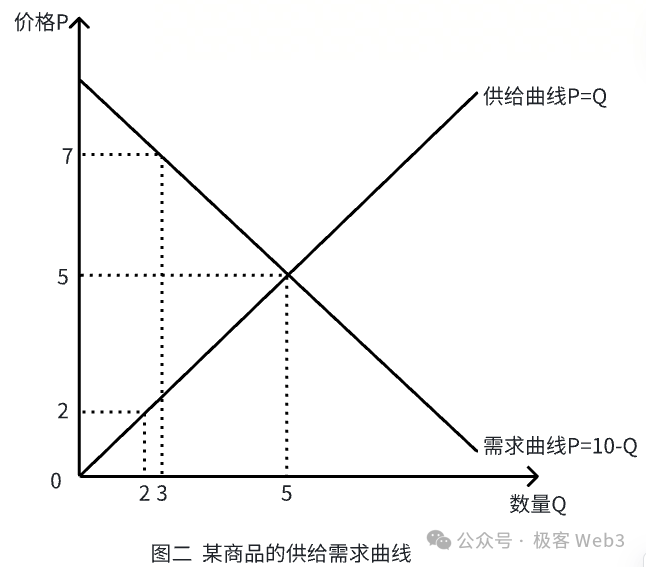
(Supply and demand curves in microeconomics)
Suppose a society produces only one good, whose price reflects the general price level. In Figure 1, at price P=5, suppliers offer 5 units and consumers want to buy 5 units—supply and demand are balanced;
If the price drops to P=2, although prices appear lower and seemingly raise social welfare, per the supply curve, producers willing to avoid losses only supply 2 units. Consumers may want 8 units, but only 2 are available, so they buy just 2. Unused production inputs go wasted, reducing overall social benefit;
Similarly, raising the price to P=7 leads to analogous inefficiencies. Therefore, P=5 is the “right price,” achieving Pareto optimality—no other price allows society to improve further.
Public goods are free, so their price is always below the “right price.” Thus, free public goods do not maximize social benefit. Some mechanism must allow providers to earn returns, ensuring sustainable development and enhancing overall social benefit.
Significance of Public Goods for Web3
Web3 reshapes the internet and digital assets for the new era. Foundational components like public chains and smart contracts inherently possess attributes of public goods. Indeed, public goods not only provide infrastructure for the Web3 ecosystem but also imbue it with profound humanistic and technological meaning.
1. Public Goods Enable Trustlessness
Trust has always been a scarce resource, even more so in the digital age. In the Web2 world, whether online or offline, economic agents must establish trust before transacting, often at great cost. In contrast, Web3 public goods like public chains and smart contracts rely on blockchain technology—every transaction and contract execution is recorded immutably and verifiably by anyone. This eliminates the need to build trust beforehand, representing one of blockchain’s major breakthroughs: trustlessness. This transparency and immutability foster greater growth of public goods within the Web3 ecosystem.
2. Public Goods Enable Permissionless Access in Web3
Resources and services in Web2 are often access-restricted. In Web3, public goods ensure equal access for everyone. On one hand, permissionlessness decentralizes approval authority from centralized institutions via smart contracts, enhancing network decentralization and security. On the other, it allows universal participation in the Web3 ecosystem, ensuring openness and inclusivity of Web3 public goods, thereby promoting ecosystem development.
3. Complexity of Public Goods in Web3
Beyond these positive implications, the Web3 public goods ecosystem exhibits unprecedented complexity arising not only from technological progress but also from Web3’s decentralization, openness, and global nature. This manifests in several ways:
(1) Transformation among goods: In Web3, tokens, smart contracts, DAOs, DApps, and other digital assets/services can interoperate and convert freely—all falling under the umbrella of public goods. These transformations bring flexibility and opportunities, but also complex risks and challenges.
(2) Incomplete decentralization: While decentralization is theoretically central to Web3, in practice, many Web3 organizations are multi-centralized rather than fully decentralized. This partial decentralization offers flexibility and freedom but complicates coordination and resource allocation—a challenge and part of their appeal.
(3) Diversity and interoperability: Various public chains, DApps, and tokens enrich the Web3 ecosystem, yet pose interoperability challenges. Ensuring seamless interaction among different public goods, avoiding silos and fragmentation, remains a pressing issue.
4. Monetization of Public Goods (Revenue-Evil Curve)
The Revenue-Evil Curve, introduced by Vitalik Buterin (2022), is a methodological tool analyzing how different monetization/commercialization strategies potentially harm public goods.
As previously defined, public goods generate positive externalities—they create societal benefits not captured in pricing. Monetizing or commercializing a public good thus reduces its positive externality by imposing charges for benefits previously free.
This benefits the owner but reduces overall social welfare. The degree to which self-interest undermines public interest is termed “evilness” in the Revenue-Evil Curve. This curve offers a novel evaluation standard for public goods—one perhaps better suited to Web3. The Revenue-Evil Curves for the six cases in Figure 1 are illustrated in Figure 3.
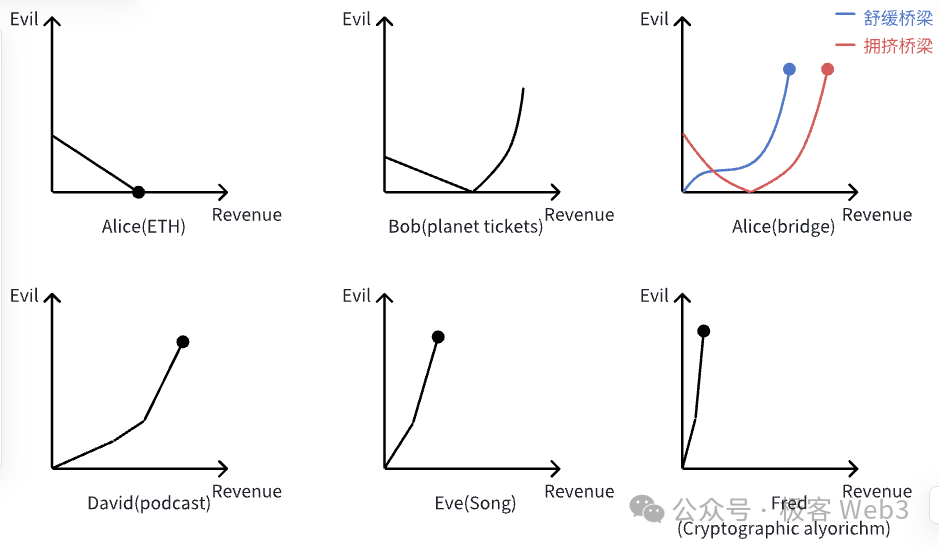
In the graph, the vertical axis “Evil” denotes the degree of evilness. As shown in Figure 3, although evilness reflects inclination toward personal gain, due to differing natures of the six goods, increased evilness yields varying actual individual gains. Analysis follows:
Alice: Higher evilness means higher listing price, fewer buyers. Paradoxically, her maximum revenue occurs at minimal evilness—selling ETH at market price.
Bob: Minimal evilness corresponds to selling tickets at market price. Selling below cost to quickly profit reduces his own revenue and prevents urgent-demand customers from securing tickets—far from Pareto optimality. Raising prices increases personal gain but distances him further from Pareto efficiency, with later-stage evilness even showing super-linear growth.
Charlie: If the bridge is uncongested, any toll discourages many potential users, creating net social loss—with higher evilness yielding greater personal gain. If congested, moderate tolls alleviate traffic, but excessive or insufficient pricing reduces overall social benefit—thus resembling Bob’s curve shape.
David & Eve: Both produce goods where charging increases personal income while decreasing social benefit, proportionally. The difference lies in monetization methods: David’s podcast relies on ads, which may not fully pass costs to listeners; Eve can directly charge per listen, making her music more costly—hence Eve’s curve is steeper.
Fred: Fred’s case is unique. Monetization would require patent sales or auctions, risking turning originally open-source innovations into monopolies held by corporations or individuals—causing massive negative externalities. Thus, his Revenue-Evil Curve is extremely steep.
A good generates positive externalities and greater social benefit precisely because its creator forgoes monetization rights, allowing free use. Goods where evilness correlates positively with personal gain can thus be classified as public goods. Among the six examples, uncongested bridges, podcasts, songs, and ZK cryptography algorithms qualify as public goods.
In the Web3 world, monetizing public goods is very easy due to tokens. On one hand, monetization causes pricing to depend more on markets than intrinsic social value, easily distorting values and eroding the essence of public goods.
On the other hand, if a public good exhibits low evilness, its development is constrained; if too high, it negatively impacts the entire ecosystem—an inherent paradox requiring external intervention. Thus, finding ways to fund public goods without compromising their public nature and value is essential (e.g., appropriate subsidies).
Furthermore, once public goods are monetized (tokenized), revenue distribution becomes a complex issue in the Web3 ecosystem. Token holders and community members alike are key participants—how should revenues be fairly distributed? Establishing new governance models to ensure transparent and equitable distribution of public goods’ benefits has become a core challenge in Web3.
Re-defining Web3 Public Goods
Reviewing earlier sections, GCC’s report details the traditional economic definition of public goods, presents modern interpretations, and cites Vitalik’s Revenue-Evil Curve. Building on this foundation, the report explores and attempts to redefine and reinterpret public goods within the Web3 ecosystem, guiding decisions about funding targets. How then should we judge whether a Web3 project or asset qualifies as a public good? Three perspectives follow:
1. Excludability and Rivalry
Excludability and rivalry remain important criteria. Yet strict binary classification yields few pure public goods and makes funding prioritization difficult. Thus, Vitalik, in describing the Revenue-Evil Curve, uses the two-dimensional spectrum of excludability and rivalry to categorize funding priorities into four tiers:
(1) Goods with full non-rivalry, whose value extraction requires reducing non-excludability (e.g., originally open-source algorithms or code);
(2) Goods with full non-rivalry, capable of generating value without reducing non-excludability (e.g., ad-supported podcasts);
(3) Goods with some rivalry, which funding can help keep affordable (e.g., airline tickets);
(4) Goods fully regulatable by markets—requiring no funding, treated as private goods (e.g., ETH tokens).
2. Positive Externalities
In the Web3 ecosystem, public chains, smart contracts, oracles, and many other components generate positive externalities. Their paid usage often benefits non-paying users too, qualifying them as public goods in a broader sense.
3. Degree of Decentralization
The production and governance of public goods should be decentralized and held collectively by the public. Otherwise, single-point failures caused by localized “evilness” threaten system security and diminish the value of public goods to the broader ecosystem and community.
In summary, Web3 public goods must ensure non-excludability, non-rivalry, and positive externalities, and ideally maintain a certain degree of decentralization—these are requirements for any robust Web3 project or asset.
Current State of the Web3 Public Goods Ecosystem
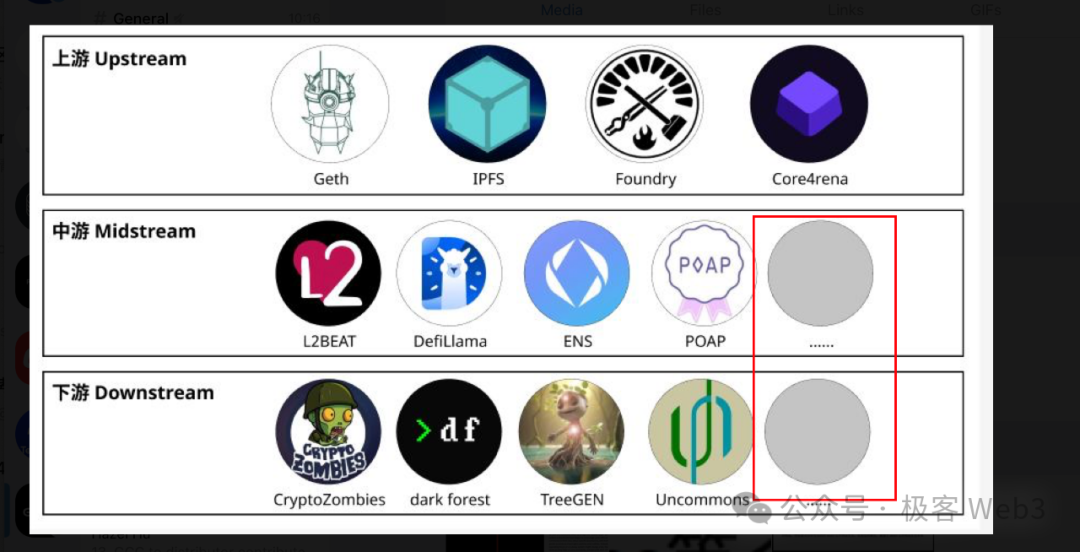
(Diagram of the Web3 Public Goods Ecosystem—Author: zhoumo from Uncommons)
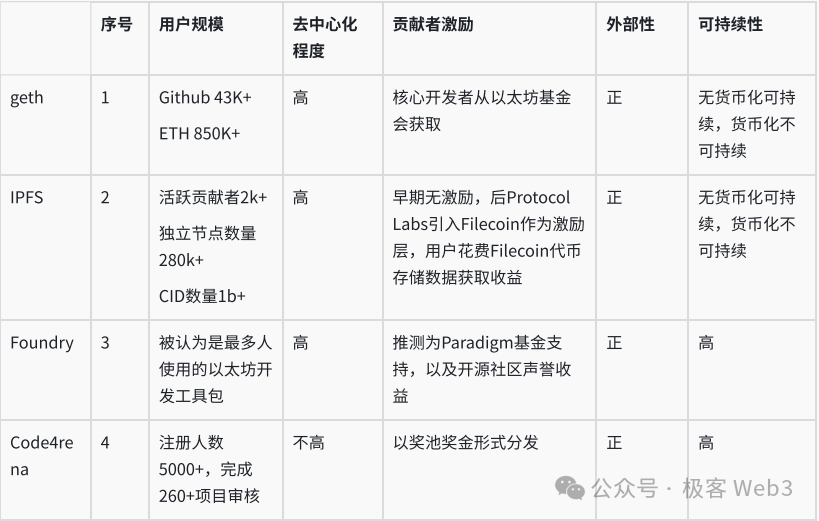
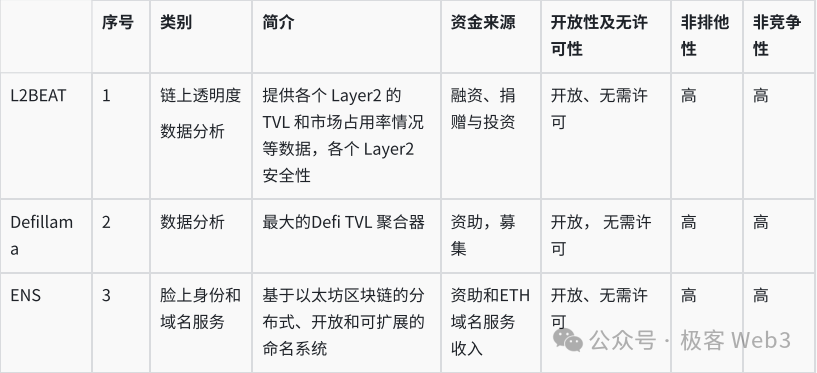
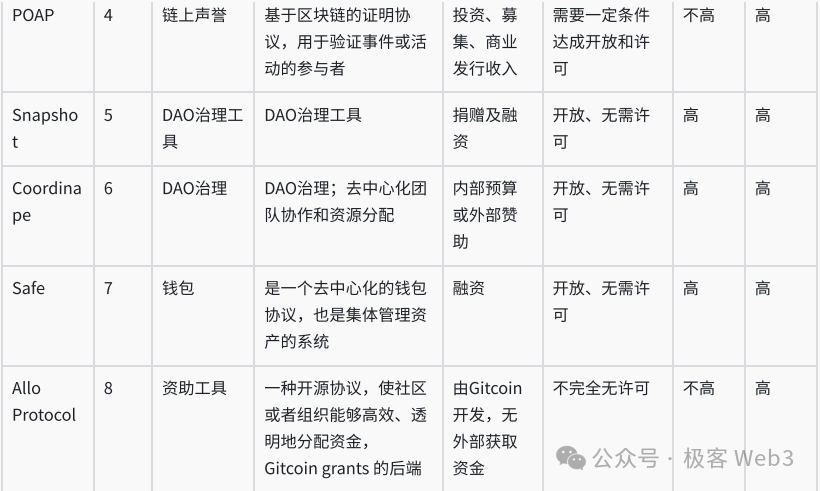
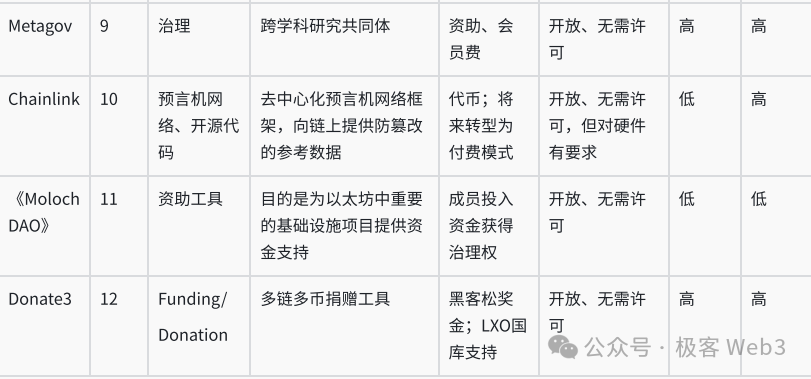
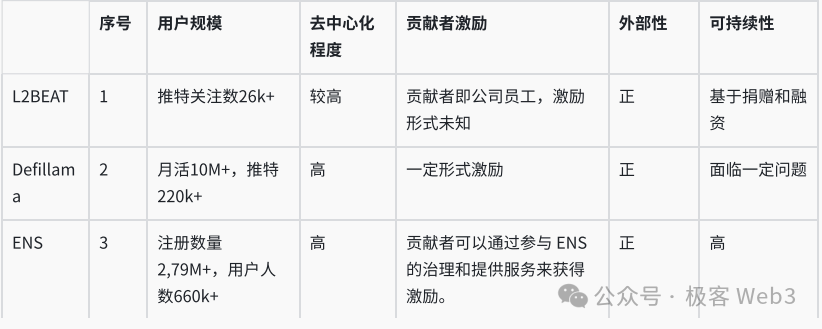
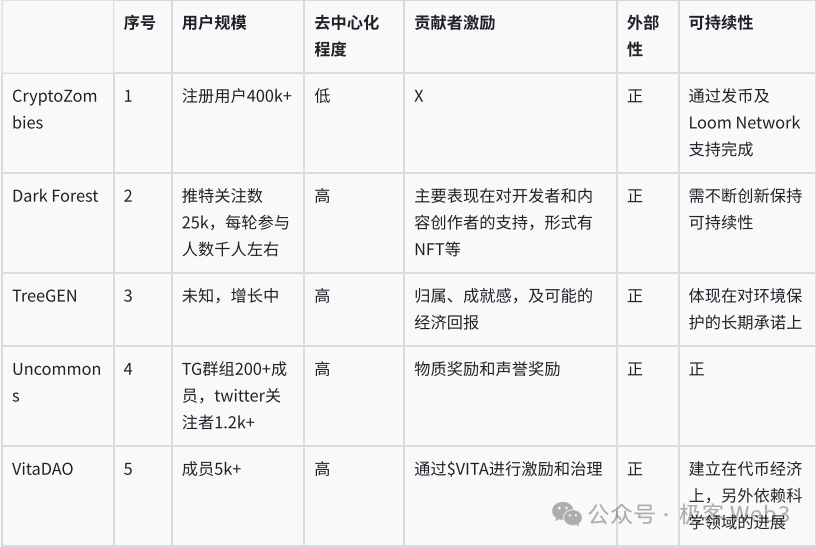
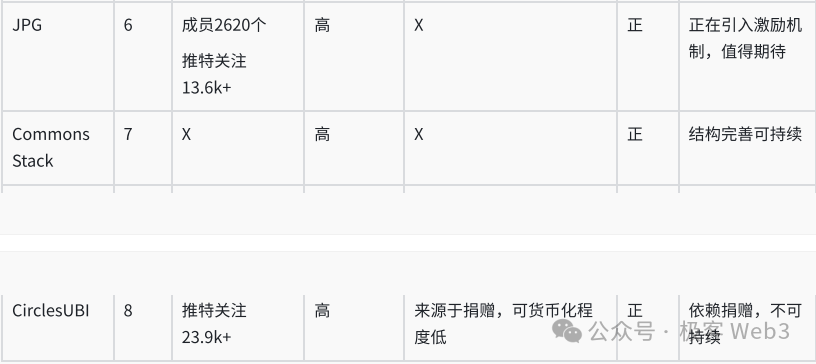
Due to the complexity of Web3 public goods, GCC’s report divides the current ecosystem into upstream, midstream, and downstream segments. Upstream includes Web3 infrastructure such as public chains, storage, SDKs, and related code; midstream covers middleware and services; downstream consists of applications directly interacting with end users. The "Web3 Public Goods Ecosystem Research Report" provides extensive detail, but due to length constraints, this article summarizes the content in tables below (X indicates topics not covered in the report).
1. Upstream
2. Midstream
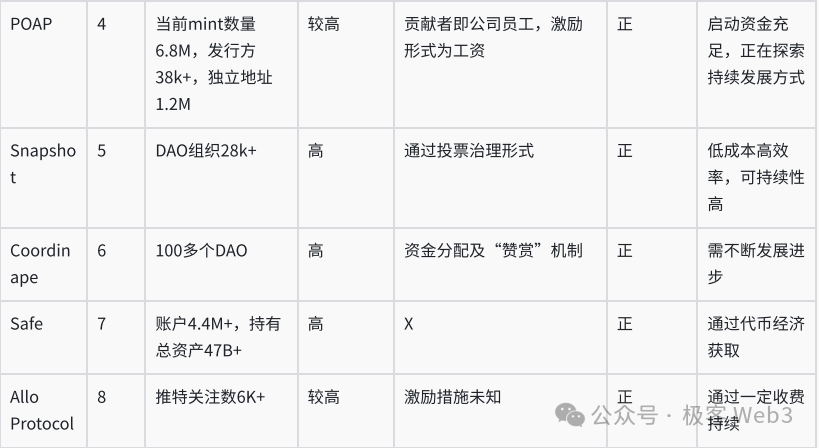
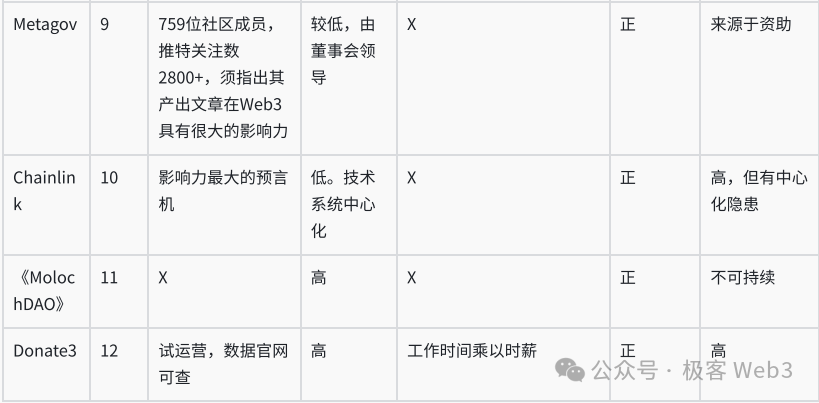
3. Downstream
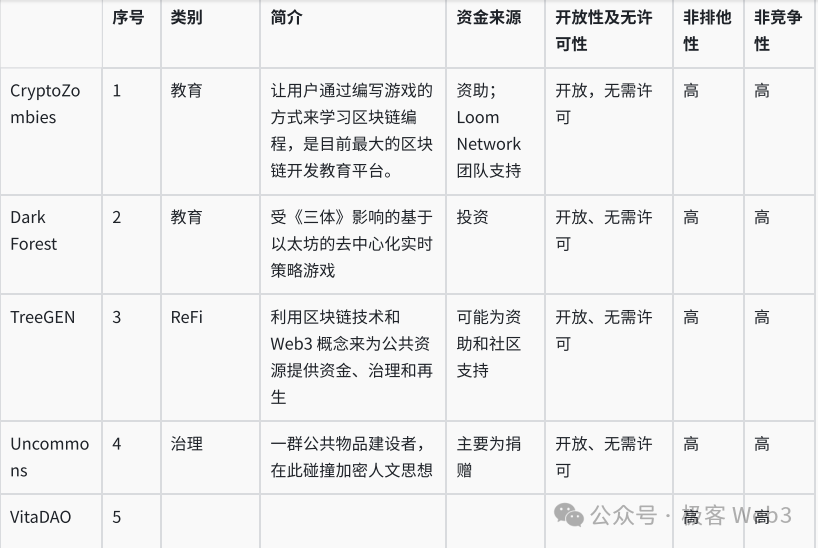
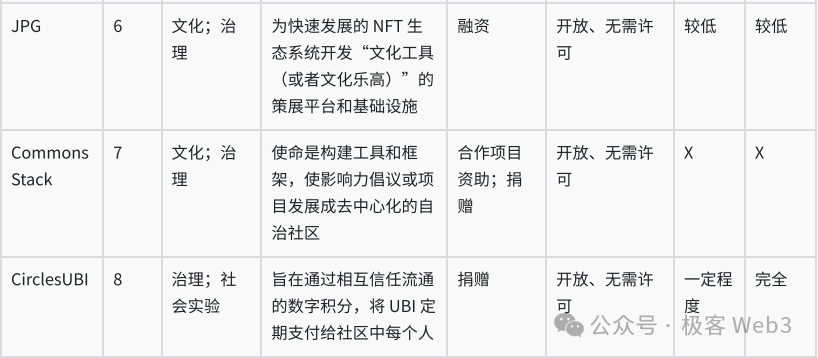
Outlook on the Web3 Public Goods Ecosystem
1. Public Chain Ecosystem Provides Foundation
Blockchain achieves trustlessness through immutable, transparent data. Public chains, tokens, and smart contracts form the basis for DAOs and on-chain governance. More people recognize the importance of sustained development of Web3 public goods, and more foundations and projects are willing to fund them. This trend will undoubtedly strengthen in the future.
2. Public Goods—New Business Model for Web3 Products
In Web2, product development focuses on building barriers via products, data, and technology to enhance excludability and rivalry. Web3’s logic is the opposite: products gain advantages only through strong user connections, necessitating high non-excludability and non-rivalry. Thus, open-source public goods will spawn new Web3 business models centered on openness, not closure.
3. Pathways to Sustainable Public Goods in Web3
As discussed, public goods generate positive externalities, but their created value rarely translates into direct revenue—making sustainability difficult. External funding or income mechanisms are needed. Here are several potential pathways:
(1) Donations: Currently the most common way to fund public goods. Priority should go to those with low monetization potential, assessed via the Revenue-Evil Curve.
However, donations face two issues: lack of return may lead to funding shortages; and donors cannot track fund usage, leading to low efficiency. Quadratic Funding (QF) lets communities decide allocations, solving target selection—but fund management remains unresolved. Best suited for early-stage projects lacking funding channels.
(2) CSR Revenue: Contract Secured Revenue (EIP-6968[159]), splitting gas fees into three parts: base network fee (burned), miner reward, and developer reward. By allocating part of gas fees to developers, CSR incentivizes investment in public goods, improving quality and usability. Applicable to contract-based public goods.
(3) Using Public Chain Gas to Support Public Goods: CSR funds only on-chain goods. Gitcoin’s experiment—PGN—proposes allocating part of node gas fees to support off-chain public goods. Ideal for bootstrapping off-chain initiatives.
(4) Retrospective Funding: Proposed by Optimism—funding provided after a public good proves valuable. Avoids misallocation and improves capital efficiency, but doesn’t solve initial funding for nascent projects, nor standardize “value” measurement. Suitable for already-contributing public goods.
(5) DAO + Token Model: Leverages blockchain fundamentals—smart contracts and tokens. Mature public goods can launch tokens via IDO, solving funding while enabling token holders to participate in transparent DAO governance, shaping future direction and sharing rewards. Most internally sustainable, suitable for mature projects.
4. Challenges
Many hurdles remain on the path to sustainable public goods:
(1) Insufficient public awareness and attention;
(2) Lack of clarity and transparency in governance;
(3) Most public goods lack influence, struggling to attract sufficient donations;
(4) Low fund utilization efficiency;
(5) Difficulty quantifying impact of public goods.
Beyond these, numerous smaller issues persist. Nevertheless, public goods profoundly benefit the Web3 ecosystem. Achieving their sustainable development is a worthwhile pursuit. Web3’s underlying logic provides suitable mechanisms and abundant funding sources. Promising Web3-native solutions are emerging to address sustainability challenges. With smart contracts and tokens, new hope emerges for the evolution of public goods.
Join TechFlow official community to stay tuned
Telegram:https://t.me/TechFlowDaily
X (Twitter):https://x.com/TechFlowPost
X (Twitter) EN:https://x.com/BlockFlow_News
 @godrealmx