








GTC Interview with Jensen Huang: How I See GPUs Differently from Others
TechFlow Selected TechFlow Selected
GTC Interview with Jensen Huang: How I See GPUs Differently from Others
"Nvidia doesn't make chips; Nvidia builds data centers."
 Navigating Web3 tides with focused insights
By Wan Chen
Edited by Jingyu
Source: GeekPark
The atmosphere suddenly turned serious.
"Some media outlets describe you as either the Da Vinci or the Oppenheimer of the AI era. What do you think?"
"Oppenheimer built bombs—we (NVIDIA) don't do that." Facing this somewhat playful question, NVIDIA founder and CEO Jensen Huang paused briefly before giving a very serious answer.
On March 19 local time, the day after delivering his keynote speech at GTC 2024 with the fervor of a pop star performance, Huang sat down for interviews with global media.
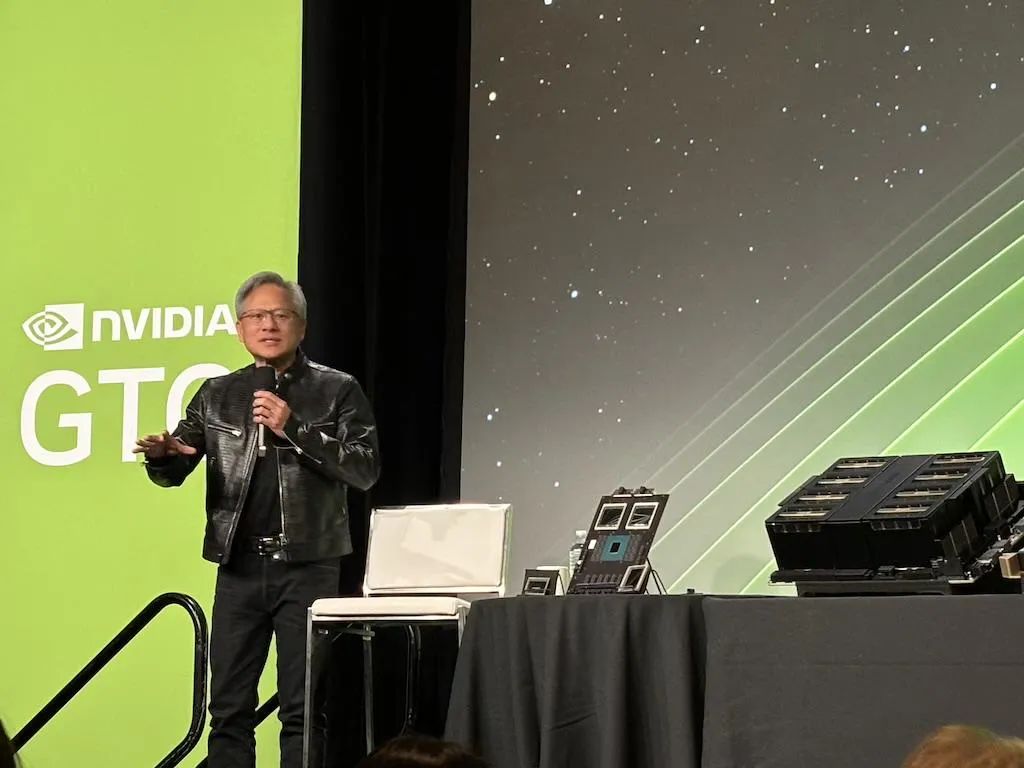
Jensen Huang reiterates key points from the "concert" to the press|Image Source: GeekPark
Whether addressing big questions like "When will AGI arrive?" and "How does NVIDIA view the Chinese market?", or specific ones such as how the newly launched NIM software can be applied, the leader of the world's third-most valuable company consistently breaks down complex topics into simpler layers, using accessible analogies to explain them. While some may suspect diplomatic evasion, the sincerity behind his responses remains hard to doubt.
At a new market valuation high of two trillion dollars, Huang believes GPU chips themselves are not NVIDIA’s ultimate pursuit—"NVIDIA doesn’t make chips; NVIDIA builds data centers." To achieve this, NVIDIA provides everything: hardware, software, and services—giving customers full control over how they purchase and configure their data center solutions.
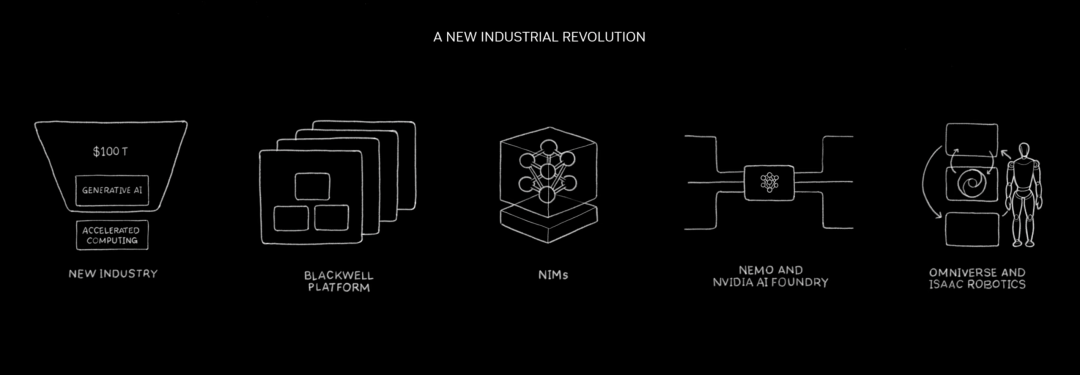
During the GTC 2024 keynote, Jensen Huang presented five key pillars: Under the new industrial revolution (accelerated computing and generative AI), NVIDIA's new infrastructure includes: the Blackwell platform; NIMs; NEMO and NVIDIA AI Foundry; Omniverse and Isaac robotics.|Image Source: Nvidia
01. Plans for GTC New Products in the China Market
Q: How much of your new networking and technology plans will be sold into China? Can you disclose any information about China-specific SKUs? Have any considerations or changes been made for this market?
Jensen Huang: I haven’t announced that yet—you’re being greedy (laughs). That’s the whole answer. For now, we have L20 and H20 chips compliant with export requirements, and we're doing our best to organize and allocate resources for the Chinese market.
02. The Goal of AI Foundry
Q: You mentioned in your keynote that AI Foundry is already working across many enterprises. What is the overall strategy and long-term vision for this initiative?
Jensen Huang: The goal of AI Foundry is to build software—not just software as tools, which everyone has. Two of the most important pieces of software ever created were Office, which made software real-time, and cuDNN (CUDA Deep Neural Network library).
We now have various AI libraries. The future of these libraries lies in microservices, because future libraries won't just be defined mathematically—they’ll be defined through AI. In the future, all of them will become NIMs (NVIDIA Inference Microservices).
These NIMs are highly sophisticated software. All you need to do is go to our website. You can choose to run it there, download and run it on another cloud, or deploy it locally on your computer. This service makes your workstation or data center extremely efficient. It’s a new way of using software within an environment. Enterprises running these libraries can access a licensed operating system for $4,500 per GPU per year.
03. Blackwell Pricing
Q: You previously said the latest-generation AI chip, Blackwell, would cost between $30,000 and $40,000. Do you have more precise figures?
Jensen Huang: It's difficult to say. I was only trying to give people a rough sense of pricing—I'm not aiming to provide exact quotes.
Pricing for Blackwell systems varies significantly because configurations differ. A Blackwell system typically includes NVLink, so different setups result in different prices. As always, pricing depends heavily on TCO (total cost of ownership).
NVIDIA doesn’t make chips—NVIDIA builds data centers. We integrate all components, introduce all necessary software, optimize everything so the data center system runs as efficiently as possible. Then comes the exciting part: we disaggregate the data center into smaller modules, allowing customers to customize according to their specific needs—including networking, storage, control plane, security, and management. We help integrate the entire data center solution into the customer’s ecosystem. Ultimately, the customer decides how to buy it. So unlike selling standalone chips, Blackwell pricing isn't about the chip—it reflects our broader business model.
NVIDIA’s opportunity isn’t in GPU chips—it’s in data centers. Data centers are rapidly accelerating, representing a $250 billion annual market growing at 20% to 25% per year, driven primarily by AI demand. NVIDIA will capture a significant share. Growing from $1 trillion to $2 trillion in value seems entirely reasonable.
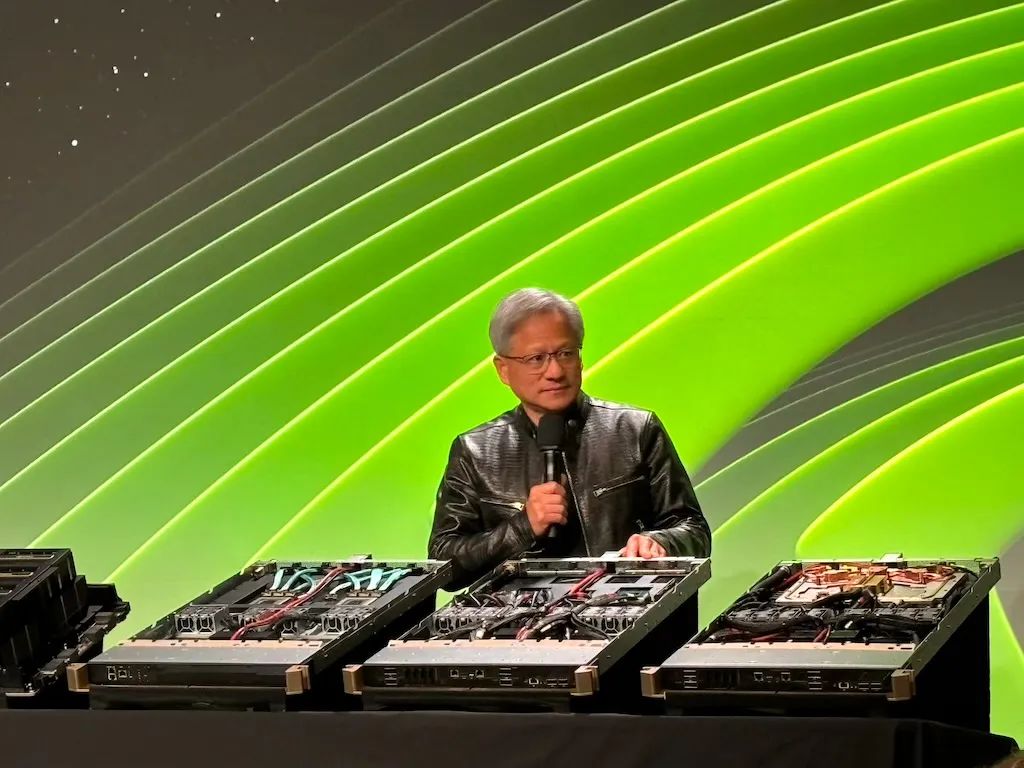
Jensen Huang: What you mean by GPU and what I mean by GPU are vastly different in imagination|Image Source: GeekPark
04. Sam Altman’s Expansion into the Chip Industry
Q: Sam Altman has been talking with people in the semiconductor industry about scaling up AI chips. Has he spoken to you about this?
Jensen Huang: I don’t know his intentions. But I agree with him that generative AI will grow massively.
Today, computers generate pixels by retrieving data from datasets, processing it, and transmitting it. Many assume this process consumes little energy—but the opposite is true. Every time you touch your phone or enter a prompt, the system must race back to the dataset and retrieve information. It uses CPUs to gather relevant parts and assemble them meaningfully (e.g., via recommendation systems), then sends results back to users—a process requiring massive computation.
It’s like if every time you asked me a question, I had to run back to my office to look it up—extremely energy-intensive. In the future, more and more computing will be generative rather than retrieval-based. And this generation must be intelligent and context-aware. I believe nearly every pixel and interaction on people’s computers in the future will be generated—and I think Sam agrees. I hope the new Blackwell architecture contributes significantly to this field. Today, most experiences are still retrieval-based, but if every human-computer interaction becomes generative in the future, I wouldn’t be surprised. It’s a massive opportunity.
05. What Will Personal Large Models Look Like?
Q: I fully agree with your definition of future software—our lives are already changing dramatically through LLMs. Regarding foundational models, what do you envision for the future?
Jensen Huang: The core question is: how do we get personal large models? There are several ways. Initially, we thought fine-tuning would be required—continuous tuning during use.
But as you know, fine-tuning is time-consuming. Then we discovered prompt engineering, in-context learning, working environments, and more.
I believe the answer will be a combination of all these methods. In the future, you could fine-tune just one layer—like LoRA weights—while locking others, enabling low-cost adaptation. You could co-create prompts, leverage in-context learning, expand model memory—all contributing to your unique large model, runnable either in the cloud or locally on your PC.
06. Thoughts on AI Chip Startups
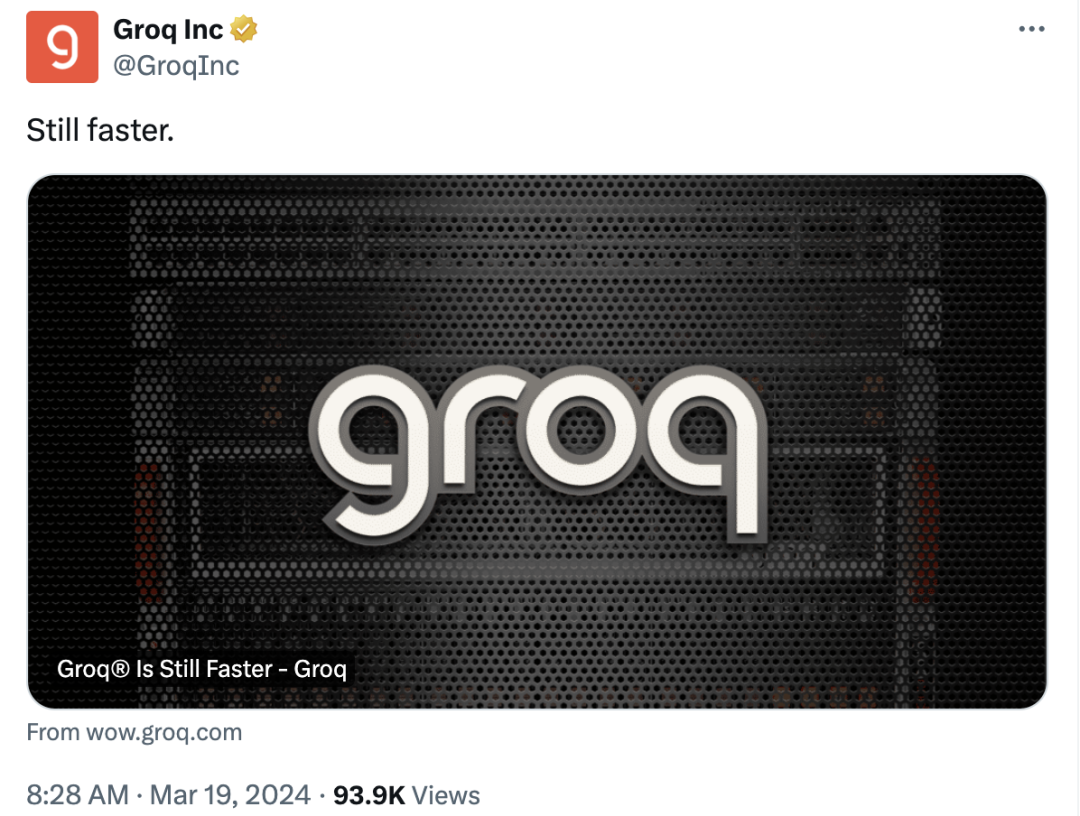
Q: After your keynote yesterday, chipmaker Groq tweeted that their chip is still faster. What do you think about comments from AI chip startups?
Jensen Huang: I haven’t looked into it much (laughs)—no comment.
Any model generating tokens requires its own specialized approach—because Transformer isn’t the name of any single model.
While these models are based on Transformer technology and use attention mechanisms, they differ significantly. Some use Mixture of Experts (MoE), with two or four experts. Their message waiting, routing, and internal processes vary greatly—each requiring unique optimization.
If a compute unit is designed to operate only in a fixed way, it becomes a configurable computer—not a programmable one—and cannot benefit from the speed and potential of software innovation.
Just as the CPU miracle shouldn’t be underestimated, CPUs have remained dominant because they overcome fixed hardware on PC motherboards—allowing software engineers’ creativity to flourish. If you hardwire functions onto a chip, you cut off the ingenuity software developers bring.
That’s why NVIDIA chips excel across diverse AI architectures—from AlexNet to Transformers. NVIDIA found a way to benefit from highly specialized computing while keeping flexibility. Our chips enable software innovation, and NVIDIA’s role is to enable invention itself—like the creation of ChatGPT.
07. How Can Language Models Be Used in Robotic Spatial Simulation?
Q: You discussed using generative AI and simulation to train robots at scale, but many things are hard to simulate well—especially structural environments. How do we break these limits to keep training robots?
Jensen Huang: There are multiple approaches. First, you can frame your problem or query within the context of our language models.
Large language models operate in an unconstrained, unstructured way—that’s also where their potential lies. They learn a lot from text, but may struggle with generalization. How they generalize spatially is almost “magical”—the robot equivalent of a ChatGPT moment might be imminent.
To overcome this, you can specify context and conditions—e.g., tell it the robot is in a kitchen under certain circumstances. By applying ChatGPT-like capabilities, robots can effectively generalize and produce meaningful tokens for software. Once computer vision recognizes these tokens, robots can infer from examples.
08. Predicting the Next ChatGPT Moment
Q: You mentioned certain industries will experience their ChatGPT moment first. Which sectors will change earliest? Any breakthroughs you’ve seen that excite you?
Jensen Huang: Many examples come to mind. I’m very excited about Sora—I saw similar capability last year with Wayve, showing text-to-video generation.
To generate such videos, models must understand physics—e.g., placing objects on tables, not mid-air; ensuring walking humans stay grounded. They can’t violate physical laws.
Another example is using Earth-2 to predict extreme weather impacts. This is critical research, as extreme weather devastates communities. With Earth-2, we can simulate extreme weather effects at a 3km resolution—a huge improvement over existing methods, which require supercomputers 25,000 times larger.
Drug and protein discovery is another impressive use case. Using reinforcement learning loops like AlphaGo, we can explore molecular spaces without physical materials—potentially revolutionizing drug development.
These are profoundly impactful. Robotics is too.
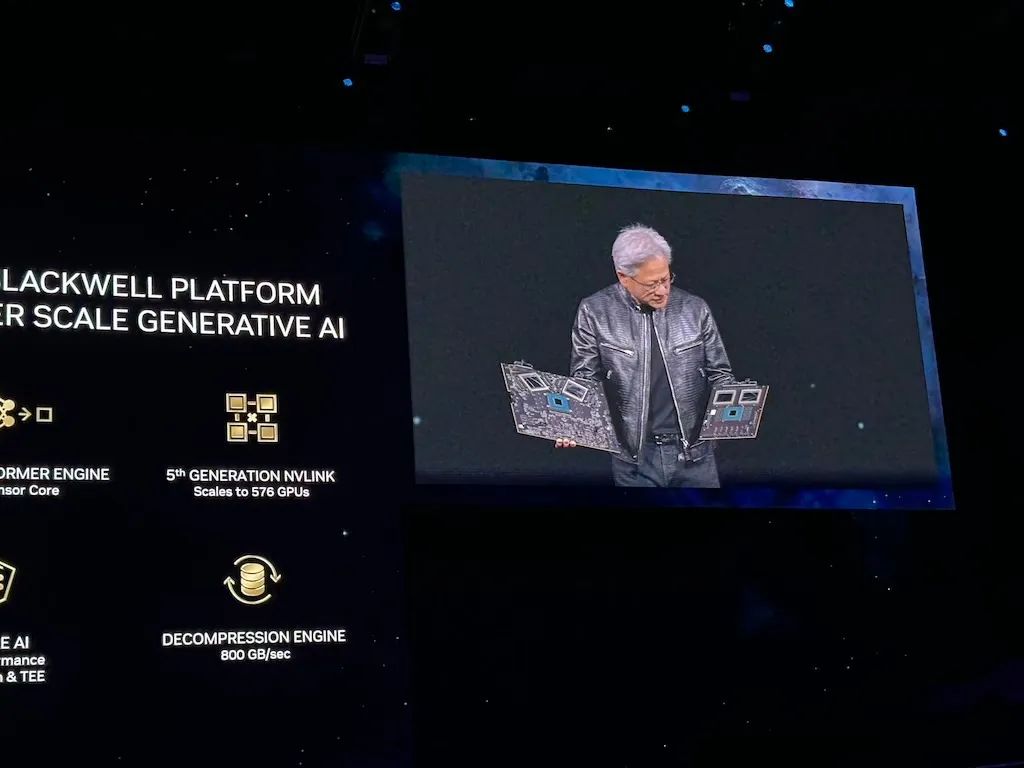
During the March 18 GTC keynote, Jensen Huang gazes at the latest Blackwell architecture product|Image Source: GeekPark
09. Impact of Chip Export Controls on NVIDIA
Q: How do chip export controls and geopolitical factors affect NVIDIA?
Jensen Huang: Two things must be done immediately. First, thoroughly understand all policies to ensure compliance. Second, strengthen supply chain resilience.
Regarding the latter, consider this: when configuring the Blackwell chip into a DGX system, it contains 600,000 components from around the world—many from China. Just like the complexity of the global automotive supply chain, globalization in supply chains is hard to dismantle.
10. Relationship with TSMC
Q: Can you discuss your relationship with TSMC? Over recent years, as chip packaging complexity increased, how has TSMC helped NVIDIA achieve its goals?
Jensen Huang: Our collaboration with TSMC is one of our closest, because what we aim to do is extremely difficult—and they excel at it.
We receive compute dies—CPU and GPU bare chips—from TSMC, with excellent yields. Memory comes from Micron, SK Hynix, Samsung, and assembly must happen in Taiwan. So supply chains aren’t simple—they require coordination among companies. These major players are increasingly realizing that deeper collaboration is essential.
We source components from various companies, then assemble them. A third company tests, a fourth integrates into systems, and ultimately, we build a supercomputer and test it again. Finally, we establish a data center. Imagine—all manufacturing aims to create one massive data center. The supply chain is incredibly complex—not just assembly. Beyond the miracle of the chip itself, we’re building vast, intricate systems.
So when people ask me what I think of GPUs, some see just an SoC. But I see racks, cables, switches—the full picture. That’s my mental model of GPUs and software. TSMC is truly vital.
11. Cloud Business Strategy
Q: NVIDIA is transitioning toward cloud services, while other cloud providers are building their own chips. Will this affect your pricing strategy? What’s NVIDIA’s cloud strategy? Will you offer DGX Cloud to Chinese customers?
Jensen Huang: NVIDIA partners with cloud service providers, integrating our hardware and software into their clouds—to attract customers to those platforms.
NVIDIA is a computing platform company. We develop software and cultivate a loyal developer base. Thus, we create demand and bring customers to CSPs offering NVIDIA DGX services.
12. "Modern-Day Da Vinci" or "Oppenheimer"?
Q: You once said AGI would arrive within five years. Has that timeline changed? Does the accelerating arrival of AGI frighten you? Some call you the modern-day Da Vinci—so talented and impactful—others the modern-day Oppenheimer. What do you think?
Jensen Huang: Oppenheimer built bombs—we (NVIDIA) don’t do that.
First, let’s clearly define AGI so we know what level constitutes achieving it and when. If AGI means that software programs outperform most humans—or even all humans—on a wide range of tests including math, reading, logic, medical exams, law exams, GMAT, SAT, etc., then computers can achieve AGI within five years.
Join TechFlow official community to stay tuned
Telegram:https://t.me/TechFlowDaily
X (Twitter):https://x.com/TechFlowPost
X (Twitter) EN:https://x.com/BlockFlow_News
 极客公园
极客公园









