








8 major blockchains outperforming Ethereum—what to expect?
TechFlow Selected TechFlow Selected
8 major blockchains outperforming Ethereum—what to expect?
Besides Solana and Sui, what other public blockchains are worth watching?
 Navigating Web3 tides with focused insights
By: Terry
Following the successful completion of Ethereum's Dencun upgrade on March 13, major Layer 2 networks such as Starknet, Optimism, and Arbitrum have been gradually integrating it. The sharp drop in transaction fees has once again made the Ethereum and L2 narrative appear more attractive.
At the same time, beyond Ethereum, newer public blockchains that have long struggled beneath the surface are also experiencing their own small springtime moment, giving rise to numerous noteworthy ecosystem projects and emerging variables.
High-Performing Leading New Public Blockchains
Over the past six months, alongside the resurgence of heterogeneous chains like Solana and the development bottlenecks facing Ethereum’s L2s, the industry has reignited debate about Ethereum and its Layer 2 ecosystem. Particularly problematic is the liquidity fragmentation and incompatibility among the ever-growing number of new Layer 2s based on scaling principles, which at one point caused the Ethereum narrative to lose momentum.
Meanwhile, the sustained surge in SOL and AVAX has acted as a powerful stimulant for "new public chains," drawing renewed market attention and capital inflows, prompting ecosystems like Solana to enter their own mini-boom period.
Solana: A Model Case of Post-Crisis Recovery
In just five months, SOL rose from $20 to a high of $200, reclaiming a multi-billion dollar market cap and fully emerging from the shadow of FTX, leaving competitors like Avalanche and NEAR far behind. Among smart contract platforms outside Ethereum, Solana now stands nearly unchallenged.
Alongside SOL’s price rally, the Solana ecosystem has flourished across DeFi, NFTs, and the currently hot DePIN sector, spawning numerous notable sub-projects, with all sectors thriving—making Solana a model case of post-crisis reconstruction.
Especially telling is the visible migration of next-generation meme coins like SILLY, DRAGON, and WIF from Ethereum to Solana—a clear sign that Solana has become the dominant player among new chains in terms of on-chain capital and community traffic.
Avalanche: Dual Narrative of “RWA + Blockchain Gaming” Takes Shape
Last year, Avalanche established itself as the go-to blockchain for traditional financial giants like Fidelity and JPMorgan to issue crypto assets on-chain, earning the label of an “RWA chain.” Combined with Avalanche’s customizable subnet architecture, it is highly likely that more traditional enterprises looking to issue RWA assets in the future will partner directly with Avalanche, given its first-mover advantage.
Additionally, following its success with the RWA narrative, in March this year South Korean game publisher Nexon Group announced that its 2D MMORPG MapleStory will collaborate with Ava Labs to launch a Web3 version called “MapleStory Universe” on the Avalanche network—setting a precedent for further gaming empowerment via Avalanche subnets.
Prior to this, Avalanche launched Arcad3, aiming to help traditional game developers transition seamlessly into Web3 gaming, intending to replicate its RWA support strategy by positioning blockchain gaming as its second core growth driver.
Overall, Avalanche’s dual narrative of “RWA + blockchain gaming” is quietly taking shape. In 2024, it may give birth to unconventional variables and products worth watching.
Sui: Significant Improvement in On-Chain Liquidity
Sui’s gradual rise in popularity over the past six months perfectly illustrates the principle that good things come to those who wait in crypto. Its progress in building on-chain liquidity during this period serves as a solid success story:
The three winning projects—Aftermath, Haedal, and Volo—from the official liquid staking hackathon held between August and October last year have been the main drivers behind TVL growth over the past several months.
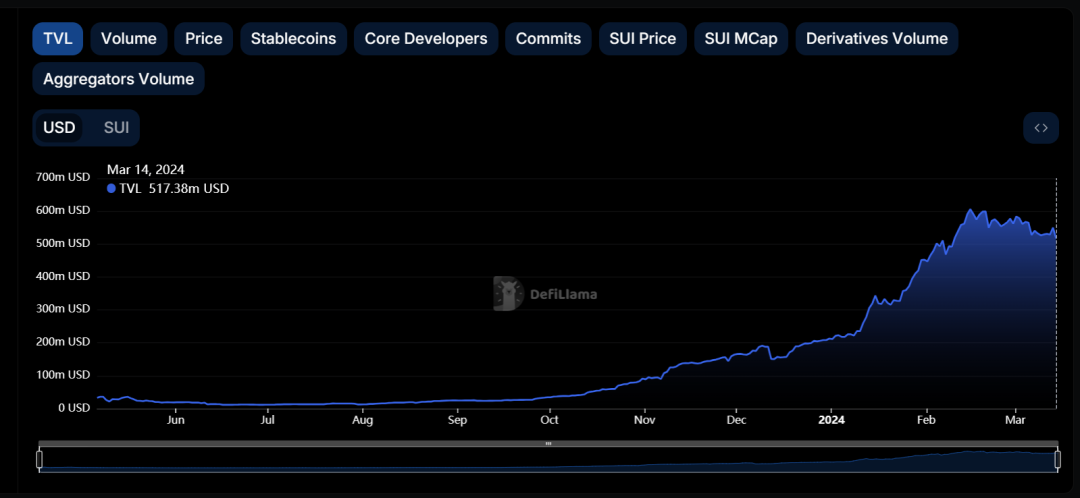
Sui's market cap trend this year, source: DefiLlama
Most notably, since October 14, 2023, Sui’s TVL has surpassed $50 million for the first time and continued rising steadily, hitting a record high of over $600 million on February 15. On-chain liquidity has improved significantly, and community buzz and market discussion have clearly overtaken Aptos, another leading Move-based chain.
Which Other New Public Chains Are Worth Watching?
NEAR: DA + Chain Abstraction + AI
NEAR has missed almost none of the recent major narratives.
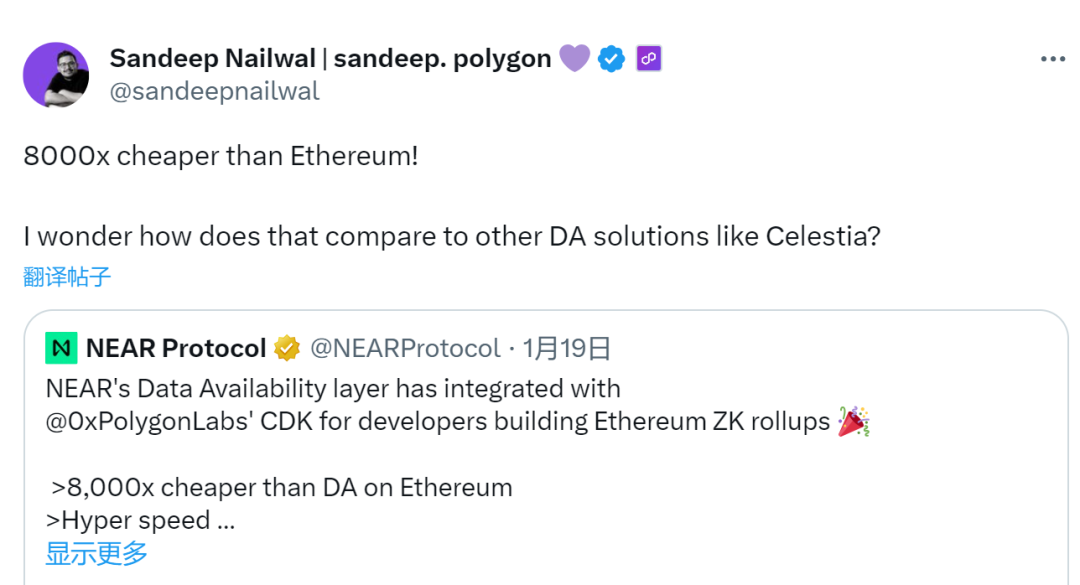
First, amid the legitimacy battle over data availability (DA), while solutions like Celestia dominate external DA offerings beyond Ethereum, NEAR has launched its own NEAR DA service—already chosen by Polygon, which claims it is “8,000 times cheaper than Ethereum.”
Second is the emerging narrative of “chain abstraction,” a next-step solution for mass Web3 adoption following account abstraction. The greatest potential of chain abstraction lies in decoupling blockchains from users, allowing dApps and projects to refocus on user-centric design.
In simple terms, it aims to create a low-barrier Web3 environment that’s easy to use and feels similar to traditional Web2 apps, removing obstacles for mainstream users entering the Web3 world.
From a product perspective, most people don’t need to understand what Web3 is—and for Web3 to go mainstream, it must be usable by ordinary people. Most won’t even need to know Web3 exists—that’s enough. And since chain abstraction hasn’t yet gained broad traction beyond projects like NEAR, there remains significant untapped potential ahead.
Finally, there’s the massive “AI” narrative, primarily fueled by news that NEAR co-founder Ilya Polosukhin will appear at NVIDIA’s AI conference, participating in the “Transforming AI” keynote and panel discussion during GTC24 on March 20—an event also attended by NVIDIA CEO Jensen Huang—catapulting NEAR into the spotlight as a leading “AI blockchain.”
The reason is straightforward: Ilya Polosukhin was one of the co-authors of the seminal 2017 AI research paper “Attention Is All You Need,” which laid the foundation for Transformer language models. By origin, today’s various GPT models all trace back to this paper.
Because of this, NEAR has recently become the only project intersecting all three major trends—“DA + chain abstraction + AI”—and its secondary market performance has been exceptionally strong.
APT: Learning from Solana’s Web3 Phone, Accelerating On-Chain Liquidity
As two related projects stemming from former Diem core team members, Aptos has lagged behind Sui in both on-chain liquidity and secondary market performance over the past half-year.
However, recent developments suggest promising new variables for Aptos—most notably the launch of the Jambo Web3 phone, modeled after Solana’s successful Saga Web3 phone, aiming to target markets in Africa, Southeast Asia, and Latin America through smartphone hardware.
Priced at $99, Jambo appears more accessible, though whether it can achieve widespread adoption in the blockchain era remains to be seen.
Meanwhile, as both are Move-based chains, liquidity migration between protocols like Cetus is relatively seamless. Thus, as Sui sees large-scale liquidity improvements, Aptos is well-positioned to absorb overflow capital. The recent outperformance of APT relative to SUI may already be signaling this shift.
Arweave: Pushing Forward AO, Building a New Narrative
Crypto never lacks new narratives, but few generate real market and sector-wide momentum. Recently, Arweave has emerged as one such example. Especially following the release of its public testnet Arweave AO at the end of February, AR and the storage sector saw a surge in interest—particularly due to its positioning as a “next-generation internet computer,” evoking memories of Dfinity’s once-grand vision.
Overall, AO adds verifiable distributed computing capabilities atop Arweave’s existing storage layer, enabling computational tasks to run directly on permanently stored data—effectively turning static data into active value. This can be understood as “a decentralized AWS built on SCP.”
In this sense, Arweave achieves verifiable distributed cloud computing—going further than centralized providers like AWS or Alibaba Cloud—and expands beyond its original narrative of permanent storage, opening up vast new possibilities for a decentralized data economy.
Telegram: The Elephant Turning Around with 900 Million Users
As a crypto user and Web3 participant, aside from exchange apps, what app do you use most frequently? For most people, the answer is likely Telegram. TON, the veteran L1 blockchain, has recently seen significant gains thanks to Telegram and growing expectations.
First, Binance’s listing of TON perpetual contracts has raised anticipation for spot trading, providing TON with a liquidity-backed trading environment and driving substantial capital inflows into the TON ecosystem.
Additionally, last month Telegram announced its ad platform would officially expand to nearly 100 new countries, allowing channel owners in these regions to earn 50% of ad revenue generated from ads displayed in their channels. To ensure fast and secure ad payments and withdrawals, TON blockchain will be used exclusively.
This gradually unlocks TON’s biggest potential—enabling crypto transactions, transfers, custody, and other social-financial use cases directly within the Telegram app. With Telegram’s 900 million user base, the potential is enormous.
Filecoin: Steady Progress in FVM Ecosystem Development
On March 14, 2023, the Filecoin Virtual Machine (FVM) officially launched on the Filecoin mainnet, introducing programmable smart contracts and enabling the Ethereum Virtual Machine (EVM) to run on top of FVM.
This means developers can now deploy Solidity- or Yul-written smart contracts compiled for EVM, making the Filecoin network programmable for the first time.
According to Starboard data, as of March 14, over 3,000 contracts have been deployed on FVM, with net deposits exceeding 23.2 million FIL. Especially since 2024, Uniswap and others have begun deploying on FVM, while LSD protocols like Glif and STFIL have significantly enhanced liquidity and diversified DApp use cases in the Filecoin ecosystem.

Conclusion
Overall, public blockchains remain the longest and most imaginative narrative in the Web3 space—from the 2018 hype around new chains like Polkadot, Cosmos, and EOS, to the 2020 rise of homogeneous chains and L2s like BSC and Arbitrum, to the rapid emergence of Solana and Avalanche in 2021 and Move-based chains in 2022—there’s never been a shortage of protagonists.
Now, as signs of a new bull market begin to emerge, the once-hyped and volatile public chain sector is shifting toward grand narratives and innovation. Our understanding of blockchains continues to evolve. In 2024, we may see more practical, scalable public chains emerge—something truly worth anticipating.
Join TechFlow official community to stay tuned
Telegram:https://t.me/TechFlowDaily
X (Twitter):https://x.com/TechFlowPost
X (Twitter) EN:https://x.com/BlockFlow_News
 白话区块链
白话区块链









