









Grayscale: How the U.S. Election and Macroeconomic Factors Influence Bitcoin
TechFlow Selected TechFlow Selected
Grayscale: How the U.S. Election and Macroeconomic Factors Influence Bitcoin
Bitcoin is an alternative monetary system that competes with the U.S. dollar. Therefore, U.S. government policies that affect the economy or the outlook for the dollar may also impact Bitcoin.
 Navigating Web3 tides with focused insights
Source: Grayscale
Translation: Deng Tong, Jinse Finance
In the upcoming election, key macroeconomic policy issues will include the scale of government deficits and debt, inflation and Federal Reserve independence, and America's role in the world.
Bitcoin is an alternative monetary system that competes with the U.S. dollar. Therefore, U.S. government policies affecting the economy or the outlook for the dollar may also impact Bitcoin.
Grayscale Research believes the dollar could weaken, and we expect Bitcoin could benefit from policy shifts that lead to (i) increased U.S. government debt, (ii) erosion of Federal Reserve independence and greater inflation risk, and (iii) a decline in U.S. leadership abroad.
As Bitcoin approaches new all-time highs, candidates in the 2024 election have begun addressing cryptocurrency market topics. For example, former President Trump recently told CNBC in an interview that Bitcoin has "gained life," and he has allowed supporters to purchase merchandise using Bitcoin. [1] Ahead of the election, a survey conducted by Harris Poll on behalf of Grayscale indicates that cryptocurrency investors may pay close attention to candidates' views on Bitcoin, as well as any signals about potential crypto legislation in the next Congress.
But Bitcoin is also a macro asset: it is an alternative monetary system and a competing "store of value" against the dollar. Thus, macroeconomic and geopolitical issues in the U.S. election—such as the level of deficit spending and America’s global role—could influence demand for the largest cryptocurrency. We believe election outcomes that increase the risk of dollar depreciation could be favorable for Bitcoin over the medium term.
Macro Issue #1: Government Deficits and Debt
To some extent, rising government debt can negatively affect a country's currency. [2] For a large, institutionally mature economy like the United States, the dollar’s risks primarily stem from the "twin deficits" mechanism. This theory suggests that because marginal demand for government bonds may come from foreign investors, budget deficits and trade deficits tend to expand simultaneously.
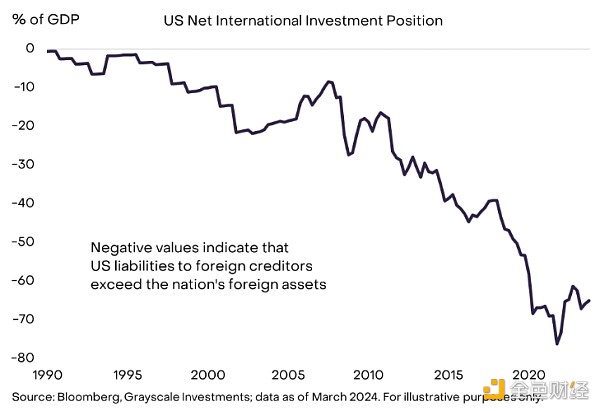
Approximately half of U.S. government debt is held by overseas investors, and federal budget deficits have historically led to widening trade deficits. [3] Moreover, for the nation as a whole, international liabilities (debts owed to foreigners) far exceed international assets, with the U.S. net liability position totaling 65% of GDP (Chart 1). As the stock of federal debt is projected to rise significantly in the coming years,[4] interest from foreign investors in U.S. Treasury securities could become more limited—or even diminish—potentially leading them to move away from the dollar and possibly toward alternatives such as Bitcoin.
Chart 1: Foreign Investors May Lose Interest in Buying U.S. Treasuries
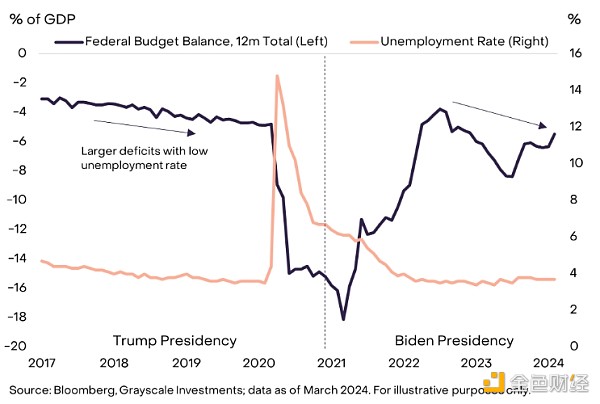
Both President Trump and President Biden have presided over rising government debt and procyclical budget deficits, though the pandemic complicates historical interpretation. Prior to the pandemic,[5] President Trump oversaw rising public debt levels and expanding budget deficits despite falling unemployment (Chart 2).[6] Government analysts also estimated that the 2017 tax law increased the budget deficit over the medium term.[7] After the pandemic, President Biden similarly governed during a period of elevated federal budget deficits while unemployment remained at historic lows. Additionally, neither candidate has prioritized balancing the budget in a second term. President Trump has indicated a desire to implement additional tax cuts, while estimates suggest President Biden’s green energy investment plans would substantially widen the deficit.[8]
Chart 2: Both President Trump and President Biden Have Governed Under Large Budget Deficits
Since public debt could rise under either candidate, a more important consideration may be whether one party controls both the White House and Congress. Under current practice,[9] the party holding a simple majority in Congress can pass fiscal policy legislation. Both President Trump and President Biden enacted major legislation at the start of their terms under unified government. Impact on Bitcoin: Demand could rise if one party controls both the White House and Congress, as passing legislation that expands deficits would be easier.
Macro Issue #2: Inflation and Federal Reserve Independence
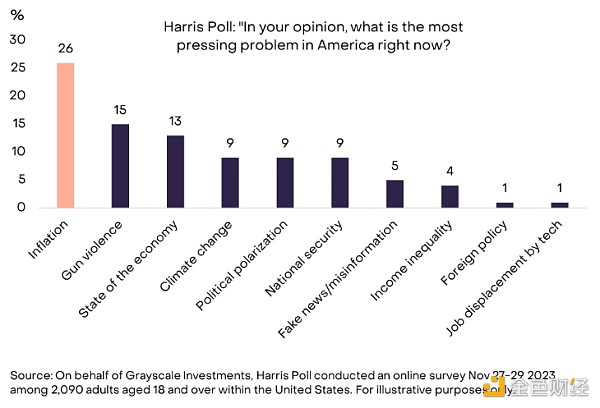
Grayscale partnered with Harris Poll to survey likely voters on their views about cryptocurrencies and the upcoming election. Notably, respondents identified inflation as the most urgent issue facing the country (Chart 3).
Chart 3: Inflation Is the Most Urgent Issue in the U.S.
We view Bitcoin as a "store of value" asset that can hedge against dollar depreciation—whether due to inflation or nominal devaluation eroding purchasing power. One way this election could affect the risk of dollar depreciation is through its impact on Federal Reserve independence. Academic research shows that independent central banks—those responsible for maintaining low and stable inflation without daily interference from elected officials—are more effective at achieving price stability.[10] Therefore, actions that undermine central bank independence could increase the likelihood of higher inflation and dollar depreciation over the medium term. Federal Reserve Chair Jerome Powell’s term expires in 2026, so the next president will have the opportunity to shape the institution.
During his presidency, Trump frequently criticized the Fed publicly—for instance, saying he was “not thrilled” with his choice of Powell and calling the FOMC’s (Federal Open Market Committee) policy decisions “way off.”[11] He has continued recent criticism, describing Powell as “political” and suggesting any rate-cutting moves are intended to “help the Democrats.”[12] In contrast, President Biden has taken a more traditional approach, stating his method for reducing inflation follows the principle: “Respect the Fed, respect the Fed’s independence.”[13] Impact on Bitcoin: If President Trump is elected and markets perceive a higher chance he might undermine the Fed’s independence in a second term, demand for Bitcoin could rise.
Macro Issue #3: America’s Role in the World
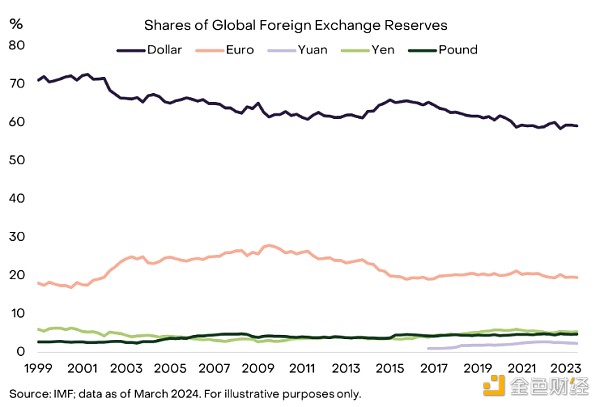
Outside the U.S., many of the largest dollar holders are foreign governments. For example, the dollar constitutes the largest share of foreign exchange reserves (official foreign assets held by governments) in most countries (Chart 4). Therefore, international demand for the dollar may be influenced by economic and political factors. Countries hosting U.S. military bases, for instance, typically hold larger dollar reserves.[14] Because demand for the dollar depends on both political and economic conditions, actions by the next president to reduce U.S. geopolitical influence could weaken demand for the dollar—and in turn open space for competing monetary systems like Bitcoin.
Chart 4: The Dollar Dominates Global Trade and Finance
President Trump has expressed more negative views on U.S. international commitments than President Biden, and his rhetoric and actions have occasionally caused friction with allies. Trump has frequently criticized NATO, pulled the U.S. out of the Trans-Pacific Partnership (TPP), imposed tariffs on a range of imports—including goods from Canada, Mexico, and the EU—and pressured Japan and South Korea to provide greater financial contributions for U.S. military protection.[15] As a candidate, Trump has proposed sweeping 10% tariffs and said tariffs on China could exceed 60%.[16]
The Biden administration has provided stronger support for existing alliances and multilateral institutions. Examples include backing for NATO and funding for Ukraine (highlighted in his recent State of the Union address) and a more positive stance toward the TPP. The Biden administration has also abandoned major new tariffs. However, following Russia’s invasion of Ukraine, the U.S. and its allies sanctioned the Russian central bank—perhaps the most significant policy decision affecting the dollar’s international role in recent years. This action prompted “dedollarization” in the Russian economy—shifting from dollars to gold and other currencies. In the future, other countries facing sanction risks may also attempt to diversify away from the dollar. Impact on Bitcoin: More isolationist policies or aggressive use of extraterritorial sanctions could weaken the dollar and support alternatives such as Bitcoin.
Bitcoin on the Ballot
Beyond the macro policy issues on the November ballot, cryptocurrency investors will also watch for guidance on specific industry legislation. The previous Congress debated several crypto-related bills. These included two comprehensive proposals[17]: the McHenry-Thompson bill and the Lummis-Gillibrand bill, both addressing registration requirements for crypto asset exchanges and the jurisdiction of the SEC and CFTC over crypto assets. Two other significant bills that crypto investors will monitor include the “Stablecoin Bill,” aimed at increasing regulatory transparency for stablecoins,[18] and the “Digital Asset Anti-Money Laundering Act,” focused on preventing illicit financial activity involving cryptocurrencies.[19]
Regardless of how the U.S. cryptocurrency regulatory environment evolves, the macroeconomic and geopolitical trends driving both the dollar and Bitcoin appear likely to persist. We believe these trends include large government budget deficits and rising debt, higher and more volatile inflation, and declining trust in institutions. Bitcoin is an alternative “store of value” competing with the dollar. If the long-term outlook for the U.S. economy and the dollar deteriorates, we expect demand for Bitcoin to rise.
For the presidential election, both candidates have previously served as president, allowing investors to partially assess the implications of re-election based on their past statements and actions. Given historical precedent, public debt is likely to continue rising if either Trump or Biden also controls Congress. Despite a healthy U.S. economy, persistent large deficits could pose downside risks to the dollar. Likewise, any policies that increase inflation risk and/or reduce foreign government demand for the dollar could lead to currency depreciation and potentially benefit competitors to the dollar—such as foreign currencies, precious metals, and Bitcoin.
Join TechFlow official community to stay tuned
Telegram:https://t.me/TechFlowDaily
X (Twitter):https://x.com/TechFlowPost
X (Twitter) EN:https://x.com/BlockFlow_News
 @Grayscale









