Will Polygon’s bet on ZK Rollups give it a chance to win the L2 war led by OP Stack?
TechFlow Selected TechFlow Selected
Will Polygon’s bet on ZK Rollups give it a chance to win the L2 war led by OP Stack?
One of the best ways to implement zkEVM is through Polygon, due to its strong business development capabilities.
 Navigating Web3 tides with focused insights
Author: Lucius Fang
Translation: TechFlow
Optimistic Rollup (ORU) is currently winning the L2 war
With the rise of the modular narrative led by Celestia, competition among Ethereum L2s has intensified. New chains are being announced almost every month, as transaction costs can now be significantly reduced by using Celestia as a data availability (DA) layer.
Many projects are considering launching their own L2, as it could help reposition themselves as chains with potentially higher fully diluted valuations (FDV) during a bull market. Some DeFi projects were among the first to jump on this trend, aiming to internalize maximum extractable value (MEV) while reducing transaction costs. These include Aevo (converted from Ribbon Finance), Lyra Finance, and Frax Finance’s Fraxtal. Notably, all of these projects have chosen Optimistic Rollups (ORU), specifically OP Labs’ OP Stack, for their chains rather than ZK Rollups.
The preference for ORU continues even among newer entrants like Coinbase's Base, Blur's Blast, and Bybit's Mantle. Beyond ORU giants like OP Stacks, Arbitrum has also gained attention by bringing Xai and ApeCoin into its Arbitrum Orbit ecosystem. From the TVL of Arbitrum and Optimism mainnets, ORU’s dominance is evident, capturing 75% of the market share across all other rollups.
Does this mean ZK Rollups (ZKR) will never catch up?
ZK Rollup (ZKR)
As a refresher, rollups are Ethereum Layer 2 solutions that bundle multiple transactions off the Ethereum mainnet and submit them as a single transaction back to Ethereum, helping reduce transaction costs while inheriting Ethereum's security. There are two main types of rollups: ZK Rollups (ZKR) and Optimistic Rollups (ORU), which use validity proofs and fraud proofs respectively.
Comparison between ZKR and ORU:
Advantages and disadvantages of ZKR over ORU:
Advantages
Near-instant transaction finality through validity proofs, avoiding the 7-day challenge period required in ORUs. Enables shorter withdrawal times.
Only the state differences need to be settled on Ethereum, unlike ORUs where all transactions must be posted.
Disadvantages
Requires more computational resources and specialized hardware to generate validity proofs.
Less compatible with EVM, requiring additional effort to migrate existing EVM-based projects, whereas ORUs are EVM-equivalent.
Essentially, ORUs are easier to build and offer smoother migration for existing EVM-based projects. The main limitation is the 7-day challenge period for transaction finality, which affects fund withdrawals from L2. This is why many consider ZKR a better scaling solution for Ethereum—it offers instant transaction finality via validity proofs, also known as zero-knowledge proofs (ZKP). However, ZKP remains a relatively nascent technology, and ongoing research focuses on optimizing proof generation and making ZKRs more EVM-friendly.
Types of ZK-Rollup (ZKR)
ZKRs are typically categorized into four types of zkEVM, each balancing EVM compatibility against proof efficiency. zkEVM refers to a virtual machine that is both EVM-compatible and supports ZKPs.
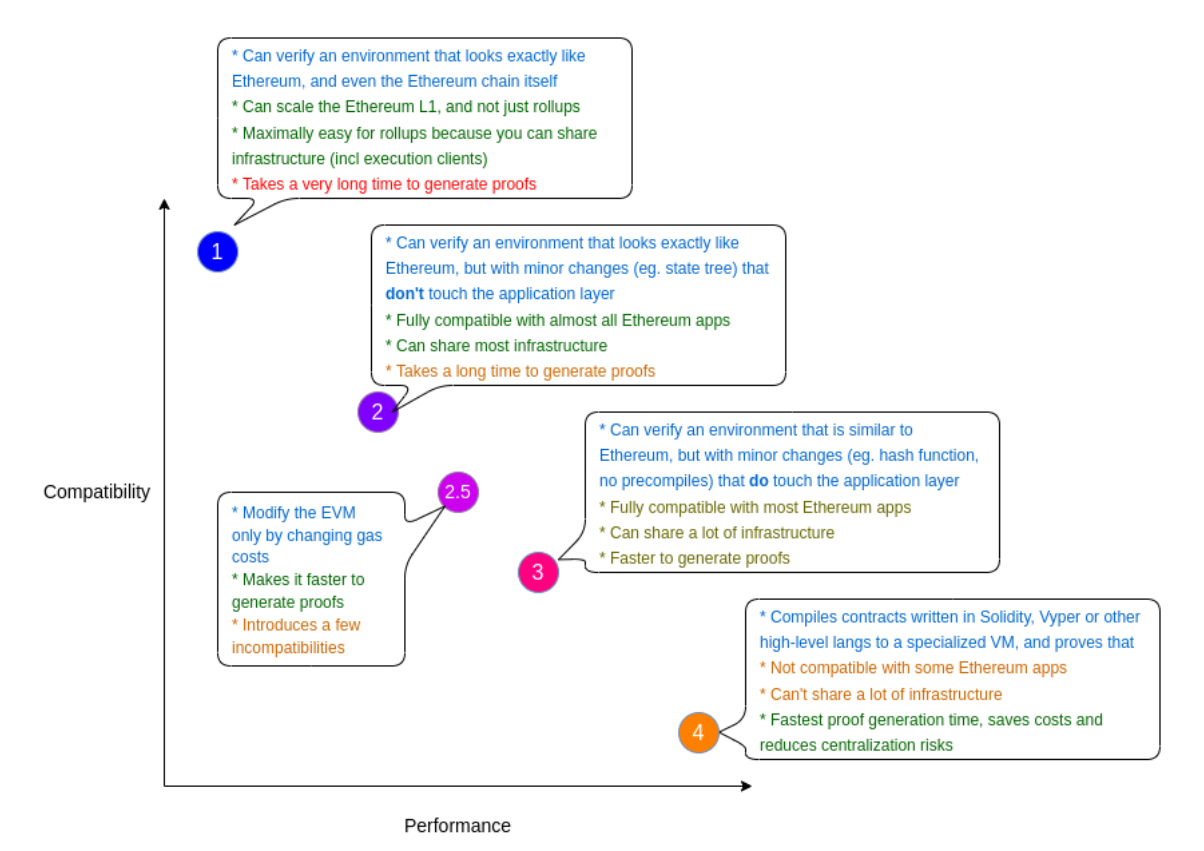
Four types of zkEVM
The EVM was not originally designed to be ZKP-friendly, so proving every part of an Ethereum transaction using ZKP is slow and expensive. To make proofs faster and cheaper, one solution is to create a custom VM optimized for ZKPs and then develop a compiler to translate EVM code.
In short, projects must choose between prioritizing portability of existing EVM applications or minimizing transaction costs.
-
Type 1: Fully equivalent to Ethereum, capable of scaling Ethereum L1 itself, but with extremely long proof times.
-
Type 2: Fully EVM-equivalent; existing EVM apps can migrate without modification, but proof times remain long.
-
Type 3: Nearly EVM-equivalent; existing EVM apps require minor modifications to migrate, with fast proof times.
-
Type 4: High-level language equivalence; requires a compiler to convert EVM code into a custom ZK-friendly VM, enabling super-fast proofs.
Type 1 ZKRs are the hardest to produce but offer the greatest potential to scale Ethereum itself. Due to complexity, they may take years to become operational. As such, currently live ZKRs are primarily Type 3 (Polygon zkEVM and Scroll) and Type 4 (Starknet and zkSync Era). It's worth noting that Type 3 projects aim to evolve toward Type 2, treating their current state as transitional to achieve greater EVM compatibility.
Due to technical difficulties in launching production-ready ZKRs, ORUs gained a head start when Arbitrum and Optimism launched their mainnets in 2021. In contrast, zkSync 2.0 and Polygon zkEVM launched only in 2023. This gave ORUs a significant lead in attracting capital and projects. The launches of ARB and OP tokens further helped retain users through continuous liquidity staking programs and grants funding.
But trends may reverse in the coming months.
Polygon: The Aggregation Layer for ZKR
Among all ZKRs, Polygon may have the most potential to overtake ORUs. Let’s examine its advantages.
Strong ZK Foundation
In previous cycles (2021–2022), the Polygon team attracted attention mainly through business partnerships with traditional companies such as Nike, Starbucks, Mastercard, Adobe, Disney, Adidas, and Mercedes. Often overlooked is Polygon’s strong commitment to ZK technology, including its 2021 acquisitions of Hermez ($250M) and Mir ($400M).
Hermez contributed to the current version of Polygon zkEVM, aiming for high EVM compatibility as a Type 2 zkEVM. Mir later became Polygon Zero, focusing exclusively on improving ZK proofs.
Polygon has consistently published groundbreaking ZK research. One recent example is Circle STARK, developed with Starkware—a fast proving system. The whitepaper was released on February 22, 2024, and Circle STARK will be integrated into the Plonky3 proving system, expected to be 10x faster than Polygon’s current Plonky2.
Eli Ben-Sasson, co-founder of StarkWare, said in a CoinDesk interview: “I think this will bring the most efficient proving system for some time.”
Multi-Pronged Market Strategy
With the rise of the modular narrative, choices around data availability (DA) have become key differentiators. Off-chain DA enables cheaper transactions and higher throughput at the cost of some security. Rather than committing to one model, Polygon has adopted three strategies.
1. Polygon PoS transitioning to zkEVM Validium
-
EVM-equivalent
-
Transaction data stored off-chain (Validium)
-
Ideal for high-frequency, low-value transactions such as gaming and social apps.
2. Polygon Miden, based on STARK
-
Miden VM optimized for ZK, supporting Rust and TypeScript
-
Offers non-EVM features such as native account abstraction (AA), allowing users to control what information they keep private
-
Suited for novel applications like orderbook exchanges
3. Polygon zkEVM
-
EVM-equivalent
-
Uses Ethereum’s DA layer
-
The most secure and most expensive variant, suitable for low-frequency, high-value transactions like DeFi.
At first glance, Polygon’s strategy may seem scattered. But as ZK technology evolves, betting on all possibilities could prove to be the right move. No matter how ZK ultimately integrates into Ethereum, Polygon will be involved.
As rollups fragment state and liquidity, Polygon introduces the AggLayer as a solution. The AggLayer provides unified liquidity and shared state across ZKRs. It achieves this by aggregating proofs from multiple ZKRs and creating a single aggregated proof to be settled on Ethereum. This enables atomic cross-rollup transactions. For example, a user on OKX’s X1 chain could directly purchase an NFT from Immutable zkEVM. Polygon also released the Type 1 Prover, allowing any EVM chain to connect to the AggLayer.
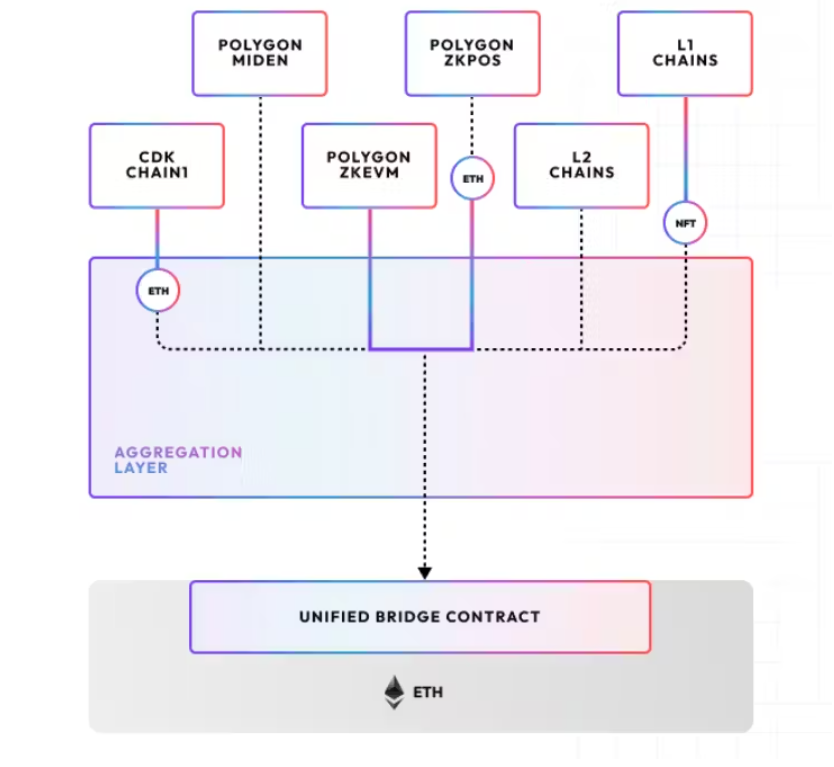
Polygon Chain Development Kit (CDK)
As mentioned earlier, applications are considering becoming app-chains. The current leaders are OP Stacks and Arbitrum Orbit. Polygon CDK is Polygon’s answer—providing tools to build custom zkEVM chains. So far, Polygon has demonstrated BD strength not just with traditional firms but also in web3. Notable products include Immutable, OKX’s X1, Astar, and Manta Network.
Securing support from Immutable on Starknet is one of Polygon’s biggest wins, as Immutable is currently the highest-valued gaming blockchain, valued at approximately $7 billion. Manta Network, the third-largest L2 by TVL, decided to switch from OP Stack to Polygon CDK. OKX, one of the top five centralized exchanges, chose Polygon CDK to launch its L2, validating Polygon’s ZK tech.
Another interesting development is that two prominent Bitcoin Layer 2 projects have chosen Polygon CDK. Both saw massive staking deposits at mainnet launch due to anticipated airdrops. Merlin Chain has about $3.8 billion in deposits, while B² Network has around $660 million. Although debate continues over what constitutes a true Bitcoin L2, seeing Polygon CDK adopted beyond the Ethereum ecosystem remains impressive.
Strong Token Value Accrual
Now, how do these innovations translate into value for Polygon’s native token? Following a similar playbook to when Matic (MATIC) rebranded to Polygon (MATIC) in 2021, the token is now being renamed to the Polygon Ecosystem Token (POL), with a 1:1 migration and new price chart. A proper rebrand helps renew attention and facilitates price discovery. A recent successful example is the rebranding of Merit Circle to Beam.
Post-rebrand, POL is positioned as the staking token for AggLayer and Polygon CDK chain sequencers. Validators will need to stake POL to begin verifying the network, generating ZKPs, and participating in the Data Availability Committee (DAC), earning protocol rewards and transaction fees in return.
POL has already been minted on Ethereum, but staking functionality is not yet enabled, and there is no deadline for migrating MATIC to POL. Polygon may be preparing a large-scale migration event coinciding with the mainnet launch of Polygon CDK chains.
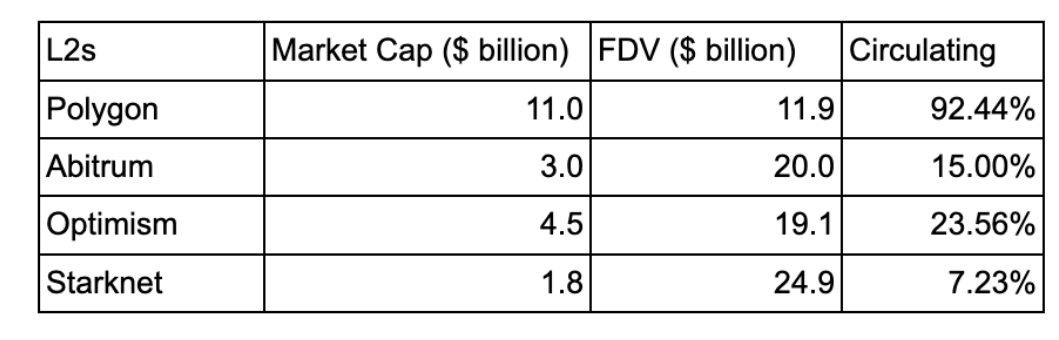
Among all ZK Rollups, POL/MATIC is the only token without aggressive future unlocks—the last unlock occurred on February 22, 2024. Nonetheless, POL has a new tokenomics model with a maximum annual inflation rate of 2%, half allocated to community funds and half to validator rewards. This represents far less supply shock compared to other L2 tokens like ARB, OP, and STRK.
Finally, Polygon has branded its DA solution as Avail. Given Celestia’s high valuation, it’s reasonable to expect Avail could debut at a similar valuation range, possibly distributing its native token via airdrop to the Polygon ecosystem. While many existing Polygon CDK chains already have their own tokens, it’s plausible that future CDK projects might also airdrop tokens to POL stakers. If so, POL could gain the powerful "stake-to-airdrop" narrative, significantly boosting its value—similar to how Celestia and Dymension have benefited.
Notable ZKRs
Starknet
Starkware was once hailed as the leader in ZKR, having attracted projects like dYdX, ImmutableX, and Sorare to launch their StarkEx chains. StarkEx is an Ethereum L2 supporting specific transaction types like trading and NFT minting.
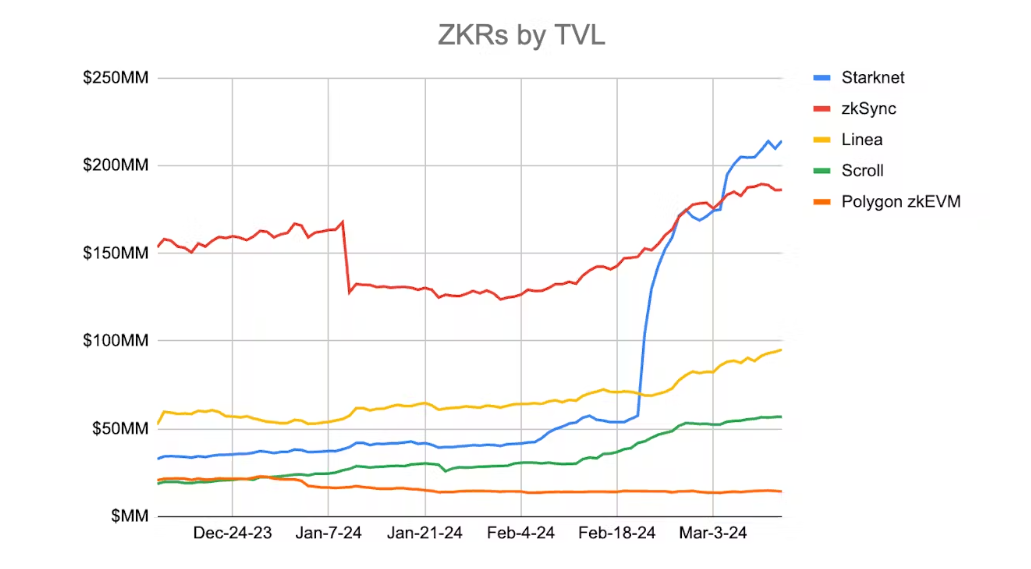
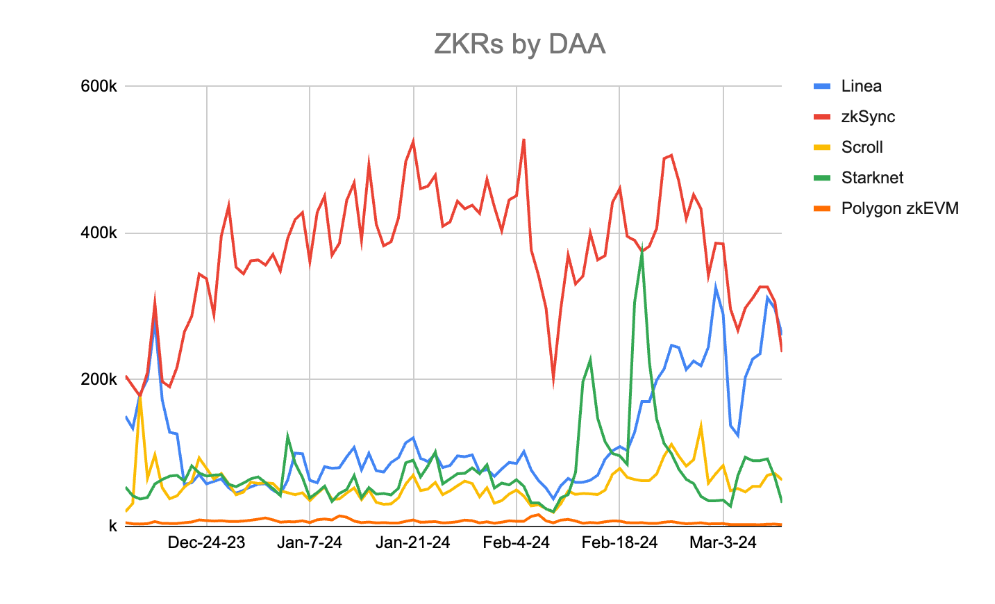
They took too long to launch their general-purpose ZKR, Starknet, causing key projects like dYdX and Immutable to migrate to ecosystems like Cosmos and Polygon. Additionally, as a Type 4 ZKR, they chose not to be compatible with standard Ethereum wallets like MetaMask, creating friction for user onboarding. This was evident before the STRK token launch on February 20, 2024, when Starknet had only ~$50M TVL and under 200k daily active users (DAA), lagging behind zkSync Era and Linea. Now, thanks to STRK’s high valuation and new DeFi activity, its TVL and DAA have caught up with zkSync Era.
Starknet recently distributed its initial STRK token, sparking community backlash due to strict airdrop criteria aimed at preventing “airdrop sybil attacks.” Tensions escalated when a core team member referred to disgruntled users as “digital beggars.” The situation worsened when users realized STRK’s unlock schedule started in 2022—not at the February 2024 distribution—effectively giving the team and investors only a two-month lock-up. In response, the team adjusted the unlock schedule to be more gradual.
Starknet has its own L2 SDK and plans to introduce L3s (app chains). But so far, no major announcements have been made, except for Paradex—an orderbook perpetuals protocol—that has gone live.
zkSync Era
As a Type 4 ZKR, zkSync Era ranks second among all ZKRs in TVL at $185M and leads in daily active users at 237k. However, high usage may be driven by expectations of a native token airdrop. Compared to Starknet, zkSync Era is easier to use because it’s compatible with standard EVM wallets like MetaMask. The team also emphasizes that projects can deploy on zkSync Era using popular EVM languages like Solidity, Vyper, and Yul, along with its LLVM-based compiler.
On their roadmap, they plan to introduce zkPorter, an off-chain DA solution to boost throughput. zkSync Era also has its own L2 SDK called Hyperchain. Upcoming launches include Crypto.com’s Cronos zkEVM, GRVT (hybrid crypto exchange), and Tradable (private credit).
Linea
Developed by Consensys, Linea is the default Ethereum L2 network on MetaMask. As the largest web3 wallet, native integration with MetaMask significantly boosts its user base. Frequent activities on Galxe also help inflate its on-chain metrics in anticipation of an airdrop.
Linea has not publicly announced any plans for an L2 SDK or L3.
Scroll
Co-developed with the Ethereum Foundation’s Privacy & Scaling Exploration (PSE) group, Scroll focuses on zkEVM research. Like others above, it has seen high usage due to airdrop expectations.
Scroll has not publicly announced any plans for an L2 SDK or L3.
Taiko
Taiko is the first project outside the Ethereum Foundation dedicated to becoming a Type 1 zkEVM. It calls itself a "rollup-native" chain, where the role of the sequencer is directly taken by Ethereum L1 validators, giving it a decentralized sequencer from day one.
Currently, it remains in testnet phase, with mainnet expected in H1 2024. Taiko has not announced any public plans for an L2 SDK or L3.
Competitive Landscape
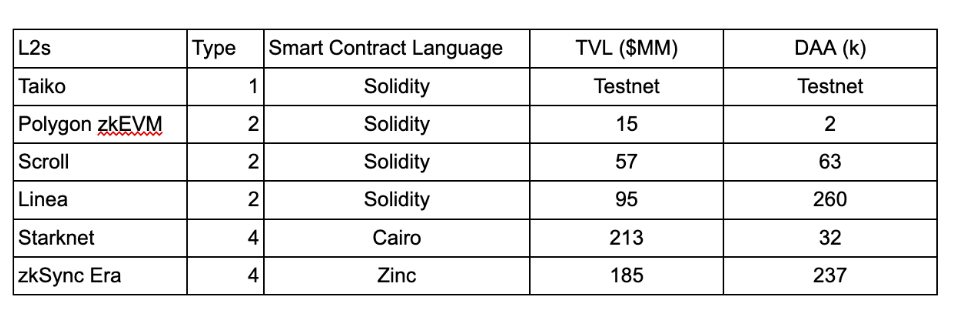
Currently, zkSync Era, Starknet, and Linea stand out among ZKRs with the highest TVL and DAA. But this could change quickly when Polygon PoS upgrades to zkEVM Validium in H1 2024, absorbing its existing $1.1B TVL and 1M DAA.
The upcoming catalyst for Polygon zkEVM lies in its diverse project lineup competing across sub-sectors. For instance, in the CEX-L2 space, OKX’s X1 will compete with Coinbase’s Base and Bybit’s Mantle—both using ORU. In gaming L2s, the highest-valued gaming chain Immutable will face Xai from Arbitrum Orbit and Redstone from OPStack. Lastly, in the general-purpose L2 arena, Manta Network already holds the third-largest TVL (at $650M) among L2 solutions. Together, these projects strengthen the Polygon ecosystem and ultimately channel value back to the POL token.
Final Thoughts
From a technical standpoint, ZKRs are more secure, efficient, and economical than ORUs. However, ORUs could still adopt hybrid proof systems to incorporate validity proofs. Whether delaying launch for better tech was the right strategic choice remains to be seen. Polygon is a rare case—it began attracting a large user base early as an Ethereum sidechain and is now poised to funnel those users into its ZKR ecosystem once ready.
The key to L2 adoption lies in exclusive applications within the ecosystem. Arbitrum currently leads in DeFi, hosting GMX, Hyperliquid, and various perpetual Dexes. Optimism has also gained traction, with Frax launching Fraxtal and Synthetix on its mainnet. In gaming, Arbitrum leads with Xai, ApeCoin, and TreasureDAO. Social apps also debuted first on ORUs—FriendTech on Base, Farcaster on Optimism.
Still, ZKRs remain promising—especially Polygon. Polygon zkEVM is entering its DeFi season. Moreover, several heavyweight Polygon CDK chains—including OKX’s X1, Immutable zkEVM, and Astar zkEVM—are set to launch mainnets in H1 2024. Combined with Polygon PoS transitioning to zkEVM Validium and the POL token migration, Polygon has numerous catalysts to reclaim market attention. Additionally, most ZKRs have yet to launch their tokens, leaving ample room for them to assert dominance. Similar to the last cycle, these ZKRs may raise substantial ecosystem funds to boost adoption.
Ultimately, one of Ethereum’s end goals is to upgrade L1 itself via zkEVM. Therefore, ZKRs hold great potential in pushing Ethereum’s scalability frontier. One of the best paths to achieving zkEVM is through Polygon—thanks to its strong business development, leadership in ZK research, and plans to funnel robust value accrual back to POL.
Join TechFlow official community to stay tuned
Telegram:https://t.me/TechFlowDaily
X (Twitter):https://x.com/TechFlowPost
X (Twitter) EN:https://x.com/BlockFlow_News
 @paragraph_xyz