









Why ETF daily data matters and how it relates to the market?
TechFlow Selected TechFlow Selected
Why ETF daily data matters and how it relates to the market?
ETF boom further boosts bull market, while slowing growth may signal short-term peak.
 Navigating Web3 tides with focused insights
Author: jk, Odaily Planet Daily
Recently, the activity in the Bitcoin ETF market has attracted significant investor attention. Numerous products such as BlackRock's IBIT, Grayscale Bitcoin Trust's GBTC, Fidelity's FBTC, and Ark Invest/21 Shares' ARKB have demonstrated pronounced volatility on exchanges. As Bitcoin continues to rise and the crypto market enters a bull phase, trading volume data from major Bitcoin ETFs has become a key barometer of market sentiment.
Odaily Planet Daily has been continuously tracking data related to spot Bitcoin ETFs. It is evident that recent ETF inflows have surged alongside rising Bitcoin prices, far outweighing the net outflows previously seen in GBTC. Meanwhile, as buying enthusiasm grows, the amount of Bitcoin held by these fund managers has also risen sharply. James Butterfill, Research Director at CoinShares, noted that digital asset ETFs/ETPs have already seen over $12 billion in net inflows year-to-date—surpassing the previous annual record of $10.6 billion set in 2021—despite only one quarter of the year having passed.
Additionally, several key Bitcoin ETF metrics have reached new highs: BlackRock’s spot Bitcoin ETF (IBIT) now holds 223,645.98255 BTC—exceeding 1% of Bitcoin’s theoretical maximum supply of 21 million—with a market value surpassing $16 billion, setting a new record. On March 12 (U.S. time), spot Bitcoin ETFs recorded a single-day net inflow of $1.05 billion, marking the highest daily net inflow since their launch, representing a 56% increase compared to the second-highest day ($673 million on February 28). The total market capitalization of all Bitcoin ETFs (including both spot and futures ETFs) stands at $60.143 billion, with total assets under management (AUM) reaching $55.374 billion.
Data Overview
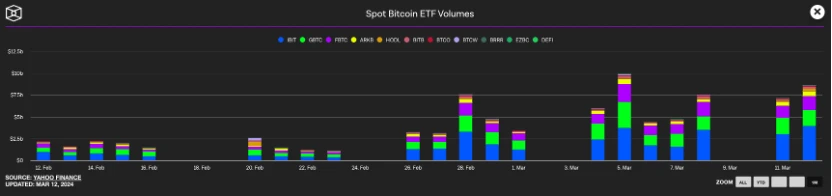
Daily trading volume of spot Bitcoin ETFs, source: The Block
The chart covers the full trading volume of newly approved spot Bitcoin ETFs over the past month. It shows that daily trading volumes began rising from late February onward—just before Bitcoin started its rapid ascent from around $50,000—with BlackRock’s IBIT leading (blue section), followed by GBTC (green section). This likely reflects investors taking profits, as those concerned about management fees may have exited shortly after approval. Fidelity’s FBTC ranks third.
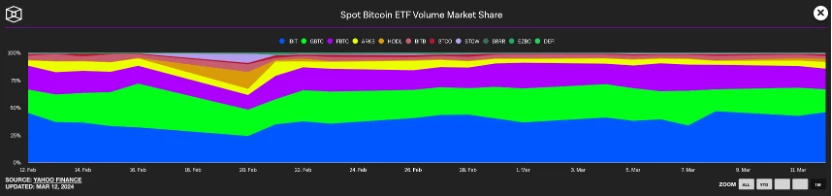
Market share of spot Bitcoin ETFs, source: The Block
In terms of market share, the distribution aligns closely with volume trends: there was a noticeable dip starting mid-February, during which VanEck’s HODL gradually gained share. However, the ranking quickly reverted to IBIT first, GBTC second, and FBTC third. Smaller players like Ark followed closely behind. After the bull market resumed, BlackRock’s IBIT saw a significant jump in market share—from around 33% to approximately 45% today.
Overall, spot Bitcoin ETFs have accumulated a net inflow of $11.828 billion since launch. Specifically:
-
IBIT: $12.0278 billion in cumulative net inflows;
-
FBTC: $6.7033 billion in cumulative net inflows;
-
BITB: $1.4313 billion in cumulative net inflows;
-
ARKB: $1.9705 billion in cumulative net inflows;
-
GBTC: $11.4026 billion in cumulative net outflows.
From this data, it is clear that the momentum of net inflows has clearly overtaken the earlier net outflows from Grayscale following ETF approvals. In fact, IBIT alone has more than offset GBTC’s outflows. Looking at daily flow data, the picture is as follows:
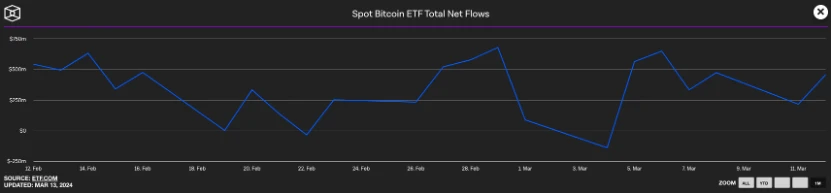
Total net inflow into Bitcoin, source: The Block
Over the past month, only a few days showed net outflows—and those were minimal. For nearly all other periods, the market remained in net inflow territory. Concerns about whether GBTC might significantly dump holdings and crash prices have largely faded.
According to on-chain analyst Yujin, the combined BTC holdings of the ten spot Bitcoin ETFs have surpassed 800,000 BTC, accounting for 3.8% of Bitcoin’s total supply. Grayscale (GBTC) now accounts for less than 50% of the total holdings among these ten ETFs, with its BTC holdings falling below 400,000 BTC. Its influence on the market is waning. Meanwhile, BlackRock (IBIT) and Fidelity (FBTC) together hold 320,000 BTC (worth $23.1 billion), approaching Grayscale’s current level.
Secondly, two competing theories have emerged regarding the relationship between spot Bitcoin ETFs and Bitcoin’s price: Are ETF inflows driving up Bitcoin’s price, or is rising Bitcoin price attracting ETF inflows? While clearly mutually reinforcing, this "chicken-or-egg" question remains unresolved. Timing-wise, both Bitcoin’s price surge and increased trading volume began around February 26 (U.S. time), making it difficult to determine causality based on timing alone. However, if ETF inflow growth slows during a bull market, it could signal that investor enthusiasm has been exhausted, potentially indicating a near-term peak.
Overall, by examining current trends in Bitcoin ETF trading volumes and associated data fluctuations, we can gain insights into subtle shifts in investor confidence and market热度. While future market performance remains uncertain, closely monitoring these key indicators enables investors and analysts to better understand market dynamics and identify strategic investment opportunities.
Join TechFlow official community to stay tuned
Telegram:https://t.me/TechFlowDaily
X (Twitter):https://x.com/TechFlowPost
X (Twitter) EN:https://x.com/BlockFlow_News
 Odaily









